Contents
On this page
- Quick answer
- Why statistical comments decide survival-analysis revisions
- Questions 1–2: proportional hazards
- Questions 3–4: follow-up and censoring
- Questions 5–6: endpoints and competing risks
- Questions 7–8: covariates and subgroups
- Questions 9–10: bias and requests you cannot meet
- How to write the response so the statistician can verify it
- When to bring in specialist support
- Frequently asked questions
- Sources
AcademyResearch Publication & Promotion
Q&AUSA
Answering Statistical Reviewer Comments on Survival Analyses: 10 Questions Ovarian Cancer Authors Ask
A statistical reviewer's comments on a survival analysis can decide a major revision. These are the ten questions gynaecologic oncology authors ask most often when the comments arrive, and what a credible answer contains.
- Research Publication & Promotion
- Oncology & haematology
- Response to reviewers
- Topic
- Research Publication & Promotion
- Written by
- Pubrica Academy
At a glanceResearch Publication & Promotion
Request a QuoteDiscuss your project
Quick answer
- Triage every statistical comment as concede, answer with evidence or decline with a reason before you write a word.
- If the reviewer questions proportional hazards, show the check (for example, a Schoenfeld residual test and plot) and, if the assumption fails, report an effect measure that does not depend on it, such as restricted mean survival time.
- State how median follow-up was estimated; the reverse Kaplan–Meier method is the usual answer to that comment.
- Label any analysis added at revision as post hoc or sensitivity analysis; reviewers accept honesty about timing more readily than a reconstructed 'pre-specified' claim.
- Every answer should point to the page and line where the change can be found.
Why statistical comments decide survival-analysis revisions
Survival analyses carry many assumptions that a reviewer cannot see from the Kaplan–Meier figure alone, so statistical reviewers tend to ask for them. In ovarian cancer papers, where progression-free survival is a common primary endpoint and follow-up for overall survival is often immature, the same handful of questions comes up again and again.
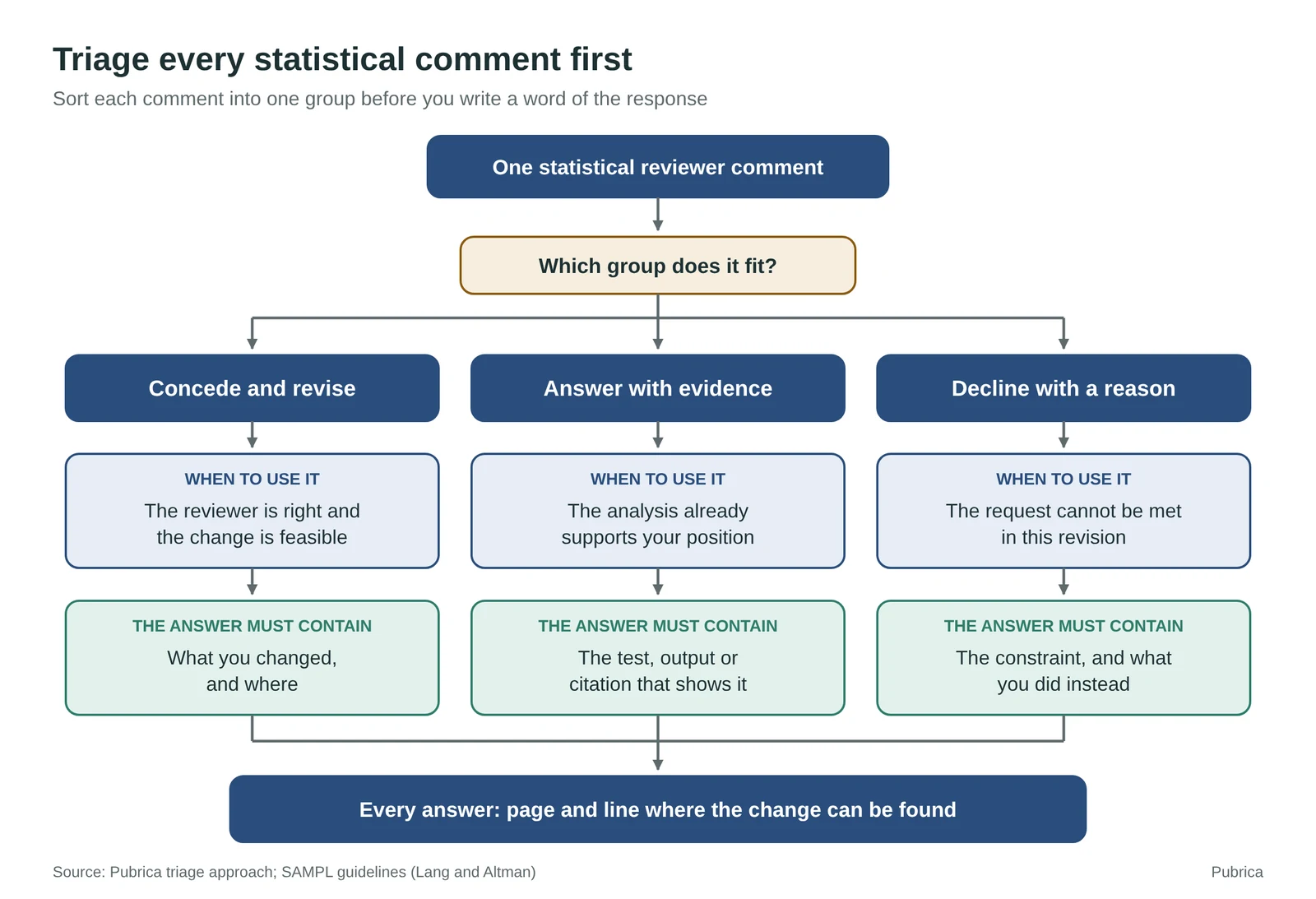
The handling editor usually sends your response back to the reviewer who raised the point. A statistician will judge the answer on whether it is correct, verifiable and honest about what was planned. Before drafting, sort every comment into one of three groups:
| Classification | When to use it | What the answer must contain |
|---|---|---|
| Concede and revise | The reviewer is right and the change is feasible | What you changed, and where |
| Answer with evidence | The analysis already supports your position | The test, output or citation that shows it |
| Decline with a reason | The request cannot be met in this revision | The constraint, and what you did instead |
The questions below are ones authors often ask after a statistical review; the examples are illustrative.
Questions 1–2: proportional hazards
1. "The reviewer says we did not check the proportional hazards assumption. What do we send?"
Show the check rather than assert it. The usual approach is a test based on scaled Schoenfeld residuals, described by Grambsch and Therneau, with a plot of the residuals against time for each covariate. Report the test result in the Methods or a supplement, include the plot, and say in the response where both can be found. If you checked the assumption at analysis but did not report it, say so plainly.
2. "Our Kaplan–Meier curves cross. The reviewer says a single hazard ratio is misleading. Do we have to abandon it?"
Not necessarily, but you do need to acknowledge what a single hazard ratio means when hazards are not proportional: it is a weighted average over follow-up that may hide an early or late difference. Options include restricted mean survival time (RMST), which Royston and Parmar proposed as an alternative to the hazard ratio that does not rely on proportional hazards, a piecewise hazard ratio over pre-defined intervals, or a model with a time-varying coefficient. If the trial's pre-specified analysis was a Cox model, keep it as the primary result and present the alternative as a sensitivity analysis, labelled as added at revision.
Practical tip
Never justify a sample size or an analysis choice by pointing to the result. A statistical reviewer will treat 'the result was significant, so the analysis was adequate' as circular, and it invites a harder second round.
Questions 3–4: follow-up and censoring
3. "How was median follow-up calculated?"
This comment usually means the reviewer suspects follow-up was estimated from all patients, including those who died, which understates the potential follow-up of survivors. The common answer is the reverse Kaplan–Meier method described by Schemper and Smith, in which the censoring indicator is reversed so that the median of the resulting curve estimates potential follow-up. State the method, the median and its interquartile range, and the data cut-off date.
4. "The reviewer asks whether censoring is informative and wants numbers at risk."
Add a numbers-at-risk table beneath every Kaplan–Meier figure; most journals expect it. Then describe why patients were censored: administrative end of follow-up, loss to follow-up, withdrawal of consent or start of a subsequent therapy. If censoring differs between arms, say so and, where possible, show a sensitivity analysis under a different censoring rule. An honest description of the pattern answers the concern better than a statement that censoring was non-informative.
Request a Free Triage of Your Reviewer Comments
Send the decision letter and reviewer reports. A Pubrica subject expert will classify every comment as concede, answer or decline, free of charge, within one business day, and quote for the full response.
Questions 5–6: endpoints and competing risks
5. "The reviewer questions our progression-free survival definition."
State exactly what counted as progression, which response criteria were used, how often assessments were scheduled, whether assessment was by investigator or independent central review, and how deaths without progression were handled. If assessment schedules differed between groups, acknowledge the potential for bias. CONSORT 2025, the current reporting guideline for randomised trials, asks for outcomes to be completely defined, so answering against the checklist addresses the comment and the reporting requirement together.
6. "The reviewer says deaths from other causes should be treated as competing risks."
This applies when your outcome is cause-specific, such as ovarian cancer-specific mortality in an older registry cohort. Censoring patients at a competing event and then using one minus Kaplan–Meier tends to overestimate the cumulative incidence of the event of interest. Austin, Lee and Fine describe the two main approaches: modelling the cause-specific hazard or modelling the cumulative incidence (the Fine–Gray subdistribution hazard). Choose according to your question, report the cumulative incidence function and explain the choice in one or two sentences.
Questions 7–8: covariates and subgroups
7. "The reviewer asks why we adjusted for these covariates and not others."
Explain how covariates were selected: pre-specified in the protocol or statistical analysis plan, chosen on clinical grounds, or selected by a data-driven method. If the number of events is small relative to the number of covariates, the reviewer may be hinting at overfitting; acknowledge it and consider a more parsimonious model as a sensitivity analysis. Avoid adding or removing covariates without saying so.
8. "The reviewer objects to our subgroup analysis by BRCA or HRD status."
The usual objection is that separate p-values within subgroups were used to claim a difference between them. The correct answer reports a treatment-by-subgroup interaction test, states whether the subgroup was pre-specified and labels unplanned subgroups as exploratory, which is also what the SAMPL statistical reporting guidelines advise. If the subgroup finding was the paper's headline, consider moderating the language in the Abstract.
Questions 9–10: bias and requests you cannot meet
9. "In our observational cohort, the reviewer raises immortal time bias."
This arises when patients are classified by a treatment they started after time zero, for example maintenance therapy begun after response to first-line chemotherapy. The time before treatment starts is credited to the treated group, during which, by definition, they could not have had the outcome. Lévesque and colleagues showed how this biases results in favour of treatment. Answer with a landmark analysis or by modelling treatment as a time-dependent covariate, and revise any causal language.
10. "The reviewer wants a reanalysis we cannot do. How do we decline?"
Name the constraint honestly, such as a data access agreement, an immature data cut or a protocol that fixes the primary analysis. Then offer something that answers the underlying concern: a sensitivity analysis, a limitation stated plainly, or a commitment to report the analysis at the next data cut. Editors accept a declined request far more readily when something was done instead.
How to write the response so the statistician can verify it
Quote each comment in full in the reviewer's numbering, and put the answer directly beneath it. State what you did first and the reasoning second. Give the page, section and line of every change, and reproduce substantive new text in the letter so the reviewer does not have to search for it. Keep the tone grateful, specific and non-defensive. Our Inside the Lab piece on responding to reviewers shows the full structure.
It also helps to know how editors read trial reports. Our CONSORT-PRO checklist for oncology journal editors shows the reporting items an editor checks in a trial submission, many of which reappear as reviewer comments.
When to bring in specialist support
Consider outside help when a comment requires reanalysis you are not confident to run, when co-authors disagree about which points to concede, or when the revision deadline is close. Pubrica's response to reviewers service drafts the point-by-point letter and makes the revisions it commits you to. A subject expert triages every comment as concede, answer with evidence or decline with a reason, and you approve that triage before drafting begins. Statistical objections are answered by a statistician, every answer is cross-referenced to the page and line of the change, and follow-up comments in the next round are handled within the same engagement. You make the scientific decisions and sign the letter.
We support academic researchers across life sciences, with gynaecology subject experts matched to ovarian cancer manuscripts and wider experience in oncology and haematology research in the USA. A triage of your reviewer comments is free and takes one business day.
Frequently asked questions
Not automatically. Run analyses that address a genuine weakness and label them as added at revision. Where a request cannot be met, decline it with a stated reason and offer an alternative that answers the underlying concern.
Keep the pre-specified primary analysis as primary, especially for a registered trial. Present the reviewer's preferred method as a sensitivity analysis and discuss any difference between the results.
The point-by-point response is delivered in four to five working days; the full timeline for a standard major revision, including your co-authors' review and resubmission, is about nine working days. Send the decision letter as soon as it arrives so the work can be planned around the journal's deadline.
Sources
Sources were checked on 27 November 2026. Requirements and guidance may change after that date; confirm the current version with the issuing body.
- 1Grambsch PM, Therneau TM. Proportional hazards tests and diagnostics based on weighted residuals. Biometrika. 1994;81(3):515-526. https://doi.org/10.2307/2337123
- 2Royston P, Parmar MKB. Restricted mean survival time: an alternative to the hazard ratio for the design and analysis of randomized trials with a time-to-event outcome. BMC Med Res Methodol. 2013;13:152. https://discovery-pp.ucl.ac.uk/1427381/1/1471-2288-13-152.pdf
- 3Schemper M, Smith TL. A note on quantifying follow-up in studies of failure time. Control Clin Trials. 1996;17(4):343-346. https://doi.org/10.1016/0197-2456(96)00075-x
- 4Austin PC, Lee DS, Fine JP. Introduction to the analysis of survival data in the presence of competing risks. Circulation. 2016;133(6):601-609. https://pmc.ncbi.nlm.nih.gov/articles/PMC4741409/
- 5Lévesque LE, Hanley JA, Kezouh A, Suissa S. Problem of immortal time bias in cohort studies: example using statins for preventing progression of diabetes. BMJ. 2010;340:b5087. https://doi.org/10.1136/bmj.b5087
- 6Hopewell S, Chan AW, Collins GS, et al. CONSORT 2025 statement: updated guideline for reporting randomised trials. BMJ. 2025. https://pubmed.ncbi.nlm.nih.gov/40228833/
- 7Lang TA, Altman DG. Basic statistical reporting for articles published in biomedical journals: the SAMPL guidelines. EQUATOR Network. https://www.equator-network.org/reporting-guidelines/sampl/
responding to statistical reviewer commentsproportional hazards assumption reviewerSchoenfeld residualsrestricted mean survival timemedian follow-up reverse Kaplan-Meiercompeting risks ovarian cancer
How to cite this article
Pick your referencing style and copy it. Your university or target journal may vary the punctuation, so check its guide if it has one.
Pubrica Academy. (2026, November 27). Answering Statistical Reviewer Comments on Survival Analyses: 10 Questions Ovarian Cancer Authors Ask. Pubrica. https://pubrica.com/academy/peer-review/statistical-reviewer-comments-on-survival-data/
This article is written to be learned from. Cite it if you are referring to what it says; if you are using the evidence behind it, cite the sources listed above instead.
Next steps
Request a Free Triage of Your Reviewer Comments
Send the decision letter and reviewer reports. A Pubrica subject expert will classify every comment as concede, answer or decline, free of charge, within one business day, and quote for the full response.
This article is general information for researchers, not legal, regulatory or funding advice. Check the current requirements of your journal, funder, ethics committee or regulator before you act on it.
More in Research Publication & Promotion