Contents
On this page
- Quick answer
- Why are university libraries asking your journal for a VPAT now?
- What is the difference between a VPAT and an ACR, and which edition should you send?
- Whose product does the report cover: yours or your publisher's?
- What will a library accessibility reviewer check first?
- Libraries cite WCAG 2.1 AA, so should you test against WCAG 2.2?
- Self-declared template or tested report: which do you need?
- How should you plan the work around a renewal or consortium deal?
- How Pubrica helps society journals produce a credible ACR
- Frequently asked questions
- Sources
AcademyResearch Publication & Promotion
Q&AUSA
Will University Libraries Accept Your Thoracic Oncology Journal Platform? A VPAT Q&A on Section 508, ADA Title II and WCAG 2.1 AA
Library licensing teams at public universities now ask society journals for an Accessibility Conformance Report before they renew. These are the questions publishing operations managers ask most often, and the answers that decide whether your report is accepted.
- Research Publication & Promotion
- Oncology & haematology
- VPAT & conformance report
- Topic
- Research Publication & Promotion
- Written by
- Pubrica Academy
At a glanceResearch Publication & Promotion
Request a QuoteDiscuss your project
Quick answer
- Public universities are state or local government entities under ADA Title II, and the 2024 DOJ rule sets WCAG 2.1 Level AA as the standard for their web content, including content provided through licensing arrangements.
- An interim final rule published on 20 April 2026 moved the compliance dates to 26 April 2027 for public entities serving 50,000 or more and 26 April 2028 for smaller entities and special district governments; the WCAG 2.1 AA standard did not change.
- Send the VPAT edition the buyer asks for: usually the WCAG or International edition for a public university, and the Revised Section 508 edition for a federal agency buyer.
- Library reviewers distrust reports that claim full support everywhere; a tested report with specific 'Partially Supports' remarks and a remediation date is more credible.
- Decide early whose product the report covers: your society's journal site and content, or the publisher's hosting platform.
Why are university libraries asking your journal for a VPAT now?
Most public universities are state or local government entities, so they fall under Title II of the Americans with Disabilities Act. In April 2024 the Department of Justice published a rule that, for the first time, sets a technical standard for their web content and mobile apps: WCAG 2.1 Level A and AA. The rule reaches content a public entity provides directly and content it provides through contractual, licensing or other arrangements, which is how libraries provide licensed journals and databases.
The original compliance dates were 24 April 2026 for entities serving a population of 50,000 or more and 26 April 2027 for smaller entities and special district governments. An interim final rule published in the Federal Register on 20 April 2026 extended them to 26 April 2027 for entities serving 50,000 or more and 26 April 2028 for smaller entities and special district governments. The WCAG 2.1 Level AA standard did not change, and public entities keep their ongoing Title II obligation to make services, programmes and activities offered through the web and mobile apps accessible in the meantime. These remain the dates in force at the time of writing (November 2026), although a court challenge to the extension is pending.
The practical result for a society journal is that licensing and procurement teams are asking vendors for evidence. The usual request is for "a VPAT", meaning a completed Accessibility Conformance Report (ACR). Whether your journal is in scope is the library's legal judgement; your job is to give its reviewer a document they can rely on.
Federal buyers, such as agency libraries, work under a different rule: Section 508 of the Rehabilitation Act. The Access Board's refreshed Section 508 standards (36 CFR Part 1194, published January 2017) incorporate WCAG 2.0 Level A and AA by reference and apply them to web content, documents and software.
What is the difference between a VPAT and an ACR, and which edition should you send?
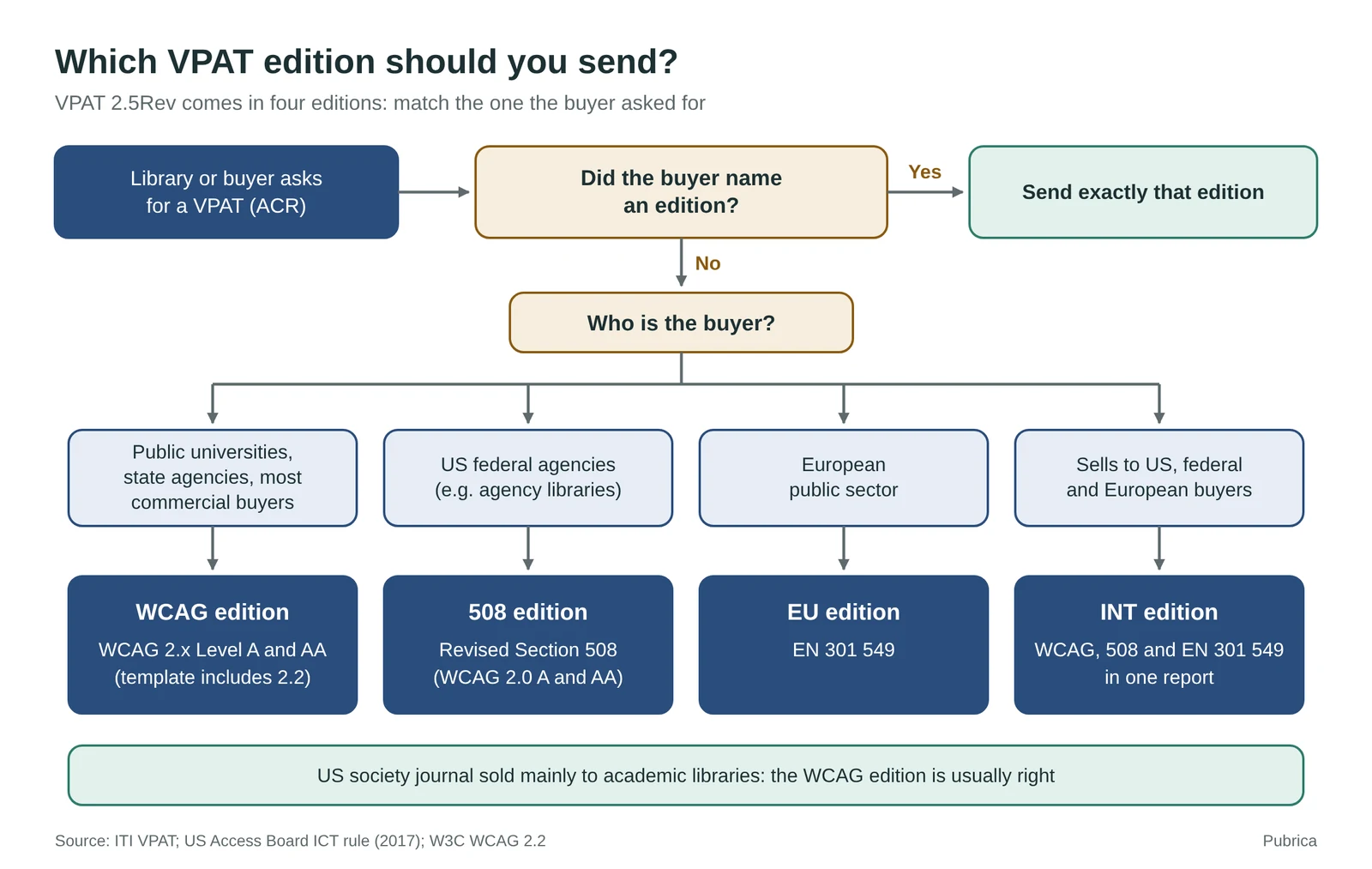
The VPAT (Voluntary Product Accessibility Template) is the blank template maintained by the Information Technology Industry Council (ITI). Once it is completed for your product, it becomes an ACR. The current template family is VPAT 2.5Rev, and it comes in four editions. Choose the one the buyer has asked for:
| Edition | Standard it reports against | Typical buyer |
|---|---|---|
| WCAG | WCAG 2.x Level A and AA (the current template includes WCAG 2.2) | Public universities, state agencies, most commercial buyers |
| 508 | Revised Section 508 (incorporating WCAG 2.0 A and AA) | US federal agencies |
| EU | EN 301 549 | European public sector |
| INT | All three in one report | Journals that sell to US, federal and European buyers |
For a US society journal sold mainly to academic libraries, the WCAG edition is usually the right choice. If your consortium deals include federal or European institutions, the International edition saves you from keeping three separate documents consistent. Sending a WCAG edition to a federal buyer who asked for Section 508 does not fail outright, but it leaves the buyer to do the mapping and suggests the request was not read closely.
Whose product does the report cover: yours or your publisher's?
Many society journals are hosted on a publishing partner's platform, and the platform provider may already publish an ACR for its reader interface. That report covers the platform's navigation, search and article display. It does not usually cover what your society controls: the society website, author instructions, the submission system you choose, editorial content such as video abstracts and podcasts, and the files your production workflow delivers.
An ACR may only claim what was tested for one product, edition and version, so agree the boundary before testing starts. For a thoracic oncology title, the society-controlled content that most often fails is predictable:
- Kaplan–Meier curves, forest plots and swimmer plots supplied as images with no text alternative or underlying data
- TNM staging and toxicity tables built as images, or as tables without programmatic header associations
- CT and PET image panels with labels that rely on colour alone
- Supplementary appendices supplied as untagged PDFs
- Video abstracts and webinars without accurate captions
If the platform's ACR is current and the remaining scope is small, a society-level report can be short. If the library asks you, not the platform, to answer for the whole reader experience, you will need to reference the platform's report and test the gaps.
Practical tip
Never claim 'Supports' for a criterion you have not tested: one disproved claim casts doubt on the whole report.
Request a Free Review of Your Current VPAT
Send your existing VPAT and we will identify, free of charge, which claims are unlikely to withstand a library's testing. For a new or re-issued report, we quote per project based on product scope and edition.
What will a library accessibility reviewer check first?
Library accessibility teams review ACRs critically, and many spot-check claims with their own tools. In our experience the claims least likely to survive testing concern contrast, data tables and focus order. Before you send a report, check it against this list:
- Date, version and scope are stated, and match the product the library is licensing.
- Edition matches the request.
- No blanket "Supports" across every criterion; reviewers read this as a sign the product was not tested.
- Remarks name the component, the condition and the effect, rather than restating the criterion.
- Contrast (1.4.3) has been measured on rendered pages, including disabled and secondary text.
- Data tables (1.3.1) in article HTML have headers associated with cells.
- Keyboard access and focus order (2.1.1, 2.4.3) work through search, article tools and PDF download.
- Non-text content (1.1.1) is addressed for figures, not only for logos and icons.
- Captions (1.2.2) exist for prerecorded video.
- A contact for accessibility questions and a remediation route are given.
Libraries cite WCAG 2.1 AA, so should you test against WCAG 2.2?
The Title II rule names WCAG 2.1 Level AA. The W3C published WCAG 2.2 as a Recommendation on 5 October 2023 and states that content conforming to WCAG 2.2 also conforms to WCAG 2.1 and 2.0. WCAG 2.2 adds nine success criteria and marks 4.1.1 Parsing as obsolete.
In practice, testing to WCAG 2.2 AA and reporting clearly against each criterion lets one report answer a library that cites 2.1 and a buyer who has moved to 2.2. Avoid a report that says "WCAG 2.2" on the cover but hides the 2.1 results the reviewer needs.
Self-declared template or tested report: which do you need?
Many journals complete the template internally from a vendor checklist. That can be adequate for a low-stakes request, but an ACR is a representation about your product, and a claim a reviewer can disprove affects your credibility for the whole renewal.
| Question | Self-declared template | Tested report |
|---|---|---|
| How are results reached? | Assertion, often from automated scans | Each criterion tested with a recorded method (keyboard, assistive technology, contrast measurement, manual inspection) |
| Typical remark | "Partially Supports. Some content may not meet this criterion." | "Partially Supports. Tables in article HTML are not associated with their headers, so a screen reader announces values without context. Remediation is scheduled for the next release." |
| Reproducible at next revision? | Rarely | Yes, because the method is recorded |
| What the library can do with it | Ask follow-up questions | Make a licensing decision |
Two points apply whichever route you choose. An accurate "Partially Supports" with a remediation date is a stronger position than an unsupported "Supports". And an ACR is not a certificate of compliance; no provider can issue one.
How should you plan the work around a renewal or consortium deal?
Start from the date the library or consortium needs the report and work back. Allow time to agree the edition and scope, test, write the remarks, and fix anything quick enough to fix before issue. If a deadline is close, limit the report to the modules the licence covers rather than rushing a whole-site claim.
After issue, keep the remediation list live and re-issue the report when a release closes significant gaps. Libraries understand that an ACR describes a product at a point in time; evidence that gaps are tracked tells them you have a process.
Access conditions are under scrutiny from authors too. Funded authors are checking licence and embargo terms before they submit, as our guide to choosing a journal for NIH-funded myeloma research explains, so accessibility is becoming one more part of how a journal's access offer is judged.
How Pubrica helps society journals produce a credible ACR
Pubrica's VPAT and Accessibility Conformance Report service completes the template as a tested, evidence-based report rather than a self-declared one. We agree the edition and scope with you first, test every applicable criterion against the live product with the method recorded, and write remarks specific enough for a library reviewer to evaluate. You receive the completed ACR and a prioritised remediation list with effort and target dates, and we re-issue the report after remediation. For publishers with several titles, a report programme keeps the testing method and remark style consistent across the portfolio.
We work with journals, publishers and societies across life sciences, and our computer science subject specialists support the technical testing. If you are also reviewing your wider oncology and haematology publishing in the USA, the same team can align accessibility work with your production schedule.
If you already have a VPAT, send it to us and we will identify, free of charge, which claims are unlikely to withstand testing.
Frequently asked questions
Yes. An interim final rule published on 20 April 2026 extended the compliance dates by one year, to 26 April 2027 for public entities serving 50,000 people or more and 26 April 2028 for smaller entities and special district governments. The WCAG 2.1 AA standard is unchanged. Check ada.gov for any later change.
It may cover the hosting platform's interface, but usually not your society website, submission system, figures, supplementary PDFs or video. Ask the library which product it is assessing, then decide whether a society-level report is needed to cover the gaps.
Use the edition the buyer asks for. For public university libraries that is usually the WCAG edition; for federal agencies it is the Revised Section 508 edition; if you sell to all three markets, the International edition covers WCAG, Section 508 and EN 301 549 in one report.
Sources
Sources were checked on 27 November 2026. Requirements and guidance may change after that date; confirm the current version with the issuing body.
- 1US Department of Justice. Extension of Compliance Dates for Nondiscrimination on the Basis of Disability; Accessibility of Web Information and Services of State and Local Government Entities (interim final rule). Federal Register 91(75). 20 April 2026. https://www.govinfo.gov/content/pkg/FR-2026-04-20/html/2026-07663.htm
- 2US Department of Justice. Extension of Compliance Dates; Accessibility of Web Information and Services of State and Local Government Entities. Interim final rule, 28 CFR Part 35 (ADA.gov copy). April 2026. https://www.ada.gov/assets/pdfs/2026-ifr.pdf
- 3US Department of Justice, Civil Rights Division. Title II web and mobile app accessibility rule. ADA.gov. https://www.ada.gov/title-ii-web-rule/
- 4US Access Board. Information and Communication Technology (ICT) Standards and Guidelines (final rule). Federal Register. 18 January 2017. https://www.federalregister.gov/documents/2017/01/18/2017-00395/information-and-communication-technology-ict-standards-and-guidelines
- 5GSA Section508.gov. 2017 Section 508 Refresh fact sheet. https://assets.section508.gov/assets/files/2017_508-Refresh-Fact-sheet-updated.pdf
- 6W3C. Web Content Accessibility Guidelines (WCAG) 2.2. W3C Recommendation. 5 October 2023. https://www.w3.org/TR/2023/REC-WCAG22-20231005/
- 7W3C Web Accessibility Initiative. WCAG 2 Overview. https://www.w3.org/WAI/standards-guidelines/wcag/
- 8Information Technology Industry Council (ITI). Voluntary Product Accessibility Template (VPAT). https://www.itic.org/policy/accessibility/vpat
VPAT accessibility conformance report journalACR for journal platformsADA Title II web accessibility ruleSection 508 VPATWCAG 2.1 AA journal accessibilityVPAT 2.5Rev edition
How to cite this article
Pick your referencing style and copy it. Your university or target journal may vary the punctuation, so check its guide if it has one.
Pubrica Academy. (2026, November 27). Will University Libraries Accept Your Thoracic Oncology Journal Platform? A VPAT Q&A on Section 508, ADA Title II and WCAG 2.1 AA. Pubrica. https://pubrica.com/academy/accessibility/vpat-q-a-for-oncology-journal-platforms/
This article is written to be learned from. Cite it if you are referring to what it says; if you are using the evidence behind it, cite the sources listed above instead.
Next steps
Request a Free Review of Your Current VPAT
Send your existing VPAT and we will identify, free of charge, which claims are unlikely to withstand a library's testing. For a new or re-issued report, we quote per project based on product scope and edition.
This article is general information for researchers, not legal, regulatory or funding advice. Check the current requirements of your journal, funder, ethics committee or regulator before you act on it.
More in Research Publication & Promotion