Contents
On this page
- Quick answer
- Why ten weeks is the real deadline for launch-year congress copy
- Step 1: set the claim boundary before anyone writes
- Step 2: back-plan the brief from the first day of the meeting
- Step 3: build one core modular message document
- Step 4: adapt the blocks to email, social and booth
- Step 5: run claim-substantiation checks before MLR sees the copy
- What to send an outside writer, and when to use one
- How Pubrica helps with ASH congress copy
- Frequently asked questions
- Sources
AcademyResearch Publication & Promotion
Checklist walkthroughUSA
Launch-Year ASH for a Follicular Lymphoma Therapy: Commissioning MLR-Ready Email, Social and Booth Copy 10 Weeks Out
The ASH Annual Meeting date does not move, but your medical-legal-regulatory review can. This checklist walks brand and congress leads through back-planning, briefing and checking a launch-year copy set so that every asset is approved before the exhibit hall opens.
- Research Publication & Promotion
- Oncology & haematology
- Omnichannel healthcare copywriting
- Topic
- Research Publication & Promotion
- Written by
- Pubrica Academy
At a glanceResearch Publication & Promotion
Request a QuoteDiscuss your project
Quick answer
- Start ten weeks before the meeting: two MLR rounds, channel adaptations and print deadlines leave little slack after that.
- If the therapy was approved under accelerated approval, promotional materials generally must be submitted to FDA at least 30 days before first use once the first 120 days after approval have passed, so your real deadline is earlier than the congress date.
- Promotional copy is limited to the approved labelling; new ASH data on unapproved uses belongs to medical affairs, not the brand booth.
- Build one core modular message document with each claim referenced to the prescribing information, then adapt it to email, social and booth panels.
- On character-limited social platforms, FDA's draft guidance says a benefit claim should carry its risk information in the same post; if both will not fit, do not make the claim there.
Why ten weeks is the real deadline for launch-year congress copy
The ASH Annual Meeting is fixed months ahead: the 2026 meeting runs from 12 to 15 December in New Orleans, and future dates are published on the society's website. For a brand in its launch year, the meeting is often the first time the field force, the booth and the digital channels all carry the same message to haematologists at once.
The constraint is review time, not writing time. A typical congress set (pre-meeting email, social posts, booth panels and a follow-up email) needs at least two MLR rounds, and each channel adaptation of a core message usually needs its own sign-off even when the core module is already approved.
FDA's rules add fixed points. Under 21 CFR 314.81(b)(3)(i), promotional labelling and advertising for an approved drug must be submitted to FDA on Form FDA 2253 at the time of initial dissemination. If your therapy was approved under accelerated approval, the requirement is stricter: under 21 CFR 314.550 (and 21 CFR 601.45 for biologics), materials intended for the first 120 days after approval are submitted during the pre-approval review period, and after that period materials must be submitted at least 30 days before first use unless FDA advises otherwise. For an accelerated approval product, the effective deadline for final, approved copy is therefore at least a month before the congress.
Step 1: set the claim boundary before anyone writes
Agree what the copy may and may not say before briefing a writer. Use this checklist:
- Source of truth. Every efficacy and safety claim traces to the current prescribing information or to data your regulatory team has confirmed as consistent with it.
- No unapproved uses. Promotional copy must not suggest uses, populations, lines of therapy or dosing outside the approved indication. If your company is presenting ASH abstracts on other settings, that data belongs to medical affairs and scientific exchange, not to brand copy.
- Scientific exchange is separate. FDA's final guidance on firm communications of scientific information on unapproved uses (January 2025) addresses a different channel with its own conditions; do not use it to justify brand copy.
- Embargo and copyright. Accepted ASH abstracts are embargoed until presentation, or until online publication for online-only abstracts, and ASH holds copyright in them. Do not quote abstracts in promotional or press materials, and check any timing with your communications team.
- Fair balance. Under 21 CFR 202.1, advertising must present a fair balance between effectiveness and risk information, and must not be false or misleading.
- Comparisons. Comparative or superiority claims need adequate head-to-head support; MLR will challenge cross-trial comparisons.
Record the outcome as a claim matrix: approved claims, their references and the required safety statement for each.
Step 2: back-plan the brief from the first day of the meeting
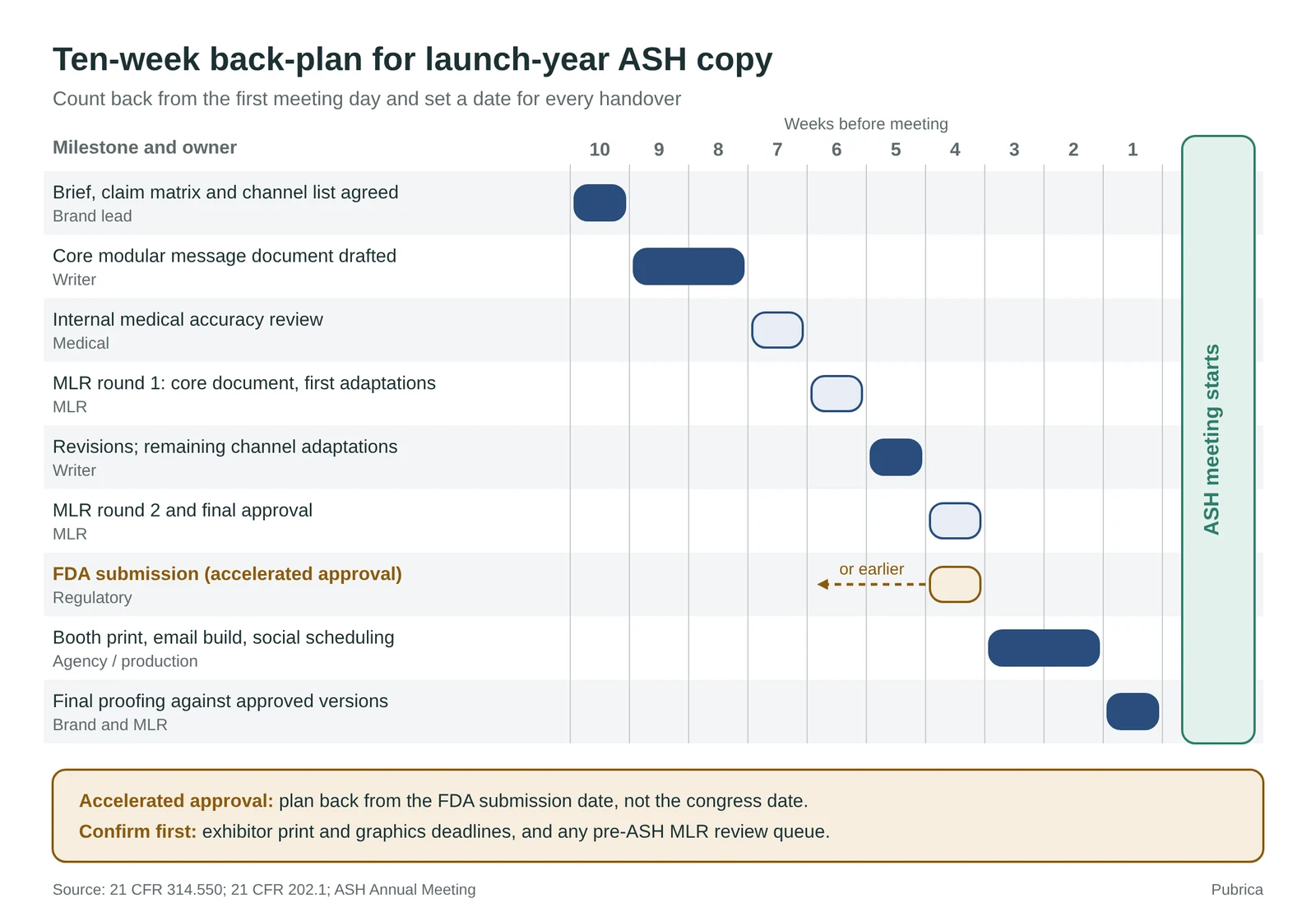
Count back from the first meeting day and set dates for every handover. A ten-week plan for a launch-year set might look like this:
| Week before meeting | Milestone | Owner |
|---|---|---|
| 10 | Brief, claim matrix and channel list agreed | Brand lead |
| 9–8 | Core modular message document drafted with references | Writer |
| 7 | Internal medical accuracy review | Medical |
| 6 | MLR round 1 on core document and first adaptations | MLR |
| 5 | Revisions; remaining channel adaptations | Writer |
| 4 | MLR round 2 and final approval | MLR |
| 4 or earlier | FDA submission (at least 30 days before first use for accelerated approval products) | Regulatory |
| 3–2 | Booth print production, email build and social scheduling | Agency / production |
| 1 | Final proofing against approved versions | Brand and MLR |
Two dates are outside your control: the exhibitor's print and graphics deadlines, and any review queue your MLR committee runs in the weeks before ASH. Confirm both before you finalise the plan.
Request a Free Scoping Assessment for Your ASH Copy Set
Tell us the channels, the congress date and your approval route. We will confirm the cost, timeline and applicable standards in two business days, before you commit.
Step 3: build one core modular message document
Modular content means writing each message once, as a self-contained block with one claim, one audience and its supporting reference, and reusing that block across channels. It keeps the detail aid, emails, booth panels and website consistent and lets MLR review the claim once rather than in four slightly different wordings.
| Block type | Contents | Review note |
|---|---|---|
| Indication statement | Approved indication, verbatim from the label | Must accompany product claims |
| Efficacy claim | One endpoint result, with study and label section referenced | Check numbers against the label, not the publication |
| Safety statement | Important safety information sized for the channel | Comparable prominence to the benefit claim |
| Call to action | Booth visit, website or representative contact | No implied claim |
| Congress logistics | Booth number, symposium time, venue | Check against ASH's published programme |
Annotate every block with its reference, page and line before the document goes to MLR. That annotation is what turns copy into MLR-ready copy.
Practical tip
If your therapy has accelerated approval, do not plan backwards from the congress date. Plan backwards from the FDA submission date, which is generally at least 30 days before first use once the first 120 days after approval have passed.
Step 4: adapt the blocks to email, social and booth
Each channel changes how much space you have for risk information, which changes what you can claim.
- Email. Subject lines and preheaders count as copy; a benefit claim in a subject line needs balancing in the body. Include the indication, important safety information and a link to the full prescribing information.
- Social. FDA's 2014 draft guidance on platforms with character space limitations recommends that a post making a benefit claim also include risk information in the same post, with a link to fuller risk information. If the claim and the risk will not both fit, choose a non-claim post, such as booth logistics. The guidance is non-binding, but it shows how FDA thinks about these posts.
- Booth panels. Large-format panels are read from a distance, so the safety information must remain legible and comparably prominent. Make full prescribing information available at the booth.
- Booth interactions. Giveaways, meals and hospitality at the booth fall under the PhRMA Code on Interactions with Health Care Professionals and your company's own policy; check them alongside the copy.
Keep a log of which approved block appears in which asset, so that a label change can be traced across every channel.
Step 5: run claim-substantiation checks before MLR sees the copy
MLR reviewers spend their time on whatever was not checked before submission. Before each round, confirm:
- every number matches the referenced source exactly, including decimals, confidence intervals and the analysis population;
- every claim is annotated to a specific page and line;
- the important safety information is the current approved version;
- no copy implies an unapproved population, line of therapy or dose;
- comparative language has head-to-head support;
- images and patient profiles are labelled as illustrative where they are not real patients;
- the revision log shows what changed since the last round and why.
If generative AI was used to draft any copy, record which tool, at what stage and what a reviewer changed, as your MLR committee may ask. The principle is the same one we describe for human QC of AI-drafted oncology clinical study reports.
What to send an outside writer, and when to use one
An outside writer makes sense when the in-house team is committed to launch materials, when the agency of record needs specialist medical copy, or when the congress set is the first omnichannel work for a new brand. To get MLR-ready drafts quickly, send:
- the brief: purpose, audience (haematologists, nurses, pharmacists) and channels;
- the prescribing information, approved core claims and any previously approved materials;
- brand and style guidelines;
- anything that must or must not appear;
- your deadline, including the congress window and any FDA submission date;
- your approval route and who sits on MLR.
Ask the writer to return copy annotated with references and a revision log, so your reviewers can check it without rebuilding the substantiation themselves.
How Pubrica helps with ASH congress copy
Pubrica's omnichannel healthcare copywriting service writes a core modular message document and channel-specific copy for web, email, social and print, annotated with claim-substantiation references for MLR review and written to the PhRMA Code. A named subject specialist leads the project, and an independent second reviewer checks the copy before it reaches you. Every engagement includes a channel style and tone guide and a revision log across review rounds.
The standard package covers one core message adapted into up to four channels, including one MLR-ready revision round per channel, from a published starting price of $6,500, with delivery in 5 to 10 business days from brief. Larger congress sets are quoted before work begins.
We work with pharma and biotech teams across life sciences, supported by biotechnology subject experts and wider experience in oncology and haematology in the USA. A free scoping assessment confirms the cost, timeline and applicable standards in two business days.
Frequently asked questions
Only if the data are consistent with the approved labelling and your MLR committee approves the claim. New data on unapproved uses should be handled by medical affairs through scientific exchange, and accepted abstracts are subject to ASH's embargo and copyright policies.
Usually yes. Each adaptation changes context, layout and the space for safety information, so most committees review each asset. A modular approach shortens these reviews because the claims themselves are already approved.
For most approved drugs, promotional materials are submitted on Form FDA 2253 at the time of initial dissemination. For accelerated approval products, materials are generally submitted at least 30 days before first use after the first 120 days post-approval. Confirm the requirement for your product with your regulatory team.
Sources
Sources were checked on 27 November 2026. Requirements and guidance may change after that date; confirm the current version with the issuing body.
- 1American Society of Hematology. ASH Annual Meeting and Exposition. https://www.hematology.org/meetings/annual-meeting
- 2American Society of Hematology. Annual Meeting embargo policy. https://www.hematology.org/newsroom/annual-meeting-press/embargo-policy
- 3eCFR. 21 CFR 202.1 Prescription-drug advertisements. https://www.ecfr.gov/current/title-21/chapter-I/subchapter-C/part-202/section-202.1
- 4eCFR. 21 CFR Part 314 Subpart H: Accelerated approval of new drugs for serious or life-threatening illnesses (314.550 Promotional materials). https://www.ecfr.gov/current/title-21/chapter-I/subchapter-D/part-314/subpart-H
- 5US Food and Drug Administration. Internet/Social Media Platforms with Character Space Limitations: Presenting Risk and Benefit Information for Prescription Drugs and Medical Devices (draft guidance). 2014. https://www.fda.gov/regulatory-information/search-fda-guidance-documents/internetsocial-media-platforms-character-space-limitations-presenting-risk-and-benefit-information
- 6US Food and Drug Administration. Communications From Firms to Health Care Providers Regarding Scientific Information on Unapproved Uses of Approved/Cleared Medical Products: Questions and Answers (final guidance). January 2025. https://www.fda.gov/regulatory-information/search-fda-guidance-documents/communications-firms-health-care-providers-regarding-scientific-information-unapproved-uses
- 7US Food and Drug Administration. Basics of drug ads. https://www.fda.gov/drugs/prescription-drug-advertising/basics-drug-ads
- 8FDA Law Blog (Hyman, Phelps & McNamara). Revised PhRMA Code took effect on January 1, 2022. 2022. https://www.thefdalawblog.com/2022/01/revised-phrma-code-took-effect-on-january-1-2022-and-certain-state-obligations-follow/
ASH congress omnichannel copyMLR-ready congress copymodular content pharmapromotional review congress materialsForm FDA 2253accelerated approval promotional materials
How to cite this article
Pick your referencing style and copy it. Your university or target journal may vary the punctuation, so check its guide if it has one.
Pubrica Academy. (2026, November 27). Launch-Year ASH for a Follicular Lymphoma Therapy: Commissioning MLR-Ready Email, Social and Booth Copy 10 Weeks Out. Pubrica. https://pubrica.com/academy/medical-communications/ash-omnichannel-copy-for-follicular-lymphoma/
This article is written to be learned from. Cite it if you are referring to what it says; if you are using the evidence behind it, cite the sources listed above instead.
Next steps
Request a Free Scoping Assessment for Your ASH Copy Set
Tell us the channels, the congress date and your approval route. We will confirm the cost, timeline and applicable standards in two business days, before you commit.
This article is general information for researchers, not legal, regulatory or funding advice. Check the current requirements of your journal, funder, ethics committee or regulator before you act on it.
More in Research Publication & Promotion