Contents
On this page
- Quick answer
- Why PRO claims need a separate look in prostate cancer submissions
- The reporting standards that apply: CONSORT 2025, CONSORT-PRO and SPIRIT-PRO
- Editor checklist: ten questions for a PRO-based submission
- Instruments and domains in advanced prostate cancer
- Missing data and attrition: where most PRO claims fail
- Multiplicity and selective emphasis
- When to commission a statistical referee
- Frequently asked questions
- Sources
InsightsPublishing & Open Access
Editor checklistUSA
Reviewing Patient-Reported Outcomes in Prostate Cancer Trial Submissions: A CONSORT-PRO Checklist for Journal Editors
Quality-of-life claims in advanced prostate cancer trials often rest on the weakest part of the analysis. This checklist helps editors decide quickly whether the PRO reporting supports the conclusions, and when to send a submission for statistical review.
- Publishing & Open Access
- Oncology & haematology
- Statistical review
- Topic
- Publishing & Open Access
- Written by
- Pubrica Insights
At a glancePublishing & Open Access
Request a QuoteDiscuss your project
Quick answer
- Use the CONSORT-PRO extension (Calvert et al., JAMA 2013) alongside the CONSORT 2025 checklist whenever PROs are a primary or key secondary endpoint.
- Check pre-specification first: the PRO hypothesis, domains and time points should match the protocol or registration, ideally written to SPIRIT-PRO.
- Missing PRO data and multiplicity across domains and time points are the two most common reasons a quality-of-life claim does not hold.
- In advanced prostate cancer, ask whether the instrument and its domains fit the treatment's expected effects and the disease stage.
- Send the submission for a statistical referee when the PRO result drives the abstract's conclusion.
Why PRO claims need a separate look in prostate cancer submissions
In advanced prostate cancer, survival gains are often measured in months, and the treatments compared can differ in fatigue, pain, urinary, bowel and sexual function. Patient-reported outcomes (PROs) are therefore often what makes a trial clinically meaningful to readers, and what authors put in the abstract.
They are also where reporting tends to be weakest. A trial can be well powered for overall survival or radiographic progression and still report quality of life from a shrinking, self-selected group of responders, across many domains and time points, with no correction for multiplicity. Subject reviewers rarely have time to unpick this, and a manuscript can pass peer review with a PRO conclusion that its data cannot support.
For editors of oncology society journals, the practical question is narrow: does the PRO reporting allow a reader to judge the claim? The CONSORT-PRO extension was written to answer exactly that question. (For the wider changes to trial reporting, see our summary of CONSORT 2025: what changed.)
The reporting standards that apply: CONSORT 2025, CONSORT-PRO and SPIRIT-PRO
Three documents frame an editor's assessment:
- CONSORT 2025 is the current core checklist for reporting randomised trials: 30 items and a participant flow diagram, published simultaneously in several journals in April 2025.
- The CONSORT-PRO extension (Calvert et al., JAMA 2013) adds five PRO-specific items and PRO-specific elaborations of existing items. It applies when PROs are primary or important secondary endpoints and is meant to be used with the main CONSORT checklist.
- SPIRIT-PRO (Calvert et al., JAMA 2018) is the 16-item protocol extension. It is not a reporting checklist, but a protocol written to it tells you what was planned, which is what the paper should be compared against.
Two further sources help with judgement rather than compliance. The FDA's final guidance Core Patient-Reported Outcomes in Cancer Clinical Trials (October 2024) sets out the core PRO concepts the agency recommends for registrational oncology trials. The SISAQOL-IMI consensus recommendations (Lancet Oncology, 2025) cover the design, analysis, interpretation and presentation of PROs in cancer trials, including thresholds for interpreting scores.
The CONSORT-PRO extension was published against CONSORT 2010, so item numbers in the 2013 paper do not map one-to-one onto CONSORT 2025. Editors should ask authors to cite the item content rather than rely on numbering.
Editor checklist: ten questions for a PRO-based submission
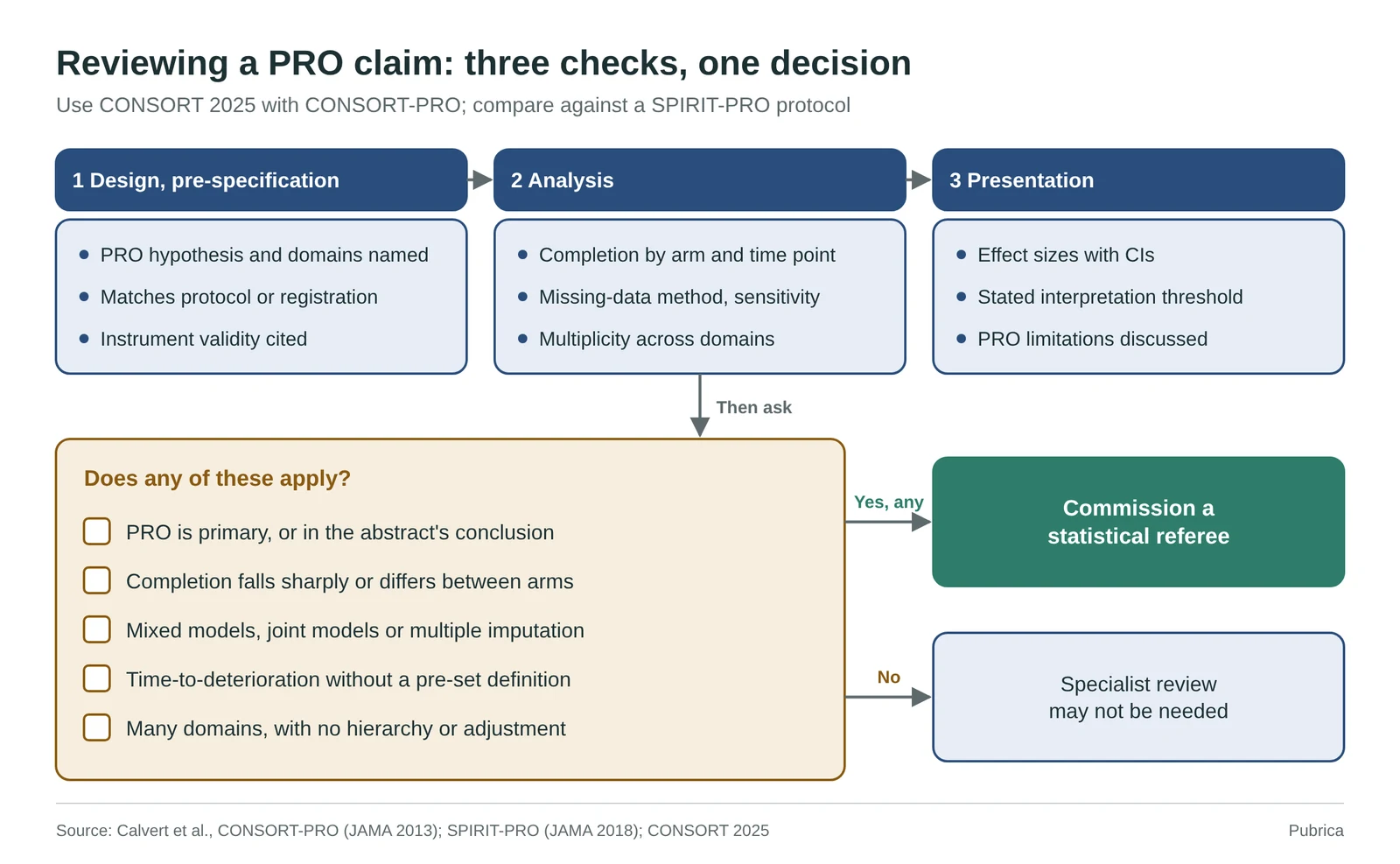
The questions below follow the order in which problems do most damage: design and pre-specification first, then analysis, then presentation.
| # | Question | What to look for | Red flag |
|---|---|---|---|
| 1 | Is the PRO identified as a primary or secondary outcome in the abstract? | CONSORT-PRO item | PRO results in the abstract with no status given |
| 2 | Is there a stated PRO hypothesis and are the relevant domains named? | CONSORT-PRO item | "Quality of life was assessed" with no hypothesis |
| 3 | Do the hypothesis, domains and time points match the protocol or registration? | Protocol, SAP or registry entry | A domain reported as key that the protocol did not prioritise |
| 4 | Is evidence of the instrument's validity and reliability given or cited? | CONSORT-PRO item | A modified or translated instrument without validation |
| 5 | Is the mode and schedule of administration described? | Methods | Assessments only at clinic visits that stop at progression |
| 6 | Is the number of patients with PRO data reported at baseline and each time point? | Flow diagram or table | Completion rates absent or only given for baseline |
| 7 | Are the statistical approaches for missing data explained? | CONSORT-PRO item | Complete-case analysis with no sensitivity analysis |
| 8 | Is multiplicity across domains and time points addressed? | SAP, hierarchy or adjustment | Many domains tested, one significant result highlighted |
| 9 | Are effect sizes reported with confidence intervals and an interpretation threshold? | Results | P values only, or an unstated "meaningful change" |
| 10 | Are PRO-specific limitations and generalisability discussed? | CONSORT-PRO item | No mention of attrition or who completed questionnaires |
Items 1, 2, 4, 7 and 10 correspond to the five CONSORT-PRO items; the others draw on its elaborations and on the main CONSORT checklist.
Pilot a statistical review on one PRO-based submission
Send the methods and results sections of one prostate cancer submission reporting patient-reported outcomes. A Pubrica statistician will report the three most serious findings free of charge, so you can judge the referee report before commissioning further reviews.
Instruments and domains in advanced prostate cancer
Several validated instruments are common in prostate cancer trials, including the EORTC QLQ-PR25 (used with the QLQ-C30), FACT-P (with or without FACT-G), the EPIC-26 short form and the UCLA Prostate Cancer Index. Each has its own domains and scoring direction, so a higher score means better function on some scales and worse symptoms on others.
For an editor, the questions are practical:
- Fit to the disease stage. Instruments developed mainly in localised disease focus on urinary, bowel and sexual function after surgery or radiotherapy. In metastatic disease, pain, fatigue and physical function may matter more. Authors should explain why the instrument and the domains they emphasise fit the population.
- Fit to the treatment. If the comparison involves hormonal therapy, chemotherapy or radioligand therapy, the expected effects differ. A PRO hypothesis should follow from them.
- Scoring and direction. Tables should state the score range and which direction is favourable. Confusion here is easy to miss and changes the reading of a figure.
- Interpretation thresholds. A between-group difference needs a stated threshold for clinical relevance, with its source. The SISAQOL-IMI recommendations include guidance on selecting and reporting such thresholds.
Practical tip
Ask authors to upload the protocol and statistical analysis plan with any trial reporting PROs as a key endpoint. Most of the checks above depend on comparing what was planned with what was reported, and that comparison is far quicker with the documents in hand.
Missing data and attrition: where most PRO claims fail
In advanced prostate cancer, questionnaire completion usually falls over time as patients progress, become too unwell to respond or die. Data are therefore rarely missing at random, and the patients who keep responding are often those doing best. A complete-case comparison at month 12 may compare two groups of survivors who no longer represent the randomised populations.
Check that the manuscript:
- reports completion rates for each arm at each scheduled time point, against the number of patients still expected to respond;
- states the main analysis method for missing PRO data and the assumption behind it;
- includes at least one sensitivity analysis that tests a less favourable assumption;
- explains how death and progression were handled, and whether the estimand for the PRO endpoint was defined, in line with ICH E9(R1).
If completion is low or differs between arms, the conclusion should be written more cautiously, however strong the p value.
Multiplicity and selective emphasis
A typical prostate cancer PRO battery covers a dozen or more domains, assessed at several time points. Without a pre-specified hierarchy or adjustment, some nominally significant differences are expected by chance.
Useful checks are:
- Was a single key PRO endpoint, or a testing hierarchy, defined in the protocol or SAP?
- Are all pre-specified domains reported, including those with no difference, or only the favourable ones?
- Is a time-to-deterioration endpoint defined, with its threshold and confirmation rule stated in advance?
- Are exploratory PRO results labelled as exploratory in the abstract as well as in the results?
Where PROs are secondary and unadjusted, the appropriate language is descriptive. A sentence such as "treatment improved quality of life" in the conclusion usually needs revision to describe what was measured and how certain it is.
When to commission a statistical referee
Not every PRO paper needs a specialist review. A reasonable rule for editors is to commission one when any of the following applies:
- the PRO result is a primary endpoint, or appears in the abstract's conclusion;
- completion falls sharply over time or differs between arms;
- the analysis uses mixed models, joint models or multiple imputation that subject reviewers are unlikely to check;
- a time-to-deterioration endpoint is reported without a pre-specified definition;
- the manuscript reports many domains with no hierarchy or adjustment.
Pubrica's statistical review service provides statistical referee reports for journals. Reviewers assess design before analysis, check pre-specification against the protocol or registration where one exists, apply the reporting checklist the study type triggers, and rank findings by severity in the journal's own report format with a recommendation. The editor makes the decision. Pubrica does not review the same manuscript for both a journal and its authors; where that conflict would arise, it declines the second engagement.
Pubrica works with journals, publishers and societies across life sciences, and matches reviewers to the topic through its cancer research subject experts. For the wider picture of support for US teams working in oncology and haematology in the USA, see the cluster overview. Editors building reporting-guideline training for fellows may also find our academy guidance on reporting standards useful.
Frequently asked questions
It is an extension to CONSORT, published by Calvert and colleagues in JAMA in 2013, for randomised trials in which patient-reported outcomes are primary or important secondary endpoints. It adds five PRO-specific items and is used together with the main CONSORT checklist.
Yes. CONSORT 2025 is the updated core checklist; CONSORT-PRO remains the PRO-specific extension. Because the extension was written against CONSORT 2010, item numbers differ, so it is clearer to check the content of each item than its number.
SPIRIT-PRO (JAMA 2018) is a 16-item extension for trial protocols, describing what should be planned for PRO data collection and analysis. CONSORT-PRO covers what should be reported in the results paper. Editors can use a SPIRIT-PRO protocol to check that the reported analysis matches the plan.
Pubrica's statistical review assesses what was done and whether it supports the conclusions; it does not reanalyse data. Where reanalysis is warranted, it is quoted separately, and for a journal it would be a separate engagement with its own independence arrangements.
Sources
Sources were checked on 24 November 2026. Requirements and guidance may change after that date; confirm the current version with the issuing body.
- 1Calvert M, Blazeby J, Altman DG, et al. Reporting of patient-reported outcomes in randomized trials: the CONSORT PRO extension. JAMA. 2013;309(8):814-822. https://pmc.ncbi.nlm.nih.gov/articles/PMC3842645/
- 2Calvert M, Kyte D, Mercieca-Bebber R, et al. Guidelines for inclusion of patient-reported outcomes in clinical trial protocols: the SPIRIT-PRO extension. JAMA. 2018;319(5):483-494. https://research.birmingham.ac.uk/en/publications/guidelines-for-inclusion-of-patient-reported-outcomes-in-clinical
- 3Hopewell S, Chan AW, Collins GS, et al. CONSORT 2025 statement: updated guideline for reporting randomized trials. 2025. https://pubmed.ncbi.nlm.nih.gov/40229553/
- 4US Food and Drug Administration. Core Patient-Reported Outcomes in Cancer Clinical Trials: Guidance for Industry. October 2024. https://www.fda.gov/regulatory-information/search-fda-guidance-documents/core-patient-reported-outcomes-cancer-clinical-trials
- 5SISAQOL-IMI Consortium. Setting international standards in analysing patient-reported outcomes and quality of life data in cancer clinical trials. Lancet Oncol. 2025;26(12):e683-e693. https://pubmed.ncbi.nlm.nih.gov/41308689/
- 6International Council for Harmonisation. E9(R1) Addendum on estimands and sensitivity analysis in clinical trials. 2019. https://database.ich.org/sites/default/files/E9-R1_Step4_Guideline_2019_1203.pdf
- 7Harrington S, Lee J, Colon G, Alappattu M. Oncology Section EDGE Task Force on Prostate Cancer: a systematic review of outcome measures for health-related quality of life. PMC4851243. https://pmc.ncbi.nlm.nih.gov/articles/PMC4851243/
CONSORT-PRO checklistpatient-reported outcomes prostate cancerCONSORT 2025 PRO reportingSPIRIT-PROPRO missing datastatistical review for journals
How to cite this article
Pick your referencing style and copy it. Your university or target journal may vary the punctuation, so check its guide if it has one.
Pubrica Insights. (2026, November 24). Reviewing Patient-Reported Outcomes in Prostate Cancer Trial Submissions: A CONSORT-PRO Checklist for Journal Editors. Pubrica. https://pubrica.com/insights/consort-pro-review-checklist-for-oncology-editors/
This article is written to be learned from. Cite it if you are referring to what it says; if you are using the evidence behind it, cite the sources listed above instead.
Next steps
Pilot a statistical review on one PRO-based submission
Send the methods and results sections of one prostate cancer submission reporting patient-reported outcomes. A Pubrica statistician will report the three most serious findings free of charge, so you can judge the referee report before commissioning further reviews.
This article is general information for researchers, not legal, regulatory or funding advice. Check the current requirements of your journal, funder, ethics committee or regulator before you act on it.
More in Publishing & Open Access