Interpretation, Reporting and Visualisation
Pubrica provides statistical interpretation, guideline-compliant reporting and publication-ready data visualisation. The service supports academic and clinical researchers, pharmaceutical and biotech companies, public bodies and publishers who have completed an analysis and need it written up. Our statisticians, subject experts and scientific illustrators work together to interpret the results, prepare reports to the guideline your study design requires, and draw figures to the journal’s specification. Deliverables include the interpretation, the report with its completed guideline checklist and the final figures, prepared so that each figure and the statistic underneath it say the same thing.
- Interpretation, not description — what the numbers mean in context, what they support and what they do not support
- Reports built to the guideline your design requires: CONSORT for trials, PRISMA for reviews, STROBE for observational work, TRIPOD for prediction models
- Figures drawn to publication specification — resolution, colour, type size at final print size and file format, so they are not sent back at production
- The right figure for the result, which for clinical work usually means CONSORT diagrams, Kaplan–Meier curves, forest plots and heatmaps rather than default chart-library output
- Uncertainty reported, because a point estimate without its interval presents the result with more confidence than the data allow
Statistical and contextual interpretationIncluded
Guideline-compliant reportingIncluded
Publication-specification figuresIncluded
Dashboards and executive summariesIncluded
Re-running the analysisBiostatistics
Making a null result look positiveNever
Results → interpreted → reported → drawn → submitted
- Guideline named on the order
- Uncertainty reported with every estimate
- Figures to publication specification
- Interpretation separated from conclusion
- Peer-reviewed before delivery
Service Scope
Six Components of Every Reporting Project
Each project is scoped on the order with the reporting guideline named. The interpretation of what the findings mean for your field remains your conclusion; we report what the results statistically support.
From the interpretationThere was a statistically significant difference between groups (p = 0.03).The intervention group had a 21% lower event rate (absolute difference 4.2 percentage points, 95% CI 0.4 to 8.0). The interval reaches close to no difference, so the direction is clearer than the magnitude.
From the reporting checkCONSORT 2025: 31 of 37 items present. Missing: 6b changes to outcomes, 11a who was blinded, 14b why the trial ended, 17b absolute and relative effect sizes, 19 harms, 24 protocol access. Each located and drafted.
From the figure check72 dpi PNG · 6 pt labels · RGB · 1,400 px wide600 dpi TIFF at 90 mm single-column width, 8 pt Arial at final size, CMYK, fonts embedded. The content is unchanged; the file is now acceptable.
From the figure noteSurvival difference shown as a bar chart of mean follow-upKaplan–Meier with numbers at risk beneath the axis and censoring marked. A bar chart of means discards the timing, which is the entire finding in a survival analysis.
From the figure standardEvery estimate plotted with its interval. Where intervals are too wide to plot legibly, they go in the table and the figure caption says so — rather than a clean-looking chart that implies precision that is not there.
From the reviewSecond read: three statements stronger than the data supports, one figure whose axis started above zero, and a subgroup result reported without noting it was not pre-specified. All corrected before delivery.
Samples are illustrative and anonymised. Hover any one of them to play it again.
Types of Reports and Figures
Report Types and Data Visualisation Formats
The report type is chosen for the audience, and the figure type for the structure of the result.
Also available. Storyboarding, custom templates and chart libraries, reformatting existing visualisations, automated and macro-driven reporting for recurring outputs, and delivery in PowerPoint, Word or PDF. What we will not do: re-run your analysis inside this service — that is biostatistics and is quoted separately — or report a result more strongly than the output supports.
Who we serve
Six Client Groups We Support with Research Reporting
Each client group needs the same evidence presented differently, depending on whether a reviewer, a regulator, a board or a funder has to act on the findings.
Compliance and Standards
Reporting Guidelines by Study Design
Each report is checked against the guideline that matches your study design. The guideline is named on the order so that compliance can be verified.
CONSORT (2025 statement)
Randomised trial reporting. The items most often missing are outcome changes, blinding, harms and absolute effect sizes.
PRISMA 2020 (27 items and the flow diagram)
Systematic reviews and meta-analyses, with the flow diagram numbers reconciled against the text rather than drawn separately.
STROBE (And RECORD for routine data)
Observational studies, where the reporting burden falls on confounding, missing data and how the sample was actually assembled.
TRIPOD+AI (BMJ, 2024)
Prediction model development and validation, including machine learning models.
ICMJE Recommendations (January 2026)
Authorship, declarations, data transparency and the statements a journal will check before it reads anything else.
Good Publication Practice (GPP 2022)
For industry-sponsored publication — authorship, writing support and the disclosures that accompany them.
The EQUATOR Network (Where the guideline is found)
Where a study design has a reporting guideline not listed here, we identify it through the EQUATOR Network.
Responsible Use of AI
Expert Interpretation and Accountable Data Visualisation
Software tools can produce a plausible chart from almost any dataset, including a misleading one. Interpretation determines what the reader concludes, so it is carried out and checked by our statisticians and subject experts.
Why we publish no accuracy figure of our own
Accuracy figures for AI tools are usually reported by the companies that sell them.
Pubrica therefore does not quote a self-generated accuracy figure, because it would carry the same conflict of interest. Instead, we tell you which tool was used on your project, at which stage, and what a human reviewer changed afterwards.
Methodology
Reporting Methodology: Five Steps with Independent Review
The interpretation is drafted by somebody who understands the analysis and checked by somebody who did not write it.
Consultation and requirements
We review your research goals, study design, data sources and target, whether a journal, a regulator or an internal decision, which determines the guideline, the structure and the figures.
Analysis and interpretation
Statisticians and subject experts work together on what the output means, what it supports and where its limits lie, instead of a statistician handing numbers to a writer.
Drafting the report
We prepare a structured report with methodology, findings, discussion and conclusions, built to the guideline your design requires and to the journal or regulatory format.
Designing the figures
We build figures, dashboards, tables and infographics suited to the result and to the publication specification for resolution, colour, type size and format.
Review and finalisation
A second reviewer checks the interpretation against the statistical output and the reporting against the checklist, with anything overstated brought back before delivery.
Request a Free Sample Interpretation and Figure Redraw
The result written up as it would appear in your target journal, with the uncertainty reported properly, plus the figure redrawn to that journal’s specification and a note on what would have to change across the rest. Two business days, no charge.
Please send the statistical output rather than a summary of it. An interpretation based on a summary inherits anything the summary left out, and the omitted details are often the most important.
Our experts
Your Reporting and Visualisation Team
A named team of subject specialists stays with your project from scoping to delivery. Your project coordinator introduces each member before work begins, and the handover records which of them completed each stage.
Reviews the scientific content for accuracy and confirms that each conclusion is supported by the evidence. Matched to your field rather than allocated from a rota.
Checks that statistical methods, tables and conclusions are consistent with the analysis plan and that the analysis can be reproduced.
Prepares, cleans and documents the data so that every step from raw data to final output can be traced and reproduced.
Independently checks code, tables and outputs against the analysis plan. Discrepancies are logged and resolved before delivery.
Sample work
Sample Work: Interpretation and Figure Before and After Revision
Step through the changes one at a time. The analysis itself was not changed; the revisions affect what the write-up claims and what the figure shows.
As received. Statistical output and a survival figure from a completed trial.
- “A significant difference was observed (p = 0.03).”
- Survival shown as a bar chart of mean follow-up
- No confidence intervals anywhere
- Subgroup result reported in the abstract
- Figure: 72 dpi PNG, 6 pt labels, RGB
- CONSORT declared; 6 items unreported
As delivered. Interpreted, reported to CONSORT and redrawn to specification.
- 21% lower event rate; absolute difference 4.2 points (95% CI 0.4 to 8.0) — direction clearer than magnitude
- Kaplan–Meier with numbers at risk and censoring marked
- Intervals on every estimate, in text, table and figure
- Subgroup moved out of the abstract — not pre-specified, and labelled so
- 600 dpi TIFF, 90 mm column, 8 pt at final size, CMYK, fonts embedded
- All 37 CONSORT items addressed; the 6 missing ones drafted
The analysis was not re-run. Every number here comes from the output as supplied. Extract redacted; field and values changed.
Finished work
A delivered figure, shown with the client’s permission.
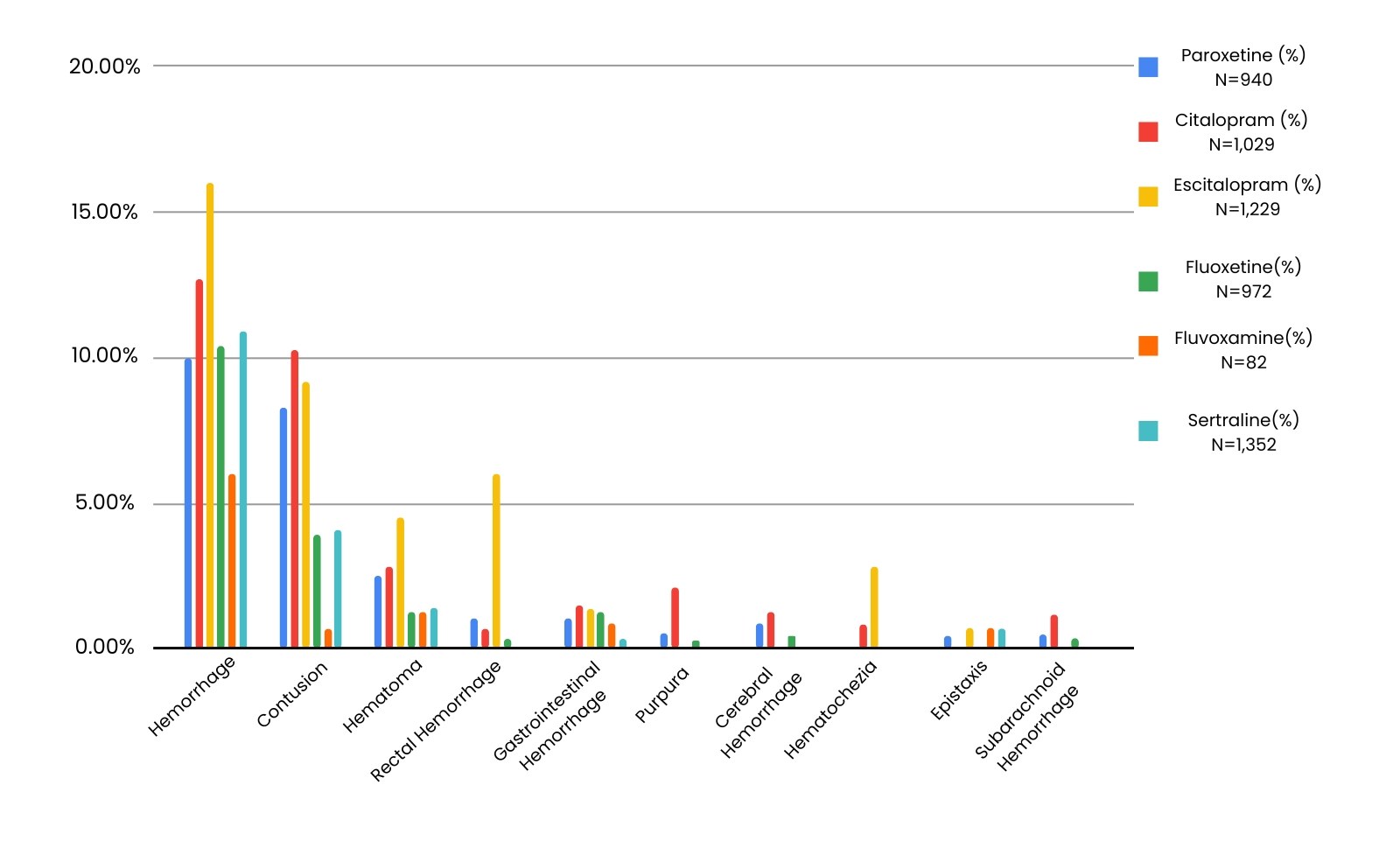
Data visualisation · comparative safety analysis
Bleeding-related adverse events across six SSRIs, grouped by event type with each drug’s sample size stated in the legend, so that rates can be compared directly.
Benefits
Benefits of Accurate Interpretation and Reporting
Each benefit can be checked in your own report and figures. None is a promise that the paper will be accepted.
Packages
Interpretation and Reporting Service Packages
The price depends on how much interpretation is needed, which guideline applies and how many figures must be built rather than adjusted. We therefore provide the free sample first.
Basic
Researchers wanting concise insight and a clear summary
Quoted per projectPriced on output volume
Delivery 5–7 business days
- ✓Interpretation with the essential statistical reporting
- ✓Concise report, two to three pages
- ✓Basic charts, graphs and tables
- ✓Uncertainty reported with every estimate
Suited to projects where the analysis is complete and only the write-up is needed.
View a sample Request a quoteStandard
Academic projects, journal submissions and structured organisational reporting
Quoted per projectPriced on guideline and figures
Delivery 10–12 business days
- ✓In-depth interpretation with the methodology explained
- ✓Reporting structured to journal or industry standards
- ✓Advanced visualisation — survival curves, forest plots, heatmaps
- ✓Figures built to the target journal’s specification
- ✓Guideline checklist completed and gaps drafted
Suited to journal submissions that require a reporting guideline.
View a sample Request a quotePremium
Clinical trials, regulatory submissions, grants and high-impact publication
Quoted per projectPriced on scope and review rounds
Delivery 15–20 business days
- ✓End-to-end interpretation including advanced statistical reporting
- ✓Full guideline-compliant reporting — CONSORT, STROBE, PRISMA or TRIPOD
- ✓Custom figures, interactive dashboards and infographics
- ✓Executive summary written for the decision-maker
- ✓Multiple review rounds with a second statistical reader
Expedited delivery is available and is quoted separately, because it affects the depth of review; we explain how when we quote.
View a sample Request a quoteSend one result and one figure, and we will interpret and redraw them free of charge. Recurring reporting, and automated or templated outputs, are quoted against a schedule.
Quality Assurance
Our Service Commitments
Each commitment below states what we check, its limits and the remedy if the work does not meet the level on your order.
The Pubrica guarantee
Conclusions Proportionate to the Statistical Evidence
The interpretation is checked against the statistical output by a second reader before delivery, and the reporting is checked against the guideline named on your order. Both are testable against documents you already have.
01
The guideline is named on the order
CONSORT, PRISMA, STROBE or TRIPOD, at its current version, so that the report is checked against a defined standard.
02
Uncertainty accompanies every estimate
In the text, the tables and the figures. A point estimate on its own claims more precision than the study produced.
03
A second reader before you see it
The interpretation is reviewed by someone other than its author, because the author is least able to see where it overstates.
04
Free rework within the agreed scope, or a refund
Where the work does not meet the level on your order we do it again at no charge within the agreed scope, and where you would rather not, we refund it.
Client Testimonials
Interpretation and reporting FAQs
Interpretation and Reporting FAQs
If your question is not answered here, ask an expert — no quote required.
Researchers preparing manuscripts, clinicians and sponsors compiling regulatory submissions, institutions and students presenting theses, and organisations that need decisions taken from analysis.
Most clients come to us with a completed analysis and a write-up that has not started, or one that does not yet present the result clearly.
Journal-ready manuscripts, clinical study reports, white papers, regulatory documents, business reports and academic submissions, each to the guideline and format that applies.
Where a study has a reporting guideline, it is named on the order and the checklist is completed and delivered with the report.
Yes — CONSORT for trials, PRISMA for reviews, STROBE for observational studies, TRIPOD for prediction models, plus ICH, GCP and journal-specific requirements.
We check every item of the declared guideline. Identifying unreported items before submission is routine and avoids having them raised in peer review.
For clinical and epidemiological work: CONSORT flow diagrams, Kaplan–Meier curves, forest plots, heatmaps, scatter and regression plots, and properly formatted data tables.
The figure type follows the shape of the result. A survival difference shown as a bar chart of means has discarded the timing, which was the finding.
It is drafted against the statistical output rather than a summary of it, and checked by a second reader who did not write it — against the output and against the checklist.
The most common correction is a statement worded more strongly than the interval supports. It is an easy error to make and difficult to see in your own writing.
Not inside this service. If the interpretation stage turns up something that looks like an analysis problem, we raise it rather than quietly correct it.
Re-analysis is biostatistics and is quoted separately, deliberately — the person interpreting a result should not also be the person who produced it.
Related services
Related Data Analytics Services
This service turns a completed analysis into a report. The services below produce the analysis or take the report through to publication.
1STATISTICAL ANALYSISbefore reporting
BiostatisticsAnalysis plans, reproducible code and the statistics themselves. Predictive analyticsModel development, validated out of sample.2FIGURE PREPARATIONand correction
Artwork preparationFigures to the publisher’s own specification. Visual & accessibility editingFigures made compliant as well as correct.3JOURNAL SUBMISSIONpublication support
Scientific editingThe reporting-guideline check and the simulated review. Manuscript editingA full copyedit plus formatting to one named journal.Insights
Further Reading on Research Reporting and Visualisation
Request a Free Sample Interpretation and Figure Redraw
The result written up as it would appear in your target journal with the uncertainty reported properly, the figure redrawn to that journal’s specification, and a note on what the rest would need. Two business days, no charge.