Conference Poster Preparation Service
Pubrica’s subject-specialist editors and scientific designers turn a manuscript, thesis chapter or set of results into a scientifically accurate, print-ready conference poster for researchers, clinicians and life-science teams. You receive a print PDF and an editable file built to your event’s specification, from $80.
Word count reduced for poster reading1,340 → 480
Body type legible at two metres14 pt → 28 pt
Figures rebuilt to 300 dpi at board size4 of 4
Conference specification metdimensions, orientation, template
Delivered as print PDF and editable file2 of 2
Brief → content edit → design draft 4d → print-ready
- From $80
- Print PDF and editable file
- Built to the conference specification
- Revisions before you print
Service Scope
Scientific Poster Design for Life Sciences, Pharmaceutical and Medical Conferences
Pubrica assigns a subject-specialist editor to decide the poster’s content and a scientific designer to plan its layout, so that the finished poster is accurate, clear and effective.
Why Poster Content Must Be Condensed
At a poster session, delegates scan many boards in limited time, usually from about two metres away. They decide whether to stop on the basis of the title, the key finding and one figure. A board carrying twelve hundred words at fourteen points is unlikely to be read, however strong the science, so reducing the text to the essential content is the most valuable step in preparing a poster.
Our Services
Four Components of Scientific Poster Preparation
Poster preparation covers four components. Design is the most visible, but the choice of content determines whether delegates stop to read the poster.
Poster Layout Options
Comparison of Three Poster Layouts
Posters are read standing up in a crowded hall, from further away than they were designed at. Select each layout and view it from two metres to compare how clearly it communicates.
Minimally invasive versus open repair in complex abdominal disease: a multicentre cohort of 248 patients
A. Researcher1, B. Colleague2, C. Supervisor1 · 1Department of Surgery, Central University Hospital · 2Institute of Clinical Research
Background
Methods
Figure 1. Participant flow and follow-up.
Results
Figure 2. Freedom from the primary endpoint at 36 months.
Secondary outcomes
Figure 3. Complication rate by timepoint and arm.
Discussion
Conclusion
References
Funding and conflicts
Scan for the full preprint, the dataset and contact details.
Layout 1 of 3
Traditional three-column
This is the layout most conferences expect and most reviewers are familiar with: background, methods, results and conclusion, read down each column in turn. It suits studies in which the method is the main interest and is the appropriate default when the conference supplies a template.
Type sizes
Title 72–90 pt, section headings 36–44 pt, body 24–32 pt, captions 18–24 pt
Word count
400 to 600 words across the whole board. Above roughly 800 words, delegates stop reading
Reads at two metres
The title and headings are legible at two metres. Body text requires the reader to step closer, which is usually when a conversation with the presenter begins
A0 landscape, 1189 × 841 mm, drawn to scale in your browser — so the point sizes quoted above are true at whatever size your screen renders it. Body text is shown as rules rather than words, because the thing being compared is the layout. Your conference’s own specification governs dimensions, orientation and any template it supplies.
Who we serve
Who We Support with Poster Preparation
We prepare posters for four main groups of presenters, each with different content requirements.
Compliance and Standards
ICMJE, CONSORT and COPE Standards for Conference Posters
Pubrica follows this guidance. A conference poster is a public disclosure and carries obligations for authorship, reporting and data protection that authors may not expect.
International Committee of Medical Journal Editors (ICMJE)
Presenting at a conference is generally not prior publication, but a full proceedings paper can be. Authorship, funding and conflicts belong on the board, and a patient image needs written consent whether it appears in a journal or on a poster.
Consolidated Standards of Reporting Trials (CONSORT and SPIRIT)
A trial presented on a poster still needs its registration number, participant flow and pre-specified primary outcome to be visible. Reporting requirements apply in full regardless of format.
Committee on Publication Ethics (COPE)
Data protection applies to a printed poster as much as to a submitted file. Identifiers are removed under GDPR and, for work involving US health data, the privacy rules that govern it, including identifiers in images, which are often overlooked.
Responsible Use of AI
Our Approach to AI and Image Integrity
AI image generation carries the greatest risk in scientific visual work. A generated cell, scan or apparatus that never existed constitutes image fabrication, and journals now screen for it.
Why We Do Not Publish AI Accuracy Figures
Accuracy figures for AI tools are usually reported by the companies that sell them.
Pubrica therefore quotes no self-generated accuracy figure, as it would carry the same conflict of interest. Instead, we tell you which tool was used on your project, at which stage, and what a human editor changed afterwards.
How It Works
How Our Poster Preparation Process Works
Your project passes through six stages between manuscript and print-ready file, with a Pubrica editor and a designer involved throughout. Please send the conference link with your brief, because the poster specification determines the format.
Submission of Manuscript and Conference Details
You send the manuscript, thesis chapter or accepted abstract, a link to the conference’s poster instructions and your figures, preferably as the editable source files from which the charts were produced.
Material Review and Brief Confirmation
We review your materials against the conference requirements and confirm anything missing, such as the board dimensions, an ethics number, a figure at usable resolution or the choice of lead finding. Design begins only once these points are confirmed.
Content Condensed to Poster Length
A domain editor condenses the paper to what a board can carry, typically four to six hundred words, in language that a delegate from an adjacent field can follow, keeping the key numbers and removing detail that only a reader with more time would need.
Layout Design and Figure Rebuilding
We prepare a structured draft in the conference’s format with a clear reading order, figures rebuilt at board size and 300 dpi, a type hierarchy legible at two metres, and institutional branding where supplied.
Revision and Three-Part Quality Check
We incorporate your comments and then check the poster for visual consistency, scientific accuracy against the source and compliance with the conference specification. We also review it at a tenth of its size to confirm that it remains legible from a distance.
Delivery of Print-Ready and Editable Files
You receive a high-resolution PDF prepared for the printer and an editable PowerPoint or Illustrator file for last-minute changes. Digital and e-poster formats are supplied where the conference uses screens.
Poster Preparation from $80, Delivered in Three to Ten Days
Send your manuscript and the conference link. Pubrica condenses the content, rebuilds the figures and returns a print-ready PDF and an editable file built to the event’s dimensions, template and deadline.
Built to the specification of the event you are presenting at — AACR, ASCO and ESMO in oncology; AHA and ACC in cardiology; ADA and EASD in diabetes; ISSCR, FENS and SfN in the basic sciences; ECCMID and IDWeek in infectious disease; plus WHO and ICMR scientific forums, university and institutional symposia, and industry exhibitions. Several supply their own template, and where one exists we work inside it rather than around it.
Our experts
Our Poster Design Team
The same named team works on your project from scoping to delivery, and your project coordinator introduces each member before work begins.
Reviews the scientific content for accuracy and confirms that each conclusion is supported by the evidence. The expert is matched to your field.
Designs figures, posters, abstracts and media that represent the data accurately and meet the specifications of the target journal or platform.
Checks the finished work independently against the agreed scope and the applicable checklist. Findings are logged and resolved before delivery.
Manages the timeline, keeps you informed at each stage and coordinates the team so that questions are answered and deadlines are met.
Sample work
Sample Poster Handover Contents
Every Pubrica poster is delivered with the files, the specification it was built to and a record of the content removed. Use the tabs to view each part.
Poster handover
Clinical cohort study · A0 landscape · society congress
1,340 words cut to 480 · 4 figures rebuilt · print PDF and editable PPT
1,340 words in, 480 outApproved before design began
- Dimensions
- A0 landscape, 1189 × 841 mm, as the congress specifies
- Title
- 78 pt, readable at five metres in a row of boards
- Key finding
- 60 pt, the one thing a passing delegate will read
- Headings
- 40 pt, sentence case, one weight throughout
- Body
- 28 pt, above the two-metre legibility floor
- Captions
- 22 pt, and no smaller anywhere on the board
- Colour
- Institutional palette, checked in greyscale and for colour-vision deficiency
4 figures rebuilt at board size2 tables removed as redundant
- Print file
- PDF at full size, fonts embedded, bleed as the printer asks
- Editable
- PowerPoint and Illustrator, for last-minute corrections
- E-poster
- 16:9 version where the congress uses screens
- Proof
- A scaled PDF for circulating to co-authors before printing
- QR target
- A one-page PDF of the detail the board could not hold
- Handout
- A4 version for delegates who ask for one
- Spec note
- What was built, against which line of the conference instructions
Redacted extract · client and conference details removedPage 1 of 4
The handover contains the files and the rationale for each decision. Use the tabs to see each part.
Content selection records which content was kept, moved or removed. Twelve hundred words were removed from this board without loss: the methods, secondary analyses and references are available through a single QR scan.
The figures were rebuilt at A0 rather than enlarged. Axis labels on a curve exported for a journal column become illegible at board size, and enlargement does not correct this.
On request, we will send a sample handover for a poster similar to yours, with the same study type, board size and conference requirements.
Redacted sample
Poster handover
Clinical cohort study · A0 landscape · society congress · 1,340 words cut to 480. Client names, journal names and identifying particulars have been removed or changed. On request, we can send a sample based on a manuscript similar to yours.
Content selection, agreed before design began
Twelve hundred words were removed from this board without loss; the content was moved behind a QR code for readers who want it.
| Decision | What | Why |
|---|---|---|
| Kept | The question, the design in one line, the primary outcome with its effect size, the conclusion. 480 words. | Content a delegate can read standing up in thirty seconds. |
| Moved to QR | Full methods, three secondary analyses, sensitivity analysis, reference list. | Available in one scan; not on the board. |
| Cut | Literature review, acknowledgements paragraph, two tables restating a figure. | This content is rarely read on a poster board. |
| Promoted | The primary finding, lifted into a single sentence at 60 pt. | Readable from across the hall, where delegates decide whether to stop. |
| Queried | Which of two findings should lead. | The authors decide the poster’s main message. |
Specification
| Element | Set to |
|---|---|
| Dimensions | A0 landscape, 1189 × 841 mm, as the congress specifies |
| Title | 78 pt — findable at five metres in a row of boards |
| Key finding | 60 pt — the one thing a passing delegate reads |
| Headings | 40 pt, sentence case, one weight throughout |
| Body | 28 pt — above the two-metre legibility floor |
| Captions | 22 pt, and nothing smaller anywhere on the board |
| Colour | Institutional palette, checked in greyscale and for colour-vision deficiency |
| QR code | Placed bottom right, resolving to the preprint and dataset, with scan tracking |
Figures, rebuilt at board size
- Participant flow rebuilt as a CONSORT-style diagram at A0 scale, numbers reconciled with the manuscript
- Primary outcome curve redrawn at 300 dpi for A0 rather than enlarged from the paper, axis labels at 24 pt
- Subgroup forest plot simplified from eleven rows to five; the full plot sits behind the QR code
- Treatment pathway drawn as a new schematic, replacing two paragraphs of methods text
Checked at a tenth of its size. This confirms that the poster remains legible from across a hall. We review every board this way before it goes to print.
Delivered
- Print-ready PDF at full size, fonts embedded, bleed as the printer requires
- Editable PowerPoint and Illustrator files for the correction you will want the night before
- A 16:9 e-poster version for congresses using screens
- A scaled PDF proof for circulating to co-authors
- A one-page PDF behind the QR code, carrying what the board could not
- A4 handout version
- Printing and next-day delivery to the venue, if you want it
Prepared by Pubrica. Pubrica is a trading name of Guires®, registered in England, Wales and India.
Download this as a PDFFinished work
Three delivered posters, shown with the authors’ permission rather than redacted. Each was presented on a conference board; none is a mock-up.
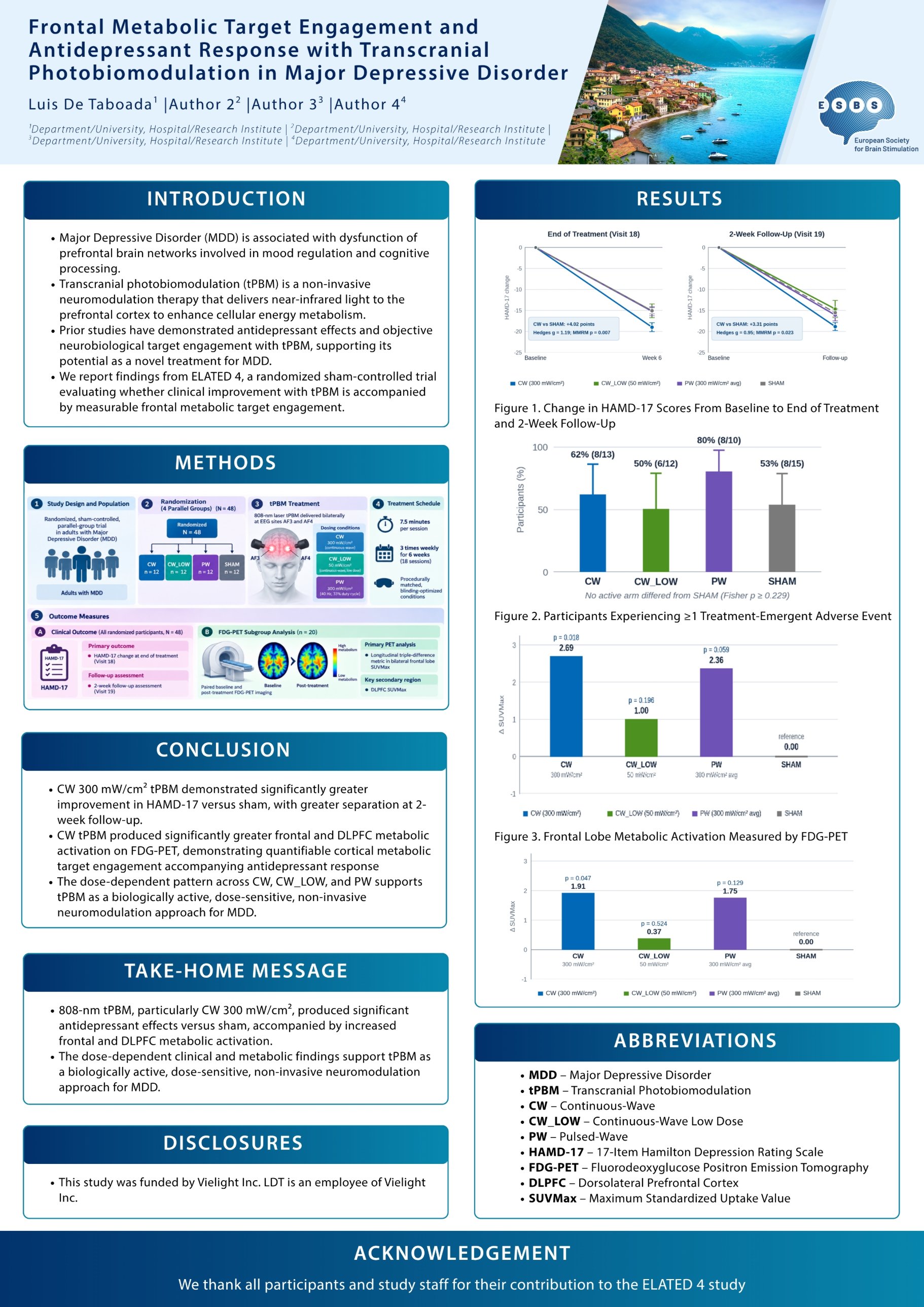
A0 · randomised sham-controlled trial
Shown with permission: Luis De Taboada et al., “Frontal Metabolic Target Engagement and Antidepressant Response with Transcranial Photobiomodulation in Major Depressive Disorder” — European Society for Brain Stimulation congress poster.
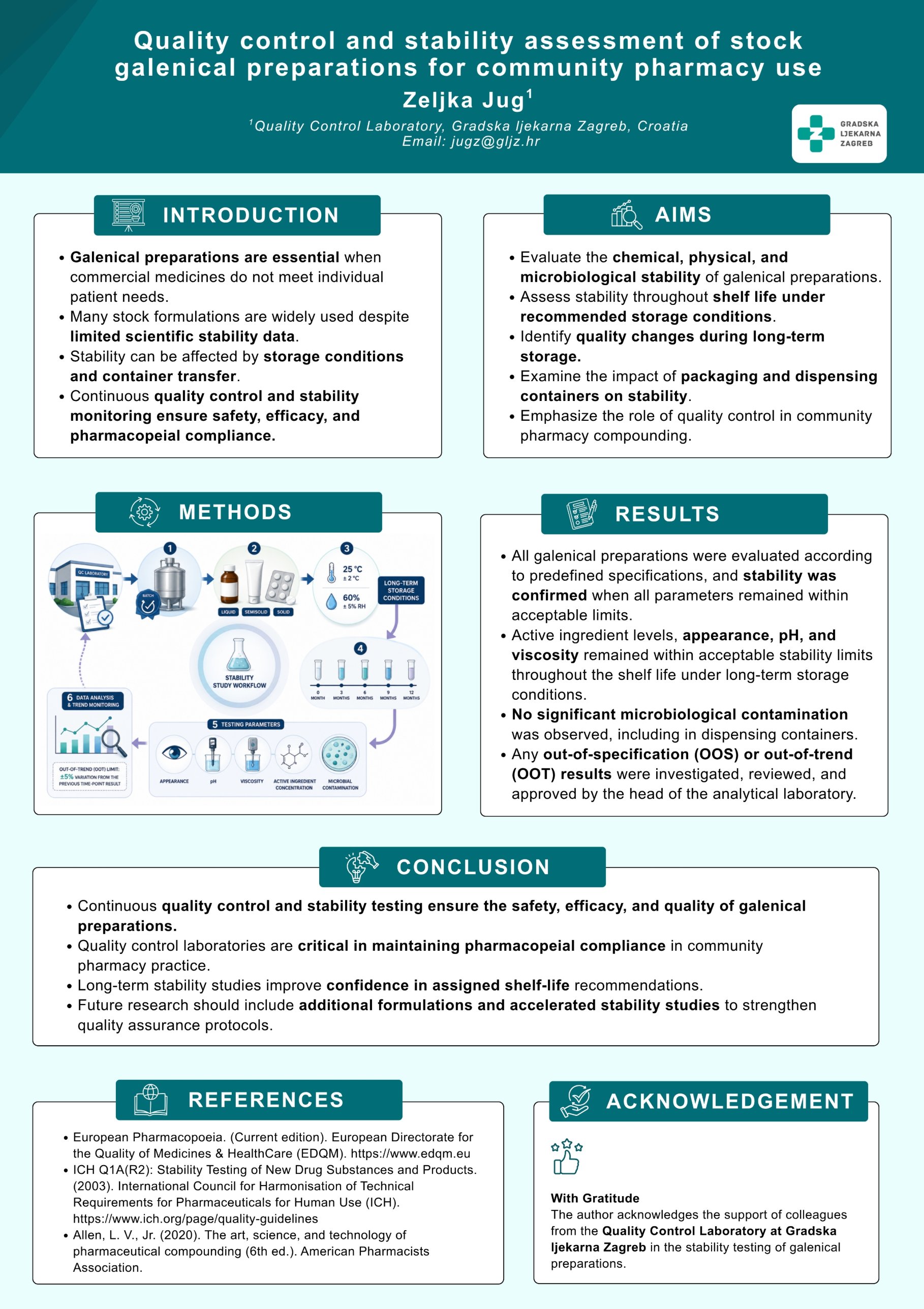
A0 · laboratory quality-control study
Shown with permission: Zeljka Jug, “Quality Control and Stability Assessment of Stock Galenical Preparations for Community Pharmacy Use” — Gradska ljekarna Zagreb, Quality Control Laboratory.
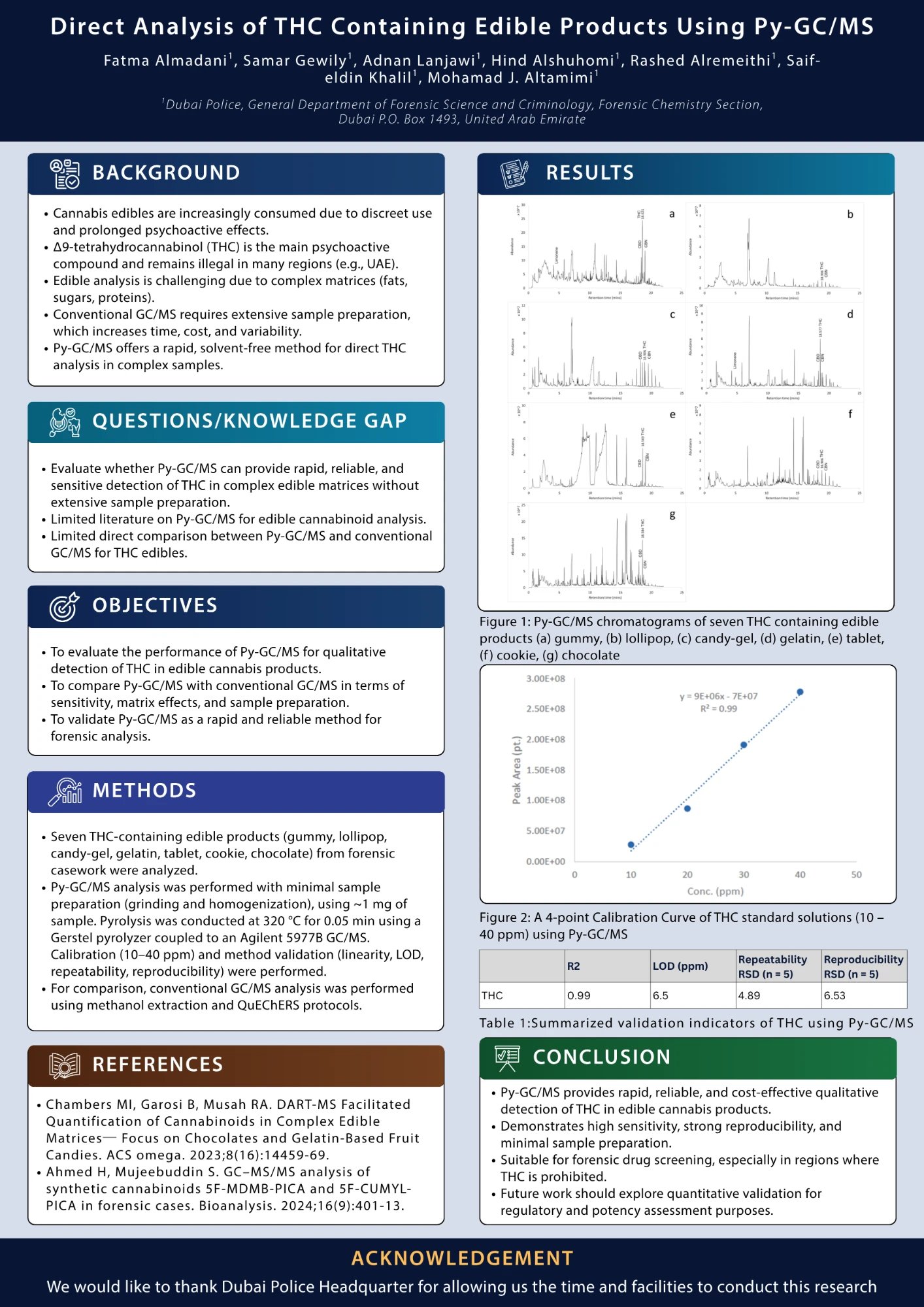
Portrait poster · forensic method validation
Shown with permission: Fatma Almadani et al., “Direct Analysis of THC Containing Edible Products Using Py-GC/MS” — Dubai Police, General Department of Forensic Science and Criminology.
Printing and Delivery
Poster Printing and Delivery to Your Conference
Pubrica can print your finished poster and deliver it to your hotel or venue, so you do not need to find a printer in an unfamiliar city before you present.
Print options and delivery
A1 · matt or satin paper
594 × 841 mm. The usual size for a departmental or university symposium
$40
ships same day
A0 · matt or satin paper
841 × 1189 mm, either orientation. The standard congress board
$55
ships same day
36 × 48 in · paper
The common North American board size, portrait or landscape
$60
ships same day
A0 · foldable fabric
Creaseless wrinkle-resistant fabric. Folds into hand luggage instead of a tube
$95
ships same day
36 × 48 in · fabric
Fabric print in the US board size, suited to air travel
$100
ships same day
Next-day delivery to the conference. We deliver to the venue, your hotel, the host department or your home. Orders placed by early afternoon ship the same day; delivery is next-day across most of India, the UK, Europe and North America, and two to three days elsewhere. Tell us the session date and we will schedule delivery accordingly. Every poster is shipped in a carry tube unless you choose fabric, and A4 handouts can be included in the same parcel.
Printing and design are available separately. Send us a finished poster and we will print and ship it, or send us a paper and we will design and print it. Print prices above are per copy and do not include design; shipping is quoted at cost when you order, with no markup.
Free Resources
Free Poster Design Review and Template Kit
Two free resources are available without placing an order: a poster design review and a template kit.
Free, no purchase
Poster design review
Send your draft or PowerPoint file, and a designer will check it against your conference’s specification and print requirements: board dimensions and orientation, type sizes at reading distance, figure resolution at final size, colour under conference lighting, embedded fonts, bleed and file size. You receive a written list of issues and their causes within one business day, which many authors use to make the corrections themselves.
Free, no purchase
Scientific poster template kit
Twelve templates in PowerPoint, Illustrator and LaTeX, each supplied at A0 portrait and landscape, A1 and 36 × 48 inches and built at true size with the type hierarchy set, so the sizes hold when you replace the text. The kit covers three layouts (traditional three-column, billboard and single-figure) and includes a one-page checklist of common reasons conferences reject posters.
Benefits
Benefits for Conference Presenters
Professional poster preparation saves you time before a conference and produces a poster that supports discussion with delegates.
Packages
Poster Preparation Packages
From $80 for a basic poster, and $250 for an advanced scientific poster with illustrations and infographics. Express delivery runs three to ten days depending on complexity.
Standard package
University and departmental conferences
$80basic poster
Turnaround 4–5 business days
Checked before you print. We proof the file against the conference specification and the printer’s requirements, so it is not rejected the day before you travel.
- ✓Custom layout in PowerPoint or PDF, with title, introduction, methods, results and conclusion structured
- ✓Charts, tables and logos placed, with institutional colours and branding applied
- ✓Language checked for grammar and clarity at poster length
Optional: print-ready file optimisation.
View a sample Select StandardAdvanced package
National and international conferences
$250with illustrations
Turnaround 5–7 business days
Checked before you print. We proof the file against the conference specification and the printer’s requirements, so it is not rejected the day before you travel.
- ✓Designed in PowerPoint, Illustrator or InDesign and delivered as a print-ready PDF
- ✓Scientific accuracy checked by a domain expert; figures, tables and graphs rebuilt at board size
- ✓Conference formatting — dimensions, font sizes, word limits — at 300 dpi in the required colour space
Optional: multi-language versions; QR code integration.
View a sample Select AdvancedPremium package
Global congresses and regulated data
$450per poster
Turnaround 10 working days
Checked before you print. We proof the file against the conference specification and the printer’s requirements, so it is not rejected the day before you travel.
- ✓Advanced design with custom icons and illustration, and the content restructured rather than trimmed
- ✓Data visualisation with infographic elements, and clinical data handled under the applicable privacy rules and ICMJE guidance
- ✓Scientific review and language editing by doctorate-level editors; submission-ready and editable files in PDF, AI and PPT
Optional: technical proofreading; a dedicated project manager for a congress programme.
View a sample Select PremiumQuality Assurance
Our Service Commitments and Limitations
Four commitments that apply to every poster Pubrica builds.
Our service commitment
Revision Support Until Agreed Requirements Are Met
We do not offer refunds. Instead, we continue working on the deliverable until the agreed requirements are met, within the agreed scope.
01
Unlimited revisions
Revisions are not limited by number of rounds, within the agreed scope, until the poster meets the conference specification and the content you approved.
02
Correction of our errors at no cost
If work is returned because of an error in something we prepared, formatted or wrote, we correct it free of charge.
03
Delivered on the date agreed
We quote a delivery date we can meet. If a deadline is at risk, we inform you early.
04
Authors retain final decisions
We advise, explain our recommendations and tell you clearly when we disagree, but you decide what is published under your name.
Limitations of our service. We cannot guarantee that a conference will accept your abstract or poster; that decision rests with the organisers. Unlimited revision covers the work we were engaged to do, within the agreed scope; new analyses, new results or a different study are treated as new work.
Three revision rounds and a pre-print check
Unlimited revisions are included on every poster, within the agreed scope, and if the conference rejects the board on a specification we set, we correct it free of charge. The file is then checked against the conference specification and the printer’s requirements for dimensions, embedded fonts, colour space, bleed and resolution, so that it is not rejected at the print shop before you travel.
Authors decide the poster content
We propose which content to remove and show you where it would be moved. The choice of lead finding is a scientific decision for the authors; we will give our recommendation and then build the poster you approve.
Editable files with every poster
An editable PowerPoint or Illustrator file is supplied with the print PDF, so that you can make late changes, such as a co-author’s affiliation or a corrected number, without needing us.
NDA, encryption and unpublished data
Posters carry results that are not published yet, often the most sensitive stage a project reaches. Every editor and designer works under an NDA, files are encrypted in transit and at rest, and material is handled under GDPR.
Client Stories
Client Feedback on Poster Preparation
Presenters describe how our poster preparation work helped them.
“They took a paper I was too close to and turned it into something people actually stopped at. Losing two thirds of the text was the part I resisted and the part that worked.”
“The layout and the formatting were handled entirely, down to the conference’s own template, which I had not read properly. I turned up with a file that printed first time.”
“Strict guidelines on dimensions and font sizes that I would have got wrong. Having it checked against the specification before printing was worth the fee on its own.”
FAQs
Poster Preparation FAQs
If you are unsure what your conference requires, please ask an expert. No quote is required.
A0 is the usual size outside North America — 841 × 1189 mm, in either orientation — while 36 × 48 inches is the common US equivalent. A1 appears at smaller meetings and many congresses now run e-posters on 16:9 screens instead. None of that matters as much as what your own event says: dimensions and orientation are always stated in the poster instructions, they vary more than people expect, and a board printed to the wrong size cannot be hung.
As a working guide: title 60 to 90 pt, section headings 36 to 44 pt, body text 24 to 32 pt, and captions no smaller than 18 pt. These sizes are based on reading distance: a title must be findable from five metres in a row of boards, and body text must be readable from two. Text below about 20 pt on A0 is not legible at reading distance, and the most common failure is body text left at 14 pt because it looked adequate on a laptop screen.
Start by deciding what the poster is about, which is usually one finding rather than the whole study, and then remove everything that does not support it. A five-thousand-word manuscript becomes four to six hundred words: the question, a one-line description of the design, the primary result with its numbers and the conclusion. The literature review and secondary analyses are removed, and the reference list is reduced to three or four citations. Detail can be placed behind a QR code so that nothing is lost.
Four hundred to six hundred words on A0 is comfortable; eight hundred is the point at which people stop reading and start skimming for the conclusion. A billboard-style board carrying one large finding and a single figure can work on two hundred. The test is not whether the text fits but whether someone can take the point in thirty seconds standing up, because that is how long you have before they move to the next board.
An effective poster has a reading order that the eye follows without instruction (columns read downwards or a clear left-to-right flow), a strong type hierarchy that distinguishes title, headings and body, generous white space, and more room for visuals than for text. Place the key finding high and large rather than at the end, and leave enough white space for the retained content to remain legible.
Title, authors and affiliations, the objective, a short methods statement, the key results with figures, and a conclusion. Then the parts people forget: funding and conflict of interest declarations, ethics approval or trial registration where applicable, a contact address or QR code, and institutional logos if your employer requires them. A full reference list is rarely worth the space — three or four citations and a QR code to the rest does the same job.
PowerPoint is the most common tool and is fully capable if the page is set to the real board size before anything is placed on it, a step many people skip. Illustrator and InDesign give better typographic control and cleaner print output, and LaTeX with a poster class suits mathematical and physics work. Whichever tool is used, the poster should be designed at full size and reviewed at a tenth of that size.
Usually not without rework. A figure exported for an 85 mm journal column has type and line weights sized for that width; enlarged to fill a third of an A0 board, it becomes soft and its labels become proportionally tiny. Rebuilding the figure from the source data at board size corrects both problems, and the figure should usually be simplified as well, because an eleven-row forest plot that works on the page is too detailed for a reader standing at a poster.
Presenting at a scientific meeting, and publishing an abstract in its proceedings, is generally not treated as prior publication and most journals say so explicitly. A full paper in a conference proceedings volume is a different matter and can be. Check the target journal’s policy before the congress rather than after it, and mention the presentation in your cover letter when you submit — editors treat disclosure as normal and non-disclosure as a problem.
The most common mistake is too much text. Others include type below the legibility threshold, no visual hierarchy, figures taken directly from the manuscript at the wrong resolution, a title that describes the topic rather than the finding, a conclusion placed at the bottom right, dark backgrounds that print poorly and are hard to read under conference lighting, and reliance on colour that colour-blind readers cannot distinguish.
Related services
Related Publication Support Services
Poster preparation is often combined with manuscript and submission services before and after the conference.
1BEFORE THE POSTERservices based on the manuscript
Artwork preparationFigures rebuilt at board size and resolution, rather than enlarged from a journal column. Pre-submission peer reviewAn independent review of whether your findings are robust before you present them on a poster.2ALONGSIDE THE POSTERthe same content in other formats
Video abstractThe condensed study presented as a ninety-second video for an e-poster screen or the journal’s own channels. Manuscript formattingThe paper the poster came from, built to the target journal’s template.3AFTER THE CONFERENCEpreparing the manuscript for submission
Journal selectionConference feedback often improves the manuscript, and the next step is selecting a target journal. Journal submissionThe portal, the cover letter and the declarations, including the one about prior presentation.Insights
Further Reading on Presenting Research
Three articles from our library on manuscript structure, journal selection and writing for readers.
Request a Free Poster Layout Review Against Your Conference Specification
A layout review against your conference’s specification is free and takes one business day. It identifies any content that would not be legible at two metres.