Contents
On this page
- Quick answer
- Why the methods section decides how a phase I paper is reviewed
- Describe the design you actually ran: 3+3, BOIN or model-based
- Define DLT, the assessment window and the evaluable population
- Explain how the recommended dose was chosen, not only the MTD
- Report deviations, committee decisions and the statistical analysis
- A pre-submission checklist for the methods section
- When to bring in a medical writer
- Frequently asked questions
- Sources
AcademyResearch Writing
GuideUSA
How to Write the Methods of a Phase I Oncology Dose-Escalation Paper: 3+3, BOIN and Model-Based Designs
Reviewers judge a first-in-human oncology paper by whether its recommended dose follows from the design. This guide shows what to report for 3+3, BOIN and model-based designs, with a pre-submission checklist.
- Research Writing
- Oncology & haematology
- Original research article (Physician writing)
- Topic
- Research Writing
- Written by
- Pubrica Academy
At a glanceResearch Writing
Request a Free Expert AssessmentDiscuss your project
Quick answer
- Name and cite the design, and describe it so each escalation decision could be reproduced.
- Write out the DLT definition, assessment window and DLT-evaluable population in full.
- For BOIN and model-based designs, report the target DLT rate, boundaries or model, priors and simulations.
- Explain how the MTD or recommended phase 2 dose was chosen, and report deviations openly.
- Check the methods against CONSORT-DEFINE (2023) before submission.
Why the methods section decides how a phase I paper is reviewed
A first-in-human dose-escalation study in advanced solid tumours is usually small, single-arm and adaptive. That makes the methods section the place where reviewers decide whether the recommended dose can be trusted. If the escalation rules, the dose-limiting toxicity (DLT) definition or the evaluable population are vague, a reviewer cannot tell whether the dose you report was chosen by the design or by the investigators after the fact.
Investigators at US cancer centres often face this at the point of submission: the trial is closed, the data are clean, and the methods still read like a shortened protocol. The decision is whether to rebuild the section yourself or bring in a writer who knows what reviewers check.
The main reporting standard is CONSORT-DEFINE, the CONSORT extension for early phase dose-finding trials published in The BMJ in October 2023. It adds 21 new items and modifies 19 existing ones, and it covers trials that use dose escalation or de-escalation rules. Randomised dose-comparison cohorts may also need items from CONSORT 2025, the updated 30-item guideline for randomised trials published in April 2025. Check which checklist your target journal asks you to upload.
Describe the design you actually ran: 3+3, BOIN or model-based
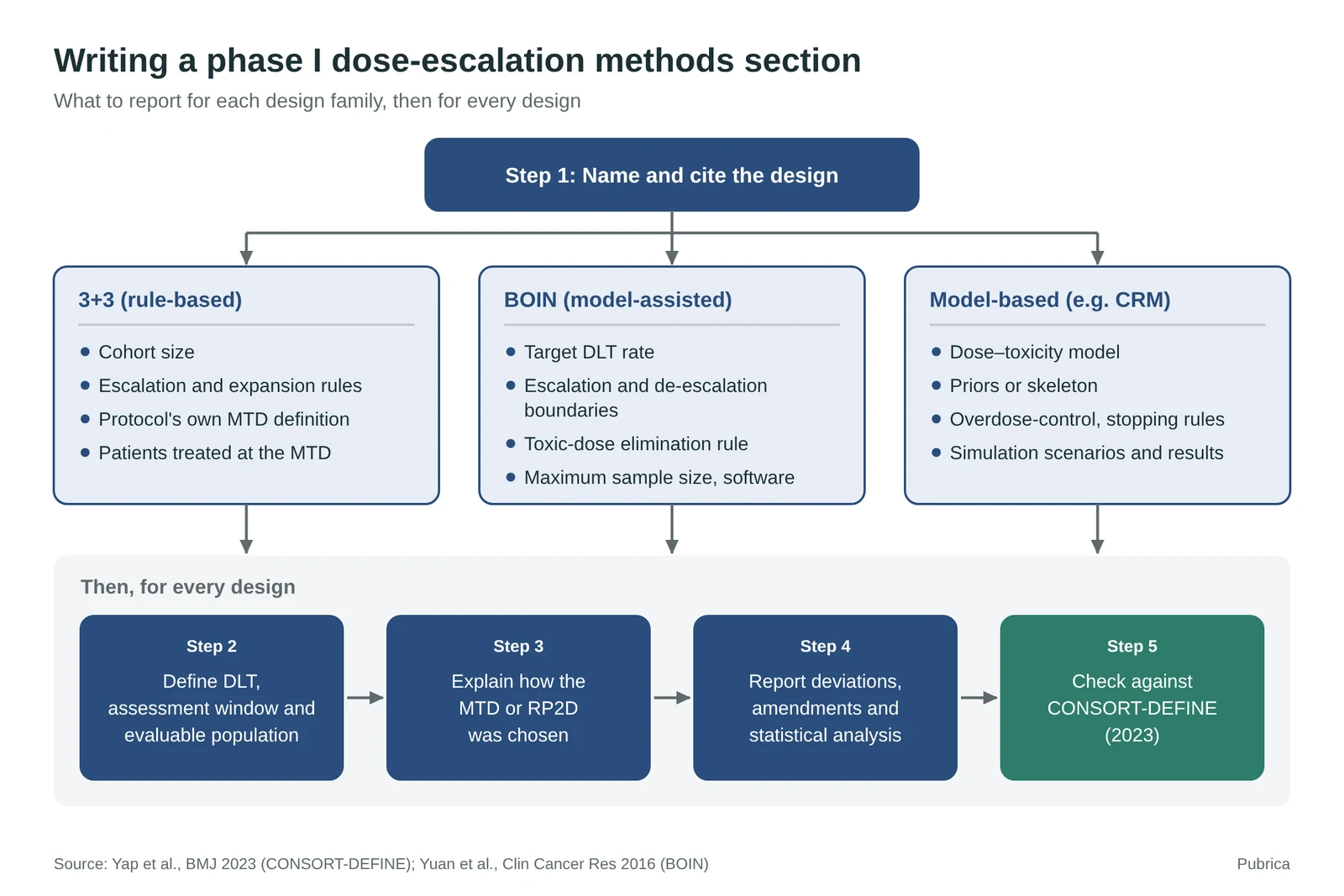
Start by naming the design and citing its source, then describe it in enough detail that a reader could reproduce each escalation decision. The three common families need different detail.
| Design | What reviewers expect in the methods |
|---|---|
| 3+3 (rule-based) | Cohort size, the escalation and expansion rules (for example, 0 of 3 DLTs: escalate; 1 of 3: add three patients), how the maximum tolerated dose (MTD) was defined, and how many patients were treated at it |
| BOIN (model-assisted) | The target DLT rate, the escalation and de-escalation boundaries, any elimination rule for overly toxic doses, cohort size, maximum sample size and the software used |
| Model-based (for example, CRM or a Bayesian logistic regression model) | The dose–toxicity model, prior distributions or skeleton, any overdose-control rule, stopping rules and the simulated operating characteristics |
3+3. The rules look simple, but definitions vary. Some protocols name the MTD as the highest dose at which no more than one of six patients had a DLT; others use different thresholds. State the rule your protocol used, not a textbook version.
BOIN. The Bayesian optimal interval design, described by Yuan and colleagues in Clinical Cancer Research in 2016, can target any prespecified DLT rate. In their analysis, BOIN generally outperformed the 3+3 and modified toxicity probability interval designs. For a target DLT rate of 0.30, the published boundaries are 0.236 (escalate) and 0.358 (de-escalate), although some protocols round the second to 0.359. Report the values your trial used.
Model-based designs. The continual reassessment method (CRM) was introduced by O'Quigley, Pepe and Fisher in 1990. Model-based designs need the most explanation: reviewers will look for the model, the priors and evidence from simulation that the design behaved acceptably across plausible dose–toxicity scenarios.
Main text or supplement? Word limits force a choice. A practical split is to keep the design name, target DLT rate, decision rules, DLT definition and dose-selection method in the main methods, and move the full decision table, prior specifications and simulation scenarios to a supplement that the methods cite. Model-assisted designs such as BOIN have an advantage here: their decision rules can be pretabulated, so a single table can show every escalation decision the design allowed, which reviewers find easy to check against the patient-level dose history.
Define DLT, the assessment window and the evaluable population
These three definitions cause more reviewer queries than the design itself. Write each one out in full in the methods, not only in a supplementary protocol.
- DLT definition: list the toxicities that counted, the grading system and version used (for example, the CTCAE version), and any exclusions, such as toxicity clearly attributable to disease progression.
- DLT assessment window: state the period (often the first treatment cycle) and how late-onset toxicities were handled.
- DLT-evaluable population: say who counted towards escalation decisions and how patients who left the window early without a DLT were replaced or handled.
- Safety population: keep this separate from the DLT-evaluable population, because the two numbers usually differ.
A short sentence linking each definition to the flow diagram helps a reviewer check that the numbers add up.
Practical tip
Reviewers compare the methods with the registered protocol. If the design changed by amendment, for example from 3+3 to BOIN, say so in the methods with the date and the reason, rather than leaving a reviewer to find the difference in the registry record.
Get an expert view of your dose-escalation manuscript
Send your draft or data. Before quoting, a Pubrica subject-matter expert reviews your material and tells you which reporting guideline governs it and what the data can support.
Explain how the recommended dose was chosen, not only the MTD
Many recent first-in-human oncology trials do not end with a single MTD. They report a recommended phase 2 dose (RP2D), or two candidate doses, chosen from toxicity, pharmacokinetic, pharmacodynamic and early activity data. The methods should say how those data were weighed and who made the decision, such as a safety review committee.
This matters more since the FDA finalised its guidance Optimizing the Dosage of Human Prescription Drugs and Biological Products for the Treatment of Oncologic Diseases in August 2024. The guidance asks sponsors to identify an optimised dosage during development, before an application for a new indication. It does not cover starting doses for first-in-human trials, so describe the starting-dose rationale separately. Our Insights article on FDA Project Optimus and the dose-optimisation evidence US biotechs need sets out the wider regulatory picture.
Also describe backfill cohorts, dose-expansion cohorts and any randomised comparison of doses, with the rules for opening each one. If expansion cohorts enrolled by biomarker or tumour type, say so here.
Report deviations, committee decisions and the statistical analysis
Adaptive trials rarely follow every rule exactly. Reviewers accept deviations that are reported openly; they question deviations they find in the results that the methods did not mention.
- Report any escalation decision that differed from the design's recommendation, and why.
- State whether intermediate dose levels were added, and on what basis.
- Describe protocol amendments that changed the design, the DLT definition or the target population, with dates.
The statistical analysis subsection should cover how the final dose estimate was obtained (for example, isotonic regression after BOIN), how toxicity, pharmacokinetic and response data were summarised, the response criteria used (such as RECIST version 1.1), and the software and version. Avoid efficacy claims that the design cannot support: a dose-escalation study is designed to characterise safety and dose, not to test efficacy.
A pre-submission checklist for the methods section
Use this checklist before submission, alongside the CONSORT-DEFINE checklist itself.
- [ ] Design named, cited and described so that each escalation decision could be reproduced
- [ ] Target DLT rate and decision boundaries (or 3+3 rules) stated as used in the trial
- [ ] Starting dose and its rationale stated separately from escalation
- [ ] DLT definition, grading system version and assessment window written out in full
- [ ] DLT-evaluable and safety populations defined and matched to the flow diagram
- [ ] Rules for backfill, expansion and any randomised dose cohorts stated
- [ ] Method for choosing the MTD or RP2D, and who made the decision
- [ ] Deviations from the design and protocol amendments reported with reasons
- [ ] Simulation results reported (or cited) for model-assisted and model-based designs
- [ ] Trial registration number and protocol availability stated
If more than two or three boxes remain open, the methods section probably needs restructuring rather than editing.
When to bring in a medical writer
Writing support is most useful when the trial is complete but the methods were drafted from the protocol, when the escalation history includes deviations that need careful explanation, or when the paper must meet a target journal's word limit without losing the details reviewers check first.
Pubrica's original research article writing service writes manuscripts from your data to the relevant reporting guideline. Manuscripts are written by subject specialists qualified in the relevant field, including oncology, and statistical analysis or revalidation of an existing analysis can be added to any package. Before any quotation, a subject-matter expert reviews your material and tells you which reporting guideline governs it. A non-disclosure agreement is signed before material is shared, and revision support runs for a full year from delivery.
We work with physicians and clinician-investigators and with sponsors across the life sciences, supported by our pharmaceutical subject-matter experts. For more on early-phase work in oncology and haematology in the USA, see our therapeutic area page, and browse more structure guides in the Research Writing Academy.
Frequently asked questions
CONSORT-DEFINE, the CONSORT extension for early phase dose-finding trials published in The BMJ in 2023, is the specific guideline. If the trial includes randomised dose cohorts, items from CONSORT 2025 may also apply. Always check the journal's instructions.
Reporting the operating characteristics, or citing where they are available, helps reviewers judge the design. It is especially important when you changed default settings such as the target DLT rate, cohort size or elimination rule.
Report whichever your protocol defined, and explain how it was chosen. Where the recommended dose was selected from toxicity, pharmacokinetic and activity data, describe how these were weighed and who made the decision.
Yes. The service writes from your data and analysis, and statistical revalidation of an existing analysis can be added. A subject-matter expert reviews your material before a quotation is provided.
Sources
Sources were checked on 27 November 2026. Requirements and guidance may change after that date; confirm the current version with the issuing body.
- 1Yap C, Solovyeva O, de Bono J, et al. Enhancing reporting quality and impact of early phase dose-finding clinical trials: CONSORT Dose-finding Extension (CONSORT-DEFINE) guidance. BMJ. 2023;383:e076387. https://pubmed.ncbi.nlm.nih.gov/37863501/
- 2Yuan Y, Hess KR, Hilsenbeck SG, Gilbert MR. Bayesian optimal interval design: a simple and well-performing design for phase I oncology trials. Clin Cancer Res. 2016;22(17):4291-4301. https://pubmed.ncbi.nlm.nih.gov/27407096/
- 3O'Quigley J, Pepe M, Fisher L. Continual reassessment method: a practical design for phase 1 clinical trials in cancer. Biometrics. 1990;46(1):33-48. https://pubmed.ncbi.nlm.nih.gov/2350571/
- 4US Food and Drug Administration. Optimizing the Dosage of Human Prescription Drugs and Biological Products for the Treatment of Oncologic Diseases: Guidance for Industry. August 2024. https://www.fda.gov/regulatory-information/search-fda-guidance-documents/optimizing-dosage-human-prescription-drugs-and-biological-products-treatment-oncologic-diseases
- 5Hopewell S, Chan AW, Collins GS, et al. CONSORT 2025 statement: updated guideline for reporting randomised trials. BMJ. 2025;389:e081123. https://pubmed.ncbi.nlm.nih.gov/40228833/
- 6Yuan Y, Lee JJ, Hilsenbeck SG. Model-assisted designs for early-phase clinical trials: simplicity meets superiority. JCO Precis Oncol. 2019;3:PO.19.00032. https://pmc.ncbi.nlm.nih.gov/articles/PMC7446379
phase I dose escalation methods section3+3 designBOIN designCONSORT-DEFINEdose-limiting toxicity definitionrecommended phase 2 dose
How to cite this article
Pick your referencing style and copy it. Your university or target journal may vary the punctuation, so check its guide if it has one.
Pubrica Academy. (2026, November 27). How to Write the Methods of a Phase I Oncology Dose-Escalation Paper: 3+3, BOIN and Model-Based Designs. Pubrica. https://pubrica.com/academy/original-research-article/phase-i-oncology-methods-3-3-vs-boin/
This article is written to be learned from. Cite it if you are referring to what it says; if you are using the evidence behind it, cite the sources listed above instead.
Next steps
Get an expert view of your dose-escalation manuscript
Send your draft or data. Before quoting, a Pubrica subject-matter expert reviews your material and tells you which reporting guideline governs it and what the data can support.
This article is general information for researchers, not legal, regulatory or funding advice. Check the current requirements of your journal, funder, ethics committee or regulator before you act on it.
More in Research Writing