Contents
On this page
- Quick answer
- Who needs a milestone map, and why it is asked for now
- What the ACGME framework actually asks for
- Why a HER2-low reporting-guidelines module is a useful test case
- Write objectives that can be graded
- Grade every match as full, partial or supporting
- Common mapping mistakes to avoid
- A checklist walkthrough before you send the map
- When to commission an independent alignment
- Frequently asked questions
- Sources
AcademyResearch Writing
Checklist walkthroughUSA
Preparing for ACGME Self-Study: Mapping a HER2-Low Biomarker Reporting-Guidelines Module to Haematology–Oncology Milestones
Programmes adopting your oncology module will ask which ACGME milestones it supports. This checklist walkthrough shows how to build a graded, defensible map, using a HER2-low biomarker reporting module as the example.
- Research Writing
- Oncology & haematology
- Standards alignment (Education & assessment)
- Topic
- Research Writing
- Written by
- Pubrica Academy
At a glanceResearch Writing
Request a Free Mapping of One UnitDiscuss your project
Quick answer
- Programmes still complete an ACGME Self-Study, so they ask suppliers which milestones a module supports.
- Map objectives to subcompetencies in the current Milestones 2.0 document, not to broad competency headings.
- Write objectives as observable, assessed performances; topic-only objectives cannot be graded.
- Grade each match full, partial or supporting, with evidence and a reason, and publish the gaps.
- A reporting-guidelines module supports, but does not satisfy, the fellow scholarly activity requirement.
Who needs a milestone map, and why it is asked for now
If your organisation builds education for haematology–oncology fellows, whether as an accredited CME/CPD provider, a medical education agency or a society education team, you will increasingly be asked one question before a programme adopts your module: which ACGME milestones does it support, and how strongly?
Programme directors carry that question into their own accreditation work. The ACGME discontinued the 10-year programme site visit in October 2023, but the programme Self-Study is still required. Programmes therefore still need to show how their curriculum, including bought-in or partner content, develops the competencies their fellows are assessed against.
Accredited CME providers have a parallel reason. The ACCME's Competencies criterion asks providers to develop activities in the context of desirable physician attributes, and the ACGME/ABMS competencies are among the frameworks providers commonly use. A label on the activity is a start; the ACCME says planning should show that the attributes were actually considered.
The decision for the budget holder is whether to produce that evidence in-house or commission an independent, graded alignment. This walkthrough uses a worked example, a module on reporting guidelines for HER2-low breast cancer biomarker studies, to show what a defensible map looks like.
What the ACGME framework actually asks for
The current framework is the ACGME Hematology and Medical Oncology Milestones 2.0 (the second revision, dated August 2019), which took effect on 1 July 2021 and is still the version ACGME publishes. Like all ACGME milestones, they are organised under six core competencies: Patient Care (PC), Medical Knowledge (MK), Systems-Based Practice (SBP), Practice-Based Learning and Improvement (PBLI), Professionalism (PROF) and Interpersonal and Communication Skills (ICS). Each subcompetency describes levels of development; Level 4 is the graduation target rather than a requirement, and the milestones are designed mainly for formative, developmental use.
Two points matter for a module mapping:
- Map to subcompetencies, not to competency headings. "Medical Knowledge" is too broad to grade against. Use the subcompetency titles and level descriptions from the current ACGME document, and cite its version and date. Medical Knowledge, for example, is split into MK1 Non-Malignant Hematology, MK2 Malignant Hematology and MK3 Solid Tumor Oncology, while the harmonised subcompetencies include PBLI1 Evidence-Based and Informed Practice and ICS1 Patient- and Family-Centered Communication. Numbering changed between the original milestones and version 2.0, so do not rely on codes copied from older curricula.
- Scholarly activity has its own requirement. The ACGME Common Program Requirements for fellowships expect each fellow to conduct, or be substantially involved in, a scholarly project in the subspecialty that is suitable for publication. A reporting-guidelines module can support that requirement, but it does not satisfy it on its own, and the map should say so.
Why a HER2-low reporting-guidelines module is a useful test case
A module on biomarker reporting touches several competencies at once, which is exactly where loose mapping creeps in. For example, a module might cover:
- REMARK, the reporting recommendations for tumour marker prognostic studies (2005), with its 20-item checklist and the 2012 explanation and elaboration paper;
- The 2023 ASCO–CAP HER2 testing guideline update, which affirmed the 2018 recommendations, did not create a new "HER2-low" result category, and recommended best practices for distinguishing IHC 0 from IHC 1+ together with a new report comment on the clinical significance of specific results;
- CONSORT 2025, the updated 30-item guideline for reporting randomised trials, for fellows appraising the trials behind biomarker-defined indications.
Reporting guidelines for patient-reported outcomes are another natural unit; our Insights checklist on reviewing patient-reported outcomes with CONSORT-PRO shows how that content reads in practice.
Because this content spans critical appraisal, diagnostic testing and communication of results, a generous reviewer could tick a dozen subcompetencies. A credible map will grade only a few as full matches.
See how your module maps before you commit
Send one unit and the framework you want to claim, and Pubrica will map it free of charge, graded full, partial or supporting, so you can compare our grading with your own.
Write objectives that can be graded
Alignment is only as good as the learning objectives. A milestone describes what a fellow can do; an objective that names a topic cannot be matched to it.
| Weak objective | Gradable objective |
|---|---|
| Understand REMARK | Appraise a published biomarker study against the REMARK items and identify the three most consequential reporting omissions |
| Learn about HER2-low | Interpret a HER2 pathology report that distinguishes IHC 0 from 1+, and explain the clinical relevance of the distinction to a patient |
| Know CONSORT 2025 | Use the CONSORT 2025 checklist to judge whether a trial report supports its stated conclusion |
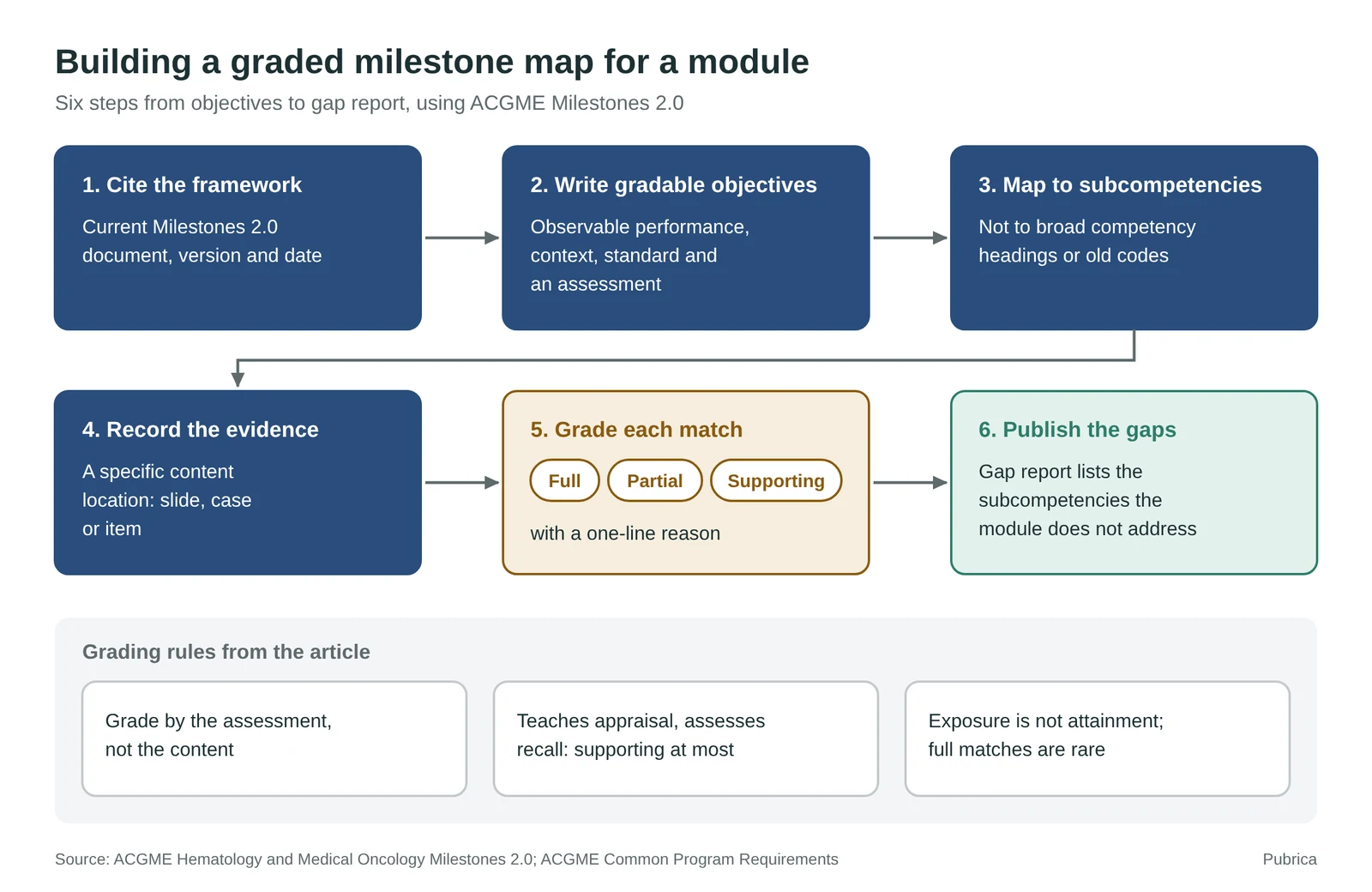
Each gradable objective names an observable performance, a context and a standard. It also needs an assessment: a module that teaches appraisal but assesses recall cannot claim more than a supporting match.
Grade every match as full, partial or supporting
Pubrica's standards alignment method grades each match on three levels, and records a specific content location as evidence for every match. Applied to the example module, an illustrative map might look like this:
| Example objective | Subcompetency (Milestones 2.0) | Illustrative grade | Reason |
|---|---|---|---|
| Appraise a biomarker study against REMARK | PBLI1 Evidence-Based and Informed Practice | Full | The learner performs the appraisal and is assessed on it |
| Interpret a HER2 report distinguishing IHC 0 from 1+ | MK3 Solid Tumor Oncology | Partial | Covers one diagnostic test, not the wider pathophysiology, prognostic and treatment knowledge the subcompetency describes |
| Explain the result's relevance to a patient | ICS1 Patient- and Family-Centered Communication | Supporting | Practised in a written case, not observed in a patient encounter |
| Judge a trial report with CONSORT 2025 | PBLI1 Evidence-Based and Informed Practice | Partial | Appraisal is practised, but applying the evidence to a patient decision is not assessed |
These grades are examples to show the reasoning, not a ruling on any real module. The point is the pattern: full matches are rare, and partial and supporting matches with stated reasons are what make a map believable. A map that claims full alignment everywhere invites the closest scrutiny.
Common mapping mistakes to avoid
Most weak maps fail in predictable ways. Watch for these before a programme director or accreditation reviewer does.
- Matching on keywords. A module that mentions "biomarkers" is not thereby aligned to every subcompetency that mentions diagnostic testing. Match on what the learner is asked to do.
- Counting exposure as attainment. Reading about patient communication supports ICS; it does not demonstrate it. Grade by the assessment, not the content.
- Ignoring levels. Milestone levels describe progression. Say which level the module is pitched at, because a module for first-year fellows and one for graduating fellows should not claim the same match.
- Out-of-date clinical content. A map is only as current as the module. If a guideline has been updated since the content was written, the alignment needs revisiting too.
- One-off PDFs. Maps kept only as PDFs are re-keyed every time the module or framework changes. Keep the map as structured data that can be updated.
Practical tip
Avoid copying subcompetency codes from an older curriculum map. Milestone numbering has changed between versions, and a map that cites retired codes undermines an otherwise sound alignment. Always cite the current ACGME document by version and date.
A checklist walkthrough before you send the map
Use this checklist on any module map before it goes to a programme director or an accreditation file.
- [ ] Framework version and date cited (ACGME Hematology and Medical Oncology Milestones 2.0, second revision August 2019, effective 1 July 2021)
- [ ] Every objective written as an observable performance with an assessment
- [ ] Each match points to a specific content location (slide, case, item) as evidence
- [ ] Every match graded full, partial or supporting, with a one-line reason
- [ ] Subcompetencies the module does not address listed in a gap report
- [ ] Scholarly activity support described honestly, not presented as meeting the requirement
- [ ] Clinical content checked against the current guideline versions (REMARK, ASCO–CAP HER2 2023, CONSORT 2025)
- [ ] For accredited CME, the competency rationale recorded in the activity planning file
- [ ] Map delivered in a form programmes can reuse, not only as a PDF
The gap report is often the most useful page. It tells your editorial team where a new case or assessment item would turn a partial match into a full one, and tells programme directors exactly what they still need to provide.
When to commission an independent alignment
An in-house map is reasonable for a single module and an internal audience. An independent, graded alignment is worth commissioning when the module will be offered to several programmes, when it supports a grant or partnership proposal, or when your team wrote the content and is too close to grade it objectively.
Pubrica's standards alignment and curriculum mapping service covers medical education frameworks, including ACGME milestones and the ACCME competency criterion, as well as school and higher education standards. It reads each standard for what it requires a learner to do, grades every match as full, partial or supporting, and reports the standards your content does not cover. The framework the buyer uses takes precedence. You receive a correlation document for reviewers, a gap report for your editorial team and a data export, and quality is managed under an ISO 9001:2015 certified system.
We support education and assessment providers and education teams across the life sciences, drawing on our e-learning subject-matter experts. For wider context on oncology and haematology in the USA, see our therapeutic area page.
Frequently asked questions
Yes. The ACGME discontinued the 10-year programme site visit in October 2023, but programmes are still required to complete the Self-Study.
Yes. One careful reading of the content can serve several frameworks, for example ACGME milestones for fellowship programmes and the competency framework an accredited CME provider uses. Each framework still needs its own grading.
Yes. Grading partial and supporting matches honestly strengthens the map. A map that claims full alignment to every subcompetency receives the closest scrutiny.
Yes. The service page offers to map one unit free of charge against the standards you want to claim, so you can compare our grading with your own.
Sources
Sources were checked on 27 November 2026. Requirements and guidance may change after that date; confirm the current version with the issuing body.
- 1ACGME. Hematology and Medical Oncology Milestones (Milestones 2.0). Second revision, August 2019; effective 1 July 2021. https://www.acgme.org/globalassets/pdfs/milestones/hematologyandmedicaloncologymilestones2.0.pdf
- 2ACGME. Supplemental Guide: Hematology and Medical Oncology. https://www.acgme.org/globalassets/pdfs/milestones/hematologyandmedicaloncologysupplementalguide.pdf
- 3ACGME Help Center. Changes to Program Self-Study and 10-Year Accreditation Site Visit Dates. https://acgmehelp.acgme.org/hc/en-us/articles/4403846820119-Changes-to-Program-Self-Study-and-10-Year-Accreditation-Site-Visit-Dates
- 4ACGME. Guide to the Common Program Requirements (Fellowship), version 3.0. 2024. https://prod2.acgme.org/globalassets/pdfs/guide-to-the-common-program-requirements-fellowship-2-15-2024.pdf
- 5ACCME. Competencies (Core Accreditation Criteria). https://accme.org/rule/competencies/
- 6Altman DG, McShane LM, Sauerbrei W, Taube SE. Reporting recommendations for tumor marker prognostic studies (REMARK): explanation and elaboration. PLoS Med. 2012;9(5):e1001216. https://pmc.ncbi.nlm.nih.gov/articles/PMC3362085
- 7Wolff AC, Somerfield MR, Dowsett M, et al. Human epidermal growth factor receptor 2 testing in breast cancer: ASCO–College of American Pathologists guideline update. J Clin Oncol. 2023. https://www.pubmed.gov/37303228/
- 8College of American Pathologists. HER2 breast update FAQs. 2023. https://documents.cap.org/documents/her2_breast_update_faqs_2023.pdf
- 9Hopewell S, Chan AW, Collins GS, et al. CONSORT 2025 statement: updated guideline for reporting randomised trials. BMJ. 2025;389:e081123. https://pubmed.ncbi.nlm.nih.gov/40228833/
ACGME milestones curriculum alignmentHematology and Medical Oncology Milestones 2.0ACGME Self-Studycurriculum mappingACCME competenciesREMARK reporting guideline
How to cite this article
Pick your referencing style and copy it. Your university or target journal may vary the punctuation, so check its guide if it has one.
Pubrica Academy. (2026, November 27). Preparing for ACGME Self-Study: Mapping a HER2-Low Biomarker Reporting-Guidelines Module to Haematology–Oncology Milestones. Pubrica. https://pubrica.com/academy/medical-education/map-oncology-modules-to-acgme-milestones/
This article is written to be learned from. Cite it if you are referring to what it says; if you are using the evidence behind it, cite the sources listed above instead.
Next steps
See how your module maps before you commit
Send one unit and the framework you want to claim, and Pubrica will map it free of charge, graded full, partial or supporting, so you can compare our grading with your own.
This article is general information for researchers, not legal, regulatory or funding advice. Check the current requirements of your journal, funder, ethics committee or regulator before you act on it.
More in Research Writing