Contents
On this page
- Quick answer
- First decide which summary you are commissioning
- Know your reader: US patients with mHSPC and their caregivers
- The template, section by section
- Explaining mHSPC terms without losing accuracy
- Present the results without overstating them
- A review and testing checklist before release
- Plan format, timing and dissemination early
- When to bring in a specialist writer
- Frequently asked questions
- Sources
AcademyResearch Writing
TemplateUSA
Plain-Language Summary Template for Prostate Cancer Trial Results: Writing for US Patients and Caregivers
A section-by-section template for summarising metastatic hormone-sensitive prostate cancer trial results for US patients and caregivers, with example wording, a plain-language glossary and a review checklist.
- Research Writing
- Oncology & haematology
- Simplified abstract & lay summary (Research impact)
- Topic
- Research Writing
- Written by
- Pubrica Academy
At a glanceResearch Writing
Request a QuoteDiscuss your project
Quick answer
- Decide first whether you need a trial-results lay summary or a plain-language summary of a publication; the rules differ.
- EU trials require a lay summary under Regulation 536/2014; in the USA they are generally voluntary.
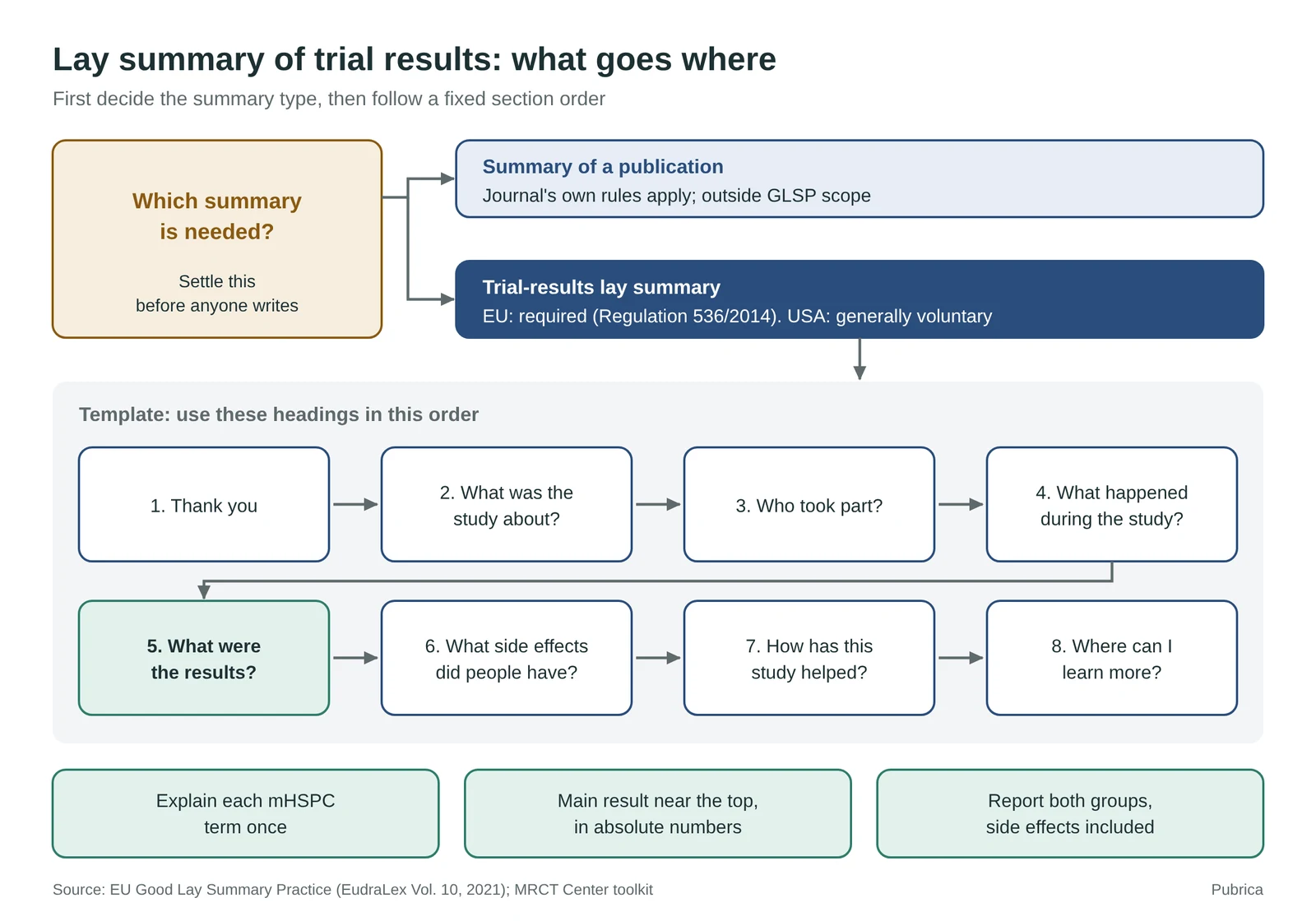
- Follow a fixed order: thanks, purpose, participants, design, main result, side effects, meaning, where to learn more.
- Explain every mHSPC term once, use absolute numbers and report both groups.
- Test readability and have patients, clinicians and non-promotional reviewers check the draft.
First decide which summary you are commissioning
Patient engagement teams are often asked for "a plain-language summary" when a prostate cancer trial reads out. Before anyone writes, settle which document is needed, because the rules and reviewers differ.
- A trial-results lay summary tells participants and the public what one trial found. In the EU it is a legal requirement: under Regulation (EU) No 536/2014, sponsors must submit a lay summary to the Clinical Trials Information System, normally within 12 months of the end of the trial. The EU's Good Lay Summary Practice (GLSP) recommendations, published in EudraLex Volume 10 in October 2021, describe how to plan, write, test and disseminate one.
- A plain-language summary of a publication accompanies a journal article or conference abstract. GLSP explicitly places these outside its scope; the journal's own rules apply.
In the USA there is no general federal requirement for sponsors to publish lay summaries of trial results, so many sponsors provide them voluntarily. A multinational trial with EU sites will need an EU-compliant summary regardless, and it is efficient to build one template that serves both audiences. The template below is written for a trial-results summary in metastatic hormone-sensitive prostate cancer (mHSPC), for US patients and caregivers.
Know your reader: US patients with mHSPC and their caregivers
Your readers are mostly older men living with advanced cancer, and the partners, adult children and friends who help them make decisions. Many will read the summary with a caregiver, and some caregivers will read it alone.
Health literacy is the main design constraint. In the most recent US national assessment of health literacy (2003), about 36% of adults had basic or below-basic health literacy. MedlinePlus guidance on easy-to-read health materials recommends writing at about a 7th to 8th grade reading level. Treat that as a ceiling to test against, not a target to write to mechanically.
Three practical consequences follow:
- Explain every disease term the first time it appears, in one short sentence.
- Use numbers that people can picture, such as "about 20 out of 100 people", alongside percentages.
- Plan for translation. GLSP recommends providing summaries in the local languages of the countries where a trial ran; for a US-only audience, decide early whether a Spanish version is needed and budget for it.
The template, section by section
Use these headings in this order. The example wording is illustrative, with placeholders in square brackets; it does not describe any real trial or product.
| Section | What to include | Example wording |
|---|---|---|
| Thank you | Thank participants first | "Thank you for taking part in this study. Your help adds to what doctors know about prostate cancer." |
| What was the study about? | The disease, the question, why it mattered | "This study looked at whether adding [study medicine] to hormone therapy helps men whose prostate cancer has spread." |
| Who took part? | Number, ages, countries, key eligibility | "[N] men aged [range] took part in [N] countries, including the USA." |
| What happened during the study? | Groups, how treatment was assigned, duration | "A computer chose by chance which group each person joined." |
| What were the results? | Main result first, in absolute numbers | "After [time], cancer had grown or spread in about [x] out of 100 people in one group and [y] out of 100 in the other." |
| What side effects did people have? | Serious and common side effects, in both groups | "The most common side effects were [list]." |
| How has this study helped? | One cautious sentence on meaning | "This is one study. Doctors look at results from many studies before deciding on treatments." |
| Where can I learn more? | Trial registry number, sponsor contact | "Search ClinicalTrials.gov for [NCT number]." |
Keep each section to a few short paragraphs. Patient readers stop early, so the main result belongs near the top.
Commission accurate lay summaries of your trial results
Send the publication or results you need summarised and tell us the audiences. Pubrica will quote the lay summary together with any other versions you need.
Explaining mHSPC terms without losing accuracy
Prostate cancer trials use terms that sound alike but mean different things. Agree a glossary with the medical team before drafting, then use the same plain wording everywhere.
| Technical term | Plain-language version |
|---|---|
| Metastatic | Cancer that has spread from the prostate to other parts of the body, such as the bones |
| Hormone-sensitive | Cancer that needs male hormones to grow, so treatments that lower or block these hormones can slow it |
| Androgen deprivation therapy (ADT) | Hormone therapy that lowers male hormones such as testosterone |
| PSA | A protein measured in a blood test; levels can rise when prostate cancer grows |
| Radiographic progression-free survival | How long people lived without their cancer growing or spreading on scans |
| Overall survival | How long people lived, from any cause |
| Adverse event | Any unwanted medical problem during the study, whether or not caused by the study medicine |
The NCI Dictionary of Cancer Terms is a useful reference point for wording. Whatever you choose, have a clinician confirm that each plain version is still correct.
Practical tip
Do not let readability scores drive the edit. Removing a caveat or a comparison group can improve a score and make the summary less accurate. Measure readability, but let a subject expert decide what can safely be simplified.
Present the results without overstating them
Simplification tends to remove caveats first. That is the main accuracy risk in a lay summary, and it can also make the document read as promotional.
- Report both groups. Give the result for the comparison group as well as the study treatment, in the same format.
- Use absolute numbers. "Fewer people" or "reduced risk by a third" without the underlying numbers can mislead.
- Give side effects equal weight. Present them in both groups, with serious side effects stated plainly.
- Use neutral language. Avoid words such as "breakthrough" or "effective"; describe what was measured and found.
- Do not advise. Tell readers to talk to their doctor before making any change to their treatment.
- Name medicines factually. Use the study medicine's name as reported and avoid any statement about uses that are not approved.
The MRCT Center's Return of Results toolkit includes sample summaries and a reviewer checklist that model this neutral approach. For how trial publications handle patient-reported outcomes in prostate cancer, see our Insights checklist on reviewing patient-reported outcomes with CONSORT-PRO.
A review and testing checklist before release
Build review into the timeline from the start. A lay summary that is accurate, readable and approved usually passes through several reviewers.
- [ ] Every number traced to the clinical study report or publication
- [ ] Clinical review confirms the plain-language versions of each term
- [ ] Readability measured across drafts, with expert judgement on any changes
- [ ] Review by at least one patient or caregiver reader, and changes recorded
- [ ] Non-promotional review by medical, legal and regulatory colleagues
- [ ] Trial registry number and contact details correct
- [ ] Translations checked by a qualified reviewer, if used
- [ ] Final version approved and dated, with a plan for dissemination
The principles carry over from patient education writing generally; our article on how physicians can write clear and impactful patient education materials covers the basics of tone and structure.
Plan format, timing and dissemination early
A good summary that reaches nobody does not meet its purpose. Decide the practical details when the trial's statistical analysis plan is finalised, not when the results arrive.
- Timing. Agree when the summary will be released relative to the topline announcement, the publication and any regulatory filing, so that participants do not learn results first from the news.
- Channels. Common routes include letters sent through trial sites, a sponsor results web page and a link from the trial registry record. Ask sites how participants prefer to receive information.
- Format. Keep a printable version of no more than a few pages, with a large clear font and simple charts. Pictograms showing "out of 100 people" work well for main results and side effects.
- Ownership. Name one person who signs off the final text and keeps the version history, because several teams will request changes.
When to bring in a specialist writer
Teams usually commission lay summaries when several readouts arrive close together, when the source material is a long clinical study report, or when internal writers are close enough to the data to miss jargon that patients will not understand.
Pubrica's simplified abstract and lay summary service prepares lay versions from the same manuscript as the journal, conference and funder versions, each adapted in tone, length and structure, and versions ordered together are quoted together. A subject expert, rather than a readability tool, checks the text, and no summary is delivered that the author has not read and approved. Quality is managed under an ISO 9001:2015 certified system.
We work with pharma and biotech teams across the life sciences, supported by our public health subject-matter experts. For more on our work in oncology and haematology in the USA, see our therapeutic area page.
Frequently asked questions
There is no general US federal requirement for sponsors to publish them, so they are usually voluntary. Trials with EU sites must provide a lay summary under Regulation (EU) No 536/2014.
MedlinePlus guidance on easy-to-read health materials recommends about a 7th to 8th grade reading level. Use it as a ceiling to test against, with expert review of any simplification.
Often, yes. A template built to the EU Good Lay Summary Practice recommendations can be adapted for US readers, for example with US registry details and a decision on Spanish translation.
Lay versions are prepared from the same manuscript as other versions, and versions ordered together are quoted together because the paper only needs to be read once. Request a quote with your source document.
Sources
Sources were checked on 27 November 2026. Requirements and guidance may change after that date; confirm the current version with the issuing body.
- 1European Commission, Clinical Trials Expert Group. Good Lay Summary Practice. EudraLex Volume 10. 2021. https://health.ec.europa.eu/medicinal-products/eudralex/eudralex-volume-10_en
- 2Regulation (EU) No 536/2014 of the European Parliament and of the Council on clinical trials on medicinal products for human use. 2014. https://eur-lex.europa.eu/eli/reg/2014/536/oj
- 3National Library of Medicine. How to Write Easy-to-Read Health Materials. MedlinePlus. https://medlineplus.gov/etr.html
- 4National Institutes of Health. Clear & Simple. https://www.nih.gov/institutes-nih/nih-office-director/office-communications-public-liaison/clear-communication/clear-simple
- 5Kutner M, Greenberg E, Jin Y, Paulsen C. The Health Literacy of America's Adults: Results From the 2003 National Assessment of Adult Literacy (NCES 2006-483). 2006. https://nces.ed.gov/pubs2006/2006483.pdf
- 6MRCT Center. Return of Aggregate Results to Participants Toolkit, version 3.1. 2017. https://mrctcenter.org/wp-content/uploads/2023/03/2017-12-07-MRCT-Return-of-Aggregate-Results-Toolkit-3.1.pdf
- 7National Cancer Institute. Hormone-sensitive prostate cancer. NCI Dictionary of Cancer Terms. https://www.cancer.gov/publications/dictionaries/cancer-terms/def/hormone-sensitive-prostate-cancer
- 8Federal Plain Language Guidelines. Revision 1, May 2011. https://digital.gov/resources/federal-plain-language-guidelines
plain language summary template clinical triallay summary clinical trial resultsGood Lay Summary Practicemetastatic hormone-sensitive prostate cancerpatient engagementhealth literacy
How to cite this article
Pick your referencing style and copy it. Your university or target journal may vary the punctuation, so check its guide if it has one.
Pubrica Academy. (2026, November 27). Plain-Language Summary Template for Prostate Cancer Trial Results: Writing for US Patients and Caregivers. Pubrica. https://pubrica.com/academy/plain-language-summary/plain-language-summary-template-prostate-cancer/
This article is written to be learned from. Cite it if you are referring to what it says; if you are using the evidence behind it, cite the sources listed above instead.
Next steps
Commission accurate lay summaries of your trial results
Send the publication or results you need summarised and tell us the audiences. Pubrica will quote the lay summary together with any other versions you need.
This article is general information for researchers, not legal, regulatory or funding advice. Check the current requirements of your journal, funder, ethics committee or regulator before you act on it.
More in Research Writing