Contents
On this page
- Quick answer
- Why the clinical study report is a hard place for generative AI
- What FDA's 2025 draft AI guidance does and does not cover
- Decide which CSR sections AI may touch
- DLBCL-specific traps to check
- Human QC steps before submission
- Keep an AI use log that answers an auditor
- How Pubrica supports AI-assisted CSR projects
- Frequently asked questions
- Sources
InsightsDigital & AI
Practical guideUSA
Drafting an Oncology Clinical Study Report With Generative AI: Human QC Steps Before an FDA Submission in Diffuse Large B-Cell Lymphoma
Generative AI can speed up the templated parts of a clinical study report, but the sponsor still answers for every number and statement in it. This guide sets out where AI can assist on a diffuse large B-cell lymphoma CSR, where it should not, and the human checks to complete before submission.
- Digital & AI
- Oncology & haematology
- Medical writing
- Topic
- Digital & AI
- Written by
- Pubrica Insights
At a glanceDigital & AI
Request a QuoteDiscuss your project
Quick answer
- FDA's January 2025 draft guidance on AI covers models that produce information or data supporting decisions on safety, effectiveness or quality. It says it does not address AI used to streamline operations, such as drafting a submission, where that use does not affect patient safety, drug quality or the reliability of results.
- That exclusion is not a licence: if an AI step changes what a CSR says about results, the reliability of those results is in question and human verification decides it.
- Limit AI to retrieval, consistency checks and first drafts of templated sections; keep efficacy interpretation, safety narratives and conclusions with named writers.
- In DLBCL, check response terminology against the protocol's criteria (often Lugano 2014), the assessor (investigator or independent review) and toxicity grading systems.
- Log every AI use: tool, stage, and what the human reviewer changed.
Why the clinical study report is a hard place for generative AI
A clinical study report (CSR) written to ICH E3 is meant to be complete, neutral and traceable. An FDA reviewer compares it against the protocol, the statistical analysis plan and the tables, figures and listings (TFLs). Every number in the text should match a table, and every statement about efficacy or safety should be supported by the data in the appendices.
Generative AI is good at fluent prose and poor at guaranteeing that prose matches a source. It can transpose a value, round a confidence interval differently, describe a non-significant difference as a trend, or fill a gap with a plausible sentence that has no source at all. In a CSR, a fluent sentence without a traceable source is worse than a plain sentence that has one.
None of this changes who is accountable. The sponsor submits the CSR and is responsible for its accuracy, whoever or whatever produced the first draft. For a writing lead, the practical question is therefore not whether to allow AI, but which tasks it may touch and what human checks must follow.
What FDA's 2025 draft AI guidance does and does not cover
In January 2025 FDA issued draft guidance, Considerations for the Use of Artificial Intelligence to Support Regulatory Decision-Making for Drug and Biological Products (docket FDA-2024-D-4689). It proposes a risk-based, seven-step credibility assessment for AI models that produce information or data intended to support regulatory decisions about a drug's safety, effectiveness or quality, built around a defined context of use. Our brief on the FDA AI draft guidance summarises the framework.
The draft states that it does not address AI used in drug discovery, or AI used to streamline operations, such as drafting a regulatory submission, where that use does not affect patient safety, drug quality or the reliability of results. So:
- The draft does not set out specific expectations for drafting a CSR with a generative AI tool.
- The exclusion depends on the condition that the reliability of results is not affected. An AI step that summarises efficacy or safety data, or derives values, can affect exactly that.
- The guidance remains a draft and is not binding.
In January 2026 FDA and the European Medicines Agency also published ten non-binding guiding principles for good AI practice in drug development, including human-centric design, a risk-based approach and clear context of use. Neither document replaces the writer's and sponsor's responsibility for the report.
Decide which CSR sections AI may touch
Set the boundary before drafting starts, and write it into the writing plan. A workable split, which matches the policy on Pubrica's medical writing page, is:
| CSR content | AI assistance | Human role |
|---|---|---|
| Finding text and values across protocol, SAP and TFLs | Acceptable | Confirm each retrieved item at source |
| Consistency of terms, abbreviations and cross-references | Acceptable | Resolve every flag |
| Highly templated text, such as study administration or a description of the investigational plan restated from the protocol | First draft only | Verify every number and statement against source |
| Results text for efficacy and safety | Not recommended | Written by the medical writer from TFLs |
| Narratives of deaths, other serious and certain other significant adverse events (ICH E3 section 12.3.2) | Not used | Written and checked by named writers |
| Discussion, overall conclusions and benefit-risk reasoning | Not used | Written by the writer with the clinical and statistical leads |
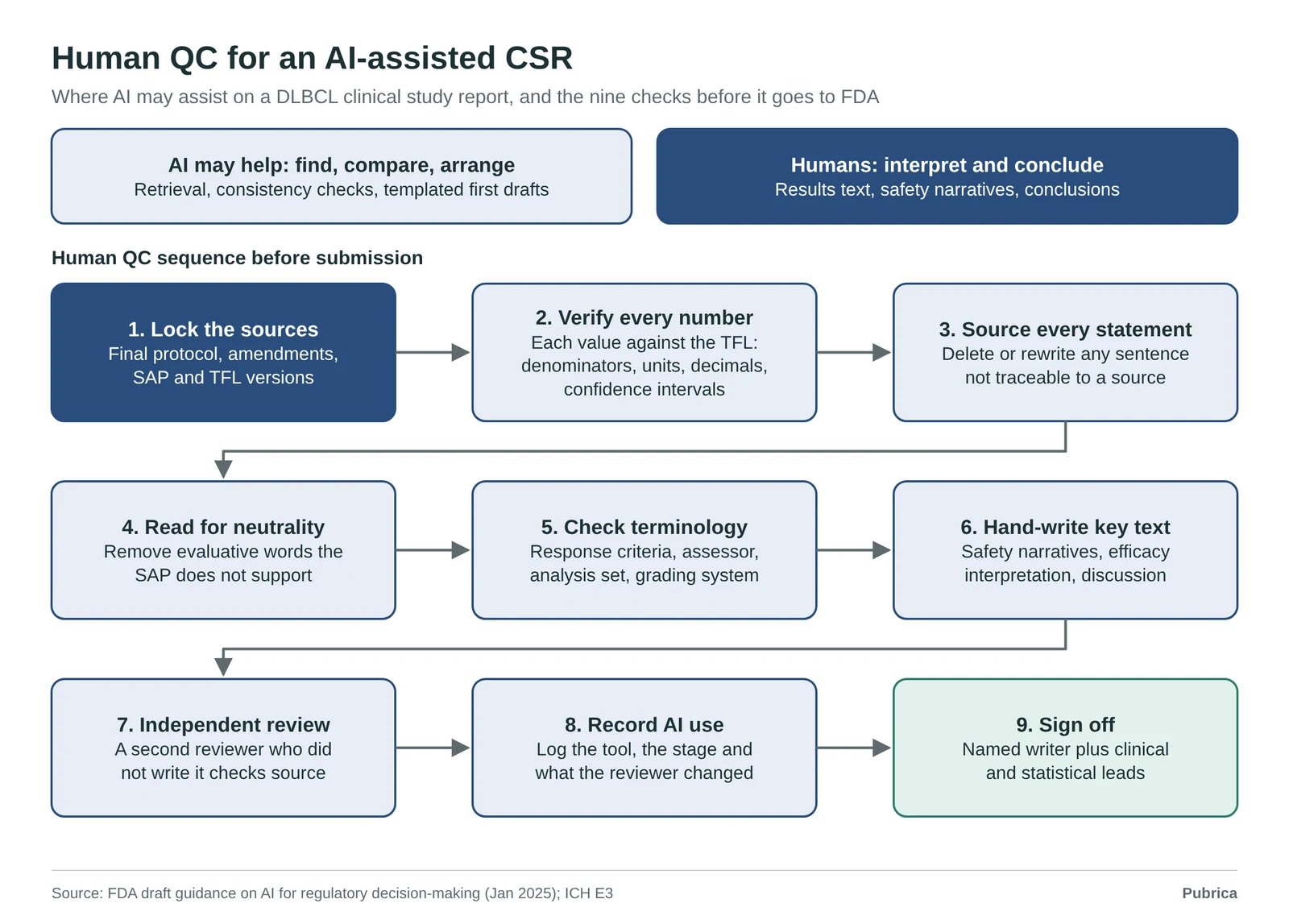
The principle is simple: AI may help find, compare and arrange; humans interpret and conclude.
Have one AI-assisted CSR section reviewed
Send one AI-assisted section with its source tables. A medical writer checks it against source and tells you what needs to change, then confirms scope and fee for the full report.
DLBCL-specific traps to check
Diffuse large B-cell lymphoma reports carry terminology that an AI tool can blur. When an AI-assisted draft is reviewed, check these points against the protocol and SAP:
- Response criteria. Many lymphoma trials use the 2014 Lugano classification, which uses PET-CT with the five-point (Deauville) scale for FDG-avid histologies such as DLBCL. Check that "complete metabolic response" and CT-based "complete response" are not used interchangeably, and that the version stated matches the protocol.
- Assessor. Primary endpoints may rest on independent review committee assessment, with investigator assessment as supportive. Each result must name its assessor, as the TFL does.
- Endpoints and estimands. Overall response rate, complete response rate, duration of response, progression-free and overall survival each have SAP definitions, censoring rules and, under ICH E9(R1), an estimand. Paraphrase can quietly change them.
- Toxicity grading. For T-cell-engaging therapies, cytokine release syndrome and immune effector cell-associated neurotoxicity syndrome (ICANS) are often graded with the ASTCT consensus system rather than CTCAE alone. Check that the grading system named in the text matches the protocol.
- Populations. Confirm which analysis set each result uses, and that the denominators match.
Human QC steps before submission
Use a fixed sequence, so that no AI-assisted text reaches a reviewer unchecked:
- Lock the sources. Record the final protocol, amendments, SAP and TFL versions that the CSR must match.
- Verify every number. Check each value in AI-assisted text against the TFL, including denominators, units, decimals and confidence intervals.
- Check every statement for a source. Any sentence that cannot be traced to a named source document is deleted or rewritten.
- Read for neutrality. Remove evaluative words such as "robust" or "clinically meaningful" unless the SAP or prespecified analysis supports them.
- Check terminology. Response criteria, assessor, analysis set and grading systems match the protocol throughout.
- Write narratives and conclusions by hand. Safety narratives, efficacy interpretation and the discussion are drafted by named writers.
- Independent review. A second reviewer who did not write the section checks it against source.
- Record AI use. Log the tool, the stage and what the reviewer changed, and keep the log with the document's QC record.
- Sign off. A named writer and the clinical and statistical leads approve the final text.
Keep an AI use log that answers an auditor
If a regulator, auditor or partner asks how a section was prepared, the answer should take minutes. A useful log records, for each section: the tool used, the task (retrieval, consistency check or first draft), the source documents provided, the date, and a summary of what the human reviewer changed.
Agree two governance points with your quality and IT teams before work starts. First, which tools are approved for confidential trial data, and under what terms. Second, whether your standard operating procedures already cover AI-assisted drafting or need an addendum. Journals now expect similar disclosure: the ICMJE recommendations updated in January 2026 include a dedicated section on AI use, with human authors keeping responsibility for content. CSRs are not journal manuscripts, but the principle of declared, accountable use is the same.
Practical tip
Never paste unreleased trial data into a consumer AI tool. Confirm which tools your organisation has approved for confidential clinical data, and under what terms, before any CSR work begins.
How Pubrica supports AI-assisted CSR projects
Pubrica's regulatory medical writers prepare clinical study reports to ICH E3, written to withstand an assessor's comparison against the protocol and SAP. The service page sets out how AI is used: to find source material across a document set, to check consistency of terms, figures and cross-references, and to draft the first pass of highly templated sections, where a writer then verifies every number against source. It is not used for anything that goes into a regulatory submission as drafted, for clinical interpretation, safety narratives or benefit-risk reasoning, or for any section where a claim cannot be traced to a named source document. Each project's declaration states the tool, the stage and the human oversight applied.
Documents are checked by an independent reviewer who did not write them, and can be delivered with a quality control report. Writers are assigned by therapeutic area, including oncology and haematology. For CROs, the team can work within your templates, style guide and quality system.
We support pharma, biotech and CRO teams in the life sciences sector, with input from machine learning specialists where AI tools are evaluated. This article is part of our oncology and haematology support for US teams; for a step-by-step view of AI-assisted drafting, see the related Academy guide on using AI tools in regulatory writing.
Frequently asked questions
No. The draft covers AI that produces information or data supporting regulatory decisions, and says it does not address AI used to streamline operations, such as drafting a submission, where that does not affect patient safety, drug quality or the reliability of results. The sponsor remains responsible for the CSR's accuracy.
We are not aware of an FDA requirement specific to CSR drafting. Keep an internal log of AI use so that you can answer questions from reviewers, auditors or partners, and follow your own procedures.
As a matter of good practice, and Pubrica's own policy: safety narratives, efficacy interpretation, the discussion and overall conclusions, benefit-risk reasoning, and any section where a claim cannot be traced to a named source.
Numbers and terms that drift from the source: a rounded interval, a changed denominator, or a response category described with the wrong criteria or assessor. Number-by-number verification against the TFLs catches most of them.
Sources
Sources were checked on 24 November 2026. Requirements and guidance may change after that date; confirm the current version with the issuing body.
- 1US Food and Drug Administration. Considerations for the Use of Artificial Intelligence To Support Regulatory Decision-Making for Drug and Biological Products; Draft Guidance for Industry; Availability. Federal Register 90(4), 7 January 2025. https://www.govinfo.gov/content/pkg/FR-2025-01-07/html/2024-31542.htm
- 2US Food and Drug Administration. Considerations for the Use of Artificial Intelligence to Support Regulatory Decision-Making for Drug and Biological Products. Draft guidance, January 2025. https://www.fda.gov/regulatory-information/search-fda-guidance-documents/considerations-use-artificial-intelligence-support-regulatory-decision-making-drug-and-biological
- 3FDA and EMA. Guiding Principles of Good AI Practice in Drug Development. January 2026. https://www.ema.europa.eu/en/documents/other/guiding-principles-good-ai-practice-drug-development_en.pdf
- 4European Medicines Agency. ICH E3 Structure and content of clinical study reports - Scientific guideline. https://www.ema.europa.eu/en/ich-e3-structure-content-clinical-study-reports-scientific-guideline
- 5Cheson BD, et al. Recommendations for Initial Evaluation, Staging, and Response Assessment of Hodgkin and Non-Hodgkin Lymphoma: The Lugano Classification. J Clin Oncol. 2014;32:3059-3067. https://pmc.ncbi.nlm.nih.gov/articles/PMC4979083/
- 6Lee DW, et al. ASTCT Consensus Grading for Cytokine Release Syndrome and Neurologic Toxicity Associated with Immune Effector Cells. Biol Blood Marrow Transplant. 2019;25(4):625-638. https://pubmed.ncbi.nlm.nih.gov/30592986/
- 7International Committee of Medical Journal Editors. Updated ICMJE Recommendations (January 2026). https://icmje.acponline.org/news-and-editorials/updated_recommendations_jan2026.html
AI clinical study report writinggenerative AI CSRICH E3 clinical study reportmedical writing quality controlFDA AI draft guidanceDLBCL clinical study report
How to cite this article
Pick your referencing style and copy it. Your university or target journal may vary the punctuation, so check its guide if it has one.
Pubrica Insights. (2026, November 24). Drafting an Oncology Clinical Study Report With Generative AI: Human QC Steps Before an FDA Submission in Diffuse Large B-Cell Lymphoma. Pubrica. https://pubrica.com/insights/human-qc-for-ai-drafted-oncology-csrs/
This article is written to be learned from. Cite it if you are referring to what it says; if you are using the evidence behind it, cite the sources listed above instead.
Next steps
Have one AI-assisted CSR section reviewed
Send one AI-assisted section with its source tables. A medical writer checks it against source and tells you what needs to change, then confirms scope and fee for the full report.
This article is general information for researchers, not legal, regulatory or funding advice. Check the current requirements of your journal, funder, ethics committee or regulator before you act on it.
More in Digital & AI