Contents
On this page
- Quick answer
- What investors test in a lower-risk MDS story
- Part 1: Define the segment the way clinicians and trials do
- Part 2: Set the approved-therapy baseline
- Part 3: Map the pipeline and active trials
- Part 4: Build an unmet-need grid investors can test
- Presenting the landscape for due diligence
- Common mistakes, and building it in-house versus commissioning
- How Pubrica supports therapeutic area landscape mapping
- Frequently asked questions
- Sources
AcademyDiscovery & Intelligence
Checklist walkthroughUSA
How to Map the Lower-Risk Myelodysplastic Syndromes Landscape Before a US Financing Round: A Pipeline, Trial and Unmet-Need Checklist
Investors in a haematology biotech will test your view of lower-risk myelodysplastic syndromes against their own. This checklist walks through what a defensible pipeline, trial and unmet-need map should contain, and how to present it so it survives due diligence.
- Discovery & Intelligence
- Oncology & haematology
- Therapeutic area landscape mapping
- Topic
- Discovery & Intelligence
- Written by
- Pubrica Academy
At a glanceDiscovery & Intelligence
Request a QuoteDiscuss your project
Quick answer
- Define 'lower-risk' explicitly: state the risk system (IPSS-R or IPSS-M), the classification and the subgroups you use.
- Start from a dated, FDA-verified baseline of approved therapies, quoting labelled indications exactly.
- Map the pipeline by asset from ClinicalTrials.gov, company disclosures, ASH abstracts and publications, and date every row.
- Build an unmet-need grid by segment and phrase gaps as unanswered evidence questions, not claims about competitors.
- Put a methods note and cut-off date in the data room; due diligence teams will ask how the landscape was built.
What investors test in a lower-risk MDS story
When a haematology biotech raises money, the competitive and unmet-need slides attract more scrutiny than almost any others. Specialist investors often hold their own view of the field, built from analyst coverage and conversations with clinicians. If your map leaves out an asset they know about, or describes the treatment pathway in a way that does not match current practice, the credibility of the whole deck suffers.
Lower-risk myelodysplastic syndromes (MDS) are a demanding area for this exercise. Treatment centres on anaemia and transfusion burden, several therapies have been approved in recent years, and the boundaries between patient segments depend on prognostic scoring and molecular features. A myelodysplastic syndromes pipeline landscape that is current, sourced and segmented correctly gives investors what they need: a clear picture of where your asset fits and why the remaining need is real.
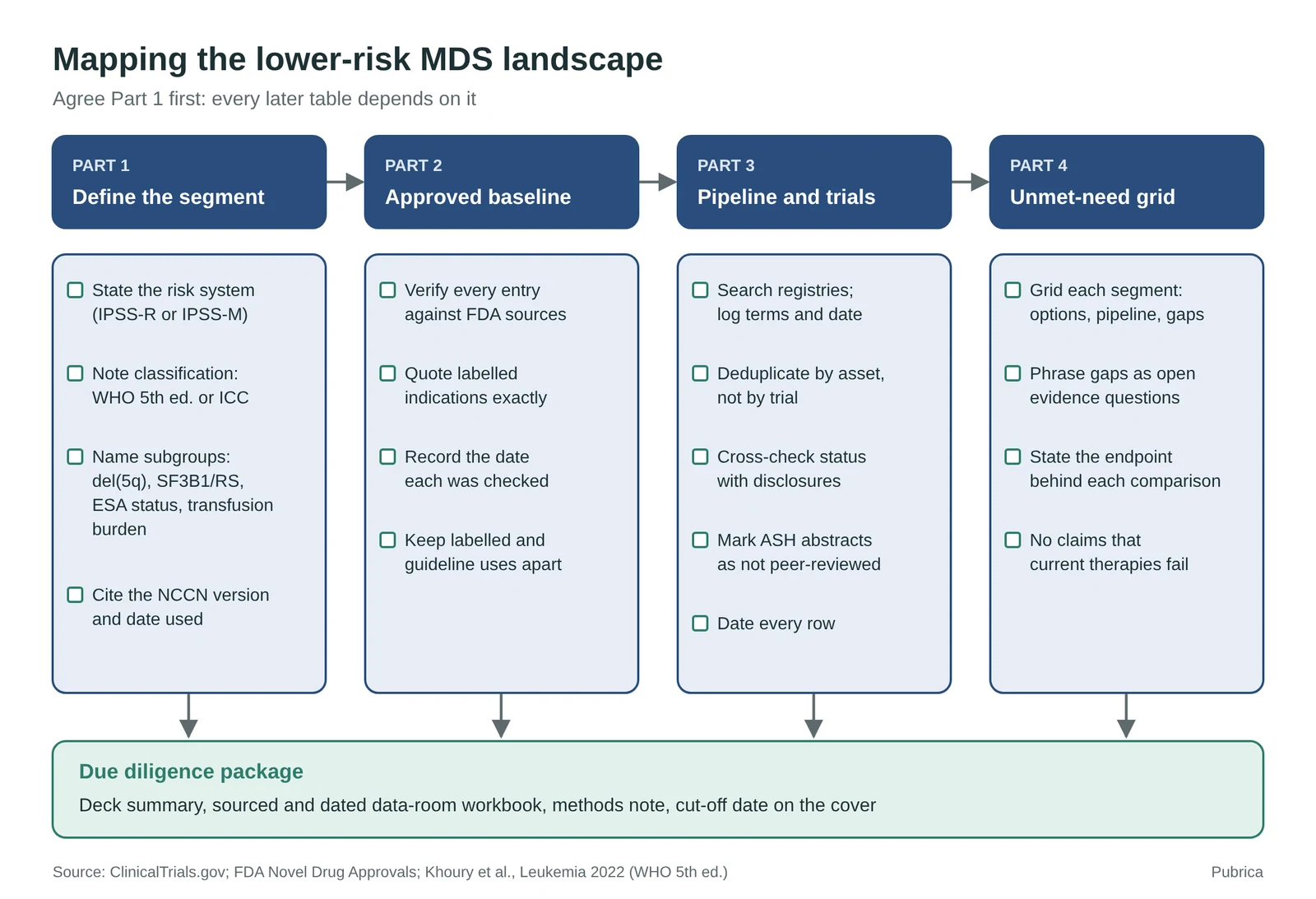
The checklist below is organised in four parts: define the segment, set the approved-therapy baseline, map the pipeline and trials, and build the unmet-need grid.
Part 1: Define the segment the way clinicians and trials do
Before mapping competitors, make sure everyone means the same patients by "lower-risk".
- [ ] State the risk system. Many trials and labels refer to the Revised International Prognostic Scoring System (IPSS-R) or older IPSS categories. The Molecular International Prognostic Scoring System (IPSS-M), published by Bernard and colleagues in NEJM Evidence in 2022, combines blood counts, cytogenetics and mutations in 31 genes. In its development cohort of 2,957 patients it improved prognostic discrimination compared with IPSS-R and reassigned 46% of patients to a different risk category.
- [ ] Note the classification in use. The fifth edition of the WHO classification, summarised in Leukemia in 2022, uses the term "myelodysplastic neoplasms", and a parallel International Consensus Classification also exists. The same patient can be classified differently under each, which affects how trial populations compare.
- [ ] Name the clinically relevant subgroups. For example: del(5q), ring sideroblasts or SF3B1 mutation, erythropoiesis-stimulating agent (ESA) naive versus ESA-refractory, and transfusion burden.
- [ ] Check current guidelines. NCCN publishes and updates Clinical Practice Guidelines in Oncology for MDS several times a year; cite the version number and the date you accessed it.
A landscape that mixes risk systems without saying so will compare trials that enrolled different patients.
Practical tip
Warning: a landscape goes out of date quickly in an active field. Put the cut-off date on the cover, and refresh the approvals and trial tables before the round closes if it runs for more than a few months.
Part 2: Set the approved-therapy baseline
Investors will expect your map to start from what is already approved in the USA. Verify every entry against FDA sources such as the Novel Drug Approvals pages, FDA approval notices and Drugs@FDA, and record the date checked. Examples of FDA actions relevant to lower-risk MDS include:
| Product | FDA action (date) | Population, in brief |
|---|---|---|
| Lenalidomide | Approval, December 2005 | Transfusion-dependent anaemia in low or intermediate-1 risk MDS with del(5q) |
| Luspatercept | Approval, 3 April 2020 | Anaemia failing an ESA and requiring 2 or more red blood cell units over 8 weeks in adults with very low- to intermediate-risk MDS with ring sideroblasts, or MDS/MPN with ring sideroblasts and thrombocytosis, based on the MEDALIST trial |
| Luspatercept | Approval, 28 August 2023 | Anaemia without previous ESA use in adults with very low- to intermediate-risk MDS who may require regular red blood cell transfusions, based on the COMMANDS trial versus epoetin alfa |
| Imetelstat | Approval, June 2024 | Low- to intermediate-1 risk MDS with transfusion-dependent anaemia after, or ineligible for, ESAs, based on the IMerge trial |
This table is illustrative, not complete; a full landscape should list every relevant approval and the exact labelled indication from the prescribing information. Include supportive care as practised and recommended in guidelines, and keep labelled and guideline-recommended uses clearly distinguished.
Preparing for a US financing round?
Tell us your asset, the lower-risk MDS segments you are targeting and your timeline. Pubrica will scope a therapeutic area landscape covering approvals, trials and unmet need, and send a free quote. We sign a mutual NDA at no cost before you share any material.
Part 3: Map the pipeline and active trials
The pipeline map is where most landscapes are either very useful or quietly out of date. Work through these checks:
- [ ] Search the registries systematically. ClinicalTrials.gov is the starting point for US trials. Record the search terms, filters and date, and export the results so the search can be repeated.
- [ ] Deduplicate by asset, not by trial. One drug may appear in several trials under different code names or combinations.
- [ ] Normalise phase and status. Registry status fields can lag; cross-check against recent company disclosures and peer-reviewed publications.
- [ ] Capture conference data. Many early results in MDS appear first as American Society of Hematology (ASH) annual meeting abstracts. Note that abstracts are not peer-reviewed full papers.
- [ ] Record mechanism and segment. For each asset, state the mechanism, the patient segment enrolled and the primary endpoint, so like can be compared with like.
- [ ] Add exclusivity and patent context. FDA's Orange Book lists patents and exclusivities for approved small-molecule drugs, and the Purple Book covers licensed biological products. Present any patent view as intelligence, not a legal opinion.
- [ ] Date everything. Each row should carry the date its information was last verified.
For an example of how a pipeline, trial and patent landscape is structured for a partnering decision, see our Insights article on mapping the Claudin 18.2 pipeline in the USA.
Part 4: Build an unmet-need grid investors can test
The unmet-need section is where a landscape becomes an argument. It is also where investors look hardest for overstatement. A grid keeps it honest.
| Segment | Approved options (dated) | Late-stage pipeline | Evidence gaps |
|---|---|---|---|
| ESA-naive, transfusion-dependent | From Part 2 | From Part 3 | For example, durability of response, quality-of-life data |
| ESA-refractory or relapsed | From Part 2 | From Part 3 | For example, options after successive therapies |
| del(5q) | From Part 2 | From Part 3 | For example, outcomes after lenalidomide |
| Ring sideroblasts or SF3B1 mutation | From Part 2 | From Part 3 | For example, sequencing between therapies |
Fill each cell from sourced evidence, and phrase gaps as questions the literature has not yet answered rather than as claims that current therapies fail. Endpoints matter here: recent approvals in this setting used transfusion independence measures, so state which endpoint each comparison relies on.
The aim is not to show that the market is empty; it rarely is. The aim is to show precisely which patients your asset is designed for, what they can receive today and what evidence would make your asset's value clear.
Presenting the landscape for due diligence
A landscape for a financing round has two audiences: the partner reading the deck and the analyst checking the data room. Prepare for both.
- [ ] A two- to three-slide summary for the deck, with sources in footnotes.
- [ ] A full report or workbook in the data room, with every row sourced and dated.
- [ ] A short methods note: databases searched, search dates, inclusion rules and how assets were deduplicated.
- [ ] A clear cut-off date on the cover, and a plan to refresh before closing if the round runs long.
- [ ] Neutral language about competitors: describe their programmes factually from public sources.
- [ ] No efficacy or safety claims for your own investigational asset beyond what your data show.
Due diligence teams often ask how the landscape was built. A documented method answers that question in one page.
Common mistakes, and building it in-house versus commissioning
Common errors in landscapes built under time pressure are predictable: a pipeline table taken from an old slide deck, trials included that have since completed or stopped, mixed risk definitions, and unmet-need statements that go beyond the evidence. Each one is easy for a specialist investor to spot.
Building the landscape in-house can work if a team member has time and data-mining experience. The case for commissioning grows when the round is close, the leadership team is stretched, or the board wants an independent view. An external team is also less likely to read the evidence in your asset's favour, which is exactly what investors want to see.
| Build in-house when | Commission when |
|---|---|
| The round is months away and someone has time to own the work | The first investor meetings are weeks away |
| The team has registry-mining and data-mining experience | Nobody on the team has run a systematic registry search |
| The landscape is for internal planning | The landscape will sit in a data room and be checked by analysts |
| Only the approved-therapy baseline is needed | Pipeline, trial, patent and unmet-need views are all needed |
Whichever route you choose, agree the segment definitions in Part 1 first, because every later table depends on them.
How Pubrica supports therapeutic area landscape mapping
Pubrica's therapeutic area landscape mapping provides competitive analysis and research gap assessment for a disease area, aligning the discovery pipeline with unmet clinical need. It can be combined with clinical trial landscape mapping from global registries, including ClinicalTrials.gov, and with patent and intellectual property intelligence, within our wider discovery and intelligence services.
Every project records its search strategy, keeps findings traceable to dated sources and delivers a decision-focused written report. Each project is reviewed by a specialist from the relevant field, such as data mining, and the work supports pharma and biotech teams across the life sciences. Our Advanced package is designed for teams preparing for investor discussions, and any patent view is an intelligence assessment; a legal freedom-to-operate opinion must come from your patent attorney. For related support, see our oncology and haematology work for US teams.
Frequently asked questions
Use the system the relevant trials and labels use, and say so. Many refer to IPSS-R or IPSS categories, while IPSS-M adds molecular data. If sources use different systems, note it rather than merging them silently.
They are an important early source in haematology, but they are not full peer-reviewed papers and results can change. Label abstract-based data clearly and update it when the full publication appears.
It can include patent and exclusivity intelligence, for example from the Orange Book or Purple Book and patent databases. A legal freedom-to-operate opinion must come from a qualified patent attorney.
At minimum before each investor meeting cycle and before closing. In an active field, a quarterly refresh of approvals and trial status is a sensible baseline.
Sources
Sources were checked on 27 November 2026. Requirements and guidance may change after that date; confirm the current version with the issuing body.
- 1Bernard E, Tuechler H, Greenberg PL, et al. Molecular International Prognostic Scoring System for Myelodysplastic Syndromes. NEJM Evidence. 2022;1(7):EVIDoa2200008. https://www.mds-foundation.org/whats-new/molecular-international-prognostic-scoring-system-developed-for-myelodysplastic-syndromes
- 2Khoury JD, Solary E, Abla O, et al. The 5th edition of the World Health Organization Classification of Haematolymphoid Tumours: Myeloid and Histiocytic/Dendritic Neoplasms. Leukemia. 2022;36(7):1703-1719. https://eprints.soton.ac.uk/467549
- 3US Food and Drug Administration. FDA approves imetelstat for low- to intermediate-1 risk myelodysplastic syndromes with transfusion-dependent anemia. 2024. https://www.fda.gov/drugs/resources-information-approved-drugs/fda-approves-imetelstat-low-intermediate-1-risk-myelodysplastic-syndromes-transfusion-dependent
- 4US Food and Drug Administration. FDA approves luspatercept-aamt for anemia in adults with MDS. 3 April 2020. https://www.fda.gov/drugs/resources-information-approved-drugs/fda-approves-luspatercept-aamt-anemia-adults-mds
- 5Bristol Myers Squibb. REBLOZYL (luspatercept-aamt) prescribing information. Drugs@FDA, BLA 761136. 2020. https://www.accessdata.fda.gov/drugsatfda_docs/label/2020/761136orig2lbl.pdf
- 6US Food and Drug Administration. FDA Briefing Document, NDA 217779 (imetelstat), Oncologic Drugs Advisory Committee. March 2024 (records the August 2023 luspatercept approval in ESA-naive lower-risk MDS). https://www.fda.gov/media/176966/download
- 7ASCO Post. FDA approves luspatercept-aamt as first-line treatment for adult patients with lower-risk MDS and anemia who may require transfusions. 2023. https://ascopost.com/news/august-2023/fda-approves-luspatercept-aamt-as-first-line-treatment-for-adult-patients-with-lower-risk-mds-and-anemia-who-may-require-transfusions
- 8National Cancer Institute. FDA approval for lenalidomide (archived). 2005-2008. https://webarchive.library.unt.edu/eot2008/20090114173848/http://www.cancer.gov/cancertopics/druginfo/fda-lenalidomide
- 9US Food and Drug Administration. Novel Drug Approvals at FDA. https://www.fda.gov/drugs/development-approval-process-drugs/new-drugs-fda-cders-new-molecular-entities-and-new-therapeutic-biological-products
- 10NCCN Guidelines Insights: Myelodysplastic Syndromes, Version 2.2025. Journal of the National Comprehensive Cancer Network. 2025;23(3). https://education.nccn.org/Mar2025
- 11US National Library of Medicine. ClinicalTrials.gov. https://clinicaltrials.gov/
myelodysplastic syndromes pipeline landscapelower-risk MDStherapeutic area landscape mappingMDS clinical trial landscapeunmet need analysisIPSS-M
How to cite this article
Pick your referencing style and copy it. Your university or target journal may vary the punctuation, so check its guide if it has one.
Pubrica Academy. (2026, November 27). How to Map the Lower-Risk Myelodysplastic Syndromes Landscape Before a US Financing Round: A Pipeline, Trial and Unmet-Need Checklist. Pubrica. https://pubrica.com/academy/discovery-intelligence/lower-risk-mds-landscape-mapping-checklist/
This article is written to be learned from. Cite it if you are referring to what it says; if you are using the evidence behind it, cite the sources listed above instead.
Next steps
Preparing for a US financing round?
Tell us your asset, the lower-risk MDS segments you are targeting and your timeline. Pubrica will scope a therapeutic area landscape covering approvals, trials and unmet need, and send a free quote. We sign a mutual NDA at no cost before you share any material.
This article is general information for researchers, not legal, regulatory or funding advice. Check the current requirements of your journal, funder, ethics committee or regulator before you act on it.
More in Discovery & Intelligence