Contents
On this page
- Quick answer
- Why Claudin 18.2 is on in-licensing shortlists
- The Claudin 18.2 pipeline at a glance (November 2026)
- What a clinical trial landscape map should capture
- Reading the patent landscape for a CLDN18.2 asset
- Competitor positioning and the US value story
- An in-licensing diligence checklist
- How Pubrica builds a Claudin 18.2 landscape
- Frequently asked questions
- Sources
InsightsMarket Access & Evidence
Landscape analysisUSA
Mapping the Claudin 18.2 Pipeline in the USA: Trial, Patent and Competitor Landscape to Inform In-Licensing and Value Positioning
Zolbetuximab's 2024 FDA approval validated Claudin 18.2 in gastric and GEJ cancer, and ADCs, cell therapies and bispecifics have followed. Here is how business development teams can map the landscape before they license.
- Market Access & Evidence
- Oncology & haematology
- Clinical trial landscape mapping (Discovery & intelligence)
- Topic
- Market Access & Evidence
- Written by
- Pubrica Insights
At a glanceMarket Access & Evidence
Request a QuoteDiscuss your project
Quick answer
- Zolbetuximab-clzb, approved by the FDA on 18 October 2024, is the US-approved CLDN18.2 therapy identified as of 24 November 2026.
- ADCs make up most of the late-stage pipeline, and two reported phase 3 results in 2026; a CLDN18.2 CAR-T was approved in China in June 2026.
- Biomarker cut-offs differ between trials (for example 75% versus 25% of tumour cells), which changes the population and the positioning.
- A defensible landscape codes every trial the same way, dates every search and groups patent families by claim type.
- A patent landscape informs a commercial decision; a legal freedom-to-operate opinion must come from a patent attorney.
Why Claudin 18.2 is on in-licensing shortlists
Claudin 18.2 (CLDN18.2) moved from an emerging target to a validated one on 18 October 2024. On that date the FDA approved zolbetuximab-clzb, a CLDN18.2-directed cytolytic antibody, with fluoropyrimidine- and platinum-containing chemotherapy for first-line treatment of adults with locally advanced unresectable or metastatic HER2-negative gastric or gastro-oesophageal junction (GEJ) adenocarcinoma whose tumours are CLDN18.2-positive. The FDA approved a companion diagnostic, the VENTANA CLDN18 (43-14A) RxDx Assay, at the same time. The US label defines positivity as at least 75% of tumour cells showing moderate to strong membranous CLDN18 staining.
For business development and in-licensing teams, a validated target has two sides. It lowers biological risk for follow-on assets, and it raises the bar on differentiation, patent position and evidence. This analysis describes the US-relevant CLDN18.2 landscape as reported up to 24 November 2026, and sets out how to build a trial, patent and competitor map that supports an in-licensing decision. It is part of our oncology and haematology support in the USA series.
The Claudin 18.2 pipeline at a glance (November 2026)
The table below lists examples of programmes in public reporting, grouped by modality. It is not a complete census. Stages and results change quickly, so treat each row as a dated snapshot and check the primary source before relying on it.
| Modality | Example | Most advanced status reported (date) |
|---|---|---|
| Monoclonal antibody | Zolbetuximab-clzb | FDA approved, first-line HER2-negative CLDN18.2-positive gastric/GEJ adenocarcinoma (October 2024) |
| ADC (MMAE payload) | Sonesitatug vedotin (AZD0901, formerly CMG901) | Phase 3 CLARITY-Gastric01: sponsor reported an overall survival benefit in second-line and later disease (2026); licensed globally by AstraZeneca from KYM Biosciences (2023) |
| ADC (exatecan payload) | Arcotatug tavatecan (IBI343) | Phase 3 G-HOPE-001 in China and Japan met its primary endpoints at first interim analysis (ESMO 2026); NDA accepted in China; Takeda holds rights outside Greater China |
| ADC (topoisomerase I inhibitor payload) | XNW27011 | Phase 1/2 in China; Astellas licensed rights outside Greater China (May 2025) |
| CAR-T cell therapy | Satricabtagene autoleucel (satri-cel) | Approved in China for CLDN18.2-positive, HER2-negative gastric/GEJ adenocarcinoma after at least two prior lines (June 2026); no US approval found |
| Bispecific (CLDN18.2 x 4-1BB) | Givastomig | FDA Fast Track designation for a first-line combination (June 2026); registrational trial reported as planned |
Three patterns matter for an in-licensing team. First, ADCs dominate the late-stage pipeline after the antibody, and they differ mainly in payload and linker. Second, a large share of the pipeline began in China, so the question of whether trial data can support a US filing comes up again and again. Third, trial entry criteria are not uniform. CLARITY-Gastric01, for example, required CLDN18.2 expression in at least 25% of tumour cells, against the 75% threshold in the zolbetuximab label. That difference changes the addressable population and the comparator argument.
What a clinical trial landscape map should capture
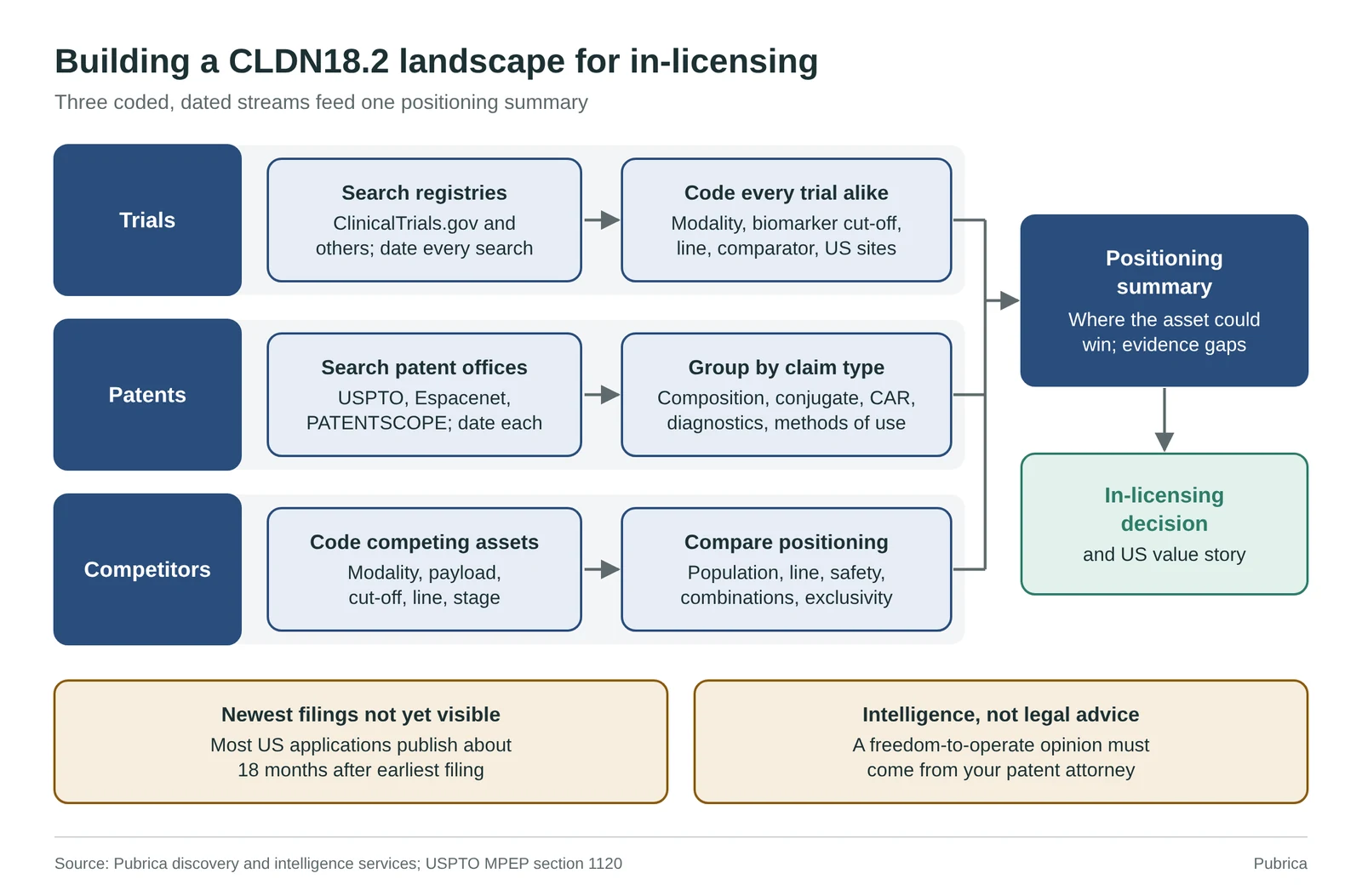
A registry export is not a landscape. To support a licensing decision, each trial record needs to be read and coded the same way. For CLDN18.2 we suggest capturing at least these fields from ClinicalTrials.gov and other registries:
- Asset and modality: antibody, ADC (with payload class and linker type), CAR-T or bispecific.
- Biomarker definition: the assay used, the staining-intensity criterion and the percentage cut-off.
- Line of therapy and setting: first-line, later-line, perioperative or other indications such as pancreatic cancer.
- Design and comparator: single-arm or randomised; placebo plus chemotherapy, physician's choice, or an active CLDN18.2 comparator.
- Combination partners: chemotherapy backbone, PD-1 or PD-L1 inhibitors.
- Geography and US sites: whether US patients are enrolled, and in what proportion.
- Status and dates: recruitment status, primary completion date and the date the record was last updated.
Record the date of every registry search. A landscape without a snapshot date cannot be checked or defended at an investment committee. Published abstracts, conference presentations and company releases fill gaps, but they should be labelled by source type, because a sponsor press release and a peer-reviewed paper carry different weight.
Practical tip
Every statement about a competitor's programme in this article is a dated public report, not an assessment of that programme. Development status, results and deal terms change often, so recheck primary sources on the day you take a decision.
Request a preliminary landscape for one CLDN18.2 asset
Tell us the asset or target, the indication and the decision it informs. We will outline the trial, patent and competitor landscape and the questions to resolve before a licensing decision. Mutual NDA available before you share anything.
Reading the patent landscape for a CLDN18.2 asset
Patent intelligence for CLDN18.2 has to go beyond a keyword search on the target name. The claims that matter usually sit in several families:
- Composition of matter: antibody sequences, epitopes and binding properties.
- Conjugate technology: linker-payload platforms, which may be owned by a different party from the antibody owner.
- Cell therapy constructs: CAR designs and manufacturing processes.
- Diagnostics: antibodies and methods used to select patients.
- Methods of treatment: indications, combinations and dosing regimens.
Search the USPTO's Patent Public Search, the EPO's Espacenet and WIPO's PATENTSCOPE, and record the date and strategy of each search. Structure-based searching matters for linker-payload chemistry, where a medicinal chemistry reviewer can recognise related compounds that name-based searches miss.
Two limits should be stated in every report. Most US utility applications are published about 18 months after their earliest filing date, so the newest filings are not yet visible. And a landscape of this kind is an intelligence assessment, not a legal opinion. Pubrica's service page is explicit on this: a legal freedom-to-operate opinion must come from your patent attorney. A well-organised landscape gives the attorney a clear starting point.
Competitor positioning and the US value story
For an in-licensing team, the landscape exists to answer one question: where could this asset win, and what evidence would it need? With an approved first-line antibody and several ADCs reporting phase 3 data in later lines, the main dimensions of differentiation are:
- Population: the biomarker cut-off and assay, and whether the asset reaches patients with lower CLDN18.2 expression.
- Line of therapy: first-line combination, later-line monotherapy, or perioperative use.
- Safety profile: zolbetuximab's most common adverse events in its pivotal trials were nausea, vomiting and decreased appetite, while ADC tolerability depends largely on the payload class. Toxicity differences can support positioning when they are well documented.
- Combination fit: compatibility with the chemotherapy and immunotherapy backbones used in US practice.
- Exclusivity runway: patent expiry dates, and for biologics the 12-year reference product exclusivity under the Biologics Price Competition and Innovation Act.
These dimensions feed the later value dossier. Payers will compare any new CLDN18.2 therapy with the current standard for the same biomarker-defined population. Mapping comparators and evidence gaps early shows which trials or real-world studies the asset will need for US market access.
An in-licensing diligence checklist
Use this list to check whether your landscape is ready for a licensing decision:
- Snapshot dates are recorded for every registry, literature and patent search.
- Each competing asset is coded by modality, payload, biomarker cut-off, line of therapy and stage.
- Late-stage results are traced to the primary source (label, publication, registry or sponsor release) and labelled by type.
- Differences in biomarker definitions across trials are stated explicitly.
- Whether ex-US data can support a US filing has been flagged for regulatory review.
- Patent families are grouped by claim type, with expiry dates and the jurisdictions covered.
- The limits of the patent search, including unpublished applications, are written down.
- Questions for patent counsel are listed separately from the intelligence findings.
- The comparator and evidence-gap map for the US value story is drafted.
How Pubrica builds a Claudin 18.2 landscape
Pubrica's clinical trial landscape mapping analyses ongoing and completed trials from global registries, including ClinicalTrials.gov and EUCTR. It sits within our wider discovery and intelligence services, which also include chemical patent landscape analysis, patent and intellectual property intelligence, therapeutic area landscape mapping and competitive product benchmarking. According to the service page, every project runs to a documented search strategy, grades evidence by study design and keeps every source traceable and dated. Findings are reported around your decision rather than as a bibliography.
For example, a landscape for one CLDN18.2 asset might combine a coded trial table, a patent family map grouped by claim type and a positioning summary that sets out where the asset could differentiate and what evidence it would still need. Pubrica signs a mutual NDA before you share any material, and, as the service page states, a legal freedom-to-operate opinion stays with your patent attorney.
We support pharmaceutical and biotech teams across the life sciences sector. Academic groups weighing a licensing pitch may also find our Academy guide on building an efficacy and safety evidence profile for a repurposing candidate useful.
Frequently asked questions
As of 24 November 2026, the FDA-approved CLDN18.2-directed therapy we identified is zolbetuximab-clzb, approved on 18 October 2024 with chemotherapy for first-line HER2-negative, CLDN18.2-positive gastric or GEJ adenocarcinoma, with a companion diagnostic. Check Drugs@FDA for any later approvals.
No. A landscape sets out the live patent families, their claims and where exposure may lie, to inform a commercial decision. A legal freedom-to-operate opinion must come from a patent attorney, who can use the landscape as a starting point.
Before every major decision point. Registry records, conference data and patent publications all change during the year, so each version should carry its own snapshot date.
Trials have used different thresholds, for example at least 75% of tumour cells in the zolbetuximab label and at least 25% in CLARITY-Gastric01. The cut-off shapes the eligible population, the comparator and the value story.
Sources
Sources were checked on 24 November 2026. Requirements and guidance may change after that date; confirm the current version with the issuing body.
- 1US FDA. FDA approves zolbetuximab-clzb with chemotherapy for gastric or gastroesophageal junction adenocarcinoma. 18 October 2024. https://www.fda.gov/drugs/resources-information-approved-drugs/fda-approves-zolbetuximab-clzb-chemotherapy-gastric-or-gastroesophageal-junction-adenocarcinoma
- 2DailyMed. VYLOY (zolbetuximab-clzb) prescribing information. https://dailymed.nlm.nih.gov/dailymed/drugInfo.cfm?setid=e7695a21-abb6-47ac-93f8-0ece5a9c4409
- 3AstraZeneca. Sonesitatug vedotin reduced the risk of death by 42% in 2nd and later line CLDN18.2-positive advanced gastric/GEJ cancers in CLARITY-Gastric01. Press release, 2026. https://www.astrazeneca.com/content/astraz/media-centre/press-releases/2026/sonesitatug-vedotin-reduced-the-risk-of-death-by-42-pct-in-2nd-and-later-line-cldn182-positive-advanced-gastricgej-cancers-in-clarity-gastric01.html
- 4AstraZeneca. AstraZeneca enters license agreement with KYM Biosciences for CMG901, a Claudin-18.2 antibody drug conjugate. 23 February 2023. https://www.astrazeneca.com/media-centre/press-releases/2023/astrazeneca-enters-license-agreement-with-kym-biosciences-for-cmg901-a-claudin-182-antibody-drug-conjugate.html
- 5OncLive. Arcotatug tavatecan improves survival in CLDN18.2+ advanced gastric or GEJ adenocarcinoma. 23 October 2026. https://www.onclive.com/view/arcotatug-tavatecan-improves-survival-in-cldn18-2-advanced-gastric-or-gej-adenocarcinoma
- 6Fierce Biotech. Astellas licenses CLDN18.2 ADC from Evopoint Biosciences. May 2025. https://www.fiercebiotech.com/biotech/astellas-aspires-strike-cldn182-gold-again-adc-licensing-deal-worth-134b
- 7OncLive. China's NMPA approves first CAR T-cell therapy for CLDN18.2+/HER2- advanced gastric/GEJ adenocarcinoma. 22 June 2026. https://www.onclive.com/view/china-s-nmpa-approves-first-car-t-cell-therapy-for-cldn18--2-her2-advanced-gastric-gej-adenocarcinoma
- 8Targeted Oncology. FDA grants fast track designation to givastomig for frontline HER2-negative metastatic gastric cancer. 17 June 2026. https://www.targetedonc.com/view/fda-grants-fast-track-designation-to-givastomig-for-frontline-her2-negative-metastatic-gastric-cancer
- 9USPTO. Manual of Patent Examining Procedure, section 1120: Eighteen-month publication of patent applications. https://www.uspto.gov/web/offices/pac/mpep/s1120.html
- 10Congressional Research Service. The Role of Patents and Regulatory Exclusivities in Drug Pricing (R46679). 2024. https://www.everycrsreport.com/reports/R46679.html
claudin 18.2 pipelineCLDN18.2 ADCclaudin 18.2 patent landscapezolbetuximabgastric cancer in-licensingclinical trial landscape mapping
How to cite this article
Pick your referencing style and copy it. Your university or target journal may vary the punctuation, so check its guide if it has one.
Pubrica Insights. (2026, November 24). Mapping the Claudin 18.2 Pipeline in the USA: Trial, Patent and Competitor Landscape to Inform In-Licensing and Value Positioning. Pubrica. https://pubrica.com/insights/claudin-18-2-pipeline-and-patent-landscape/
This article is written to be learned from. Cite it if you are referring to what it says; if you are using the evidence behind it, cite the sources listed above instead.
Next steps
Request a preliminary landscape for one CLDN18.2 asset
Tell us the asset or target, the indication and the decision it informs. We will outline the trial, patent and competitor landscape and the questions to resolve before a licensing decision. Mutual NDA available before you share anything.
This article is general information for researchers, not legal, regulatory or funding advice. Check the current requirements of your journal, funder, ethics committee or regulator before you act on it.
More in Market Access & Evidence