Contents
On this page
- Quick answer
- What reviewers and licensees ask of a repurposing candidate
- Why glioblastoma raises the evidence bar
- The template: seven evidence domains
- Grade every row, not just the strongest studies
- Benchmark against published repurposing profiles
- Grant version or licensing version?
- Gaps that most often weaken a pitch
- How Pubrica supports efficacy and safety profiling
- Frequently asked questions
- Sources
AcademyDiscovery & Intelligence
TemplateUSA
Building the Efficacy and Safety Evidence Profile for a Glioblastoma Repurposing Candidate Before a Grant or Licensing Pitch
Grant panels and licensing teams judge a repurposing candidate on the quality of its evidence, not the enthusiasm behind it. This template shows the evidence domains a glioblastoma profile should cover, how to grade them and where most profiles fall short.
- Discovery & Intelligence
- Oncology & haematology
- Efficacy & safety profiling
- Topic
- Discovery & Intelligence
- Written by
- Pubrica Academy
At a glanceDiscovery & Intelligence
Request a QuoteDiscuss your project
Quick answer
- A drug repurposing evidence profile grades efficacy, safety, mechanism and exposure evidence and states what is still unknown.
- In glioblastoma, reviewers expect CNS exposure data and a clear position on combination with radiotherapy and temozolomide.
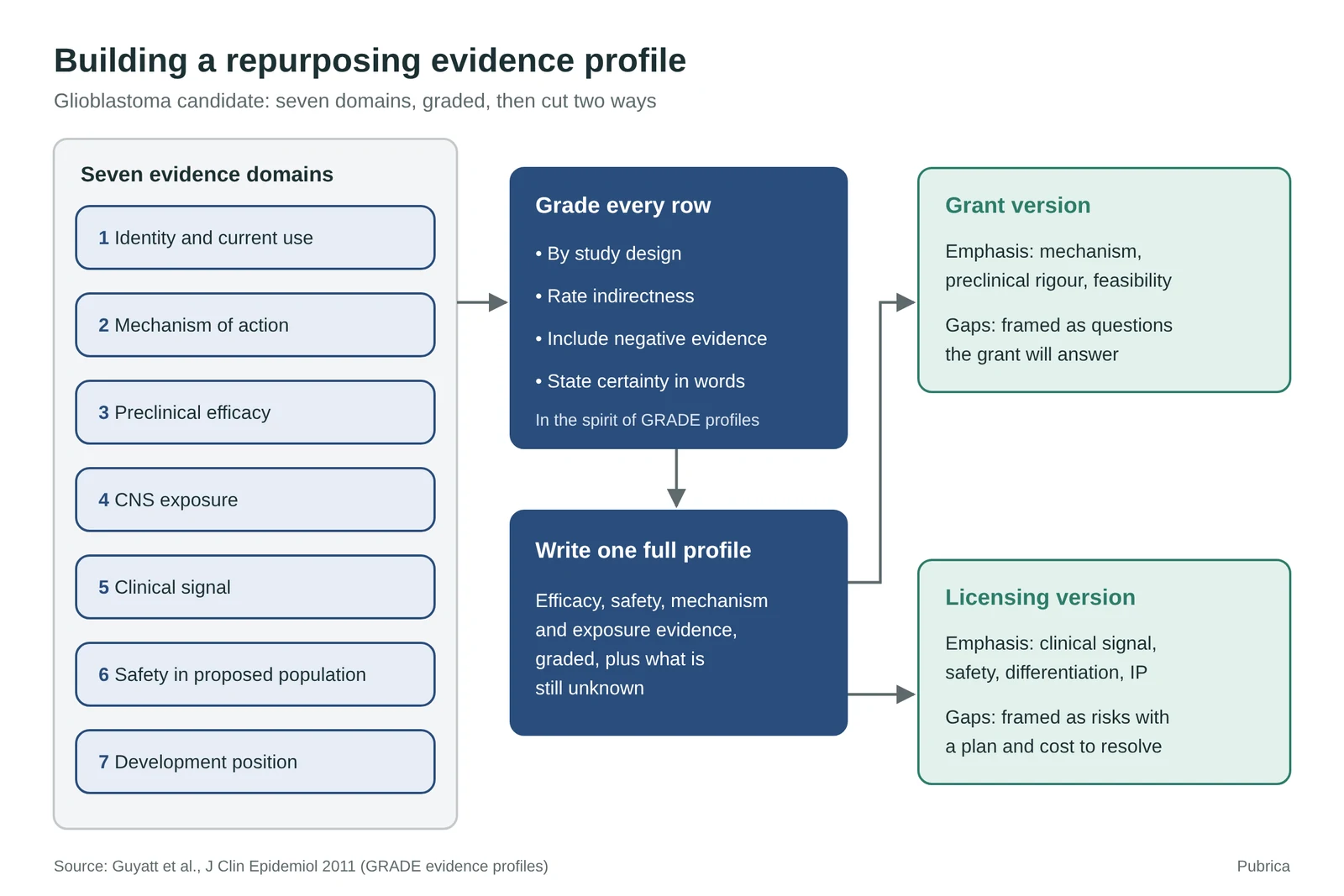
- Use seven domains: identity, mechanism, preclinical efficacy, CNS exposure, clinical signal, safety and development position.
- Grade every row by study design and indirectness, in the spirit of GRADE evidence profiles, and include negative evidence.
- Write one full profile, then cut a grant version and a licensing version from it.
What reviewers and licensees ask of a repurposing candidate
Academic groups often reach the same point: a licensed non-cancer drug shows activity in glioblastoma models, the team believes in it, and the next step needs money. That money comes from one of two places, a grant panel or an organisation willing to license or co-develop the idea. Both ask the same underlying question: is the evidence strong enough, and honest enough about its gaps, to justify the next study?
A drug repurposing evidence profile is the document that answers it. It brings together everything known about the candidate's efficacy, safety, mechanism and exposure in the proposed setting, grades each piece, and states what remains unknown. Done well, it shortens review. Done poorly, as a list of supportive papers, it invites the reviewer to find the gaps for you.
Repurposing candidates in glioblastoma are investigational. A profile describes the evidence and its limits; it should never imply that a candidate is effective or safe in glioblastoma before trials have shown it.
Why glioblastoma raises the evidence bar
Three features of glioblastoma shape what a reviewer expects to see.
A well-defined standard of care. The trial by Stupp and colleagues, published in the New England Journal of Medicine in 2005, reported median survival of 14.6 months with radiotherapy plus temozolomide against 12.1 months with radiotherapy alone. Any new candidate will usually be tested alongside or after this backbone, so the profile must address how the candidate interacts with it.
The blood-brain barrier. A drug that works on glioma cells in a dish is of little use if it does not reach the tumour at adequate concentrations. Reviewers will look for exposure evidence, not just activity evidence. Medicinal chemistry tools such as the CNS multiparameter optimisation (CNS MPO) score, described by Wager and colleagues in 2010, offer an early view of whether a molecule's physicochemical properties suit brain penetration, but they are no substitute for measured exposure data.
A long record of promising preclinical signals. Reviewers in this field are used to candidates that look strong in vitro and do not translate. The profile has to show that the team understands which evidence is predictive and which is merely encouraging.
The template: seven evidence domains
The table below is a working template. Each row becomes a section of the profile, with an evidence table underneath it. Our Academy templates library has related formats for other research documents.
| Domain | What to include | Typical sources |
|---|---|---|
| 1. Candidate identity and current use | Approved indication(s), formulation, dose range, generic status, jurisdictions | Product labelling, Drugs@FDA, regulator databases |
| 2. Mechanism of action | Proposed anti-tumour mechanism, and whether it is shown in glioma models at achievable concentrations | Mechanistic studies, pathway data |
| 3. Preclinical efficacy | In vitro results, orthotopic and patient-derived models, combination with temozolomide or radiotherapy | Peer-reviewed literature |
| 4. CNS exposure | Physicochemical profile, measured brain or tumour concentrations, efflux transporter data | Pharmacokinetic studies, medicinal chemistry analysis |
| 5. Clinical signal | Completed and ongoing trials, retrospective cohorts, case series, epidemiological data | ClinicalTrials.gov, publications, conference abstracts |
| 6. Safety in the proposed population | Known adverse effects at the proposed dose, overlap with chemoradiotherapy toxicity, interactions with common co-medications | Labelling, pharmacovigilance literature, trial safety data |
| 7. Development and commercial position | Existing trials by others, patent landscape, practical route to a trial | Registries, patent databases (intelligence only) |
Under each domain, use the same evidence-table columns so reviewers can compare rows quickly: study and year, design, model or population, dose or concentration, comparator, outcome measured, direction of effect, main limitation and a short certainty statement. Add a final column for the source, with a link or identifier and the date you accessed it. A consistent table also makes it easy to update the profile when a new paper or trial result appears, which matters if the grant or licensing discussion runs over several months.
Domain 7 matters most for licensing. Many repurposing candidates are off-patent, and the 2014 paper launching the Repurposing Drugs in Oncology (ReDO) project discussed the challenges of moving such candidates into trials and practice. A licensee will want to understand the position early; any view you give is an intelligence assessment, and legal conclusions belong to a patent attorney.
Preparing a repurposing grant or licensing pitch?
Pubrica offers a free preliminary assessment of one compound, covering whether efficacy literature exists and how crowded the patent space is, delivered within five business days. For a full graded efficacy and safety profile, tell us the candidate, the indication and your deadline, and we will send a quote.
Grade every row, not just the strongest studies
A profile that lists studies without grading them leaves the reviewer to do the work. The GRADE approach, described in the first of the Journal of Clinical Epidemiology GRADE guidelines papers in 2011, presents evidence in evidence profiles and summary of findings tables, rating certainty by study design, risk of bias, imprecision, inconsistency, indirectness and other factors.
GRADE was built for clinical questions, so a repurposing profile adapts its spirit rather than applying it mechanically. For each domain:
- Separate study types. Report randomised trials, non-randomised clinical data, animal models and in vitro work as distinct groups.
- Rate indirectness explicitly. Data from another cancer, another route of administration or a dose above what patients tolerate is indirect evidence for glioblastoma.
- Record what argues against the candidate. Negative or null studies, failed trials and toxicity signals belong in the table.
- State certainty in words. For example: "Mechanism plausible in two glioma cell lines at concentrations above reported plasma levels; not shown in vivo."
Keep mechanism and outcome apart. A pathway shown in cell lines supports a mechanism statement; it does not show that the drug will change survival.
Practical tip
Tip: search ClinicalTrials.gov and the ReDO resources for your candidate before you write a word. If a glioblastoma trial of the same drug is already registered, reviewers will expect your profile to say how your proposal differs.
Benchmark against published repurposing profiles
The ReDO project, a collaboration between not-for-profit organisations in Europe and the United States, offers a useful benchmark. Its 2014 launch paper in ecancermedicalscience set out selection criteria for licensed non-cancer drugs with anticancer potential, and the group later published single-drug evidence reviews.
The project's database, ReDO_DB, described in 2018, listed 268 licensed non-cancer drugs meeting its criteria as of 16 August 2018, and a 2021 follow-up created a database of repurposing clinical trials in oncology. Before writing your own profile, check whether your candidate already appears in these resources and in ClinicalTrials.gov. Reviewers will. If another group has run or registered a glioblastoma trial with the same drug, your profile must explain what your proposal adds.
Grant version or licensing version?
The evidence base is the same, but the emphasis differs.
| Element | Grant application | Licensing or partnering pitch |
|---|---|---|
| Lead question | Is the science sound and the next study well designed? | Is there a credible development and commercial path? |
| Emphasis | Mechanism, preclinical rigour, feasibility | Clinical signal, safety, differentiation, IP position |
| Gaps | Framed as the questions the grant will answer | Framed as risks with a plan and cost to resolve them |
| Length | Fits the funder's page limits | Short executive summary plus a data appendix |
| Tone | Scholarly and cautious | Concise and decision-focused, still cautious |
Write one full profile, then cut two versions from it. That keeps the evidence consistent if a funder and a partner compare notes.
Gaps that most often weaken a pitch
Before submission, check the profile against this list:
- [ ] Exposure data are missing or rely only on predicted brain penetration.
- [ ] Preclinical doses or concentrations are not compared with those achievable in patients.
- [ ] Combination with temozolomide and radiotherapy is not addressed.
- [ ] Negative studies and earlier failed trials are omitted.
- [ ] The search behind the profile is not documented, so completeness cannot be judged.
- [ ] Safety focuses on the original indication and ignores overlap with chemoradiotherapy toxicity.
- [ ] Ongoing trials by other groups are not acknowledged.
- [ ] Claims go beyond the evidence, for example implying clinical benefit from cell-line data.
Each unticked box is a question a reviewer is likely to raise. It is better to answer it in the profile than in a rejection letter.
How Pubrica supports efficacy and safety profiling
Pubrica's efficacy and safety profiling is a structured review of clinical, in vivo and in vitro studies that assesses the efficacy and safety profile of a compound. Each project documents its search strategy, grades evidence by study design, reports mechanism-of-action evidence separately from clinical outcome evidence and delivers a decision-focused report that sets out findings, remaining uncertainties and the cost of resolving them. Patent work is offered as an intelligence assessment; a legal freedom-to-operate opinion must come from your patent attorney.
We work with universities and research institutions across the life sciences, with each project reviewed by a specialist from the relevant field, such as medicinal chemistry. For an example of how pipeline and patent intelligence is presented for a partnering decision, see our Insights article on mapping the Claudin 18.2 pipeline in the USA. Our wider oncology and haematology support for US teams covers related writing and evidence work.
Frequently asked questions
A structured document that brings together and grades the evidence for using an already approved drug in a new indication, covering efficacy, safety, mechanism, exposure and development position, and stating the gaps that remain.
GRADE was developed for clinical questions. Its principles, especially rating by study design, risk of bias and indirectness, can be adapted to organise preclinical evidence, as long as the profile states clearly how it has been adapted.
Usually less than for a licensing pitch, but funders may still ask about the route to patients. Any patent view should be presented as intelligence, with legal questions referred to a patent attorney.
Not on its own. Safety data from the original indication may not reflect the dose, duration or co-medications in glioblastoma, so the profile should assess overlap with chemoradiotherapy toxicity and likely interactions.
Sources
Sources were checked on 27 November 2026. Requirements and guidance may change after that date; confirm the current version with the issuing body.
- 1Stupp R, Mason WP, van den Bent MJ, et al. Radiotherapy plus concomitant and adjuvant temozolomide for glioblastoma. New England Journal of Medicine. 2005;352:987-996. https://pubmed.ncbi.nlm.nih.gov/15758009/
- 2Pantziarka P, et al. The Repurposing Drugs in Oncology (ReDO) Project. ecancermedicalscience. 2014;8:442. https://pmc.ncbi.nlm.nih.gov/articles/PMC4096030
- 3Pantziarka P, et al. ReDO_DB: the repurposing drugs in oncology database. ecancermedicalscience. 2018;12:886. https://www.ncbi.nlm.nih.gov/pmc/articles/PMC6345075/
- 4Pantziarka P, Vandeborne L, Bouche G. A database of drug repurposing clinical trials in oncology. Frontiers in Pharmacology. 2021;12:790952. https://www.frontiersin.org/articles/10.3389/fphar.2021.790952
- 5Guyatt G, Oxman AD, Akl EA, et al. GRADE guidelines: 1. Introduction-GRADE evidence profiles and summary of findings tables. Journal of Clinical Epidemiology. 2011;64(4):383-394. https://pubmed.ncbi.nlm.nih.gov/21195583/
- 6Wager TT, Hou X, Verhoest PR, Villalobos A. Moving beyond rules: the development of a central nervous system multiparameter optimization (CNS MPO) approach. ACS Chemical Neuroscience. 2010;1(6):435-449. https://pmc.ncbi.nlm.nih.gov/articles/PMC3368654
- 7US National Library of Medicine. ClinicalTrials.gov. https://clinicaltrials.gov/
drug repurposing evidence profileglioblastoma drug repurposingefficacy and safety profilingrepurposing grant applicationGRADE evidence profileCNS exposure blood-brain barrier
How to cite this article
Pick your referencing style and copy it. Your university or target journal may vary the punctuation, so check its guide if it has one.
Pubrica Academy. (2026, November 27). Building the Efficacy and Safety Evidence Profile for a Glioblastoma Repurposing Candidate Before a Grant or Licensing Pitch. Pubrica. https://pubrica.com/academy/discovery-intelligence/glioblastoma-repurposing-evidence-profiles/
This article is written to be learned from. Cite it if you are referring to what it says; if you are using the evidence behind it, cite the sources listed above instead.
Next steps
Preparing a repurposing grant or licensing pitch?
Pubrica offers a free preliminary assessment of one compound, covering whether efficacy literature exists and how crowded the patent space is, delivered within five business days. For a full graded efficacy and safety profile, tell us the candidate, the indication and your deadline, and we will send a quote.
This article is general information for researchers, not legal, regulatory or funding advice. Check the current requirements of your journal, funder, ethics committee or regulator before you act on it.
More in Discovery & Intelligence