Contents
On this page
- Quick answer
- The decision: which TNBC target earns your next year of work
- Step 1: Frame the question before anyone searches
- Step 2: Cover the sources that answer different questions
- Step 3: Make the target identification literature search reproducible
- Step 4: Grade the evidence for each candidate target
- Step 5: Turn the evidence into a ranked shortlist and a decision note
- Build it in-house or commission it?
- How Pubrica supports biomarker and target discovery
- Frequently asked questions
- Sources
AcademyDiscovery & Intelligence
Step-by-step tutorialUSA
Choosing Which Triple-Negative Breast Cancer Target to Pursue: What a Reproducible Target and Biomarker Landscape Should Deliver
Before a start-up commits a year of laboratory work to one triple-negative breast cancer target, the evidence behind that choice should be searchable, graded and repeatable. This step-by-step guide sets out what a target and biomarker landscape should deliver, so you can judge one, whether you build it or commission it.
- Discovery & Intelligence
- Oncology & haematology
- Biomarker & target discovery
- Topic
- Discovery & Intelligence
- Written by
- Pubrica Academy
At a glanceDiscovery & Intelligence
Request a QuoteDiscuss your project
Quick answer
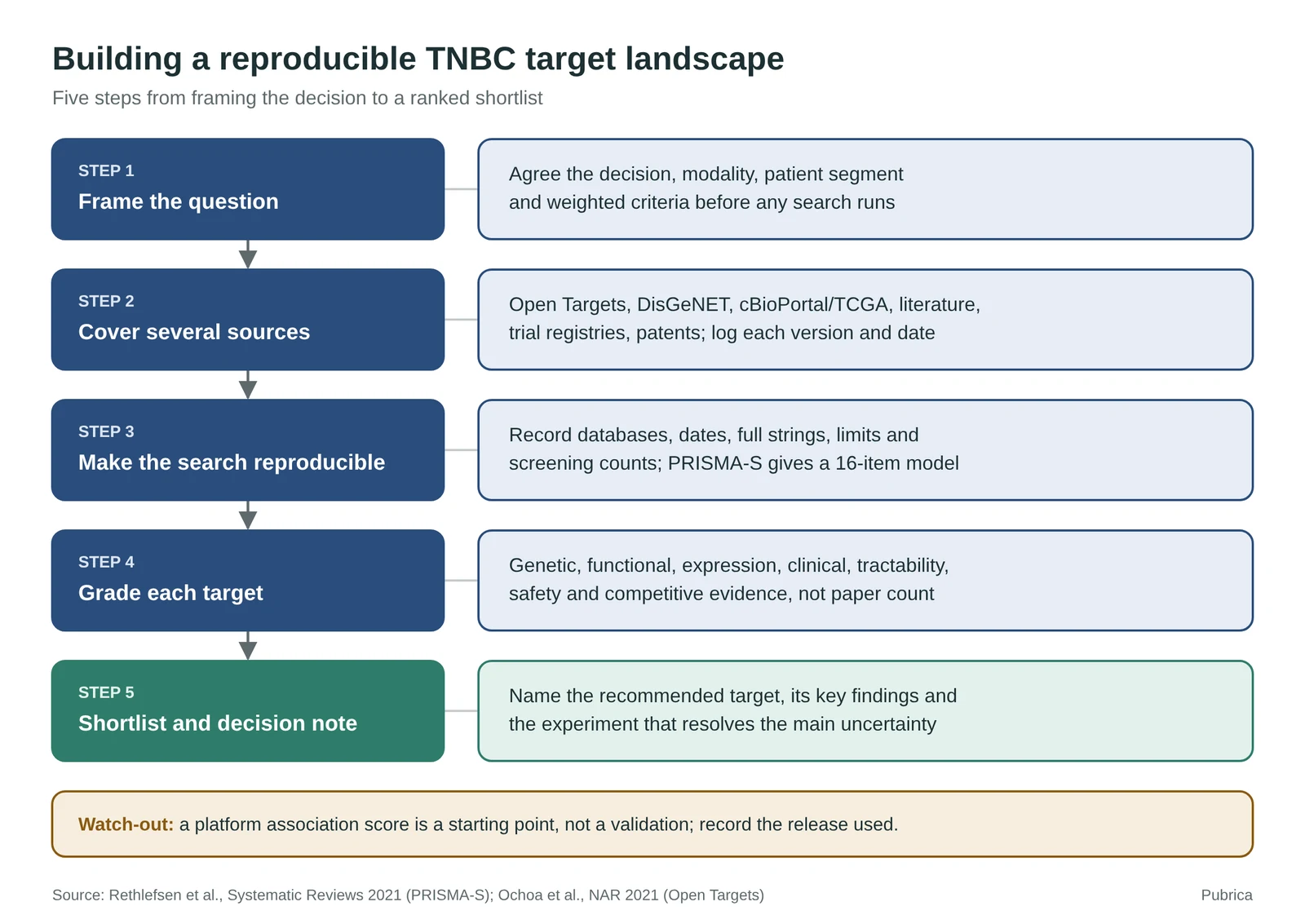
- Agree the decision, modality, patient segment and scoring criteria before any search runs.
- Use several sources (Open Targets, DisGeNET, cBioPortal/TCGA, literature, trial registries, patents) and record the version and date of each.
- Document the target identification literature search well enough to rerun it; PRISMA-S gives a 16-item reporting model.
- Grade each target across genetic, functional, expression, clinical, tractability, safety and competitive evidence, not by paper count.
- The deliverable should name a recommended target, its supporting findings and the experiment that would resolve the main uncertainty.
The decision: which TNBC target earns your next year of work
For a small biotech team, choosing a target is one of the most expensive decisions it will make, even though it often happens in a few weeks of reading. Once assays, cell lines and animal models are built around one protein, changing course costs months and a slice of the runway.
In triple-negative breast cancer (TNBC) the choice is harder still. The disease is defined by what the tumour lacks: the US National Cancer Institute describes TNBC as breast cancer whose cells do not have oestrogen or progesterone receptors or large amounts of HER2 protein. A definition by absence means the patient population is biologically mixed, so a target that looks strong in one dataset can look weak in another.
The practical question is not "what is known about my favourite target?" but "across the plausible targets, which one has the strongest, most reproducible evidence for the patients and modality we can address?" A well-run target identification literature search, combined with structured database evidence, is how that question gets a defensible answer. The rest of this guide sets out what that landscape should contain.
Step 1: Frame the question before anyone searches
A landscape is only as useful as the question it answers. Before a single search string is written, agree four things in writing:
- The decision. For example: pick one of five candidate targets to take into a 12-month validation plan, or decide whether a newly published target is worth adding to the shortlist.
- The modality. A small-molecule inhibitor, an antibody, an antibody-drug conjugate (ADC) or a degrader each needs different evidence. Surface expression matters for an ADC; a binding pocket matters for a small molecule.
- The patient segment. All TNBC, a molecular subgroup, early or metastatic disease, or patients after a specific prior therapy.
- The decision criteria and their weights. Genetic and functional evidence, expression in tumour versus normal tissue, tractability, safety signals and competitive crowding.
Writing this down protects the work from scope drift and lets anyone reviewing it, including a future investor, see why some evidence was collected and other evidence was not.
Practical tip
Warning: an association score from a public platform is a starting point, not a validation. Platforms change their evidence sources between releases, so a target's score can move without any new biology. Always record the release you used and read the underlying evidence before ranking.
Step 2: Cover the sources that answer different questions
No single database answers every target question. A credible landscape draws on several, and states which version of each was used.
| Source | What it helps answer | Watch-outs |
|---|---|---|
| Open Targets Platform | Aggregated target-disease association evidence from many public sources, plus known drugs and tractability | Released several times a year and evidence sources change between releases; record the release number |
| DisGeNET | Gene-disease associations curated from repositories, GWAS catalogues, animal models and literature | Access terms now differ for academic and commercial users; check the licence before use |
| cBioPortal (including TCGA PanCancer Atlas breast data) | Mutation, copy-number and expression patterns in tumour samples | TNBC must be defined from receptor data within the study; sample sizes for subgroups can be small |
| PubMed, Embase and preprint servers | Functional studies, mechanism and resistance data | Needs a documented strategy, or unfavourable papers are easily missed |
| ClinicalTrials.gov and company disclosures | Which targets are already in clinical development, and in what setting | Registry entries can lag behind actual status; record the search date |
| Patent databases | How crowded the space is and which claims may matter | An intelligence view only; legal conclusions need a patent attorney |
Clinical benchmarks also belong here. In April 2021 the FDA granted regular approval to sacituzumab govitecan, a Trop-2-directed ADC, for previously treated metastatic TNBC, and in July 2021 it approved pembrolizumab with chemotherapy for high-risk early-stage TNBC. A new target does not compete with these products directly, but investors will ask how your approach fits alongside them. For the nonclinical package an ADC programme later needs, see our Insights article on ICH S9 for first-in-human antibody-drug conjugate trials.
Need a target landscape you can defend?
Tell us your candidate targets, modality and the decision the landscape must support. Pubrica will scope a documented, graded biomarker and target landscape and send a quote, and we sign a mutual NDA at no cost before you share any material.
Step 3: Make the target identification literature search reproducible
Reproducibility is what separates a landscape from a reading list. If a colleague reran the work in six months, they should be able to see exactly what was searched and why each paper was kept or excluded.
The PRISMA-S extension, published in Systematic Reviews in 2021, sets out 16 reporting items for literature searches. It was written for systematic reviews, but its logic transfers well to target work. In practice, a reproducible search records:
- every database and platform searched, with the date of each search;
- full search strings, including gene symbols, aliases, protein names and older nomenclature;
- limits applied (date range, language, species, publication type) and the reason for each;
- the inclusion and exclusion criteria used at screening, and how many records each stage removed;
- the release or version of each structured database, because platforms such as Open Targets add and remove evidence sources between releases.
For start-ups that also need a formal evidence synthesis, our literature review and gap analysis service applies the same documentation standard to a full review.
Step 4: Grade the evidence for each candidate target
Counting papers is not grading evidence. Twenty cell-line studies do not outweigh one well-designed genetic dependency screen, and an association in a public dataset is not proof that the target drives the disease. A useful landscape scores each candidate across separate evidence types and shows the reasoning.
| Evidence type | Stronger | Weaker |
|---|---|---|
| Genetic or somatic | Recurrent alterations or dependency in TNBC models and patient samples | Single association, unreplicated |
| Functional | Knockdown or inhibition changes tumour growth in more than one model | One cell line, one method |
| Expression | Higher in TNBC tumour than relevant normal tissue, confirmed at protein level | mRNA only, no normal-tissue comparison |
| Clinical | Biomarker or outcome association in a patient cohort | Preclinical only |
| Tractability | Known ligands, structural data or suitable surface expression for the modality | No chemical or biological starting point |
| Safety | Normal-tissue expression and knockout phenotypes reviewed | Not examined |
| Competitive position | Space understood, with differentiation stated | Unknown |
Two rules keep the grading honest. First, record conflicting evidence rather than leaving it out. Second, keep mechanism evidence separate from outcome evidence: a plausible pathway is not the same as showing that hitting the target changes the disease.
Step 5: Turn the evidence into a ranked shortlist and a decision note
The deliverable should support a decision, not only describe a field. When you receive a landscape, from your own team or from a provider, check that it contains:
- [ ] a one-page summary that names the recommended target and the two or three findings the recommendation rests on;
- [ ] a ranked shortlist with scores for each evidence type and the weights agreed in Step 1;
- [ ] the full search methods: databases, versions, dates and strings;
- [ ] an evidence table in which every statement links to a dated source;
- [ ] a biomarker view: which patients would be selected or stratified, and which assay would do it;
- [ ] a short competitive and patent overview, clearly labelled as intelligence rather than legal advice;
- [ ] the open uncertainties and the experiment that would resolve each one.
The last item matters most. A landscape that states "the evidence for target B depends on one knockout study; a second model would settle it" gives the team its next experiment and gives an investor a credible plan.
Build it in-house or commission it?
Many start-ups build their first landscape themselves, and for a single well-known target that can be enough. The balance changes as the number of candidates grows, as the work needs to stand up in due diligence, or as the people best placed to do it are needed at the bench.
| Consider in-house when | Consider commissioning when |
|---|---|
| One or two targets, mostly in your team's own field | Five or more candidates, or targets outside your core expertise |
| The output is for internal discussion only | The output will go to investors, partners or a grant panel |
| You have bioinformatics capacity with time to spare | Scientists are the bottleneck for laboratory work |
| No patent or competitive questions yet | You need a view on crowding before committing |
A commissioned landscape is also a second pair of eyes. An external team without a favourite target is more likely to record the evidence that cuts against your preferred candidate.
How Pubrica supports biomarker and target discovery
Pubrica's biomarker and target discovery work covers predictive biomarkers, therapeutic targets and mechanism-of-action evidence, including for drug repurposing. Every project records the databases, terms, filters, date range and inclusion criteria before the search runs, grades evidence by study design, keeps mechanism evidence separate from clinical outcome evidence and delivers a decision-focused written report rather than a bibliography.
Each project is reviewed by a specialist from the relevant field, such as bioinformatics, and the work sits within our wider support for pharma and biotech teams across the life sciences. Pubrica uses AI tools to search and cluster literature, but a named analyst reads the underlying sources and is responsible for every output. Any patent view is an intelligence assessment to inform your decision; a legal freedom-to-operate opinion must come from your patent attorney.
For context on related work in this therapy area, see our oncology and haematology support for US teams.
Frequently asked questions
Enough to make the choice meaningful but few enough to grade properly. Many start-ups compare three to eight candidates in depth after a broader screen. The number matters less than applying the same criteria and weights to each.
No. Both are valuable aggregators, but scores reflect which evidence sources were included in a given release and how they are weighted. Use them to find and compare evidence, then read and grade the underlying studies for your specific patient segment and modality.
A landscape can show how crowded the patent space is and which families may be relevant, as an intelligence assessment. A legal freedom-to-operate opinion must come from a qualified patent attorney.
Investors and partners increasingly ask how a target was chosen. A documented search shows what was and was not examined, so the choice can be defended and rerun when new data appear.
Sources
Sources were checked on 27 November 2026. Requirements and guidance may change after that date; confirm the current version with the issuing body.
- 1National Cancer Institute. Definition of triple-negative breast cancer. NCI Dictionary of Cancer Terms. https://www.cancer.gov/publications/dictionaries/cancer-terms/def/triple-negative-breast-cancer
- 2Rethlefsen ML, Kirtley S, Waffenschmidt S, et al. PRISMA-S: an extension to the PRISMA Statement for Reporting Literature Searches in Systematic Reviews. Systematic Reviews. 2021;10:39. https://pubmed.ncbi.nlm.nih.gov/34285662
- 3Ochoa D, Hercules A, Carmona M, et al. Open Targets Platform: supporting systematic drug-target identification and prioritisation. Nucleic Acids Research. 2021;49(D1):D1302-D1310. https://www.ncbi.nlm.nih.gov/pmc/articles/PMC7779013/
- 4Open Targets. Open Targets Platform 25.12 has been released. 2025. https://blog.opentargets.org/open-targets-platform-25-12-has-been-released/
- 5Piñero J, Bravo À, Queralt-Rosinach N, et al. DisGeNET: a comprehensive platform integrating information on human disease-associated genes and variants. Nucleic Acids Research. 2017;45(D1):D833-D839. https://pubmed.ncbi.nlm.nih.gov/27924018/
- 6Cerami E, Gao J, Dogrusoz U, et al. The cBio cancer genomics portal: an open platform for exploring multidimensional cancer genomics data. Cancer Discovery. 2012;2(5):401-404. https://pubmed.ncbi.nlm.nih.gov/22588877/
- 7US Food and Drug Administration. FDA grants regular approval to sacituzumab govitecan for triple-negative breast cancer. 2021. https://www.fda.gov/drugs/resources-information-approved-drugs/fda-grants-regular-approval-sacituzumab-govitecan-triple-negative-breast-cancer
- 8US Food and Drug Administration. FDA approves pembrolizumab for high-risk early-stage triple-negative breast cancer. 2021. https://www.fda.gov/drugs/resources-information-approved-drugs/fda-approves-pembrolizumab-high-risk-early-stage-triple-negative-breast-cancer
target identification literature searchTNBC target landscapebiomarker and target discoverytarget prioritisationOpen Targets PlatformcBioPortal TCGA breast cancer
How to cite this article
Pick your referencing style and copy it. Your university or target journal may vary the punctuation, so check its guide if it has one.
Pubrica Academy. (2026, November 27). Choosing Which Triple-Negative Breast Cancer Target to Pursue: What a Reproducible Target and Biomarker Landscape Should Deliver. Pubrica. https://pubrica.com/academy/discovery-intelligence/what-a-tnbc-target-landscape-should-deliver/
This article is written to be learned from. Cite it if you are referring to what it says; if you are using the evidence behind it, cite the sources listed above instead.
Next steps
Need a target landscape you can defend?
Tell us your candidate targets, modality and the decision the landscape must support. Pubrica will scope a documented, graded biomarker and target landscape and send a quote, and we sign a mutual NDA at no cost before you share any material.
This article is general information for researchers, not legal, regulatory or funding advice. Check the current requirements of your journal, funder, ethics committee or regulator before you act on it.
More in Discovery & Intelligence