Contents
On this page
- Quick answer
- Why journal choice is now a compliance decision
- What the 2024 NIH Public Access Policy requires
- Four checks to run on every candidate journal
- Embargo terms: what to look for on publisher pages
- Licences, rights statements and APCs
- A worked shortlisting sequence for a myeloma manuscript
- How Pubrica's journal selection service fits in
- Frequently asked questions
- Sources
InsightsPublishing & Open Access
Decision guideUSA
Choosing a Journal for NIH-Funded Myeloma Research Under the 2025 Public Access Policy: Embargo, Licence and APC Checks Before Submission
Since 1 July 2025, NIH-funded papers must be freely available in PubMed Central from the day they are published. For haematology PIs and postdocs, that turns journal choice into a compliance decision as well as a scientific one.
- Publishing & Open Access
- Oncology & haematology
- Journal selection
- Topic
- Publishing & Open Access
- Written by
- Pubrica Insights
At a glancePublishing & Open Access
Request a QuoteDiscuss your project
Quick answer
- The 2024 NIH Public Access Policy applies to author accepted manuscripts accepted on or after 1 July 2025; the 12-month embargo no longer applies.
- You do not have to pay an article processing charge (APC) to comply: depositing the accepted manuscript in PubMed Central is free.
- Before submitting, check four things for each candidate journal: embargo terms, the licence or rights language, how the paper reaches PMC, and the APC against your budget.
- NIH has proposed limits on allowable publication costs; check the current NIH Guide notice before budgeting for an APC.
- Shortlist journals on scope and audience first, then remove any whose terms conflict with your NIH obligations.
Why journal choice is now a compliance decision
Myeloma research spans bench, translational and clinical work: bone marrow microenvironment studies, cell-therapy correlatives, minimal residual disease methods and trial secondary analyses. The natural journals for that work range from society titles in haematology to broad cell biology and oncology journals, with very different publishing models.
Until mid-2025, most NIH-funded authors could submit almost anywhere and rely on a 12-month embargo before their manuscript appeared in PubMed Central (PMC). That changed when the 2024 NIH Public Access Policy took effect. If a journal's terms do not allow your accepted manuscript to be public on the day the article is published, you have a conflict to resolve before submission, not after acceptance.
This guide covers the journal-level checks. For the policy itself, see our brief on the NIH Public Access Policy 2025.
What the 2024 NIH Public Access Policy requires
NIH published the 2024 Public Access Policy in December 2024 (NOT-OD-25-047) and, in April 2025, brought its effective date forward from 31 December 2025 to 1 July 2025 (NOT-OD-25-101). It replaced the 2008 policy. In outline:
- Scope. It applies to author accepted manuscripts (AAMs) arising from NIH funding that are accepted for publication on or after 1 July 2025.
- No embargo. The AAM must be made publicly available in PMC, without embargo, on the Official Date of Publication, which NIH defines as the date the final published article is first made available in final, edited form, in print or online.
- Rights. Supplemental guidance (NOT-OD-25-049) explains that NIH relies on a licence similar to the federal Government Use License (2 CFR 200.315): a royalty-free, nonexclusive and irrevocable right to make the AAM available. NIH asks authors to include a statement in the manuscript informing the journal that the work is subject to the policy.
- Costs. Supplemental guidance on publication costs (NOT-OD-25-048) confirms that the policy does not require an APC, that submission to PMC is free, and that publication costs remain allowable when they meet NIH cost principles.
Some universities note that manuscripts from grants that closed before 1 July 2025 may fall under the earlier rules. Check the NIH FAQs, or your institution's library or research office, if that applies to you.
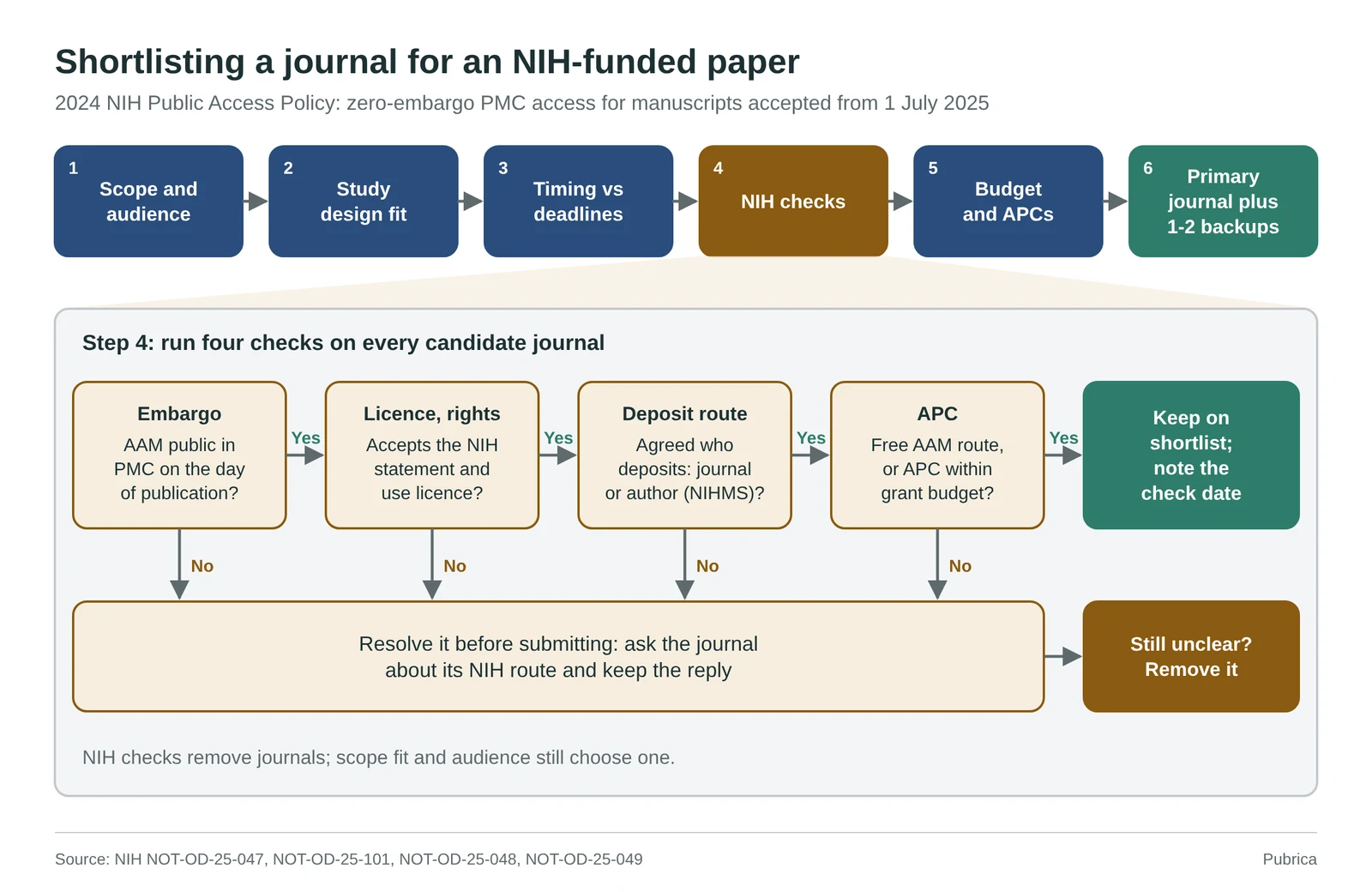
Four checks to run on every candidate journal
Once you have a scientific longlist, run each journal through four checks. They take a few minutes per title on the publisher's author pages, and they are the part most often left until after acceptance.
| Check | Question to answer | What a conflict looks like | Typical resolution |
|---|---|---|---|
| Embargo | Does the journal allow the AAM to be public in PMC on the publication date? | A self-archiving policy with a 6- or 12-month embargo and no NIH exception | Ask the journal how it handles NIH-funded papers; many publishers have an NIH-specific route |
| Licence and rights | Will the copyright transfer or licence agreement accept the NIH statement and the government use licence? | An agreement requiring exclusive rights with no carve-out | Confirm before submission; keep the correspondence |
| Deposit route | How does the paper reach PMC: does the journal deposit the final article, or does the author deposit the AAM through the NIH Manuscript Submission system (NIHMS)? | Unclear responsibility, so nobody deposits | Agree who deposits, and note it in your lab's publication tracker |
| APC | Is there a charge, is it optional, and does it fit your grant budget? | A gold open access charge above your budget, or a fee for PMC deposit | Use a free AAM deposit route, or budget the APC as an allowable cost |
Note the date you checked each policy. Publisher terms change, and a record of what the journal said when you submitted is useful if a compliance question is raised later.
Get a scoping assessment for your manuscript
Send your myeloma manuscript and your NIH constraints. A Pubrica subject expert will provide a free scoping assessment within two business days, showing the reasoning behind a journal shortlist as well as the list itself.
Embargo terms: what to look for on publisher pages
Publisher self-archiving pages often describe embargoes in general terms that predate the 2024 policy. When reading them:
- Look for a funder-specific statement on NIH. Many large publishers now describe how they handle NIH-funded manuscripts separately from their general green open access terms.
- Distinguish the AAM from the version of record. The policy concerns the AAM; you do not need permission to deposit the publisher's typeset PDF.
- Check hybrid journals carefully. A subscription journal may offer immediate open access for a fee and a separate free AAM route for funded authors. You only need one compliant route.
- If the page is silent or contradictory, email the editorial office before submitting and keep the reply.
If a journal cannot confirm a compliant route, it is safer to remove it from the shortlist than to rely on resolving the issue after acceptance.
Practical tip
Add the NIH-recommended rights statement to your manuscript before first submission, not at acceptance. It informs the journal from the outset that the work is subject to the policy, and a journal that objects will tell you while you can still choose another.
Licences, rights statements and APCs
The NIH policy does not require a particular Creative Commons licence. It requires that NIH can make the AAM publicly available. A journal that publishes under CC BY, or another open licence, will usually present no rights conflict. A subscription journal can also be compliant if its agreement accommodates the NIH rights language.
APCs are a budget question rather than a compliance one. Paying for gold open access can be convenient, because the publisher deposits the final article, but it is optional. Points to check:
- whether your award budget includes publication costs, and how much remains;
- whether your institution has a read-and-publish agreement with the publisher that covers or reduces the charge;
- whether any fee is being requested specifically for PMC deposit, which NIH does not treat as allowable under the new policy.
In July 2025, NIH issued a request for information (NOT-OD-25-138) proposing limits on allowable publication costs, including a per-article cap option of $2,000. At the time of writing, we could not confirm that a final limit has been adopted, so check the NIH Guide for the latest notice before committing to a high APC.
A worked shortlisting sequence for a myeloma manuscript
For example, a postdoc preparing a manuscript on bone marrow stromal signalling in myeloma cell survival, funded by an NIH R01, might work as follows:
- Scope and audience first. List journals that publish mechanistic myeloma or haematological malignancy biology and whose readers include both haematologists and cell biologists.
- Study design fit. Remove titles that rarely publish purely preclinical work, or that expect clinical validation the study does not have.
- Timing. Compare median time to first decision against any grant renewal or progress report deadline.
- NIH checks. Apply the four checks above to the remaining titles and record the date of each check.
- Budget. Compare APCs, institutional agreements and the free AAM route.
- Primary target. Choose one primary journal with one or two alternatives already checked, so a rejection does not restart the process.
The NIH checks remove journals; they do not choose one. Scope fit and audience still decide where the paper has the best chance of acceptance and of being read.
How Pubrica's journal selection service fits in
Pubrica's journal selection service is designed for this stage. A subject expert who publishes in the field reads the manuscript and shortlists three to five journals that fit its scope, study design and audience, with one named as the primary target. Each journal is assessed on scope, study design, audience, decision time and APC, and the report gives the reasoning for each recommendation, verified metrics and indexing, and an exclusion log of journals screened out and why. The weighting can reflect a grant requirement, a deadline or maximum reach, and you can set an APC ceiling as a hard filter.
Pubrica is publisher-independent: it owns no journal portfolio. It supports academic researchers across the life sciences, with reviewers drawn from its cell biology subject experts for mechanistic myeloma work. For the wider set of resources for teams in oncology and haematology in the USA, see the cluster overview, and for related practical guidance on journal platforms see our academy articles on journal publishing.
You remain responsible for NIH compliance. Ask for the NIH checks above to be included in the brief, and confirm the deposit route with the journal you choose.
Frequently asked questions
No. It requires your author accepted manuscript to be publicly available in PubMed Central, without embargo, from the official date of publication. You can comply in a subscription journal through a free AAM deposit, provided the journal's terms allow it.
Author accepted manuscripts arising from NIH funding that are accepted for publication on or after 1 July 2025. Manuscripts from grants that had closed before that date may fall under the earlier rules; check the NIH FAQs or your research office.
Publication costs are allowable when they meet NIH cost principles, but no APC is needed for compliance, and fees charged for PMC deposit are not allowable. NIH has also consulted on capping publication costs, so check the latest NIH Guide notice.
No. Pubrica's journal selection service shortlists journals on scope, design, audience, timing and APC, and can weight a grant requirement in the brief. Compliance remains the responsibility of the author and institution.
Sources
Sources were checked on 24 November 2026. Requirements and guidance may change after that date; confirm the current version with the issuing body.
- 1National Institutes of Health. 2024 NIH Public Access Policy (NOT-OD-25-047). December 2024. https://grants.nih.gov/grants/guide/notice-files/NOT-OD-25-047.html
- 2National Institutes of Health. Revision: Notice of Updated Effective Date for the 2024 NIH Public Access Policy (NOT-OD-25-101). April 2025. https://grants.nih.gov/grants/guide/notice-files/NOT-OD-25-101.html
- 3National Institutes of Health. Supplemental Guidance to the 2024 NIH Public Access Policy: Publication Costs (NOT-OD-25-048). https://grants.nih.gov/grants/guide/notice-files/NOT-OD-25-048.html
- 4National Institutes of Health. Supplemental Guidance to the 2024 NIH Public Access Policy: Government Use License and Rights (NOT-OD-25-049). https://grants.nih.gov/grants/guide/notice-files/NOT-OD-25-049.html
- 5National Institutes of Health. Request for Information on Maximizing Research Funds by Limiting Allowable Publishing Costs (NOT-OD-25-138). July 2025. https://grants.nih.gov/grants/guide/notice-files/NOT-OD-25-138.html
- 6National Institutes of Health. Submitting to PubMed Central. https://grants.nih.gov/node/1204
- 7Galter Health Sciences Library, Northwestern University. NIH public access guide. https://libguides.galter.northwestern.edu/NIH-public-access
NIH public access policy open access journalsNIH public access policy 2025zero embargo PubMed Centralauthor accepted manuscriptarticle processing charge NIH grantjournal selection myeloma
How to cite this article
Pick your referencing style and copy it. Your university or target journal may vary the punctuation, so check its guide if it has one.
Pubrica Insights. (2026, November 24). Choosing a Journal for NIH-Funded Myeloma Research Under the 2025 Public Access Policy: Embargo, Licence and APC Checks Before Submission. Pubrica. https://pubrica.com/insights/nih-compliant-journal-choice-for-myeloma-papers/
This article is written to be learned from. Cite it if you are referring to what it says; if you are using the evidence behind it, cite the sources listed above instead.
Next steps
Get a scoping assessment for your manuscript
Send your myeloma manuscript and your NIH constraints. A Pubrica subject expert will provide a free scoping assessment within two business days, showing the reasoning behind a journal shortlist as well as the list itself.
This article is general information for researchers, not legal, regulatory or funding advice. Check the current requirements of your journal, funder, ethics committee or regulator before you act on it.
More in Publishing & Open Access