Contents
On this page
- Quick answer
- Why the 2025 orphan change matters for myelofibrosis forecasts
- What the law changed: the exclusion and the clock
- Which budget impact assumptions need rebuilding
- Rebuilding the model step by step
- Presenting the update to payers
- How Pubrica supports budget impact model updates
- Frequently asked questions
- Sources
InsightsMarket Access & Evidence
Policy analysisUSA
Rebuilding a US Budget Impact Model for a Myelofibrosis Therapy After the 2025 Orphan Exclusion Change to Medicare Drug Price Negotiation
The 2025 reconciliation law widened the orphan drug exclusion from Medicare drug price negotiation and changed when the negotiation clock starts. For myelofibrosis and other rare haematologic cancers, several budget impact assumptions now need revisiting.
- Market Access & Evidence
- Oncology & haematology
- Budget impact model
- Topic
- Market Access & Evidence
- Written by
- Pubrica Insights
At a glanceMarket Access & Evidence
Request a QuoteDiscuss your project
Quick answer
- Public Law 119-21, signed on 4 July 2025, amended the orphan drug exclusion in the Medicare Drug Price Negotiation Program (section 71203, as cited by CMS).
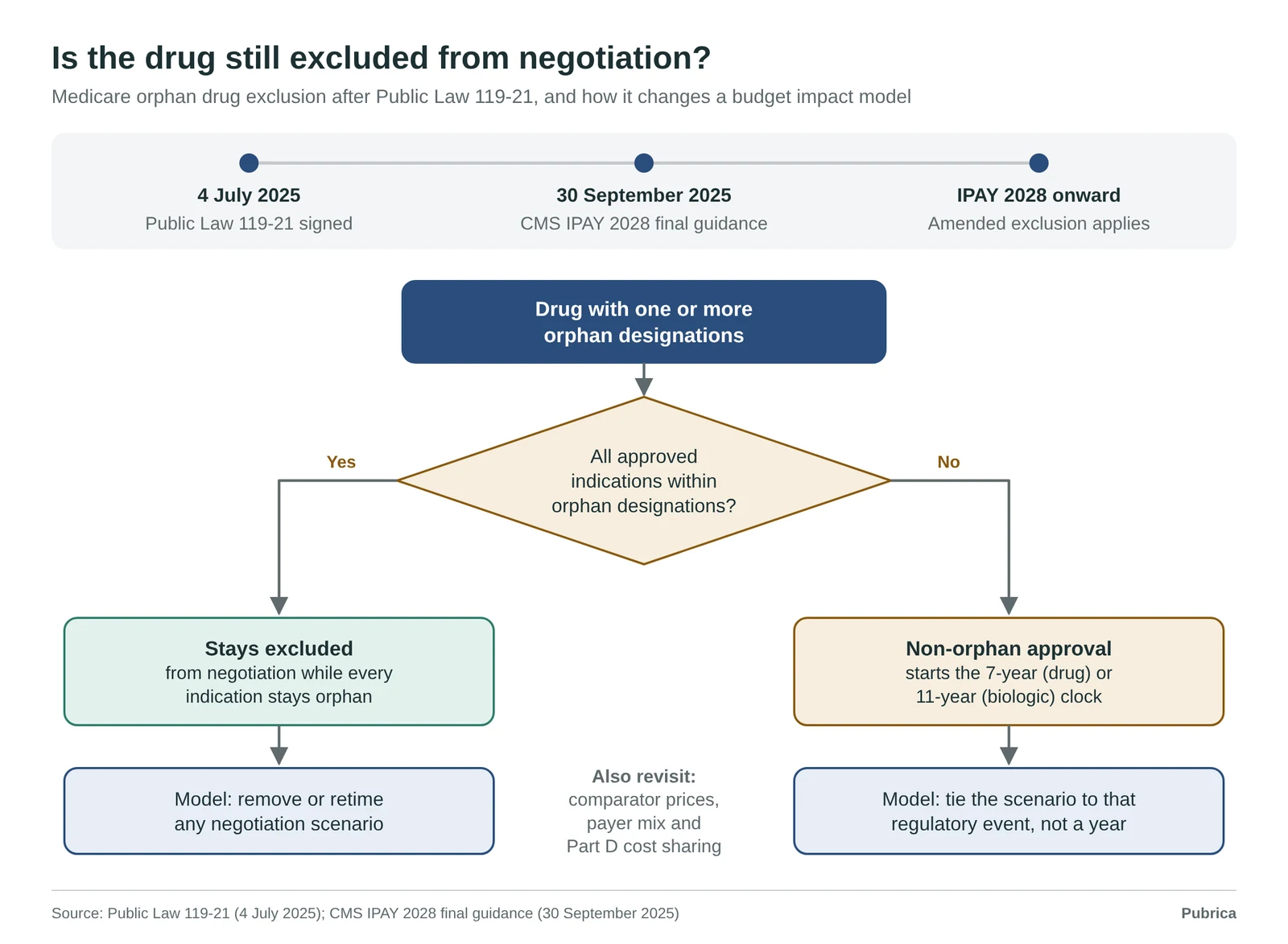
- A drug designated and approved for more than one rare disease can now stay excluded, provided all its approved indications fall within orphan designations.
- If a drug later gains a non-orphan indication, its 7- or 11-year eligibility period now runs from that approval rather than from first approval.
- The changes apply from initial price applicability year 2028; CMS implemented them in its IPAY 2028 final guidance of 30 September 2025.
- Budget impact models for myelofibrosis therapies should revisit price trajectory, comparator pricing, label-expansion scenarios and Medicare payer mix.
Why the 2025 orphan change matters for myelofibrosis forecasts
Myelofibrosis is a rare myeloproliferative neoplasm that mainly affects older adults; the median age at diagnosis is about 65 years. In the USA, a large share of treated patients are therefore Medicare beneficiaries, and Medicare policy shapes both the payer's budget and the manufacturer's net price over a product's life.
Most therapies developed for myelofibrosis also target related rare conditions, such as polycythaemia vera or other rare haematologic cancers. Under the original Inflation Reduction Act (IRA) wording, a second orphan indication could remove a drug from the orphan exclusion and expose it to selection for Medicare price negotiation. The 2025 change removes that effect for drugs whose indications all remain orphan.
That changes the assumptions behind a US budget impact model, particularly over the later years of the horizon and in scenario analyses. Teams that built models before July 2025 should check whether their price, comparator and payer-mix inputs still hold. For background on the negotiation programme itself, see our article on the first negotiated Medicare prices taking effect in 2026.
What the law changed: the exclusion and the clock
The IRA (Public Law 117-169, section 11001) created the Medicare Drug Price Negotiation Program in sections 1191 to 1198 of the Social Security Act. Section 1192(e)(3)(A) originally excluded from negotiation a drug designated for only one rare disease or condition under the Orphan Drug Act, and approved only for that disease or condition. Under the Orphan Drug Act, a rare disease or condition generally affects fewer than 200,000 people in the USA.
Public Law 119-21, the 2025 budget reconciliation law signed on 4 July 2025, amended the exclusion in two ways. CMS cites the provision as section 71203; it incorporated provisions from the ORPHAN Cures Act.
| Element | Original IRA rule | After Public Law 119-21 |
|---|---|---|
| Orphan designations | Only one rare disease or condition | One or more rare diseases or conditions |
| Approved indications | Only for that one disease | All approved indications within the orphan designations |
| Start of 7- or 11-year eligibility period | Approval or licensure of the drug | First approval or licensure for an indication outside the orphan exclusion |
| Application | From the start of the programme | Initial price applicability year (IPAY) 2028 onward |
CMS implemented these changes in its final guidance for IPAY 2028, released on 30 September 2025. CMS has since moved to rulemaking for IPAY 2029 and later years, so teams should check the current proposed or final rule for any further detail on how the exclusion is applied.
For example, consider a hypothetical small-molecule therapy approved first for intermediate- or high-risk myelofibrosis and later for a second rare haematologic cancer, with both indications orphan-designated. Under the original wording, the second approval could have ended the exclusion, and the seven-year clock would have counted from the first approval, so selection could become possible soon after the second launch. Under the amended rule, the drug stays excluded while both indications remain orphan. If the sponsor later gains approval in a common, non-orphan indication, the seven-year period would start from that approval. The forecast question therefore shifts from 'when might the product be selected?' to 'which regulatory event would make it eligible, and when?'
Which budget impact assumptions need rebuilding
A US budget impact model answers what a payer will spend, undiscounted, over a short horizon for its own population. The orphan change affects several inputs directly or through scenarios.
- Net price trajectory. Models that included a scenario in which the product was selected for negotiation, with a maximum fair price from a given year, may need that scenario removed or retimed if all indications stay orphan.
- Comparator prices. Approved myelofibrosis therapies include four JAK inhibitors (ruxolitinib, fedratinib, pacritinib and momelotinib). Assumptions about whether, and when, any comparator could be selected for negotiation affect the current and projected treatment-mix costs. These should be reviewed against each comparator's designations and indications, not assumed.
- Label-expansion scenarios. If the development plan includes a non-orphan indication, the eligibility clock would start from that approval. The model's timing assumptions for any negotiation scenario should follow the regulatory plan.
- Payer mix. For an older population, the split between Medicare Part D, Medicare Part B, Medicare Advantage and commercial plans drives which perspective each version of the model should take.
- Patient cost sharing. Since 2025, the Part D redesign has capped annual out-of-pocket costs ($2,000 in 2025, $2,100 in 2026) and replaced the coverage gap discount with the Manufacturer Discount Program. Where adherence or uptake inputs were linked to out-of-pocket burden, they may need updating.
None of these changes alters the core method. ISPOR good practice still calls for the budget holder's perspective, a short horizon, undiscounted costs and scenario analysis.
Practical tip
Date-stamp every policy assumption in the model. The orphan exclusion was amended once in 2025 and the programme is moving from annual guidance to rulemaking, so a model that records which statute, guidance or rule version it reflects is far easier to defend and update.
Book a scoping call to review your budget impact model
Send the indication, the market and your current model. Pubrica will scope the update and provide a quote, and can build the eligible population calculation free of charge so you can see whether the epidemiology supports your case.
Rebuilding the model step by step
A practical sequence for a model built before July 2025:
- Confirm the product's status. List every orphan designation and every approved or planned indication, and check whether all fall within the amended exclusion. Record the source and date.
- Repeat the exercise for comparators. The current and new treatment mix depends on comparator prices over the horizon; document the assumption for each one.
- Rebuild the eligible population. Recheck prevalence, diagnosis and treatment rates for the US payer, by risk category and line of therapy, with each step sourced. A population that does not reconcile with the payer's own claims data undermines the rest of the analysis.
- Revisit uptake. Base market share on treatment line, prescriber behaviour and expected competitor entry, with optimistic and conservative scenarios.
- Update costs. Apply current drug, administration, monitoring and adverse event costs, and the current Part D benefit design where Part D applies.
- Restructure scenarios. Replace a single negotiation scenario with scenarios tied to explicit regulatory events, such as a non-orphan approval.
- Re-check consistency. Where a cost-effectiveness model exists, confirm the two share the same clinical and price inputs.
The eligible population calculation is usually the step payers scrutinise first, so it is also the best place to start a review.
Presenting the update to payers
Payers and formulary committees usually focus on the next one to five years, while the orphan change mainly affects later-year pricing assumptions. A few principles help:
- Keep the base case conservative. Do not present the exclusion as a pricing advantage to the payer; it is a statutory change in negotiation eligibility, not a commitment on price.
- Make scenarios explicit. State what would trigger a change, such as a non-orphan approval, rather than an assumed year.
- Give the payer control. An interactive tool in which the payer enters its own population, mix and price allows it to test the result rather than rebuild it.
- Document sources and dates. Policy assumptions should cite the statute, CMS guidance or rule, and the date checked.
Policy may change again. Some health policy analysts have argued for narrowing the expanded exclusion, so models should treat it as a dated assumption, not a permanent fact.
How Pubrica supports budget impact model updates
Pubrica's budget impact model service builds models from the payer's perspective, over a one-to-five-year horizon, undiscounted in line with ISPOR good practice. Health economists build the eligible population step by step from market epidemiology with each rate sourced, model uptake on market dynamics with optimistic and conservative scenarios, and apply drug, administration, monitoring and offset costs. Deliverables include the model, an interactive payer tool and a written analysis, cross-checked against the cost-effectiveness model where one exists. For existing models, Pubrica also adapts epidemiology, costs, comparator mix and uptake to new markets or payer accounts.
Pubrica works with pharmaceutical and biotech teams across the life sciences, drawing on its public health subject experts for epidemiology inputs. For the wider set of resources on oncology and haematology in the USA, see the cluster overview. If trial-design assumptions also feed your clinical inputs, our academy guidance on study design covers survival-endpoint planning.
Frequently asked questions
Public Law 119-21, signed on 4 July 2025, extended the exclusion to drugs designated for more than one rare disease, provided all approved indications fall within orphan designations. It also moved the start of the eligibility period to the first approval for a non-orphan indication.
It applies from initial price applicability year 2028. CMS implemented it in the IPAY 2028 final guidance released on 30 September 2025.
Only while every approved indication remains within its orphan designations. A non-orphan approval would start the 7-year (drug) or 11-year (biologic) eligibility period from that date, and the law could be amended again.
No. ISPOR good practice states that budget impact analysis should be undiscounted, because a budget is spent in the year it is allocated. Where an agency also requests a discounted version, both can be provided.
Sources
Sources were checked on 24 November 2026. Requirements and guidance may change after that date; confirm the current version with the issuing body.
- 1CMS. CMS releases final guidance for initial price applicability year 2028 (press release). 30 September 2025. https://www.cms.gov/newsroom/press-releases/cms-releases-final-guidance-initial-price-applicability-year-2028
- 2CMS. Medicare Drug Price Negotiation Program: IPAY 2028 final guidance fact sheet. 2025. https://www.cms.gov/files/document/ipay-2028-final-guidance-fact-sheet.pdf
- 3Public Law 119-21 (119th Congress). 4 July 2025. https://www.govinfo.gov/content/pkg/PLAW-119publ21/html/PLAW-119publ21.htm
- 4CMS. Medicare drug price negotiation: selected drug list for IPAY 2028 (fact sheet). January 2026. https://www.cms.gov/files/document/factsheet-medicare-negotiation-selected-drug-list-ipay-2028.pdf
- 5CMS. Final CY 2025 Part D redesign program instructions fact sheet. April 2024. https://www.cms.gov/newsroom/fact-sheets/final-cy-2025-part-d-redesign-program-instructions-fact-sheet
- 6Sullivan SD, Mauskopf JA, Augustovski F, et al. Budget impact analysis: principles of good practice. Report of the ISPOR 2012 Budget Impact Analysis Good Practice II Task Force. Value Health. 2014;17(1):5-14. https://www.ispor.org/heor-resources/good-practices/article/principles-of-good-practice-for-budget-impact-analysis-ii
- 7US Food and Drug Administration. Rare Diseases at FDA. https://www.fda.gov/patients/rare-diseases-fda
- 8KFF. People with Medicare will face higher costs for some orphan drugs due to changes in the new tax and budget law. 2025. https://www.kff.org/medicare/people-with-medicare-will-face-higher-costs-for-some-orphan-drugs-due-to-changes-in-the-new-tax-and-budget-law/
- 9Tefferi A, et al. One thousand patients with primary myelofibrosis: the Mayo Clinic experience (PMC3538387). https://pmc.ncbi.nlm.nih.gov/articles/PMC3538387/
Medicare negotiation orphan drug exclusionbudget impact model US payermyelofibrosis market accessInflation Reduction Act orphan drugsORPHAN Cures ActMedicare Part D redesign
How to cite this article
Pick your referencing style and copy it. Your university or target journal may vary the punctuation, so check its guide if it has one.
Pubrica Insights. (2026, November 24). Rebuilding a US Budget Impact Model for a Myelofibrosis Therapy After the 2025 Orphan Exclusion Change to Medicare Drug Price Negotiation. Pubrica. https://pubrica.com/insights/us-budget-impact-update-after-orphan-change/
This article is written to be learned from. Cite it if you are referring to what it says; if you are using the evidence behind it, cite the sources listed above instead.
Next steps
Book a scoping call to review your budget impact model
Send the indication, the market and your current model. Pubrica will scope the update and provide a quote, and can build the eligible population calculation free of charge so you can see whether the epidemiology supports your case.
This article is general information for researchers, not legal, regulatory or funding advice. Check the current requirements of your journal, funder, ethics committee or regulator before you act on it.
More in Market Access & Evidence