Contents
On this page
- Quick answer
- Why dose optimisation is now a question before the registrational trial
- What the August 2024 FDA guidance on oncology dosage asks for
- Why KRAS-targeted programmes are a useful test case
- The dose-optimisation evidence package: a pre-meeting checklist
- Designing the randomised dose comparison
- Timing the FDA conversation and the briefing document
- Common gaps in phase I/II development plans
- How Pubrica's clinical trial support helps
- Frequently asked questions
- Sources
InsightsRegulatory Intelligence
Regulatory briefUSA
FDA Project Optimus for US Biotechs: The Dose-Optimisation Evidence Needed Before a Registrational Trial in KRAS-Mutant Solid Tumours
Project Optimus has moved the question "why this dose?" to the end of phase I/II. Here is what the FDA's final guidance asks for, and the evidence a KRAS-targeted programme should assemble before its dose meeting.
- Regulatory Intelligence
- Oncology & haematology
- Clinical trial support
- Topic
- Regulatory Intelligence
- Written by
- Pubrica Insights
At a glanceRegulatory Intelligence
Request a QuoteDiscuss your project
Quick answer
- FDA's final oncology dosage guidance (August 2024) expects an optimised dose to be identified before a marketing application, not after approval.
- Compare at least two dosages, ideally randomised, using PK, exposure-response, tolerability and PRO data rather than the MTD alone.
- Dose-comparison trials need not be powered for superiority or non-inferiority (2023 draft), but the decision rule should be prespecified.
- Raise the dose strategy with FDA before the registrational trial, while phase I/II can still generate randomised data.
- KRAS G12C history shows the cost of deferral: sotorasib's 2021 accelerated approval carried a postmarketing dose-comparison requirement.
Why dose optimisation is now a question before the registrational trial
For most of the history of cytotoxic chemotherapy, the dose taken into a pivotal trial was the maximum tolerated dose (MTD) found in a small 3+3 escalation. The FDA Oncology Center of Excellence launched Project Optimus to reform that paradigm. Its stated aim is to move oncology dose selection towards a dose that maximises benefit and tolerability, using randomised comparisons where possible and early discussion with FDA review divisions before a registration trial starts.
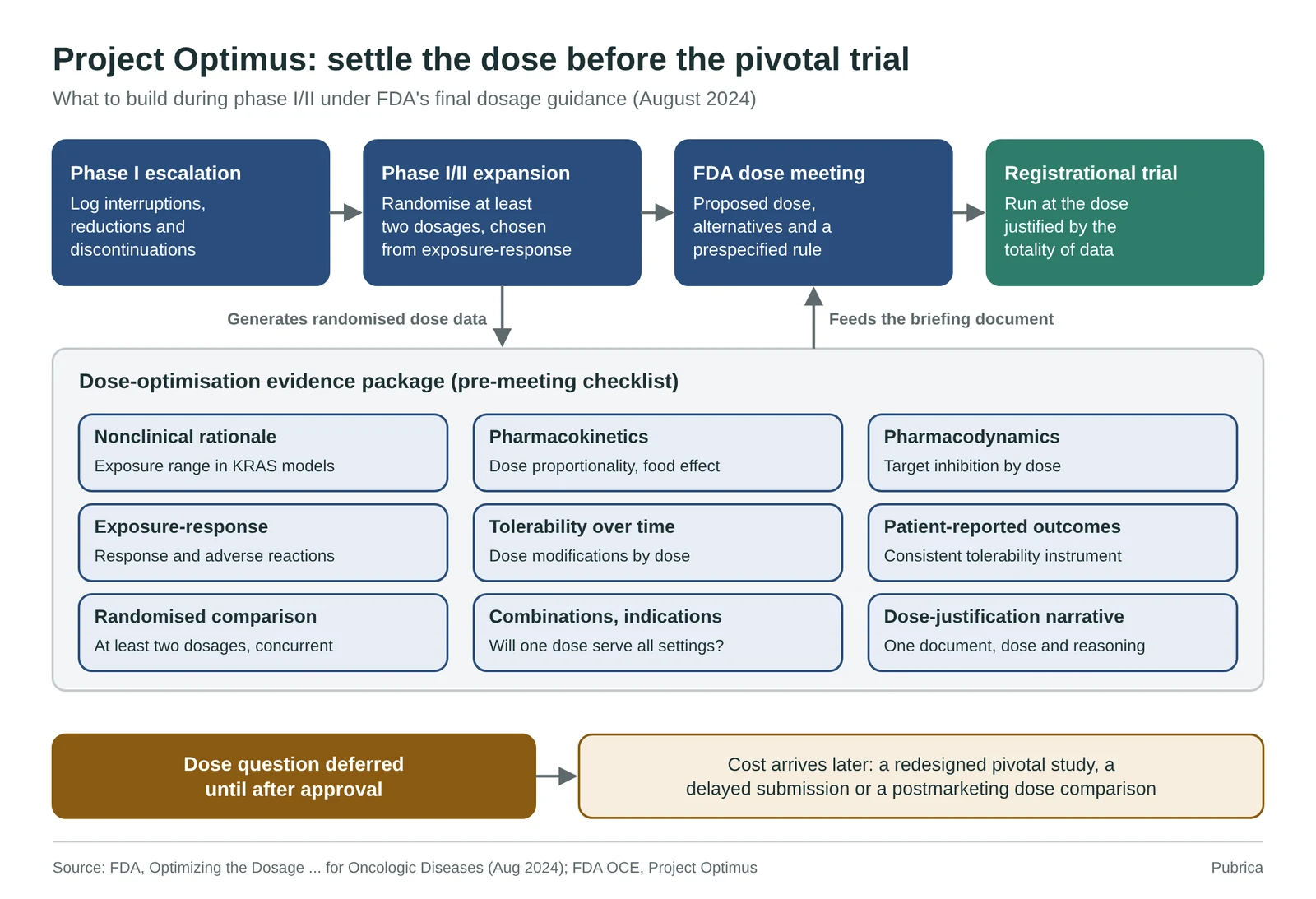
For a regulatory affairs lead at an emerging biotech, the practical consequence is simple: the question "why this dose?" is now asked at the end of phase I/II, not after approval. If the answer is thin, the cost arrives later as a redesigned pivotal study, a delayed submission or a postmarketing requirement to compare doses.
This brief summarises what the FDA's final guidance asks for, why KRAS-targeted programmes are a useful test case, and the evidence package to assemble before you request a meeting. It sits within our wider oncology and haematology research and publication support in the USA.
What the August 2024 FDA guidance on oncology dosage asks for
In August 2024 the FDA finalised Optimizing the Dosage of Human Prescription Drugs and Biological Products for the Treatment of Oncologic Diseases, replacing the January 2023 draft. It describes how sponsors should identify an optimised dosage during clinical development and before a marketing application. Like all FDA guidance, it is non-binding, and the final version places more emphasis on seeking product-specific advice from FDA because no single approach fits every programme.
The main expectations can be summarised as follows.
| Theme | What the guidance expects |
|---|---|
| Move away from MTD by default | Dose selection should draw on the totality of nonclinical and clinical data, not on tolerability alone |
| Compare more than one dosage | Activity, safety and tolerability of multiple dosages should be compared, ideally in a randomised, parallel dose-response design where feasible |
| Use clinical pharmacology | Pharmacokinetic, pharmacodynamic and exposure-response data should inform which dosages to compare |
| Measure tolerability properly | Dose interruptions, reductions and discontinuations and patient-reported outcomes count alongside serious adverse reactions |
| Talk to FDA early | Plans to support an application with data from more than one dosage should be discussed early in development |
Scope matters. The guidance does not cover the starting dose for first-in-human trials, and it excludes radiopharmaceuticals, cellular and gene therapies, oncolytics, microbiota-based products and cancer vaccines; it also does not specifically address paediatric development. A small-molecule KRAS inhibitor sits squarely within its scope.
Why KRAS-targeted programmes are a useful test case
Targeted therapies often show a plateau in activity well below the MTD, while chronic, lower-grade toxicities shape how long patients actually stay on treatment. The FDA has argued that the MTD approach is particularly poorly suited to such agents.
The KRAS G12C inhibitor sotorasib illustrates the point factually. When the FDA granted accelerated approval in May 2021 for previously treated KRAS G12C-mutated non-small cell lung cancer at 960 mg once daily, it also required a postmarketing trial comparing 960 mg with a lower daily dose, to establish whether a lower dose would have a similar clinical effect. The lower dose studied, 240 mg, was chosen from pharmacokinetic data and response rates in lower-dose cohorts of the escalation phase. A later randomised trial in colorectal cancer, CodeBreaK 300, included 960 mg and 240 mg arms in combination with panitumumab; the FDA's January 2025 approval in that setting is at 960 mg.
The lesson for sponsors developing the next generation of KRAS-directed agents is not about any one product. It is that a dose comparison deferred to the postmarketing period is now an outcome FDA actively seeks to avoid, and that a sponsor which arrives with randomised dose data is in a far stronger position.
Get a free dose-optimisation gap check
Send us one phase I/II development plan or protocol. Our clinical trial writers and biostatisticians will review it against the FDA's 2024 dosage guidance and list the evidence gaps to close before your registrational dose meeting.
The dose-optimisation evidence package: a pre-meeting checklist
Before requesting an FDA meeting to agree the registrational dose, check that your development plan can answer each of the following. Gaps are easier to close in an ongoing phase I/II study than after the pivotal protocol is written.
- Nonclinical rationale. Target engagement and efficacy across a range of exposures in relevant KRAS-mutant models, and the exposure margin to key toxicities.
- Pharmacokinetics. Dose proportionality, food effect, accumulation and inter-patient variability across the escalation cohorts; a prespecified PK sampling plan for the dose-finding trial.
- Pharmacodynamics. Evidence that the doses you plan to compare differ (or do not) in target inhibition, for example through pathway biomarkers or circulating tumour DNA, where such assays are validated for the purpose.
- Exposure-response. Analyses relating exposure to response and to adverse reactions, including dose modifications, rather than to nominal dose alone.
- Tolerability over time. Rates and timing of interruptions, reductions and discontinuations by dose, and the persistent low-grade toxicities (for example gastrointestinal or hepatic events) that drive them.
- Patient-reported outcomes. A tolerability instrument collected consistently enough to compare dosages.
- Randomised dose comparison. At least two dosages compared concurrently, or a justified reason why that is not feasible.
- Combination and indication questions. If the agent will be combined with another therapy, or developed across tumour types with different KRAS alleles, a plan for whether one dose will serve all settings.
- A written dose-justification narrative. One document that brings the above together and states the proposed dose and the reasoning.
Designing the randomised dose comparison
Sponsors often assume that a randomised dose comparison means a large, formally powered study. The guidance takes a more pragmatic position. The January 2023 draft stated that such a trial does not need to be powered to show superiority of one dosage or non-inferiority between dosages; it should be sized to allow a meaningful assessment of activity, safety and tolerability for each arm. Commentators have noted that the guidance stops short of prescribing statistical criteria for choosing the final dose, so the decision rule is something you should prespecify and discuss with the agency.
Practical design choices include:
- Number of arms. Two dosages is common, chosen from exposure-response modelling rather than simply the MTD and one step below.
- Adaptive features. An interim analysis that allows enrolment to stop in an arm failing prespecified safety or activity criteria.
- Endpoints. Objective response is usually the primary activity measure at this stage, supported by duration of response, dose-modification rates and PROs.
- Seamless designs. Dose arms can be added to a registrational trial, but if the trial aims to show superiority of a dosage over a control, strong control of the type I error rate is required, and that must be built into the statistical analysis plan.
Investigators who later publish the escalation phase will need to describe these choices clearly; our Academy guide on writing the methods of a phase I oncology dose-escalation paper covers how 3+3, BOIN and model-based designs are reported.
Practical tip
Tip: capture dose interruptions, reductions and discontinuations as analysable variables from the first escalation cohort. Recreating them later from adverse event narratives is slow and rarely convincing in a dose-justification package.
Timing the FDA conversation and the briefing document
Project Optimus explicitly encourages sponsors to meet FDA review divisions early, before the registration trial. In practice that means planning the dose-optimisation strategy while phase I is still recruiting, so the expansion cohorts can generate randomised data rather than being repurposed afterwards.
A briefing document for a dose-focused meeting usually works best when it:
- States the proposed registrational dose and one or more alternatives.
- Presents the evidence in the order the checklist above follows, with exposure-response figures rather than tables of nominal doses.
- Frames specific questions for the agency, for example whether the planned randomised comparison is adequate, or whether a further arm is needed for a combination.
- Shows how the decision rule will be applied, and what result would change the dose.
FDA's Oncology Center of Excellence also maintains an Oncology Dosing Tool Kit and a page on statistical designs for dose optimisation, which are useful references when drafting.
Common gaps in phase I/II development plans
Several recurring weaknesses make a dose justification harder to defend. They are worth checking for in any plan, whatever the indication.
- Expansion cohorts that enrol at a single dose, leaving no concurrent comparison.
- PK sampling that is too sparse in later cohorts to support exposure-response modelling.
- Dose modifications captured only as adverse event outcomes, not as analysable variables.
- No PRO tolerability measure, or one introduced part-way through.
- A statistical analysis plan that describes dose escalation in detail but says nothing about how the final dose will be chosen.
- Protocol language that commits the sponsor to an MTD-based recommended phase 2 dose without reference to the totality of data.
Each of these is cheaper to fix by protocol amendment during phase I/II than by redesigning the pivotal trial.
How Pubrica's clinical trial support helps
Pubrica's clinical trial support service is documentation, analysis and evidence; the sponsor remains the sponsor throughout. For a dose-optimisation programme, the relevant deliverables on that page are:
- Clinical development plans and target product profiles written so trials are designed backwards from the intended label.
- Protocols and amendments to the ICH M11 structured template, with critical-to-quality factors identified under ICH E8(R1).
- Statistical analysis plans with estimands framed under ICH E9(R1), sample size and analysis populations defined before database lock.
- Independent analysis, tables, listings and figures, and clinical study reports to ICH E3.
We do not monitor sites, manage patients or accept a transfer of sponsor obligations under 21 CFR 312.52. Writers and statisticians are matched by therapeutic area, and each document is reviewed by a trial methodologist and quality-checked before delivery.
Pubrica works with pharmaceutical and biotech companies across the life sciences sector, drawing on subject experts in pharmaceuticals.
Frequently asked questions
No. The August 2024 guidance is non-binding and reflects FDA's current thinking. In practice, sponsors who depart from it should expect to explain why, and FDA encourages product-specific discussion early in development.
The 2023 draft stated that it does not; the trial should be sized to assess activity, safety and tolerability of each dosage. Confirm the current wording in the final guidance and agree your decision rule with FDA.
No. Starting-dose selection for first-in-human trials is outside its scope. It also excludes radiopharmaceuticals, cellular and gene therapies, oncolytics, microbiota products and cancer vaccines.
Before the registration trial is designed, ideally while phase I/II is still enrolling, so that expansion cohorts can generate a randomised comparison of dosages.
Sources
Sources were checked on 24 November 2026. Requirements and guidance may change after that date; confirm the current version with the issuing body.
- 1US Food and Drug Administration. Optimizing the Dosage of Human Prescription Drugs and Biological Products for the Treatment of Oncologic Diseases: Guidance for Industry. August 2024. https://www.fda.gov/regulatory-information/search-fda-guidance-documents/optimizing-dosage-human-prescription-drugs-and-biological-products-treatment-oncologic-diseases
- 2Federal Register. Optimizing the Dosage of Human Prescription Drugs and Biological Products for the Treatment of Oncologic Diseases; Guidance for Industry; Availability. Docket FDA-2022-D-2827. 9 August 2024. https://downloads.regulations.gov/FDA-2022-D-2827-0025/content.htm
- 3FDA Oncology Center of Excellence. Project Optimus. https://www.fda.gov/about-fda/oncology-center-excellence/project-optimus
- 4FDA Oncology Center of Excellence. Statistical Designs and Considerations for Dose Optimization, Drug Combination and Multiple Indication. https://www.fda.gov/about-fda/oncology-center-excellence/statistical-designs-and-considerations-dose-optimization-drug-combination-and-multiple-indication
- 5FDA Oncology Center of Excellence. Oncology Dosing Tool Kit. https://www.fda.gov/about-fda/oncology-center-excellence/oncology-dosing-tool-kit
- 6US Food and Drug Administration. FDA grants accelerated approval to sotorasib for KRAS G12C-mutated NSCLC. May 2021. https://www.fda.gov/drugs/resources-information-approved-drugs/fda-grants-accelerated-approval-sotorasib-kras-g12c-mutated-nsclc
- 7US Food and Drug Administration. NDA 214665 accelerated approval letter (Lumakras). 2021. https://www.accessdata.fda.gov/drugsatfda_docs/nda/2021/214665rig1s000ltr.pdf
- 8US Food and Drug Administration. FDA approves sotorasib with panitumumab for KRAS G12C-mutated colorectal cancer. January 2025. https://www.fda.gov/drugs/resources-information-approved-drugs/fda-approves-sotorasib-panitumumab-kras-g12c-mutated-colorectal-cancer
FDA Project Optimus dose optimizationoncology dose optimization guidancerandomized dose comparisonexposure-response oncologyKRAS inhibitor dose selectionrecommended phase 2 dose
How to cite this article
Pick your referencing style and copy it. Your university or target journal may vary the punctuation, so check its guide if it has one.
Pubrica Insights. (2026, November 24). FDA Project Optimus for US Biotechs: The Dose-Optimisation Evidence Needed Before a Registrational Trial in KRAS-Mutant Solid Tumours. Pubrica. https://pubrica.com/insights/fda-project-optimus-oncology-dose-optimisation/
This article is written to be learned from. Cite it if you are referring to what it says; if you are using the evidence behind it, cite the sources listed above instead.
Next steps
Get a free dose-optimisation gap check
Send us one phase I/II development plan or protocol. Our clinical trial writers and biostatisticians will review it against the FDA's 2024 dosage guidance and list the evidence gaps to close before your registrational dose meeting.
This article is general information for researchers, not legal, regulatory or funding advice. Check the current requirements of your journal, funder, ethics committee or regulator before you act on it.
More in Regulatory Intelligence