Contents
On this page
- Quick answer
- When real-world evidence can support an oncology label expansion
- What FDA guidance asks of registry and EHR data
- A public example: palbociclib in men with HR+/HER2- breast cancer
- Designing the study: emulate the trial you cannot run
- Where metastatic breast cancer data break down
- Checklist: is your RWE study concept ready?
- How Pubrica supports RWE and registry studies
- Frequently asked questions
- Sources
InsightsMarket Access & Evidence
ExplainerUSA
Real-World Evidence for Oncology Label Expansion in the USA: Designing Registry and EHR Studies for Metastatic Breast Cancer
Real-world data can support a new indication for an approved oncology drug, but only when the question, the data source and the design are fit for the regulatory decision. This guide sets out how to plan a registry or EHR study for HR+/HER2- metastatic breast cancer before money is spent on data access.
- Market Access & Evidence
- Oncology & haematology
- RWE & registry data analysis
- Topic
- Market Access & Evidence
- Written by
- Pubrica Insights
At a glanceMarket Access & Evidence
Request a QuoteDiscuss your project
Quick answer
- FDA's 2018 Real-World Evidence Framework focuses first on using RWE to support new indications for drugs that are already approved, and on post-approval study requirements.
- FDA weighs three things: whether the real-world data are fit for use, whether the design can provide adequate evidence, and whether the study meets regulatory requirements.
- In HR+/HER2- metastatic breast cancer, the hardest variables are often in unstructured EHR text: receptor status, line of therapy, progression and response.
- Pre-specify the protocol and analysis plan, emulate a target trial, and plan sensitivity analyses before the data are analysed.
- The 2019 palbociclib approval in men shows that RWE can support a narrow expansion when randomised data in a related population already exist.
When real-world evidence can support an oncology label expansion
For an approved oncology drug, the question is rarely whether real-world data (RWD) exist. It is whether a study built on them can answer a regulatory question well enough for FDA to rely on it. That decision should be made before data licences are signed.
The 21st Century Cures Act added section 505F to the Federal Food, Drug, and Cosmetic Act, which required FDA to evaluate the use of real-world evidence (RWE) to help support approval of a new indication for an approved drug and to help satisfy post-approval study requirements. FDA's December 2018 Framework for its RWE Program responded to that mandate and said its initial focus would be new indications for drugs already on the market.
RWE is most persuasive for label expansion when the new population is closely related to one already studied in randomised trials, when a randomised trial is impractical (for example, a rare subgroup), and when the outcomes can be measured reliably in routine care. It is least persuasive when the expected effect is small, when treatment choice depends on prognosis in ways the data do not capture, or when the endpoint relies on assessments that are not recorded consistently.
For teams across our oncology and haematology support for US life-science teams, this is usually the first conversation: is this a question RWD can answer, or does it need a trial?
What FDA guidance asks of registry and EHR data
Several FDA documents now shape how a drug sponsor plans an RWD study. All are guidance, not regulation, but reviewers read submissions against them.
| Document | Status | What it covers |
|---|---|---|
| Framework for FDA's Real-World Evidence Program | December 2018 | Programme scope; evaluation of RWD fitness, study design and regulatory conduct |
| Real-World Data: Assessing Registries to Support Regulatory Decision-Making | Final, December 2023 | Relevance and reliability of registry data, including registries run by other organisations; not study design or statistical methods |
| Considerations for the Use of RWD and RWE to Support Regulatory Decision-Making | Final, August 2023 | IND requirements for studies using RWD; non-interventional study considerations; FDA access to patient-level data |
| Real-World Data: Assessing EHR and Medical Claims Data | Final, July 2024 | Data source selection, definitions and validation of exposures, outcomes and covariates |
| Considerations for the Design and Conduct of Externally Controlled Trials | Draft, February 2023 | Patient-level external controls, pre-specification of protocol and analysis plan |
Two practical points stand out. First, if another organisation owns the data, agreements should allow FDA to access patient-level records. Second, the 2023 considerations guidance encourages sponsors to consult FDA early when they plan to use a non-interventional study to support a marketing application. The device-side equivalent was finalised separately; see our brief on the FDA real-world evidence guidance for medical devices, which is a different document from the drug guidances above.
A public example: palbociclib in men with HR+/HER2- breast cancer
On 4 April 2019, FDA approved an expansion of the palbociclib (Ibrance) indication to include men with HR+, HER2- advanced or metastatic breast cancer, in combination with an aromatase inhibitor or fulvestrant. Pfizer described the approval as based predominantly on real-world data, drawn from electronic health records and post-marketing reports in three sources: IQVIA insurance data, the Flatiron Health breast cancer database and Pfizer's global safety database.
Three features of this example are worth noting when you plan your own study:
- A related randomised evidence base already existed. The drug had randomised trial evidence in women; the RWE addressed whether that evidence applied to a rare population that is hard to enrol.
- The question was narrow. The study did not try to establish efficacy from scratch.
- Safety was assessed alongside effectiveness. Limited EHR and post-marketing data were used to check that the safety profile in men was consistent with that in women.
This is one example, not a template. It does not mean RWE will support an expansion in a different setting, and the sample sizes involved were small.
Request a feasibility review of your RWE study concept
Send one study concept and the data source you are considering. We assess whether the data can answer the question and confirm the design, deliverables and fee.
Designing the study: emulate the trial you cannot run
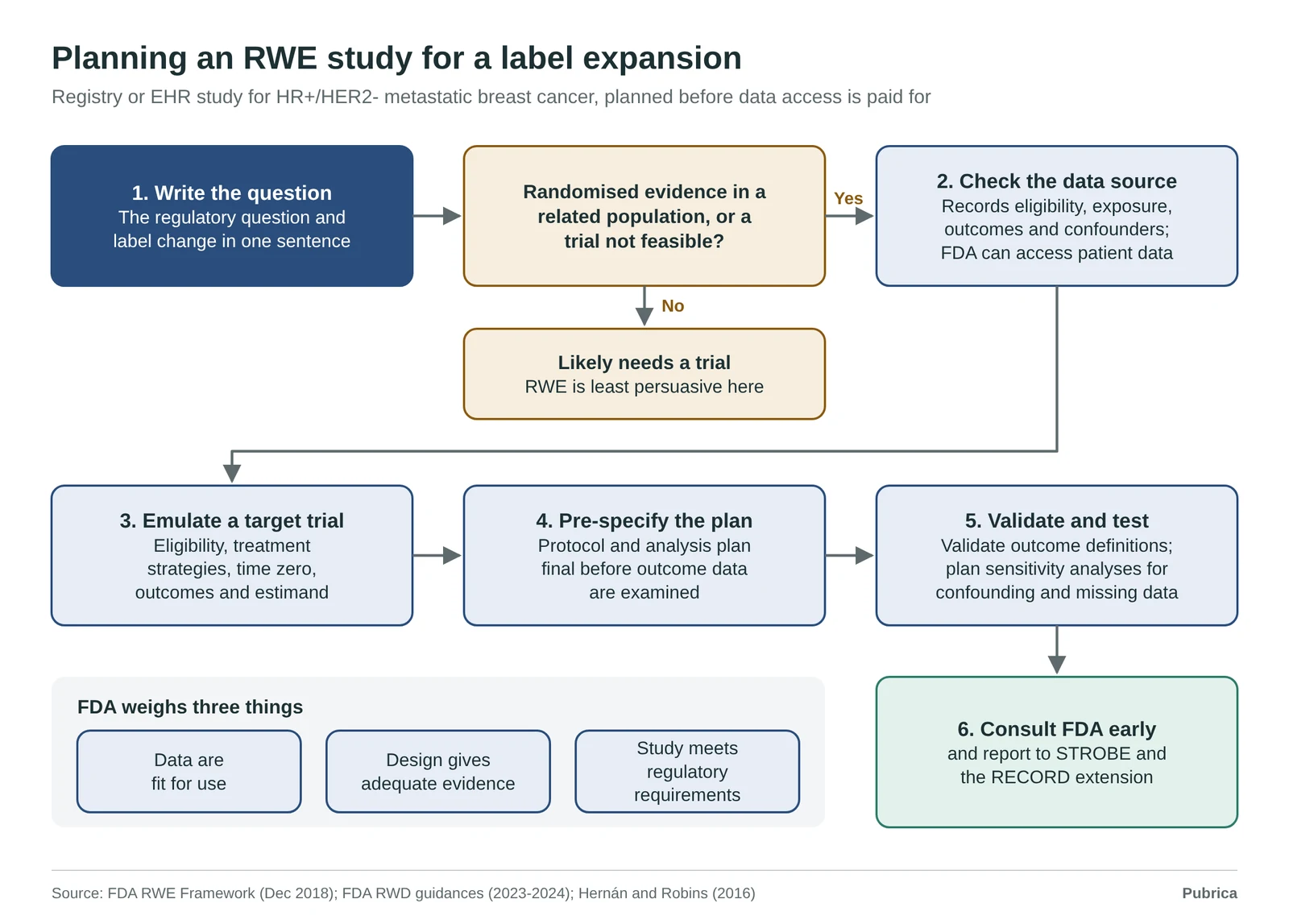
Target trial emulation, described by Hernán and Robins in 2016, starts by writing the protocol of the randomised trial you would ideally run, then designs the observational analysis to mirror it. For an HR+/HER2- metastatic breast cancer question, that means specifying:
- Eligibility: receptor status confirmed from pathology, metastatic diagnosis date, menopausal status where relevant, prior endocrine therapy and the setting in which it was given.
- Treatment strategies: the regimens compared, and the line of therapy, defined by an algorithm agreed in advance.
- Time zero: the date treatment starts, aligned with eligibility, to avoid immortal time bias.
- Outcomes: real-world progression, time to next treatment and overall survival, each with a written definition and source.
- Causal contrast and analysis: the estimand, the confounders measured, and the method used to balance them (for example, propensity score weighting).
The protocol and statistical analysis plan should be final before outcome data are examined. That record is what lets a reviewer see that the analysis was not chosen after the results were known.
Where metastatic breast cancer data break down
Much of what an oncology study needs sits in unstructured EHR text rather than coded fields. In HR+/HER2- metastatic breast cancer, the following problems recur:
- Receptor status may be recorded in pathology reports, and can change between primary tumour and metastatic biopsy. Decide which result defines eligibility.
- Line of therapy is rarely recorded directly. It is derived from regimen sequences, and different rules give different answers.
- Progression in routine care is not assessed to RECIST at fixed intervals. Real-world progression usually relies on clinician documentation or imaging reports abstracted from the chart, so the abstraction method and its reliability must be described.
- Death may be incomplete in a single EHR source and may need linkage to another source.
- Claims data show what was dispensed and billed, but not tumour characteristics or response.
The July 2024 FDA guidance on EHR and claims data includes sections on defining and validating outcomes. Plan validation work, such as comparing an algorithm against chart review in a sample, as part of the study, not as an afterthought.
Practical tip
Do not license data before the question and design are fixed. The most expensive RWE failure is discovering, after access is paid for, that the source does not record the variable that defines eligibility or the outcome.
Checklist: is your RWE study concept ready?
Before commissioning data access or analysis, check that you can answer yes to each item:
- The regulatory question and the proposed label change are written in one sentence.
- Randomised evidence in a related population exists, or there is a clear reason a trial is not feasible.
- The data source records eligibility, exposure, outcomes and key confounders, and you have checked this on a data dictionary, not a sales summary.
- FDA can be given access to patient-level data under the data agreement.
- A target trial protocol is drafted, with time zero, treatment strategies and the estimand defined.
- Outcome definitions have a validation plan.
- Sensitivity analyses for unmeasured confounding, missing data and alternative definitions are listed.
- Reporting will follow STROBE and the RECORD extension for routinely collected data.
- A plan exists for early discussion with FDA.
How Pubrica supports RWE and registry studies
Pubrica's real-world evidence and registry data analysis service starts with the question and the data, not the analysis. The process on the service page has five stages: a question and data review that assesses whether the available data can answer it; a protocol and analysis plan agreed and documented before analysis; cohort construction and the planned analyses, with code reviewed; sensitivity analyses; and reporting to STROBE and RECORD.
The team works with registries, EHR, claims and linked datasets, subject to the access arrangements and approvals for each source, and uses target trial emulation where a causal question is asked of observational data. Deliverables include the protocol and statistical analysis plan, analysis code and code lists, results tables and figures, study report or manuscript sections and a sensitivity analysis summary. Specialists in data mining support cohort and variable derivation from routine data.
We work with pharma and biotech teams across the life sciences sector. For the study design principles behind this article in more depth, see our related Academy guide on real-world evidence study design for oncology.
Frequently asked questions
It has done so in narrow cases, such as the 2019 palbociclib expansion to men, where randomised evidence already existed in a related population. In most settings RWE supplements other evidence. Discuss the plan with FDA early.
It depends on the question. EHR-derived data can capture tumour characteristics and treatment detail but need abstraction and validation; registries may have structured clinical variables but can be limited in size or follow-up. FDA has separate guidance on each.
Common examples are real-world progression, time to next treatment and overall survival. Each needs a written definition, a documented source and, ideally, validation against chart review.
The service page describes study design, analysis and STROBE- and RECORD-compliant reporting so that the evidence can be assessed by journals, regulators and payers. Regulatory strategy and submission remain with the sponsor and its regulatory team.
Sources
Sources were checked on 24 November 2026. Requirements and guidance may change after that date; confirm the current version with the issuing body.
- 1US Food and Drug Administration. Framework for FDA's Real-World Evidence Program. December 2018. https://www.fda.gov/media/120060/download
- 2US Food and Drug Administration. Real-World Data: Assessing Registries to Support Regulatory Decision-Making for Drug and Biological Products. Final guidance, December 2023. https://www.fda.gov/regulatory-information/search-fda-guidance-documents/real-world-data-assessing-registries-support-regulatory-decision-making-drug-and-biological-products
- 3US Food and Drug Administration. Considerations for the Use of Real-World Data and Real-World Evidence to Support Regulatory Decision-Making for Drug and Biological Products. Final guidance, August 2023. https://www.fda.gov/regulatory-information/search-fda-guidance-documents/considerations-use-real-world-data-and-real-world-evidence-support-regulatory-decision-making-drug
- 4US Food and Drug Administration. Real-World Data: Assessing Electronic Health Records and Medical Claims Data to Support Regulatory Decision-Making for Drug and Biological Products. Final guidance, July 2024. https://www.fda.gov/regulatory-information/search-fda-guidance-documents/real-world-data-assessing-electronic-health-records-and-medical-claims-data-support-regulatory
- 5US Food and Drug Administration. Considerations for the Design and Conduct of Externally Controlled Trials for Drug and Biological Products. Draft guidance, February 2023. https://www.fda.gov/media/164960/download
- 6Pfizer. U.S. FDA Approves IBRANCE (palbociclib) for the Treatment of Men with HR+, HER2- Metastatic Breast Cancer. Press release, 4 April 2019. https://www.pfizer.com/news/press-release/press-release-detail/u_s_fda_approves_ibrance_palbociclib_for_the_treatment_of_men_with_hr_her2_metastatic_breast_cancer
- 7Hernán MA, Robins JM. Using Big Data to Emulate a Target Trial When a Randomized Trial Is Not Available. Am J Epidemiol. 2016;183(8):758-764. https://pubmed.ncbi.nlm.nih.gov/26994063/
- 8Benchimol EI, et al. The REporting of studies Conducted using Observational Routinely-collected health Data (RECORD) statement. PLoS Med. 2015;12(10):e1001885. https://pubmed.ncbi.nlm.nih.gov/26440803/
real-world evidence oncology label expansionFDA real-world evidence frameworkEHR-derived real-world data oncologyregistry data regulatory decision-makingtarget trial emulationHR+/HER2- metastatic breast cancer real-world data
How to cite this article
Pick your referencing style and copy it. Your university or target journal may vary the punctuation, so check its guide if it has one.
Pubrica Insights. (2026, November 24). Real-World Evidence for Oncology Label Expansion in the USA: Designing Registry and EHR Studies for Metastatic Breast Cancer. Pubrica. https://pubrica.com/insights/rwe-for-us-oncology-label-expansion/
This article is written to be learned from. Cite it if you are referring to what it says; if you are using the evidence behind it, cite the sources listed above instead.
Next steps
Request a feasibility review of your RWE study concept
Send one study concept and the data source you are considering. We assess whether the data can answer the question and confirm the design, deliverables and fee.
This article is general information for researchers, not legal, regulatory or funding advice. Check the current requirements of your journal, funder, ethics committee or regulator before you act on it.
More in Market Access & Evidence