Contents
On this page
- Quick answer
- Why ICH S9 frames a first-in-human ADC package
- What the ICH S9 package contains before a first-in-human trial
- ADC-specific questions reviewers will ask
- The 2026 FDA draft on streamlined studies for conjugated products
- A pre-IND gap check for your nonclinical package
- How a literature-based pharmacology and toxicology evaluation helps
- Frequently asked questions
- Sources
InsightsRegulatory Intelligence
Regulatory briefUSA
ICH S9 for First-in-Human Antibody-Drug Conjugate Trials: The Nonclinical Pharmacology and Toxicology Package US Biotechs Need
ICH S9 allows a leaner nonclinical package for advanced-cancer trials, but ADCs raise their own questions about species, analytes and payload. This brief sets out what a US biotech should have ready before a pre-IND meeting.
- Regulatory Intelligence
- Oncology & haematology
- Pharmacological & toxicological evaluation (Discovery & intelligence)
- Topic
- Regulatory Intelligence
- Written by
- Pubrica Insights
At a glanceRegulatory Intelligence
Request a QuoteDiscuss your project
Quick answer
- ICH S9 (2009; FDA final guidance March 2010) and its 2018 Q&A set the nonclinical expectations for FIH trials in advanced cancer, including ADC trials.
- Before FIH: pharmacology, toxicokinetics and repeat-dose toxicology that reflects the clinical schedule; genotoxicity and embryo-fetal studies can generally wait until marketing.
- For ADCs, the intact conjugate is the main test article; species relevance, linker stability and the choice of analytes are the questions reviewers ask most.
- The FDA's May 2026 draft would allow a rodent-only 3-month study for some ADCs with well-characterised payloads, but it is still a draft.
- A cited, graded literature evaluation of the payload class and approved-ADC precedent supports the weight-of-evidence case.
Why ICH S9 frames a first-in-human ADC package
If your team is preparing an IND for a first-in-human (FIH) trial of an antibody-drug conjugate (ADC) in HER2-expressing solid tumours, the nonclinical package will be judged mainly against ICH S9, Nonclinical Evaluation for Anticancer Pharmaceuticals. S9 reached Step 4 in October 2009 and the FDA published it as final guidance in March 2010. Its scope is pharmaceuticals for patients with advanced cancer and limited therapeutic options, which is why it allows a leaner and faster package than standard development.
Two other documents sit beside it. The ICH S9 Questions and Answers (Step 4 in April 2018, issued by the FDA in June 2018) clarify how S9 is applied, including when one species may be enough. ICH S6(R1), for biotechnology-derived products, governs much of the antibody side of an ADC. There is still no ICH guideline written only for ADCs, so a sponsor has to show how the principles for small molecules and biologics have been combined for its own construct.
The HER2 setting adds precedent. The FDA has approved HER2-directed ADCs, and in April 2024 it granted accelerated approval to fam-trastuzumab deruxtecan for previously treated unresectable or metastatic HER2-positive (IHC 3+) solid tumours. Precedent of this kind helps you predict which toxicities reviewers will expect you to have looked for. It does not replace data on your own molecule.
Pubrica's ICH guidelines overview summarises the wider ICH framework. This brief concentrates on the decisions a nonclinical lead has to make before the pre-IND meeting.
What the ICH S9 package contains before a first-in-human trial
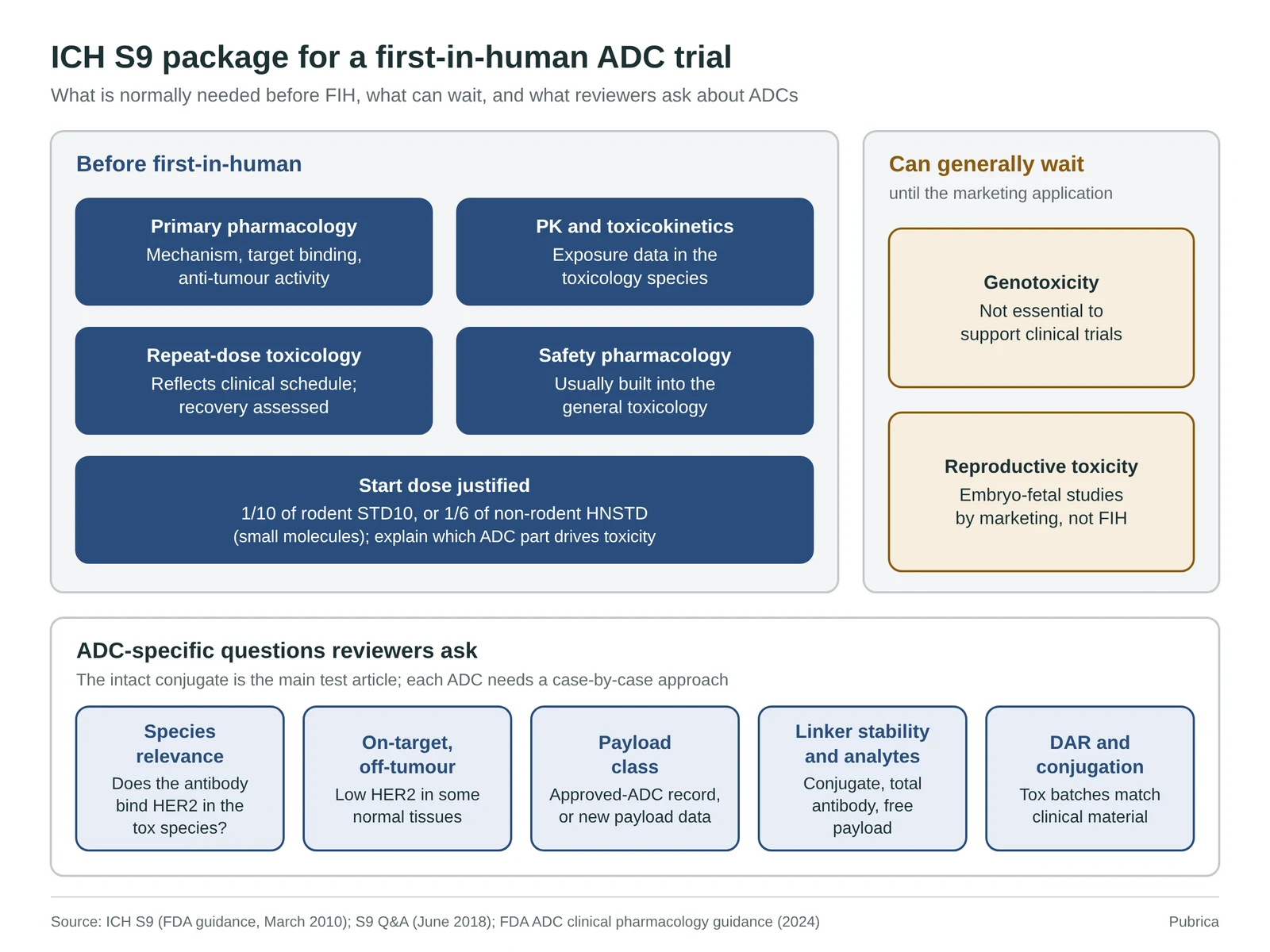
S9 lists what is normally needed to start a clinical trial in advanced cancer and what can wait until the marketing application. The table summarises the main elements. Always confirm the detail against the guideline and the Q&A text for your own programme.
| Element | Expectation before FIH under S9 | ADC-specific question |
|---|---|---|
| Primary pharmacology | Mechanism, target binding and anti-tumour activity in relevant models | Does activity track HER2 expression level? Is a bystander effect expected? |
| Pharmacokinetics and toxicokinetics | Exposure data in the toxicology species | Which analytes: conjugate, total antibody, unconjugated payload? |
| General toxicology | Repeat-dose studies that reflect the intended clinical schedule, with an assessment of whether toxicity can recover | Is the intact ADC the test article, and is it stable in the species used? |
| Safety pharmacology | Can usually be built into the general toxicology studies | Are cardiovascular, respiratory and CNS endpoints covered there? |
| Genotoxicity | Not considered essential to support clinical trials; needed for marketing | Is published genotoxicity data on the payload class enough to inform the first trial? |
| Reproductive toxicity | Embryo-fetal studies are generally expected by the marketing application, not before FIH | Does the payload mechanism already predict embryo-fetal risk? |
| Start dose | Justified from the most appropriate toxicology species | Rodent STD10, non-rodent HNSTD, or a pharmacology-based approach? |
For small molecules, S9 describes a start dose of one-tenth of the dose severely toxic to 10% of rodents (STD10), or one-sixth of the highest non-severely toxic dose (HNSTD) when a non-rodent is the more appropriate species. For biopharmaceuticals, S9 also refers to pharmacology-based approaches such as the minimum anticipated biological effect level (MABEL) for some immune-activating products. For an ADC, the rationale has to explain which component drives toxicity in the species chosen.
ADC-specific questions reviewers will ask
S9 has a section on conjugated products. In practice the intact conjugate is the main test article, and the components that are not conjugated, including the linker and free payload, are assessed in a more limited, risk-based way. Published reviews of ADC nonclinical strategy agree that each ADC needs a case-by-case, science-based approach rather than a fixed checklist.
The questions that most often decide whether a package is ready are these:
- Species relevance. Does the antibody bind HER2 in the toxicology species with comparable affinity? If not, a study in that species can show payload and off-target toxicity but will not show on-target, off-tumour effects.
- On-target, off-tumour risk. HER2 is expressed at low levels in some normal tissues. Tissue cross-reactivity and expression data help to predict where on-target toxicity might appear.
- Payload class. A payload already used in approved ADCs comes with a published toxicity record. A new payload needs more of its own characterisation.
- Linker stability and analytes. The FDA's clinical pharmacology guidance on ADCs (finalised in March 2024) defines terms such as total antibody, unconjugated antibody and unconjugated payload. Using the same terms in your toxicokinetic plan makes the step from nonclinical to clinical easier to follow.
- Drug-to-antibody ratio and conjugation method. Toxicology batches should be representative of the clinical material, and any differences should be explained.
Linker chemistry, conjugation site and payload release make up the delivery system. Reviewing them with a drug delivery system specialist helps you decide whether earlier published data on a linker and payload really apply to your construct.
Practical tip
ICH S9 sets out principles, not a fixed protocol. Treat any summary, this one included, as a starting point, and quote the guideline, the Q&A and current FDA guidance directly in your pre-IND briefing package.
Get a gap check of one planned nonclinical package
Send us your planned FIH package for one ADC and we will set out how it maps to ICH S9 and the S9 Q&A, and where the published evidence supports or weakens your justification. Mutual NDA available before you share anything.
The 2026 FDA draft on streamlined studies for conjugated products
In May 2026 the FDA released a draft guidance, Oncology Pharmaceuticals: Streamlined Nonclinical Safety Studies for Biologics and Conjugated Products. It supplements ICH S9 and the S9 Q&A, and the comment period closed on 30 July 2026 (docket FDA-2026-D-2839).
For ADCs with cytotoxic payloads, the draft describes a case where the payload is well characterised and is the main driver of toxicity. In that case, the 3-month study could be conducted in rodents only, using the ADC or the payload as appropriate. The draft relies on a weight-of-evidence assessment. Public comments have asked the FDA to define a "well-characterised" payload and to address on-target, off-tumour toxicity that a rodent-only or payload-only study would not capture.
Three practical points follow:
- A draft guidance is not binding and may change. Check its status on the FDA website before you build a plan around it.
- The draft mainly affects later general toxicology. Your FIH package still needs a defensible species and start-dose rationale.
- A weight-of-evidence argument is only as good as the evidence behind it. Published data on the payload class, the toxicities seen with approved ADCs that share it, and your own early studies all need to be assembled and cited.
A pre-IND gap check for your nonclinical package
Before you send pre-IND questions to the FDA, check the planned package against this list. Each "no" is either a gap to close or a point to justify in writing.
- The scope argument is clear: the trial population fits S9's advanced-cancer scope.
- Species selection is justified by HER2 binding data for the antibody and by knowledge of the payload's toxicity.
- The intact ADC is the main test article, and its stability in each species has been characterised.
- Toxicokinetic analytes are defined (conjugate, total antibody, unconjugated payload) and linked to the bioanalytical plan.
- The dosing schedule in the toxicology studies reflects the proposed clinical schedule.
- Recovery is assessed where it is needed to interpret findings.
- Safety pharmacology endpoints are built into the general toxicology studies, or the absence of stand-alone studies is justified.
- The start-dose calculation is written out, with the species, the endpoint (STD10 or HNSTD) and any pharmacology-based cross-check.
- Expected toxicities are mapped against published data for the payload class and for approved ADCs, with each source cited.
- Studies deferred to the marketing application (genotoxicity, embryo-fetal toxicity) are listed with the S9 basis for deferring them.
- Any reliance on the 2026 FDA draft is flagged as reliance on a draft.
How a literature-based pharmacology and toxicology evaluation helps
Most of the weight-of-evidence work above is secondary research. It means finding, reading and grading what is already known about the target, the antibody class, the linker and the payload, and then setting it against S9 and the Q&A. It is also where a small nonclinical team often has the least time.
Pubrica's pharmacological and toxicological evaluation compiles pharmacodynamic, pharmacokinetic and toxicology parameters from the published literature to inform safe dosing, bioavailability and potential contraindications. The service page states that every search follows a documented strategy, that evidence is graded by study design and that each source is traceable and dated. Its Advanced package includes a safety, pharmacological and toxicological profile alongside mechanism-of-action evidence mapping.
Be clear about what this work is not. Pubrica does not run laboratory, GLP or clinical studies. The evaluation does not replace your toxicology CRO, your study reports or your regulatory strategy. What it gives you is an organised, cited evidence base that your team, your CRO and your regulatory writers can use when they design studies and draft the nonclinical overview.
For example, a gap check might take one planned package and set out, for each S9 element, what is planned, what published evidence supports the approach, and where the justification is still thin.
Pubrica works with pharmaceutical and biotech teams across the life sciences sector. If you are also choosing which oncology targets to take forward, our Academy guide on what a reproducible target and biomarker landscape should deliver covers the step before this one. Our wider oncology and haematology support in the USA brings together research, writing and publication services for US teams.
Frequently asked questions
For patients with advanced cancer and limited therapeutic options, ICH S9 is the main reference for nonclinical expectations, with ICH S6(R1) relevant to the antibody component. If the intended population falls outside S9's scope, for example an adjuvant setting with a high cure rate, the S9 Q&A indicates that more extensive studies may be needed.
Under ICH S9, genotoxicity studies are not considered essential to support clinical trials in advanced cancer, but they are expected to support a marketing application. Published data on the payload class are often discussed in the IND regardless.
The FDA's May 2026 draft guidance describes a case, a well-characterised cytotoxic payload that drives toxicity, where the 3-month study could be rodent-only. It is a draft, it relies on a weight-of-evidence assessment, and it is not intended to remove the need for a justified species choice for first-in-human studies.
No. Pubrica provides secondary research and intelligence: literature-based pharmacology and toxicology evaluation, evidence grading and regulatory landscape intelligence. Laboratory and GLP studies are run by your CRO.
Sources
Sources were checked on 24 November 2026. Requirements and guidance may change after that date; confirm the current version with the issuing body.
- 1ICH / US FDA. Guidance for Industry: S9 Nonclinical Evaluation for Anticancer Pharmaceuticals. March 2010. https://www.fda.gov/media/73161/download
- 2US FDA. S9 Nonclinical Evaluation for Anticancer Pharmaceuticals: Questions and Answers. Guidance for Industry. June 2018. https://www.fda.gov/regulatory-information/search-fda-guidance-documents/s9-nonclinical-evaluation-anticancer-pharmaceuticals-questions-and-answers
- 3Federal Register. International Conference on Harmonisation; Guidance on S9 Nonclinical Evaluation for Anticancer Pharmaceuticals; Availability. 8 March 2010. https://www.federalregister.gov/documents/2010/03/08/2010-4841/international-conference-on-harmonisation-guidance-on-s9-nonclinical-evaluation-for-anticancer
- 4US FDA. Oncology Pharmaceuticals: Streamlined Nonclinical Safety Studies for Biologics and Conjugated Products. Draft Guidance for Industry. May 2026. https://www.fda.gov/regulatory-information/search-fda-guidance-documents/oncology-pharmaceuticals-streamlined-nonclinical-safety-studies-biologics-and-conjugated-products
- 5US FDA. Clinical Pharmacology Considerations for Antibody-Drug Conjugates. Guidance for Industry. March 2024. https://www.fda.gov/regulatory-information/search-fda-guidance-documents/clinical-pharmacology-considerations-antibody-drug-conjugates-guidance-industry
- 6US FDA. FDA grants accelerated approval to fam-trastuzumab deruxtecan-nxki for unresectable or metastatic HER2-positive solid tumors. 5 April 2024. https://www.fda.gov/drugs/resources-information-approved-drugs/fda-grants-accelerated-approval-fam-trastuzumab-deruxtecan-nxki-unresectable-or-metastatic-her2
- 7Roberts SA, Andrews PA, Blanset D, et al. Considerations for the nonclinical safety evaluation of antibody drug conjugates for oncology. Regul Toxicol Pharmacol. 2013;67(3):382-391. https://doi.org/10.1016/j.yrtph.2013.08.017
- 8Lansita JA, Burke JM, Apgar JF, Mounho-Zamora B. An introduction to the regulatory and nonclinical aspects of the nonclinical development of antibody drug conjugates. Pharm Res. 2015;32(11):3584-3592. https://doi.org/10.1007/s11095-015-1742-y
- 9Liu F. Safety assessment of antibody-drug conjugates: nonclinical toxicology, non-active ingredients, and environmental risk considerations. Crit Rev Oncol Hematol. 2025;215:104865. https://doi.org/10.1016/j.critrevonc.2025.104865
ICH S9 nonclinical evaluation anticancerICH S9 antibody-drug conjugateADC nonclinical toxicologyfirst-in-human start dose HNSTDICH S9 Q&A 2018pre-IND nonclinical package
How to cite this article
Pick your referencing style and copy it. Your university or target journal may vary the punctuation, so check its guide if it has one.
Pubrica Insights. (2026, November 24). ICH S9 for First-in-Human Antibody-Drug Conjugate Trials: The Nonclinical Pharmacology and Toxicology Package US Biotechs Need. Pubrica. https://pubrica.com/insights/ich-s9-nonclinical-data-for-oncology-adcs/
This article is written to be learned from. Cite it if you are referring to what it says; if you are using the evidence behind it, cite the sources listed above instead.
Next steps
Get a gap check of one planned nonclinical package
Send us your planned FIH package for one ADC and we will set out how it maps to ICH S9 and the S9 Q&A, and where the published evidence supports or weakens your justification. Mutual NDA available before you share anything.
This article is general information for researchers, not legal, regulatory or funding advice. Check the current requirements of your journal, funder, ethics committee or regulator before you act on it.
More in Regulatory Intelligence