Contents
On this page
- Quick answer
- The decision in front of a research integrity officer
- What the revised 42 CFR Part 93 means for the early stages
- What an independent forensic examination can and cannot do
- Before you commission: a seven-point checklist
- Scoping an audit of CLL preclinical image and flow cytometry data
- What a usable forensic report looks like
- Working with journals while the proceeding runs
- How Pubrica's forensic and quality audit supports an inquiry
- Frequently asked questions
- Sources
InsightsRegulatory Intelligence
Decision guideUSA
Before a Misconduct Inquiry at a US Cancer Centre: Commissioning an Independent Image and Data Forensic Audit Under 42 CFR Part 93
When an allegation concerns blots, flow plots or microscopy in a leukaemia lab, the inquiry clock is already running. Here is how to scope and commission an independent forensic examination that a committee, ORI and journals can rely on.
- Regulatory Intelligence
- Oncology & haematology
- Forensic & quality audit
- Topic
- Regulatory Intelligence
- Written by
- Pubrica Insights
At a glanceRegulatory Intelligence
Request a QuoteDiscuss your project
Quick answer
- Revised 42 CFR Part 93 applies to allegations received on or after 1 January 2026; inquiries have a 90-day and investigations a 180-day time limit.
- Commission forensic work on sequestered originals, with a documented chain of custody and a need-to-know confidentiality agreement.
- Scope by data type: blots and gels, flow cytometry files, microscopy, statistics; ask for raw instrument files, not exported figures.
- A forensic report shows what the evidence is; only the institution decides whether misconduct occurred.
- Plan journal communication early; COPE guidance allows an expression of concern while an institutional investigation runs.
The decision in front of a research integrity officer
An allegation arrives about a chronic lymphocytic leukaemia (CLL) laboratory: a western blot band that appears in two figures with different labels, flow cytometry plots that look too similar across conditions, or microscopy panels that a reader believes have been reused. The allegation is specific, the work is funded by the National Institutes of Health, and the respondent is a productive investigator in your cancer centre.
At this point a research integrity officer (RIO) has two linked questions. First, what does 42 CFR Part 93 require you to do, and by when? Second, does your institution have the image and data expertise in-house to examine the evidence in a way that will stand up to the respondent, to ORI and, possibly, to a journal?
This guide is about the second question, and about how to commission independent forensic examination without compromising the proceeding. It is written for the US context and forms part of our oncology and haematology research and publication support in the USA. It is not legal advice; your institutional counsel should be involved throughout.
What the revised 42 CFR Part 93 means for the early stages
HHS published the revised Public Health Service Policies on Research Misconduct as a final rule on 17 September 2024. It became effective on 1 January 2025, and its requirements apply to allegations received on or after 1 January 2026. Allegations received earlier stay under the 2005 regulation unless the respondent agrees in writing to proceed under the new rule. Our news brief on the revised ORI research misconduct regulation summarises the transition in more detail.
Several provisions shape how forensic work fits into a case:
- Definition. Research misconduct means fabrication, falsification or plagiarism in proposing, performing or reviewing research, or in reporting research results. It does not include honest error or differences of opinion. Image manipulation that makes the research record inaccurate falls within falsification.
- Standard of proof. A finding requires a preponderance of the evidence and that the conduct was intentional, knowing or reckless. The final rule now defines those terms.
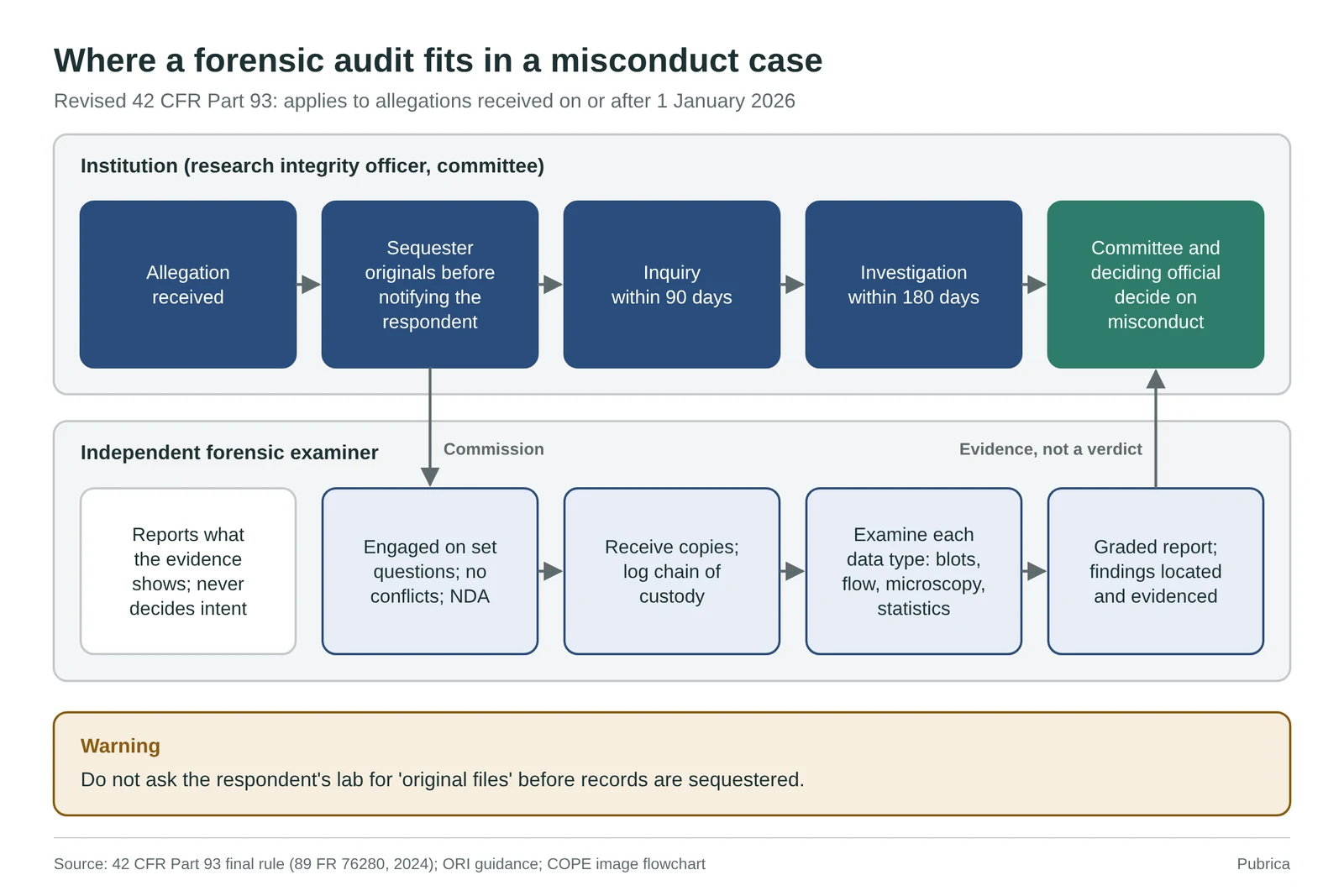
- Records. Institutions must obtain and sequester the research records and evidence needed for the proceeding. ORI guidance stresses that sequestration before the respondent is notified is critical to protecting the integrity of the record.
- Time limits. An inquiry should be completed within 90 days of its initiation, with any overrun documented; an investigation within 180 days, with extensions requested from ORI in writing.
- Confidentiality. Disclosure of the identities of respondents, complainants and witnesses is limited, as far as possible, to those who need to know, as determined by the institution.
These clocks are why the forensic question matters early. An image or data examination that is commissioned late, or on copies rather than sequestered originals, can delay the inquiry or weaken its conclusions.
What an independent forensic examination can and cannot do
An external forensic audit gives the inquiry or investigation committee an evidenced, technical account of the images and data. It can show, for example, that two panels share an identical region at a different rotation, that a gel lane has a discontinuity consistent with splicing, or that the numbers in a table cannot be reproduced from the raw files.
It cannot decide whether research misconduct occurred. Intent, and whether the evidence meets the preponderance standard, are matters for the institution's committee and deciding official. A credible forensic report keeps to what the evidence shows, distinguishes possible artefacts from findings, and avoids language about motive.
That boundary also protects your proceeding. A report that strays into conclusions about intent is easier for a respondent to challenge, and harder for a committee to rely on.
Book a confidential scoping call
Tell us the stage of your proceeding and the figures or datasets in question. We will agree the questions, the originals needed and the chain-of-custody arrangements, then give you a fixed-scope quote for an audit of one paper or grant dataset.
Before you commission: a seven-point checklist
Use this checklist before any material leaves the institution.
- Confirm the stage. Is this an assessment of the allegation, an inquiry or an investigation? The depth of examination, and who receives the report, differ by stage.
- Work from sequestered originals. Ensure the original image files, instrument output and laboratory records have been secured, and that the examiner receives copies whose provenance you can document.
- Record the chain of custody. Log what was sent, when, in what format and by whom, and require the examiner to log what they received and how each item was handled.
- Define the questions. List the specific figures, panels, datasets and grant or manuscript sections in scope, and the question asked of each.
- Check for conflicts. Confirm that the examiner has no relationship with the respondent, complainant, laboratory or the journals involved.
- Agree confidentiality. Put a non-disclosure agreement and secure transfer arrangements in place, consistent with your need-to-know determination.
- Agree the report format. Specify that findings should be located, evidenced and graded, with methods described so that a committee member or ORI could check them.
Practical tip
Warning: do not send the respondent's laboratory a request for 'original files' before records are sequestered. ORI guidance treats the timing of sequestration relative to respondent notification as critical to the integrity of the evidence.
Scoping an audit of CLL preclinical image and flow cytometry data
CLL laboratory papers typically combine several data types, each with its own originals and its own forensic questions. Scoping by data type keeps the cost proportionate and makes the report easier to use.
| Data type | What is examined | Originals to request |
|---|---|---|
| Western blots and gels | Duplicated or reused bands, splicing, inconsistent backgrounds, undisclosed cropping | Uncropped scans and instrument image files, with lane annotations |
| Flow cytometry plots | Duplicated or near-identical plots across conditions, gating consistency, mismatch between plots and reported percentages | Raw flow cytometry data files, gating templates and acquisition records |
| Microscopy and histology | Reused fields of view, rotated or flipped panels, contrast or resizing changes | Original microscope files with metadata |
| Quantitative data and statistics | Whether reported values, error bars and tests are consistent with the raw data and the methods | Raw spreadsheets or analysis files and any code |
| Text and authorship | Text reuse and citation accuracy, where relevant to the allegation | Manuscript and grant versions |
Note that self-plagiarism and authorship or credit disputes are excluded from research misconduct under the revised rule, though your institution may still address them under its own policies. ORI also offers free forensic image tools and advice to institutions conducting investigations, which some RIOs use for an initial look.
What a usable forensic report looks like
A report that a committee can rely on usually has the following features.
- Each finding is located. Figure, panel and coordinates, with both crops or plots attached.
- Each finding is evidenced. The method used to detect it is described so it can be repeated.
- Findings are graded. Severity is stated, and possible innocent explanations (compression artefacts, legitimate reuse of a loading control that was disclosed) are considered.
- Repetition is distinguished from a single anomaly. One irregularity may be an artefact; the same irregularity in several places carries more weight.
- No conclusions on intent. The report describes what the evidence shows and leaves determinations to the institution.
Statistical anomalies deserve the same rigour as images. Where an allegation concerns analyses rather than pictures, for example survival curves that cannot be reproduced, the issues overlap with those authors face in peer review; our Academy piece on answering statistical reviewer comments on survival analyses covers the most common ones.
Working with journals while the proceeding runs
Image concerns often reach a journal at the same time as the institution. The Committee on Publication Ethics (COPE) flowchart on inappropriate image manipulation in a published article guides editors through contacting authors and, where needed, the institution. It notes that an expression of concern may be appropriate while an institutional investigation is ongoing, and that a correction may be considered for very minor manipulation that does not affect the conclusions.
Under the revised rule, journals and publishers are among those who may need to know about a proceeding, and the confidentiality provision does not prevent institutions from acknowledging that published data may be unreliable. Agree with counsel what will be shared, and when, before a journal asks.
How Pubrica's forensic and quality audit supports an inquiry
Pubrica's forensic and quality audit service examines manuscripts, datasets, figures and research documentation for institutions, publishers, healthcare organisations and legal teams. The service page sets out the scope relevant to a misconduct inquiry:
- Image forensics on microscopy, gels, flow cytometry plots and medical scans for duplication, splicing, contrast manipulation and resizing.
- Data integrity checks of whether reported numbers are consistent with the described methods and raw data.
- Methodology and statistical quality checks by statisticians and subject experts.
- Compliance checks against COPE, ICMJE and the applicable reporting guideline, item by item.
- An evidenced report, graded by severity, delivered under NDA with encrypted transfer and access control.
Two limits are stated explicitly: we report what the evidence shows and do not conclude that misconduct occurred, and we do not correct the manuscript as part of the audit, so the audit remains independent. For legal and investigation work, chain of custody and the evidentiary standard are agreed before work begins.
We support universities and research institutions across the life sciences sector, drawing on our forensics subject experts.
Frequently asked questions
The final rule took effect on 1 January 2025, and institutions must apply its requirements to allegations received on or after 1 January 2026. Earlier allegations stay under the 2005 regulation unless the respondent agrees in writing to proceed under the new rule.
No. A forensic audit reports what the images and data show. Whether misconduct occurred, including intent and whether the preponderance standard is met, is decided by the institution's committee and deciding official.
Not necessarily. A focused examination during the inquiry can help decide whether an investigation is warranted, provided it uses sequestered originals and the 90-day inquiry timeline is respected.
No. ORI states that plagiarism under the rule does not include self-plagiarism or authorship and credit disputes, although institutions may address them under their own policies.
The raw instrument data files, gating templates and acquisition records, not only the exported plots in the figure. Exported images rarely allow gating or duplication questions to be resolved.
Sources
Sources were checked on 24 November 2026. Requirements and guidance may change after that date; confirm the current version with the issuing body.
- 1US Department of Health and Human Services. Public Health Service Policies on Research Misconduct. Final rule. Federal Register 89 FR 76280, document 2024-20814. 17 September 2024. https://www.federalregister.gov/documents/2024/09/17/2024-20814/public-health-service-policies-on-research-misconduct
- 2Electronic Code of Federal Regulations. 42 CFR Part 93, Subpart C: Responsibilities of Institutions. https://www.ecfr.gov/current/title-42/chapter-I/subchapter-H/part-93/subpart-C
- 3Electronic Code of Federal Regulations. 42 CFR 93.106: Confidentiality. https://www.ecfr.gov/current/title-42/chapter-I/subchapter-H/part-93/subpart-A/section-93.106
- 4Office of Research Integrity. Implementing the Revised Regulation (guidance). June 2025. https://ori.hhs.gov/sites/default/files/2025-06/Implementing%20the%20Final%20Rule_final.pdf
- 5Office of Research Integrity. Research Records Guidance. December 2025. https://ori.hhs.gov/sites/default/files/2025-12/Research%20Records%20Guidance_final.pdf
- 6Office of Research Integrity. Forensic Tools. https://ori.hhs.gov/forensic-tools
- 7Committee on Publication Ethics. Inappropriate image manipulation in a published article (flowchart), version 2. April 2024. https://publicationethics.org/resources/flowcharts/image-manipulation-published-article
- 8Epstein Becker Green. The Final Rule on Research Misconduct Regulations: What Institutions Need to Know as Implementation Looms. 2025. https://www.ebglaw.com/insights/publications/the-final-rule-on-research-misconduct-regulations-what-institutions-need-to-know-as-implementation-looms
research misconduct forensic audit42 CFR Part 93 inquiryimage forensics research misconductresearch integrity officersequestration of research recordsflow cytometry image duplication
How to cite this article
Pick your referencing style and copy it. Your university or target journal may vary the punctuation, so check its guide if it has one.
Pubrica Insights. (2026, November 24). Before a Misconduct Inquiry at a US Cancer Centre: Commissioning an Independent Image and Data Forensic Audit Under 42 CFR Part 93. Pubrica. https://pubrica.com/insights/forensic-audit-before-a-misconduct-inquiry/
This article is written to be learned from. Cite it if you are referring to what it says; if you are using the evidence behind it, cite the sources listed above instead.
Next steps
Book a confidential scoping call
Tell us the stage of your proceeding and the figures or datasets in question. We will agree the questions, the originals needed and the chain-of-custody arrangements, then give you a fixed-scope quote for an audit of one paper or grant dataset.
This article is general information for researchers, not legal, regulatory or funding advice. Check the current requirements of your journal, funder, ethics committee or regulator before you act on it.
More in Regulatory Intelligence