Contents
On this page
- Quick answer
- The decision in front of you
- What the AMCP Format and FDA guidance expect
- What OMOP-mapped EHR data can and cannot show in mCRC
- Choose the figure by the payer question
- Payer review checks before submission
- What to send a visualisation provider, and when
- How Pubrica helps
- Frequently asked questions
- Sources
InsightsDigital & AI
Decision guideUSA
Your AMCP Dossier Is Due: Commissioning RWE Visuals From OMOP-Mapped EHR Data in Metastatic Colorectal Cancer, With Payer Review Checks
A formulary review date is fixed and the real-world analyses are done, but the figures are not. This guide helps value evidence and payer communication managers decide what to commission, what to check in OMOP-mapped oncology data, and how to test each figure before a payer sees it.
- Digital & AI
- Oncology & haematology
- Real-world evidence (RWE) visualizations
- Topic
- Digital & AI
- Written by
- Pubrica Insights
At a glanceDigital & AI
Request a QuoteDiscuss your project
Quick answer
- The AMCP Format is advisory, but payers use it to navigate dossiers; version 5.0 (2024) gave real-world evidence more emphasis, and version 6.0 was published in October 2026.
- Health care economic information shared with payers must follow FDA's 2018 payor communications guidance; figures must stay consistent with the approved labelling.
- OMOP standardises structure and vocabulary, but lines of therapy and biomarker status in metastatic colorectal cancer often need extra derivation; ask for the mapping documentation.
- Choose each figure by the payer question it answers, then test it against a written review checklist before it enters the dossier.
- Work backwards from the formulary review date and allow time for MLR review.
The decision in front of you
Your health plan or pharmacy and therapeutics (P&T) committee meeting is booked, the real-world analyses of your metastatic colorectal cancer (mCRC) therapy are complete, and the dossier needs figures. You have three choices: build them internally, ask the analytics vendor to export its default charts, or commission specialist visualisations. The right answer depends on how much the figures need to do and how much time remains before medical, legal and regulatory (MLR) review.
This guide covers the decisions that most affect whether payer reviewers trust a real-world evidence (RWE) figure: what the AMCP Format and FDA guidance expect, what OMOP-mapped EHR data can support, which figure answers which payer question, and the checks to run before submission. It is written for teams across our oncology and haematology support for US biotechs.
What the AMCP Format and FDA guidance expect
The Academy of Managed Care Pharmacy (AMCP) Format for Formulary Submissions sets out a recognised structure for the clinical and economic evidence manufacturers provide to US health care decision makers. AMCP describes it as advisory; manufacturers decide how to communicate. Version 5.0, released in spring 2024, gave more emphasis to real-world evidence, including for under-represented populations. Version 6.0 was published in October 2026, adding guidance for biosimilars and cell and gene therapies and revising economic modelling recommendations; see our brief on AMCP Format 6.0.
What you can say to payers is governed separately. FDA's June 2018 guidance, Drug and Device Manufacturer Communications With Payors, Formulary Committees, and Similar Entities, answers questions on communicating health care economic information (HCEI) to payers and on sharing information about unapproved products and uses. In practice, every figure in a post-approval dossier should be consistent with the approved labelling, and any limits of the analysis should be stated alongside it.
FDA's 2018 Framework for its RWE Program defines real-world data as data routinely collected from sources such as EHRs, claims and registries, and RWE as the clinical evidence derived from analysing them. FDA documents on RWE are written for regulatory decisions, but the same idea of fitness for use is what a payer reviewer probes. Device teams can compare FDA's separate real-world evidence guidance for medical devices.
What OMOP-mapped EHR data can and cannot show in mCRC
The OHDSI OMOP Common Data Model standardises the structure and vocabulary of observational data so that analyses can run across sources; version 5.4 is the version OHDSI documents for new implementations. Version 5.4 also added EPISODE and EPISODE_EVENT tables, which can group drug exposures into higher-level units such as lines of therapy. HL7's mCODE (minimal Common Oncology Data Elements) FHIR implementation guide defines a core set of structured oncology data elements in EHR exchange.
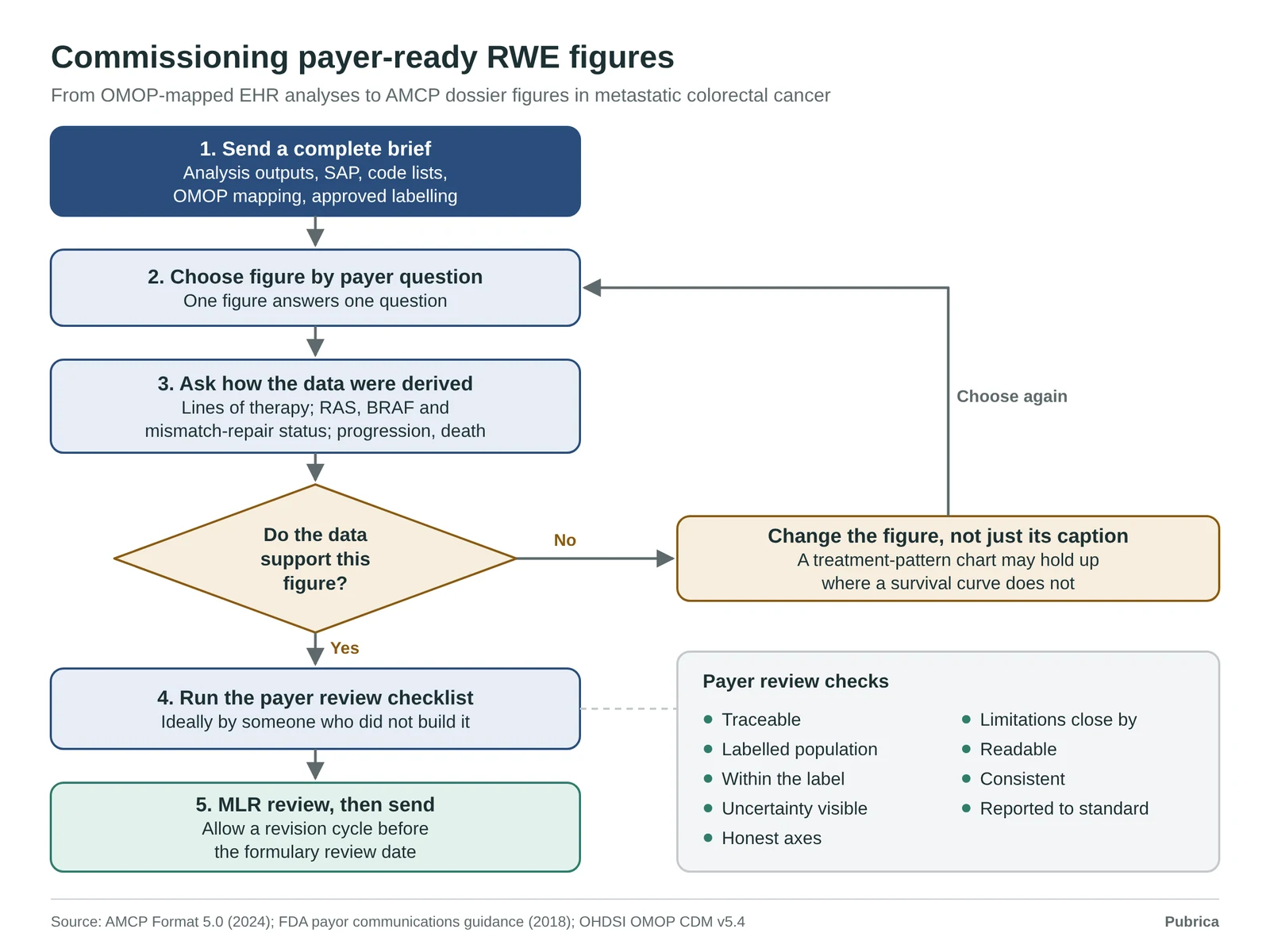
Standardisation does not create data that were never recorded. Before you design a figure, ask the analytics team:
- How were lines of therapy derived? Episode logic is an algorithm; a figure of treatment sequences is only as sound as its rules.
- Where did biomarker status come from? In mCRC, results such as RAS, BRAF and mismatch-repair status often sit in pathology or genomic report text. Ask what share of patients have a recorded result.
- How were progression and death captured? Real-world progression is usually abstracted from clinician notes; death may require linkage.
- What was lost in mapping? Request the mapping documentation from source codes to OMOP concepts, and the code lists for each definition.
If the answers are weak, change the figure, not just its caption. A treatment-pattern chart may be defensible where a comparative survival curve is not.
Have your RWE figures checked against payer review criteria
Send one existing RWE figure set and your dossier timeline. We confirm the brief, standards and cost in a free scoping assessment before you commit.
Choose the figure by the payer question
Payer reviewers read quickly and look for the population, the comparator, the time frame and the uncertainty. Match each figure to one question:
| Payer question | Figure type | Must show |
|---|---|---|
| Who is in the analysis? | Cohort attrition flow diagram | Each exclusion step with counts; data source and dates |
| How are patients treated today? | Treatment sequence (Sankey) or stacked bars by line | Line definition; patients without a next line |
| How long do outcomes last? | Kaplan-Meier curve | Numbers at risk, censoring, median with confidence interval |
| Were the groups comparable? | Covariate balance plot | Standardised differences before and after adjustment |
| What does care cost? | Bar or dot plot of resource use | Units, time window, uncertainty intervals |
Decide early whether each figure is a static dossier exhibit, a slide for a payer meeting, or an interactive version. Interactive figures can help in a meeting, but the dossier still needs a static version that stands alone.
Payer review checks before submission
Run every figure through a written checklist, ideally by someone who did not build it:
- Traceable. Each figure maps to a named analysis output, dataset version and code list.
- Labelled population. The data source, time period, cohort definition and analysis set appear on the figure or in its footnote.
- Within the label. The population and outcomes are consistent with the approved labelling.
- Uncertainty visible. Confidence intervals, numbers at risk and censoring are shown, not just point estimates.
- Honest axes. Axes start where a reader expects, and scales are the same across comparable panels.
- Limitations close by. Missing data, unmeasured confounding and definition choices are stated next to the figure.
- Readable. Text is legible at dossier print size; colours remain distinguishable for colour-blind readers and in greyscale.
- Consistent. The same number appears identically in the dossier, the slide deck and any publication.
- Reported to standard. The underlying study is described in line with STROBE and RECORD.
What to send a visualisation provider, and when
A strong brief saves a revision round. Send the analysis outputs and the statistical analysis plan; the code lists and OMOP mapping documentation; the approved labelling; the dossier section each figure supports; brand guidelines; the audience (dossier reviewer, P&T committee or account team); your MLR approval route; and the formulary review date.
Then work backwards. Allow for MLR review, a revision cycle and final production before the date the dossier must be sent. Pubrica's service page sets delivery at scoping, typically 15 to 25 business days from brief to final delivery, after a free scoping assessment that takes two business days. If that window no longer fits, prioritise the two or three figures payers will look at first: usually the cohort definition, treatment patterns and the main outcome curve.
Practical tip
Do not let a figure say more than the data. If line-of-therapy or biomarker data are incomplete, a payer reviewer will find it; state the limitation on the figure, or choose a figure the data can support.
How Pubrica helps
Pubrica's real-world evidence visualizations service turns claims, EHR and registry analyses into finished static or interactive figures, with format variants for publications, payer dossiers and HTA submissions. Data visualisation specialists and biostatistics-literate designers work to the ISPOR-ISPE good practices for real-world data studies. Every engagement includes source data mapping that ties each visualisation back to the underlying dataset and analysis, plus an accessibility and labelling review. A named subject specialist leads the project, and a second, independent reviewer checks each visualisation before delivery. AI tools are used only for layout variations, colour systems and first-pass drafts, never to generate a figure presented as real clinical data, and their use is disclosed.
The team supports pharma and biotech companies across the life sciences sector, drawing on big data and Hadoop specialists for large EHR datasets. For the analysis side, see our related Academy guide on preparing real-world evidence for US payers.
Frequently asked questions
No. AMCP describes it as advisory. It is widely recognised, so a dossier that follows its structure is easier for payer reviewers to navigate.
Communications about unapproved uses fall under a separate part of FDA's 2018 payor communications guidance and need regulatory and legal review. Post-approval dossier figures should stay consistent with the approved labelling.
Each figure depends on how source records were mapped to standard concepts and how episodes such as lines of therapy were derived. Mapping documentation lets a reviewer trace a figure back to its source.
Interactive figures can help in a payer meeting, but the dossier needs static versions that stand alone with their footnotes and limitations.
Sources
Sources were checked on 24 November 2026. Requirements and guidance may change after that date; confirm the current version with the issuing body.
- 1Academy of Managed Care Pharmacy. AMCP Format for Formulary Submissions, Version 5.0. J Manag Care Spec Pharm. April 2024. https://www.amcp.org/sites/default/files/2024-04/AMCP-Format-5.0-JMCP-web_0.pdf
- 2Academy of Managed Care Pharmacy. AMCP Publishes Format 6.0, Adding Dossier Guidance for Biosimilars and Cell and Gene Therapies. October 2026. https://www.amcp.org/press-releases/amcp-publishes-format-60-adding-dossier-guidance-biosimilars-and-cell-and-gene-therapies
- 3US Food and Drug Administration. Drug and Device Manufacturer Communications With Payors, Formulary Committees, and Similar Entities: Questions and Answers. Final guidance, June 2018. https://www.fda.gov/regulatory-information/search-fda-guidance-documents/drug-and-device-manufacturer-communications-payors-formulary-committees-and-similar-entities
- 4US Food and Drug Administration. Framework for FDA's Real-World Evidence Program. December 2018. https://www.fda.gov/media/120060/download
- 5OHDSI. OMOP Common Data Model v5.4 specification. https://ohdsi.github.io/CommonDataModel/cdm54.html
- 6HL7 International. minimal Common Oncology Data Elements (mCODE) FHIR Implementation Guide. https://hl7.org/fhir/us/mcode/
- 7Benchimol EI, et al. The REporting of studies Conducted using Observational Routinely-collected health Data (RECORD) statement. PLoS Med. 2015;12(10):e1001885. https://pubmed.ncbi.nlm.nih.gov/26440803/
AMCP dossier RWE visualisationAMCP Format for Formulary SubmissionsOMOP common data model oncologymCODE FHIRpayer-ready real-world evidence figuresmetastatic colorectal cancer real-world data
How to cite this article
Pick your referencing style and copy it. Your university or target journal may vary the punctuation, so check its guide if it has one.
Pubrica Insights. (2026, November 24). Your AMCP Dossier Is Due: Commissioning RWE Visuals From OMOP-Mapped EHR Data in Metastatic Colorectal Cancer, With Payer Review Checks. Pubrica. https://pubrica.com/insights/amcp-dossier-rwe-visuals-in-metastatic-crc/
This article is written to be learned from. Cite it if you are referring to what it says; if you are using the evidence behind it, cite the sources listed above instead.
Next steps
Have your RWE figures checked against payer review criteria
Send one existing RWE figure set and your dossier timeline. We confirm the brief, standards and cost in a free scoping assessment before you commit.
This article is general information for researchers, not legal, regulatory or funding advice. Check the current requirements of your journal, funder, ethics committee or regulator before you act on it.
More in Digital & AI