
- Services
- Publication Support Services
-
Publication Support Service
-
- Editing & Translation
-
Editing and Translation Service
-
- Research Services
-
Research Services
-
- Physician Writing
-
Physician Writing Service
-
- Statistical Analyses
-
Statistical Analyses
-
- AI and ML Services
-
AI and ML Services
-
- Medical Writing
-
Medical Writing
-
- Research Impact
-
Research Impact
-
- Medical & Scientific Communication
-
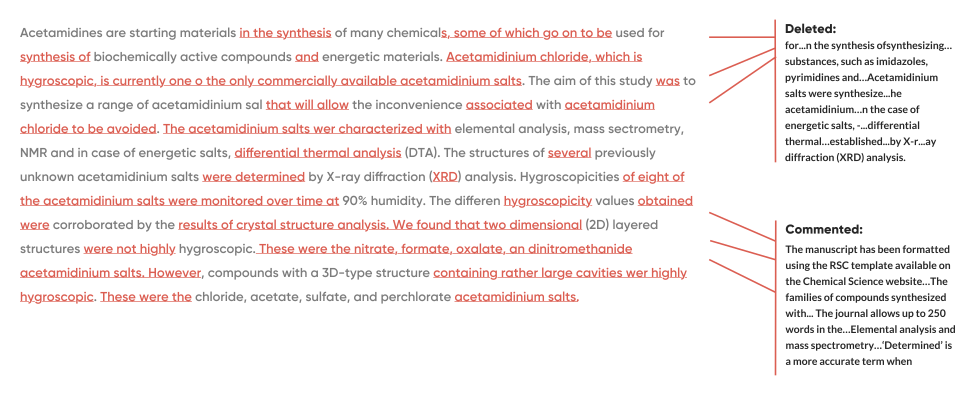
Medical & Scientific Communication
-
- Academic Editorial Services
-
Academic Editorial Services
-
- Educational Editorial Service
-
Education Editorial Services
-
- Publication Support Services
Forensic Pathology
Involves conducting postmortem examinations and analysing biopsies and other biologically qualitative samples to establish causes and mechanisms of death. Forensic Pathology helps to identify how and why a person died in criminal investigations and gives insight into the type of injuries sustained because of violence perpetrated against an individual.

Forensic Toxicology
studies chemical agents, toxins and drugs, and their metabolites in humans and animals through testing biological fluids (blood, urine, saliva). Forensic Toxicologists utilize this science to help determine the cause of death or injuries from poisonings, drug overdoses and DUI cases.

DNA forensic science
Refers to gathering evidence from DNA for use in law enforcement to assist with identifying suspects, victims, and/or other biological samples used in evidence. It is also a key technique used in the investigation of cold cases, the resolution of paternity, and the identification of bodies involved in crimes.

Digital Forensics
Includes locating, preserving and evaluating of data that has been electronically stored on computers, smartphones and other electronic devices. Digital Forensics also provides important information in relation to Cybercrime investigations, Data Breach investigations and Digital Evidence in a court of law.

Anthropological Factors
In Forensics Identify Human Skeletons and Analyze Samples to Determine Identity, Death, Cause of Death; They Help Law Enforcement with Cases Involving Human Remains.

Forensic psychology
Applies psychological principles to issues of law in connection with criminal behaviour, witness accounts, and mental competency evaluations, all of which are necessary for determining if someone meets the standard of civil competency to stand trial. Forensic psychologists are often used in criminal profiling and assessing the mental state of individuals involved in civil court cases.











Criminal Investigations: DNA, fingerprints, and ballistics are utilized to help identify suspects and to solve crimes.

Forensic Pathology: (through autopsy) is used to ascertain the "cause of death".

Digital Forensics: Cyber-crimes can be investigated via the examination of electronic information.

Forensic Toxicology: Biological specimens can be tested for the presence of poisons or drugs.

Forensic Anthropology: Can be used to identify human remains and estimate time since death.

Forensic Psychology: Looks at the mental state and the likely behaviour of a criminal.

Forensic Odontology: Forensic odontology uses dental records to identify victims and suspects.

Environmental Forensics: Gives investigators the ability to determine the cause of pollution and other environmental crimes.






Working with the team was an incredible experience. Their depth of knowledge and attention to detail have been essential in every phase of our projects. We rely on their expert analysis and timely advice for our forensic investigations.


The research and support we received were top-notch. Dr. Carter's team provided the detailed toxicology analysis we needed for a critical case, and the results were spot-on. Their professionalism in handling complex data and their clear communication made all the difference.


Dr. Nair and his team consistently deliver high-quality, reliable results under tight deadlines. Their expertise in forensic biochemistry has been pivotal in several cases where precision was essential. We know we can always count on them.



" Pubrica’s team provided exceptional support throughout my meta-analysis cardiovascular drug efficacy. Their adherence to PRISMA guidelines and attention to statistical detail helped me publish in the European Heart Journal. Highly recommended "
— Dr. Anna Müller
Cardiologist, University Hospital Munich, Germany


" The meta-analysis manuscript I co-authored with Pubrica’s experts was accepted by BMC Public Health without major revisions. Their data synthesis and transparent methodology were critical to this success. "
— Dr. Rohan Mehta
Public Health Researcher,
All India Institute of Medical Sciences (AIIMS), India


" Thanks to Pubrica’s guidance, our meta-analysis on paediatric nutrition was published in The Lancet Child & Adolescent Health. The methodological rigor and rewriting support were key contributors to the paper’s clarity and impact. "
— Dr. Luis Fernández
Pediatrician & Research Fellow, University of Barcelona, Spain

How to Structure Case Reports and Review Articles for Medical Journals
Medical journals expect a structure for case reports and review articles, with clear objectives....

How Should Physicians Choose the Right Journal for Submitting a Case...
Publishing a case report involves more than clinical knowledge; it also demands strategic journal ....

How Physicians Can Write Clear and Impactful Patient Education Materials
Effective patient education materials (PEMs) are crucial for promoting health literacy, enhancing....