Contents
On this page
- Quick answer
- Overview
- Meta-Analysis Workflow Flowchart
- Stages, Owners and Indicative Timelines
- Planning Stages: Question, Protocol and Registration
- Evidence Stages: Search, Screening, Extraction and Risk of Bias
- Analysis Stages: Synthesis, Heterogeneity and GRADE
- Reporting and Submission
- Who Does What: Team Roles
- Conclusion
- Frequently asked questions
- Sources
AcademyMeta-Analysis
Flow chart
The Meta-Analysis Workflow: 10 Stages from Question to Submission, Who Does What and How Long Each Takes
A flowchart of the ten stages, the owner of each and indicative durations, so review teams can plan resources and deadlines realistically.
- Meta-analysis
- Systematic review
- Workflow
- Stages
- 10, in 4 phases
- Work time
- About 22–45 weeks
- To publication
- Mean 67.3 weeks
- Reporting
- PRISMA 2020
At a glanceMeta-Analysis
Explore meta-analysis supportDiscuss your project
Quick answer
- A meta-analysis runs through ten stages: question, protocol, search, screening, extraction, risk of bias, synthesis, heterogeneity and sensitivity analyses, GRADE and reporting.
- Screening, extraction and risk of bias are done by two independent reviewers; the statistician owns synthesis.
- Plan for about 22–45 weeks of work, and more than a year from registration to publication.
Overview
A meta-analysis is the statistical end point of a systematic review, and the meta-analysis process runs from a precise question to a reporting-guideline-compliant manuscript. It typically involves a review team of several people and often takes more than a year: an analysis of PROSPERO-registered reviews found a mean of 67.3 weeks from registration to publication3.
This flowchart breaks the process into ten stages, names who is responsible for each one and gives indicative durations, so teams can plan resources and deadlines realistically12.
Meta-Analysis Workflow Flowchart
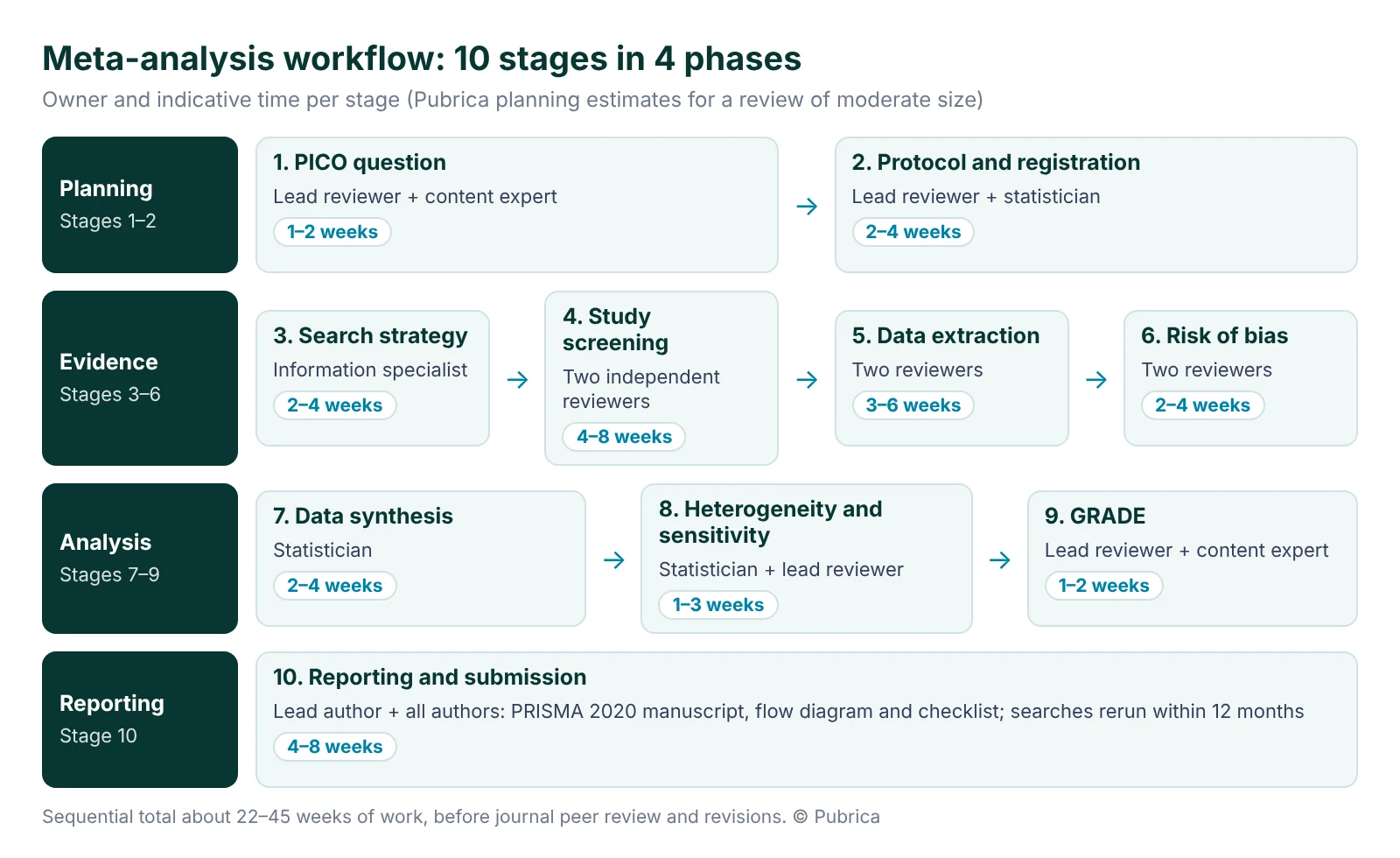
The flowchart groups the ten stages into four phases: planning (stages 1–2), evidence (3–6), analysis (7–9) and reporting (10). Each box names the accountable owner and the indicative time for the stage.
Stages, Owners and Indicative Timelines
Durations are Pubrica planning estimates for a review of moderate size, not published benchmarks; they depend on the number of records, team capacity and topic complexity. Run in sequence, the stages total about 22–45 weeks (5–10 months) of work. Journal peer review and revisions add further time, which is why registration to publication averaged 67.3 weeks in PROSPERO-registered reviews3.
Table 1. Indicative meta-analysis process timeline (Pubrica planning estimates, not published benchmarks)
| Stage | Owner | Indicative time | Key output |
|---|---|---|---|
| 1. PICO question | Lead reviewer + content expert | 1–2 weeks | Structured question and eligibility criteria |
| 2. Protocol and registration | Lead reviewer + statistician | 2–4 weeks | Protocol and PROSPERO record |
| 3. Search strategy | Information specialist | 2–4 weeks | Peer-reviewed search strings, records |
| 4. Study screening | Two independent reviewers | 4–8 weeks | Included studies and PRISMA flow numbers |
| 5. Data extraction | Two reviewers | 3–6 weeks | Piloted extraction forms, dataset |
| 6. Risk of bias | Two reviewers | 2–4 weeks | RoB 2 or ROBINS-I judgements |
| 7. Data synthesis | Statistician | 2–4 weeks | Pooled estimates, forest plots |
| 8. Heterogeneity and sensitivity | Statistician + lead reviewer | 1–3 weeks | Subgroup, sensitivity and small-study analyses |
| 9. GRADE | Lead reviewer + content expert | 1–2 weeks | Summary of findings table |
| 10. Reporting and submission | Lead author + all authors | 4–8 weeks | PRISMA 2020 manuscript and checklist |
Planning a meta-analysis?
Pubrica’s evidence synthesis team supports protocol and PROSPERO registration, searching, screening, extraction, risk of bias, statistical synthesis, GRADE and PRISMA 2020 reporting. Review authors keep ownership of and accountability for the review, and no provider can guarantee acceptance.
Planning Stages: Question, Protocol and Registration
Define the question with the PICO question framework (population, intervention, comparator, outcomes) and turn it into explicit eligibility criteria1. Write a protocol that pre-specifies outcomes, effect measures, the synthesis model and planned subgroup and sensitivity analyses, and register it prospectively, for example through PROSPERO registration, before screening begins to reduce the risk of selective reporting4.
Evidence Stages: Search, Screening, Extraction and Risk of Bias
These stages carry most of the workload. Screening, data extraction and risk-of-bias assessment should be done independently by two reviewers, and the search strategy should be peer reviewed1:
- Search strategy: an information specialist searches several bibliographic databases plus trial registers and grey literature, and records full search strings for reporting.
- Study screening: screen titles and abstracts, then full texts, independently and in duplicate, resolving disagreements by discussion or a third reviewer.
- Data extraction: pilot the extraction form and extract outcome data, study characteristics and funding in duplicate.
- Risk of bias: use RoB 2 for randomised trials and ROBINS-I for non-randomised studies of interventions; our risk of bias tool decision tree shows which applies.
Analysis Stages: Synthesis, Heterogeneity and GRADE
The statistician pools results with the pre-specified effect measure and model, produces forest plots, quantifies heterogeneity and runs planned subgroup and sensitivity analyses, plus small-study-effect analyses where at least 10 studies are available1. The methods to follow are set out in our Cochrane Handbook Chapter 10 and MECIR guide. The review team then rates the certainty of evidence for each key outcome with GRADE, considering risk of bias, inconsistency, indirectness, imprecision and publication bias, and summarises it in a summary of findings table1.
Reporting and Submission
Write the manuscript to PRISMA 2020, including the flow diagram and the completed checklist, and state any deviations from the registered protocol2. Rerun the searches within 12 months before publication (MECIR C37, mandatory)5, and confirm that data, code and extraction forms are available as the target journal requires.
Who Does What: Team Roles
A typical review team combines several roles, and one person may hold more than one; reviews in the PROSPERO analysis had a mean of five authors13.
Table 2. Meta-analysis team roles
| Role | Responsibilities |
|---|---|
| Lead reviewer | Coordinates the review, protocol, interpretation and manuscript |
| Content expert | Clinical relevance of question, outcomes and interpretation |
| Information specialist | Search strategy design, execution and documentation |
| Second reviewer(s) | Independent screening, extraction and risk of bias assessment |
| Statistician | Data synthesis, heterogeneity and sensitivity analyses |
Conclusion
A well-run meta-analysis process is a managed project: a registered protocol, duplicate screening and extraction, pre-specified data synthesis, GRADE assessment and PRISMA reporting, each with a named owner and a realistic deadline. Planning for months rather than weeks protects quality and makes the final submission defensible. For common technical questions, see our meta-analysis Q&A; for support at any stage, see meta-analysis services.
Pubrica team verdict
Name an owner and a deadline for every stage before screening starts; most delays come from screening and extraction, not the statistics.
Frequently asked questions
Sources
Sources were checked on 13 November 2026. Requirements and guidance may change after that date; confirm the current version with the issuing body.
- 1Higgins, J. P. T., Thomas, J., Chandler, J., Cumpston, M., Li, T., Page, M. J., & Welch, V. A. (Eds.). (2024). Cochrane handbook for systematic reviews of interventions (Version 6.5). Cochrane. https://www.cochrane.org/authors/handbooks-and-manuals/handbook/current
- 2Page, M. J., McKenzie, J. E., Bossuyt, P. M., Boutron, I., Hoffmann, T. C., Mulrow, C. D., Shamseer, L., Tetzlaff, J. M., Akl, E. A., Brennan, S. E., Chou, R., Glanville, J., Grimshaw, J. M., Hróbjartsson, A., Lalu, M. M., Li, T., Loder, E. W., Mayo-Wilson, E., McDonald, S., . . . Moher, D. (2021). The PRISMA 2020 statement: An updated guideline for reporting systematic reviews. BMJ, 372, Article n71. https://doi.org/10.1136/bmj.n71
- 3Borah, R., Brown, A. W., Capers, P. L., & Kaiser, K. A. (2017). Analysis of the time and workers needed to conduct systematic reviews of medical interventions using data from the PROSPERO registry. BMJ Open, 7(2), Article e012545. https://doi.org/10.1136/bmjopen-2016-012545
- 4Centre for Reviews and Dissemination. (n.d.). PROSPERO: International prospective register of systematic reviews. Retrieved November 13, 2026, from https://www.crd.york.ac.uk/prospero/
- 5Higgins, J. P. T., Lasserson, T., Thomas, J., Flemyng, E., & Churchill, R. (2023). Methodological expectations of Cochrane intervention reviews (MECIR) (Version August 2023). Cochrane. https://www.cochrane.org/authors/handbooks-and-manuals/mecir-manual
meta-analysis processPICO questionPROSPERO registrationsearch strategystudy screeningdata extraction
How to cite this article
Pick your referencing style and copy it. Your university or target journal may vary the punctuation, so check its guide if it has one.
Dr. Charlie. (2026, November 13). The Meta-Analysis Workflow: 10 Stages from Question to Submission, Who Does What and How Long Each Takes. Pubrica. https://pubrica.com/academy/meta-analysis/meta-analysis-workflow-flowchart/
This article is written to be learned from. Cite it if you are referring to what it says; if you are using the evidence behind it, cite the sources listed above instead.
Next steps
Planning a meta-analysis?
Pubrica’s evidence synthesis team supports protocol and PROSPERO registration, searching, screening, extraction, risk of bias, statistical synthesis, GRADE and PRISMA 2020 reporting. Review authors keep ownership of and accountability for the review, and no provider can guarantee acceptance.
This article is general information for researchers, not legal, regulatory or funding advice. Check the current requirements of your journal, funder, ethics committee or regulator before you act on it.
More in Meta-Analysis