Which Risk of Bias Tool? A Decision Tree for RoB 2, ROBINS-I, Newcastle–Ottawa, QUADAS-3 and JBI Tools
Risk-of-bias tool selection starts with the question, not the study design label. Match the effect you want to estimate to the framework built for it, then fix the version and assessment unit before appraisal.

- Randomized trials
- RoB 2
- Non-randomized
- ROBINS-I (interventions) or ROBINS-E (exposures)
- Diagnostic accuracy
- QUADAS-3 for new reviews
- Prognosis and prediction
- QUIPS or PROBAST+AI
Quick answer
- Define the estimand first: the tool follows the effect you want to estimate, not the design label alone.
- RoB 2 for randomized controlled trials, ROBINS-I for non-randomized intervention studies, ROBINS-E for causal exposure effects.
- QUADAS-3 for diagnostic accuracy assessment, QUIPS for prognostic-factor studies, PROBAST+AI for prediction models.
- Use NOS or a JBI checklist only when its scope genuinely fits the question.
011. Define the research question first
Risk of bias assessment in a systematic review judges whether design or conduct could distort a result. Before choosing a risk of bias tool, define population, intervention or exposure, comparator, outcome, follow-up and the estimand: the specific effect the review aims to estimate.
The question type decides the framework. An intervention question asks whether a treatment changes an outcome; an exposure question asks about the causal effect of an exposure; a prognostic-factor question examines association with a future outcome; a prediction question asks how accurately a model estimates individual risk; a diagnostic question asks how well a test identifies a condition against a reference standard. So the same cohort study may need ROBINS-I for a medicine’s causal effect, QUIPS for a biomarker’s prognostic value or PROBAST+AI for a prediction model. In a trial, the effect of assignment can differ from the effect of adhering to treatment, and RoB 2 must match the effect and analysis you intend [1].
022. Decision tree: which tool should you choose?
Step 1: What is the target of inference?
- Causal intervention effect: RoB 2 for randomized trials [1]; ROBINS-I for non-randomized intervention studies [2].
- Causal exposure effect: ROBINS-E for non-randomized exposure studies [7].
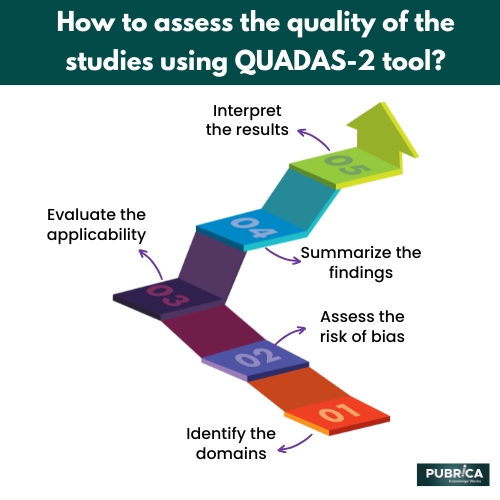
- Diagnostic accuracy: QUADAS-3 for new assessments [3], or QUADAS-2 where an existing protocol justifies it [4].
- Prognostic-factor association: QUIPS [8].
- Prediction-model assessment (development or evaluation): PROBAST+AI [5].
- Other eligible questions: a design-specific JBI critical appraisal checklist [10] or the Newcastle–Ottawa Scale [9], where their scope fits.
Step 2: Define the assessment unit: the outcome, comparison and particular result or estimate being judged.
Step 3: Fix the version and rules: prespecify the tool version, judgment rules and how disagreements are resolved. If a review answers several questions, give each evidence stream its own framework.
033. Compare the main tools
| Tool | Primary target | Key methodological issue | Assessment unit |
|---|---|---|---|
| RoB 2 | Randomized intervention effect | Effect of assignment versus adherence | Specific result |
| ROBINS-I | Non-randomized intervention effect | Confounding and selection | Specific result |
| ROBINS-E | Causal exposure effect | Confounding and exposure measurement | Specific result |
| QUADAS-3 | Diagnostic accuracy | Participants, reference standard and analysis | Selected accuracy estimate |
| QUADAS-2 | Diagnostic accuracy (earlier framework) | Version-specific domains | As specified by the tool |
| QUIPS | Prognostic-factor association | Participation, attrition and confounding | Factor–outcome result |
| PROBAST+AI | Prediction-model development and evaluation | Overfitting, data quality, evaluation design | Development or evaluation |
| NOS | Selected cohort and case-control studies | Selection, comparability, ascertainment | Study-level checklist |
| JBI tools | Eligible study designs | Design-specific validity threats | Depends on the tool |
A popular checklist is not automatically appropriate, and more detailed appraisal cannot fix a mismatch between tool and question.
044. Resolve common selection dilemmas
Randomized trials. RoB 2 covers five domains: randomization, deviations from intended interventions, missing outcome data, outcome measurement and selection of the reported result [1]. Judgments apply to a result, not a publication; use the cluster and crossover variants where relevant. See our RoB 2 explainer.
ROBINS-I or ROBINS-E? ROBINS-I is for intervention effects, ROBINS-E for causal exposure effects. Both demand explicit handling of confounding, so prespecify important confounders and the intended comparison. The original ROBINS-I dates from 2016 [2]; Version 2, first released in 2024 and revised in November 2025, adds judgment algorithms and addresses immortal-time bias, but remains a draft [11]. Record which version you used and never mix guidance across versions.
QUADAS-2 or QUADAS-3? QUADAS-3, published in 2026, assesses four domains (Participants, Index Test, Target Condition and Analysis), with applicability judged for the first three, across six phases from defining the review question to the overall judgment [3]. Its key change is estimate-level assessment: a study reporting sensitivity and specificity at several thresholds may carry different risk of bias for each estimate. QUADAS-2 [4] remains valid for existing protocols that justify it; document any switch.
QUIPS or PROBAST+AI? QUIPS judges prognostic-factor associations [8]. PROBAST+AI separates model development from evaluation of predictive performance and covers regression and machine-learning prediction models [5].
NOS or JBI? NOS can suit selected cohort and case-control reviews, but a total star score hides domain-level weaknesses [9]; see our NOS guide. JBI tools give design-specific checklists [10]. Neither replaces a framework built for causal effects, diagnostic accuracy or prediction.
055. Check the tool before appraisal
- Scope: does the tool match the question and design?
- Assessment unit: is the judgment about a study, result, estimate or model?
- Version: is the version appropriate and recorded?
- Evidence: is each judgment backed by reported information and stated reasoning?
- Synthesis: is the use of judgments in the analysis prespecified?
Poor reporting does not prove bias, though it may prevent a confident judgment. Applicability, whether the evidence matches your question, is a separate issue from internal risk of bias.
066. Use the judgments in evidence synthesis
Risk-of-bias judgments should shape interpretation, not trigger automatic numerical corrections. Suppose a pooled risk ratio of 0.80 (95% CI 0.72–0.89) becomes 0.91 (95% CI 0.80–1.04) when high-risk studies are excluded. That shows sensitivity to study selection; it does not prove the excluded studies were biased or that 0.91 is the true effect. Examine study weights, confounding control and outcome definitions. A prespecified sensitivity analysis tests robustness but cannot identify the mechanism or direction of bias. Carry the judgments into the certainty of evidence alongside inconsistency, indirectness, imprecision and publication bias [6].
Questions
Which risk-of-bias tool should I use for a systematic review?
RoB 2 for randomized trials, ROBINS-I for non-randomized intervention studies, ROBINS-E for exposure studies, QUADAS-3 for diagnostic accuracy, QUIPS for prognostic factors and PROBAST+AI for prediction models.
What is the difference between RoB 2 and ROBINS-I?
RoB 2 assesses randomized trials; ROBINS-I assesses non-randomized intervention studies, where confounding and participant selection dominate.
What is the difference between QUADAS-2 and QUADAS-3?
QUADAS-3 (2026) replaces the Flow and Timing domain with Analysis and judges risk of bias per accuracy estimate rather than per study.
References
- Sterne JAC, Savović J, Page MJ, et al. RoB 2: a revised tool for assessing risk of bias in randomised trials. BMJ. 2019;366:l4898. https://doi.org/10.1136/bmj.l4898
- Sterne JAC, Hernán MA, Reeves BC, et al. ROBINS-I: a tool for assessing risk of bias in non-randomised studies of interventions. BMJ. 2016;355:i4919. https://doi.org/10.1136/bmj.i4919
- Whiting PF, Tomlinson E, Rutjes AWS, et al. QUADAS-3: a revised tool for the quality assessment of diagnostic test accuracy studies. Ann Intern Med. 2026;179(4):548–555. https://doi.org/10.7326/ANNALS-25-02104
- Whiting PF, Rutjes AWS, Westwood ME, et al. QUADAS-2: a revised tool for the quality assessment of diagnostic accuracy studies. Ann Intern Med. 2011;155(8):529–536. https://doi.org/10.7326/0003-4819-155-8-201110180-00009
- Moons KGM, Damen JAA, Kaul T, et al. PROBAST+AI: an updated quality, risk of bias, and applicability assessment tool for prediction models using regression or artificial intelligence methods. BMJ. 2025;388:e082505. https://doi.org/10.1136/bmj-2024-082505
- Schünemann HJ, Cuello C, Akl EA, et al. GRADE guidelines: 18. How ROBINS-I and other tools to assess risk of bias in nonrandomized studies should be used to rate the certainty of a body of evidence. J Clin Epidemiol. 2019;111:105–114. https://doi.org/10.1016/j.jclinepi.2018.01.012
- Higgins JPT, Morgan RL, Rooney AA, et al. A tool to assess risk of bias in non-randomized follow-up studies of exposure effects (ROBINS-E). Environ Int. 2024;186:108602. https://doi.org/10.1016/j.envint.2024.108602
- Hayden JA, van der Windt DA, Cartwright JL, Côté P, Bombardier C. Assessing bias in studies of prognostic factors. Ann Intern Med. 2013;158(4):280–286. https://doi.org/10.7326/0003-4819-158-4-201302190-00009
- Wells GA, Shea B, O’Connell D, et al. The Newcastle–Ottawa Scale (NOS) for assessing the quality of nonrandomised studies in meta-analyses. Ottawa Hospital Research Institute. https://www.ohri.ca/programs/clinical_epidemiology/oxford.asp
- JBI. Critical appraisal tools. https://jbi.global/critical-appraisal-tools
- Risk of Bias tools. ROBINS-I V2 (revised draft, November 2025). https://www.riskofbias.info/welcome/robins-i-v2
Update log
- Published by Pubrica
How to cite this article
Pubrica Academy. (2026, October 23). Which Risk of Bias Tool? A Decision Tree for RoB 2, ROBINS-I, Newcastle–Ottawa, QUADAS-3 and JBI Tools. Pubrica. https://pubrica.com/academy/systematic-review/risk-of-bias-tool-decision-tree/
This article is general information for researchers, not legal, regulatory or funding advice. Check the current requirements of your journal, funder, ethics committee or regulator before you act on it.