

How AI Tools Are Transforming Academic Publishing
High-Impact Journals
- The Growing Role of AI in Academic Publishing
- Key Areas Where AI is Transforming Publication Support
- Benefits of AI Tools in Publication Support Services
- Popular AI Tools Used in Publication Support
- Challenges and Ethical Concerns
- AI and the Future of Publication Services
- Best Practices for Researchers Using AI Tools
- AI-Assisted Academic Publishing
- AI in Research Writing and Journal Submission
- Conclusion
Interesting topics
How AI Tools Are Transforming Academic Publishing
The academic publishing environment is rapidly changing with the use of AI tools for academic publishing in the process of publication support. Scientists, academicians, and publishing houses have embraced AI manuscript editing services and other AI-powered journal submission tools in improving efficiency, quality, and accuracy in scholarly communication. This ranges from the editing of manuscripts to detecting plagiarised work and journal selection. [1]
1. The Growing Role of AI in Academic Publishing
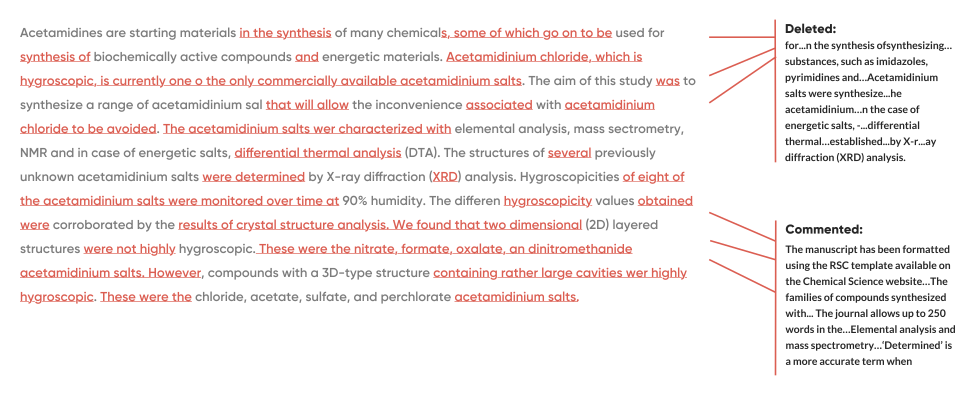
Manually based services for editing, proofreading, formatting, and peer review have traditionally been used by publication support services. However, with the use of AI manuscript editing services, repetition in these activities has been automated, and recommendations have been made to increase productivity. [1]
The applications of AI technologies include Natural Language Processing (NLP), machine learning, and generative AI in research paper preparation and scholarly publishing automation.
2. Key Areas Where AI is Transforming Publication Support
Publication Service | Traditional Approach | AI-Driven Improvement |
Language Editing | Manual proofreading | AI grammar and clarity enhancement through AI manuscript editing services |
Plagiarism Checking | Basic similarity detection | Advanced contextual plagiarism analysis |
Journal Selection | Manual search | AI-powered journal submission tools for journal matching |
Citation Management | Manual referencing | Automated citation generation |
Peer Review Support | Time-consuming screening | AI-assisted reviewer suggestions |
Abstract Writing | Researcher-written summaries | AI-generated concise abstracts |
3. Benefits of AI Tools in Publication Support Services
Publication services that employ the use of AI technologies have numerous benefits for researchers and publishers alike. [2]
- Quick Editing of Texts: Useful in identifying and correcting grammatical mistakes, improving sentence structures, and suggesting proper words for your texts, the software will reduce the amount of time necessary for editing.
- Improving Writing Quality: AI-powered tools help enhance the language used by authors who lack command of English; thus, the papers become easier to read and understand.
- Finding the Right Journals: With the help of an advanced algorithm, manuscripts can be compared with journals and find appropriate venues for publication.
- Protecting Research Integrity: Advanced AI plagiarism detectors will be able to identify paraphrased similarities and other problems associated with citations.
- Citation Management: The technology allows for quick generation of references in different formats, such as APA, MLA, or Chicago.
4. Popular AI Tools Used in Publication Support
Popular AI-based solutions in academia [3]
- AI-based Grammar and Editing – Corrects spelling, grammar, and style; improves clarity. (e.g., Grammarly)
- Citation Generators – Automatically format references in different styles. (e.g., Zotero)
- Journal Recommendation Systems – Suggests suitable journals for your manuscript using AI-powered journal submission tools. (e.g., Elsevier Journal Finder)
- Plagiarism Detection AIs – Checks text for copied content and similarity. (e.g., Turnitin)
- Literature Review Assistance – Finds and summarises relevant research papers. (e.g., Connected Papers)
- Research Summarisation Services – Condenses papers into key points or abstracts. (e.g., Scholarcy)
- AI Peer-Review Screening – Pre-screens manuscripts for quality and relevance before review, part of AI peer review automation. (e.g., ScholarOne features)
5. Challenges and Ethical Concerns
While there are numerous benefits of using AI, it is imperative for scientists to use this technology judiciously. The heavy reliance on the output produced through this technology can adversely impact its originality. [4]
| Key Issues of AI | Guidelines for Using AI Ethically |
|
|
6. AI and the Future of Publication Services
Publication services in the future are bound to include both human skills and artificial intelligence technology. AI is not supposed to replace editors and publication specialists but work alongside them to provide better and faster results. [3]
Future applications of AI in the field may include:
- Timely assessment of the manuscript’s quality – Quickly evaluates clarity, structure, and relevance of a paper.
- Help in peer review – Assists reviewers by highlighting strengths, weaknesses, or errors in manuscripts.
- Detection of knowledge gaps – Identifies missing areas or unanswered questions in research.
- Publication strategy development – Suggests the best journals, target audience, and submission approach.
- Support for researchers’ writing – Offers grammar, style, and clarity improvements for manuscripts.
7. Best Practices for Researchers Using AI Tools
For optimising the utility of AI in publications, the following guidelines are suggested:
- Guidelines to follow for optimising the use of AI in publications
- Mix the use of AI in research with human expertise
- Check the references and citations made in research
- Never copy and paste from AI-generated output
- Use best AI publication support software to maintain quality.
8. AI-Assisted Academic Publishing
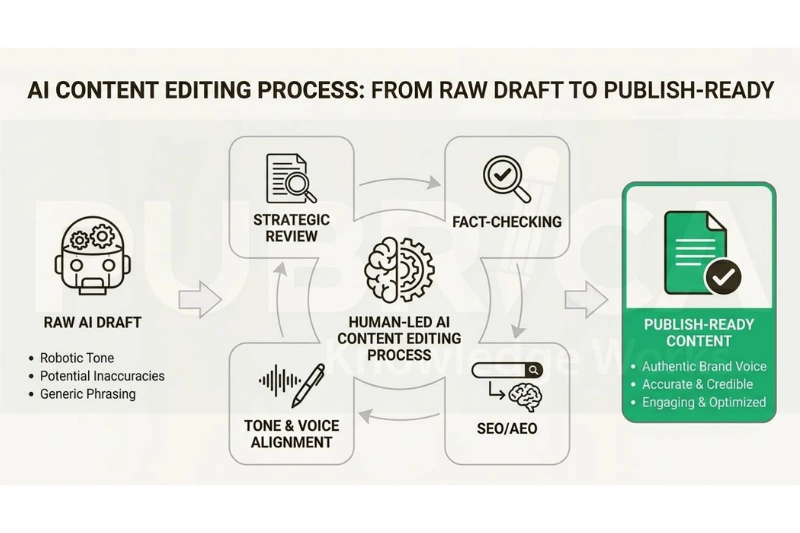
Artificial Intelligence (AI) is reshaping academic publishing by supporting researchers in writing, editing, data analysis, and publication workflows. AI tools for academic publishing improve efficiency, accuracy, and accessibility throughout the research lifecycle.
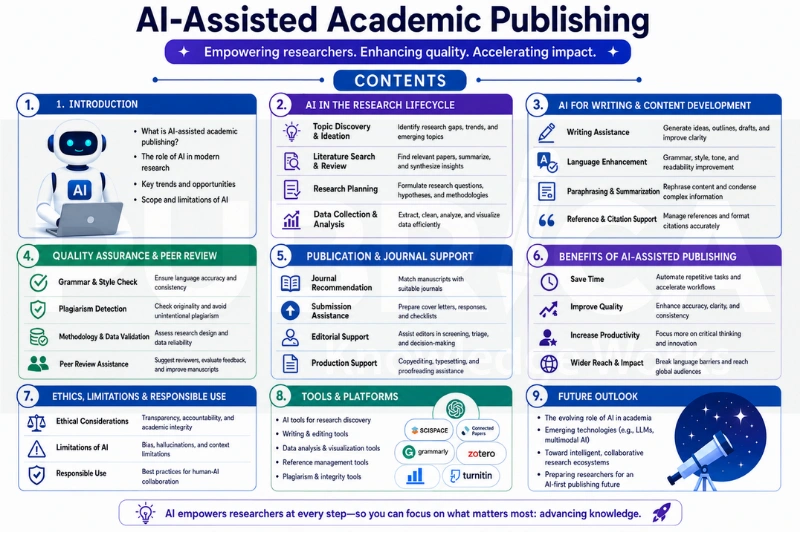
9. AI in Research Writing and Journal Submission
Artificial Intelligence (AI) is revolutionising research writing and journal submission by helping researchers work smarter, faster, and more efficiently. From literature review and manuscript drafting to language enhancement and submission preparation, AI-powered journal submission tools and AI manuscript editing services streamline the academic publishing process while improving the quality and impact of scholarly work. [5]
Connect with us to explore how we can support you in maintaining academic integrity and enhancing the visibility of your research across the world!
Conclusion
The AI-based technology is changing the world of AI manuscript editing services and scholarly publishing automation through efficient and accurate publication processes. For instance, through AI technology, publication processes such as manuscript editing and plagiarism detection, among others, can be simplified. Nevertheless, the ethics of the AI application process are crucial for ensuring that the publication services are of high standards and do not compromise research standards. With further development of AI, AI-powered journal submission tools, AI peer review automation, and best AI publication support software will make publication support services smarter and more research-oriented.
How AI Tools Are Transforming Academic Publishing. Our Pubrica consultants are here to guide you. [Get Expert Publishing Support] or [Schedule a Free Consultation]
References
- Oermann, M. H., Owens, J. K., Carter-Templeton, H., Peterson, G., & Bailey, H. E. (2025). Using Artificial Intelligence for Scholarly Writing. The American journal of nursing, 125(11), 52–55. https://doi.org/10.1097/AJN.0000000000000179
- Frangou, S., Volpe, U., & Fiorillo, A. (2025). AI in scientific writing and publishing: A call for critical engagement. European psychiatry : the journal of the Association of European Psychiatrists, 68(1), e98. https://doi.org/10.1192/j.eurpsy.2025.10061
- Al-Quorain, A. A., Shaikh, A. K., & Abdul Salam, A. (2026). Appropriate Use and Reporting of AI tools in Manuscript Preparation. Saudi journal of medicine & medical sciences, 14(1), 1–3. https://doi.org/10.4103/sjmms.sjmms_10_26
- Weiner, E. B., Dankwa-Mullan, I., Nelson, W. A., & Hassanpour, S. (2025). Ethical challenges and evolving strategies in the integration of artificial intelligence into clinical practice. PLOS digital health, 4(4), e0000810. https://doi.org/10.1371/journal.pdig.0000810
- Yoo J. H. (2025). Defining the Boundaries of AI Use in Scientific Writing: A Comparative Review of Editorial Policies. Journal of Korean medical science, 40(23), e187. https://doi.org/10.3346/jkms.2025.40.e187