Contents
On this page
- Quick answer
- Why a cover invitation needs a different plan from a figure
- Step one: the brief, written from the accepted paper
- Step two: concepts built around one idea
- Step three: the scientific accuracy check
- Step four: building to the cover specification
- Using AI responsibly in cover art
- Step five: files, the submission note and second review
- Who this method suits
- Frequently asked questions
- Sources
InsightsInside the Lab
Method featureUSA
How We Design Journal Cover Art for an Accepted Melanoma Immunotherapy Paper: Brief, Scientific Accuracy Checks and the Cover Specification
A cover invitation usually arrives with a short deadline. Here is how Pubrica turns an accepted tumour immunology paper into one accurate, selectable image built to the journal's template, and what you can prepare to make the process faster.
- Inside the Lab
- Oncology & haematology
- Journal cover art
- Topic
- Inside the Lab
- Written by
- Pubrica Insights
At a glanceInside the Lab
Request a QuoteDiscuss your project
Quick answer
- Start from the journal's own cover specification: trim, bleed, safe area, resolution, colour space and the masthead area that must stay clear.
- A cover carries one idea, not a summary of the paper; the paper does the explaining.
- Stylisation is acceptable, but showing an interaction or mechanism the paper did not demonstrate is not, and editors read the paper.
- Check the design at thumbnail size throughout, because that is how panels and most readers first see it.
- Prepare the paper, the cover specification, your deadline and a list of anything that must or must not appear before the brief is written.
Why a cover invitation needs a different plan from a figure
An email from the editor saying your accepted paper is being considered for the cover is good news with a catch: the deadline is often short, and the specification is unlike anything you have prepared for the manuscript. Some journals ask authors to make contact soon after acceptance. JCI Insight, for example, asks authors to contact its production team within 72 hours of acceptance to receive a cover deadline, and it accepts up to five images per author.
A cover is also judged differently from a figure. Figures explain; a cover has one job, which is to make someone pick up the issue. For a tumour immunology group used to dense multi-panel figures, this is the hardest shift. This piece describes the method Pubrica's journal cover art team follows, using a melanoma immune checkpoint inhibitor paper as a worked illustration. It is a description of our general process, not of a specific client project.
Step one: the brief, written from the accepted paper
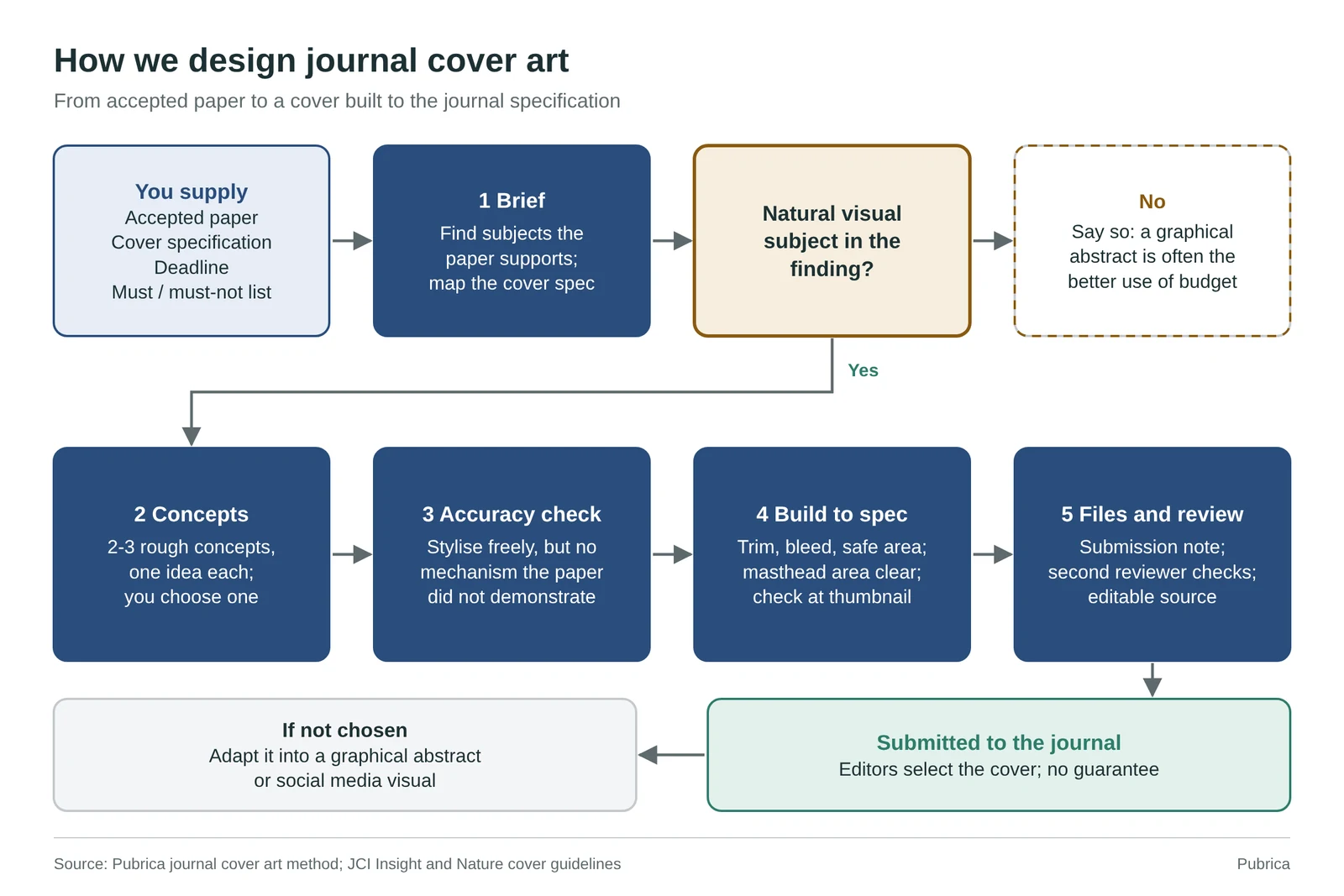
Every cover begins with two documents: the accepted manuscript and the journal's cover specification. Our subject specialist reads the paper to find subjects that could carry an image; the designer maps the specification before any sketching.
For a melanoma immunotherapy paper, for example, candidate subjects might include a cytotoxic T cell engaging a melanoma cell, the checkpoint receptor and ligand pair at the centre of the finding, or a change in the tumour microenvironment after treatment. The brief records which of these the paper actually supports, and how strongly.
What we ask you to supply:
- The accepted manuscript and supplementary figures
- The journal name and its cover specification, or the editor's invitation email if it includes one
- Your deadline, and whether the cover is invited or speculative
- Anything that must appear, and anything that must not (for example, an unpublished target or a proprietary compound structure)
- Existing micrographs or renders you own and are willing to have referenced
If the invitation is from the editor, tell us at the start. Invited covers usually come with a deadline and sometimes a different specification, and the aim shifts from the most selectable image to the strongest one.
Practical tip
Tip: before you reply to a cover invitation, ask the editorial office for the current cover template and deadline in writing. Designing to an outdated size or an assumed masthead position is the most avoidable delay.
Step two: concepts built around one idea
We prepare two or three distinct rough concepts, each based on a single idea, and you choose one before rendering begins. Covers are selected competitively, so seeing more than one direction early is worth the time.
The common temptation is to show the whole study: the pathway, the mouse model, the patient cohort and the survival curve. At cover size, an image that tries to show the method, the result and the implication conveys none of them clearly. A stronger concept for a checkpoint paper might be one scene, such as a T cell released from inhibition at the tumour boundary, rendered so the focal point reads instantly.
Not every paper has a natural image. Some findings are structural or cellular and translate well; others are entirely statistical. Where there is no natural image, a forced concept tends to look generic, and we will say so. In that case a graphical abstract is often the better use of budget.
Have a cover invitation for an accepted paper?
Send us the paper and target journal. We will sketch one concept free of charge and tell you whether the paper lends itself to a cover image, before you commit.
Step three: the scientific accuracy check
This is where tumour immunology covers most often go wrong, and where our biomedical imaging and subject specialists spend the most time. Changes to colour, scale and level of abstraction are acceptable. Showing a structure that does not exist, or an interaction the paper did not demonstrate, is not. Editors read the paper before selecting a cover, so overstatement is noticed.
| Check | Example question for a melanoma checkpoint paper |
|---|---|
| Mechanism | Does the image show only the receptor, ligand and cell types the paper studied? A PD-1 study should not imply LAG-3 or CTLA-4 biology it did not test. |
| Direction of effect | If the paper reports resistance or a subgroup without benefit, does the image avoid implying universal response? |
| Model system | Is a mouse model drawn as a mouse model, not as human tissue? |
| Scale | Are antibodies, receptors and cells stylised consistently, without implying a size relationship the data contradicts? |
| Products | Are approved medicines named or depicted only factually, if at all? |
| Source material | Is every reused micrograph or structure owned by the authors or properly licensed? |
On products: several checkpoint inhibitors are approved in the USA for advanced melanoma, including the nivolumab and relatlimab fixed-dose combination approved by the FDA in March 2022. A cover is not the place to imply a use beyond the paper's data, so we keep any product reference strictly to what the article reports.
Step four: building to the cover specification
The most common technical rejection is a composition whose focal point sits under the masthead. Starting from the template prevents it. Each journal publishes its own requirements, and they differ, which is why we never work from a generic size.
Two published examples show the range:
- JCI Insight asks for images of 8.375 × 7.4 inches (21.3 × 18.8 cm) at no less than 300 dpi, prefers TIFF, and asks for no text, arrows, scale bars or other symbols.
- Nature's cover guidance specifies a full-page format that includes a 3 mm bleed on the top, bottom and right edges, with files of at least 300 dpi at actual size.
Our specification checklist covers trim size, bleed, safe area, resolution, colour space, file format and the area reserved for the masthead and cover lines. We render the chosen concept, check it at thumbnail size throughout, and keep the reserved areas clear. An image whose detail is visible only at full size may be attractive but will be weak as a cover.
Using AI responsibly in cover art
Policies on generative AI images are now explicit at several publishers. Springer Nature, for example, states that it is unable to permit AI-generated images for publication while legal questions remain unresolved, with limited exceptions. The January 2026 update to the ICMJE Recommendations added a new section on AI use and places responsibility for content on the authors.
Our approach follows the service page: AI tools may help with layout options, colour systems and specification checks, but we do not use them to generate any image that depicts data, a specimen, a scan or an apparatus. We tell you which tool, if any, was used and at which stage, so your declaration is accurate. Check your target journal's own policy, because rules vary.
Step five: files, the submission note and second review
Most journals ask for a short explanation to accompany the image. We write the cover submission note in plain language, linking the image to the finding without overstating it. Before delivery, a second reviewer checks the files independently against the agreed scope and checklist, and findings are resolved before release. You receive the files to the journal's requirements and the editable source.
No designer can guarantee selection; editors decide. What a careful process can do is remove the technical reasons for rejection and give the image the best chance at the size it is judged. Licence and reuse terms for cover images also vary by publisher, so read the journal's terms before agreeing to transfer rights in the image.
Who this method suits
The method is designed for academic researchers and for translational and company teams in the life sciences who have an accepted paper and limited time. It sits within Pubrica's wider oncology and haematology support for US groups, where the same visual style can be extended to a graphical abstract or social media sizes if the paper is being promoted alongside the cover.
If you are weighing whether to commission a cover at all, three questions help: does the finding have a natural visual subject, is the deadline realistic for two or three concept rounds, and will the image be reused in talks, press or a graphical abstract? If the answer to the first is no, put the budget elsewhere.
Frequently asked questions
No. Editors select covers, often competitively. We can make sure the image meets the journal's technical specification, represents the paper accurately and works at the size it is assessed.
Tell us the deadline when you first contact us. Invited covers usually have a fixed date, and the timeline is planned around it, including concept rounds and the specification check.
We advise against it. Stylisation is acceptable, but an interaction the paper did not demonstrate is a misrepresentation, and editors read the paper before choosing a cover.
The concept can often be adapted into a graphical abstract or social media visual in the same style, so the work is not wasted.
Sources
Sources were checked on 24 November 2026. Requirements and guidance may change after that date; confirm the current version with the issuing body.
- 1JCI Insight. Cover image submission guidelines. https://insight.jci.org/kiosks/cover-submission
- 2Nature Research Figure Guide. Covers. https://research-figure-guide.nature.com/covers/
- 3Springer Nature. Editorial policies: Artificial Intelligence (AI). https://www.springer.com/us/editorial-policies/artificial-intelligence--ai-/25428500
- 4International Committee of Medical Journal Editors. Updated ICMJE Recommendations, January 2026. https://icmje.acponline.org/news-and-editorials/updated_recommendations_jan2026.html
- 5US Food and Drug Administration. FDA approves Opdualag for unresectable or metastatic melanoma. 2022. https://www.fda.gov/drugs/resources-information-approved-drugs/fda-approves-opdualag-unresectable-or-metastatic-melanoma
journal cover art designscientific cover imagejournal cover submissioncover art for accepted papermelanoma immunotherapy illustrationcover image specification
How to cite this article
Pick your referencing style and copy it. Your university or target journal may vary the punctuation, so check its guide if it has one.
Pubrica Insights. (2026, November 24). How We Design Journal Cover Art for an Accepted Melanoma Immunotherapy Paper: Brief, Scientific Accuracy Checks and the Cover Specification. Pubrica. https://pubrica.com/insights/how-we-design-journal-cover-art-melanoma/
This article is written to be learned from. Cite it if you are referring to what it says; if you are using the evidence behind it, cite the sources listed above instead.
Next steps
Have a cover invitation for an accepted paper?
Send us the paper and target journal. We will sketch one concept free of charge and tell you whether the paper lends itself to a cover image, before you commit.
This article is general information for researchers, not legal, regulatory or funding advice. Check the current requirements of your journal, funder, ethics committee or regulator before you act on it.
More in Inside the Lab