
- Services
- Discovery & Intelligence Services
- Publication Support Services
- Sample Work
Publication Support Service
- Editing & Translation
-
Editing and Translation Services
- Sample Work
Editing and Translation Service
-
- Research Services
- Sample Work
Research Services
- Physician Writing
- Sample Work
Physician Writing Service
- Statistical Analyses
- Sample Work
Statistical Analyses
- Data Collection
- AI and ML Services
- Sample Work
AI and ML Services
- Medical Writing
- Sample Work
Medical Writing
- Research Impact
- Sample Work
Research Impact
- Medical & Scientific Communication
- Sample Work
Medical & Scientific Communication
- Medico Legal Services
- Educational Content
- Academic Editorial Services
- Sample Work
Academic Editorial Services
- Educational Editorial Service
-
Education Editorial Services
- Sample Work
Education Editorial Services
-
- Industries
- Subjects
- About Us
- Academy
- Insights
- Contact Us
Rewrite Right: Paraphrasing Tips to Avoid Plagiarism
- Home
- Academy
- Poster Presentation
- Paraphrasing Tips to Avoid Plagiarism
Research Impact
- Understanding Plagiarism and Paraphrasing
- The Importance of Effective Paraphrasing
- Practical Steps to Paraphrase Without Plagiarizing
- How to Paraphrase in Research Papers – The Essential Techniques
- The Role of Citation in Preventing Plagiarism
- Revising and Checking Your Paraphrase
- Common Paraphrasing Mistakes to Avoid
- Tools for Effective Paraphrasing and Plagiarism Prevention
Interesting topics
Rewrite Right: Paraphrasing Tips to Avoid Plagiarism
1. Understanding Plagiarism and Paraphrasing
2. The Importance of Effective Paraphrasing
3. Practical Steps to Paraphrase Without Plagiarizing
4. How to Paraphrase in Research Papers – The Essential Techniques
5. The Role of Citation in Preventing Plagiarism
6. Revising and Checking Your Paraphrase
7. Common Paraphrasing Mistakes to Avoid
8. Tools for Effective Paraphrasing and Plagiarism Prevention
To properly paraphrase and avoid plagiarism, you must understand the original idea, rewrite it entirely in your own words and sentence structure, and always provide a citation. Simply swapping a few words for synonyms is not enough and can be considered “patchwriting”. Plagiarism is one of the most significant ethical violations associated with academic writing, and one of the best ways to keep your writing original, ethical, and academically rigorous is to master effective techniques for paraphrasing. Paraphrasing in research plays a critical role in maintaining academic integrity, and many scholars rely on an Academic paraphrasing tool or a Research paraphrasing tool to support accurate restatement of source material. This article discusses appropriate tools and learning strategies to help you paraphrase appropriately and avoid committing plagiarism.
1. Understanding Plagiarism and Paraphrasing
- What is Plagiarism? – Plagiarism refers to the use of another person’s idea, words or research without giving proper credit to that person. You can plagiarise by directly copying what someone else has written, closely imitating what they have written or changing just a couple of words in the original but keeping most of it intact. If none of these methods of copying or adapting from another author’s original text includes a proper citation, then you have committed plagiarism.[1]
- What is Paraphrasing? – Paraphrasing means restating another person’s ideas in your own voice while still accurately representing the original idea and providing the proper citation to the source. A good paraphrase does not just replace a few words from the original with their synonyms, it will also show the reader that you have a full understanding of the ideas found within the source and can give a detailed description of those ideas to another person.[2]
Understanding the distinction between Paraphrasing vs rewriting is essential, as rewriting may change the meaning, whereas effective paraphrasing preserves the author’s original intent while reducing plagiarism risk.
2. The Importance of Effective Paraphrasing
Paraphrasing is a creative activity; it allows you to
- Include well-researched information, as seamlessly as possible.
- Show that you understand what you have read in the literature.
- Utilize fewer direct quotes (a potential pitfall that every writer should avoid).
- Acknowledge the sources from which you are borrowing ideas to maintain integrity. [3]
For students writing academic research papers, mastering techniques for effective paraphrasing is one of the best practices for paraphrasing source text.
Even with excellent paraphrasing techniques, failing to cite the original source can still constitute plagiarism.
3. Practical Steps to Paraphrase Without Plagiarizing
First Comprehend, Then Write | Before you write a new version of the information in the original document, ensure that you understand it completely. Make sure to write notes about what you have read in your own words instead of copying any phrases directly from the original text.[4] |
Alter Language and Sentence Structure | Change the order of the sentences (for example, converting from the active voice to the passive voice) and use synonym(s) with care; do not substitute the same word(s) multiple times in a row. Break up long sentences from the source or combine shorter ones to fit your writing style. |
Preserve Original Meaning | The purpose of your paraphrase should be to reflect what the author intended to convey, not change the meaning of the information or the arguments presented. To misinterpret what is being said is as serious as copying the work of others in scientific writing.[5] |
Read from a Range of Sources | By only using one source, you may unintentionally have an identical writing style or idea throughout all of your writings. Reading many different sources will allow you to generate diverse, critical ideas in your writing. [6] |
These synonym replacement techniques and sentence restructuring strategies help writers paraphrase accurately without distorting meaning
Example
BEFORE:
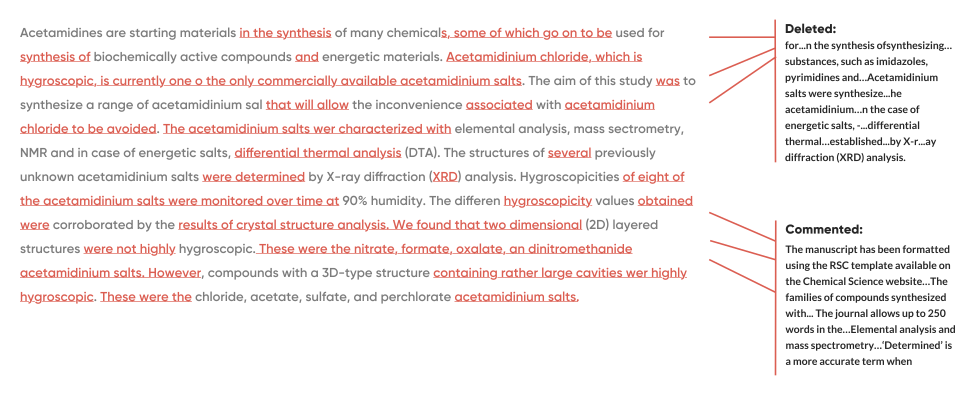
The rapid deforestation of the Amazon is due to various factors like logging, agriculture, and cattle ranching
AFTER:
Logging, farming, and rearing cattle have significantly contributed to the swift clearing of the Amazon forest.
4. How to Paraphrase in Research Papers – The Essential Techniques
The techniques for paraphrasing include: [7]

5. The Role of Citation in Preventing Plagiarism
The citation guidelines for paraphrased content are as follows:
- The in-text citation should be placed at the end of the paraphrase.
- A reference list entry should be included that corresponds with the in-text citation.
- It is important to use a consistent citation style (APA, AMA, MLA, Chicago, etc.).
Not citing paraphrased material is one of the most frequently made errors by students and can result in unintentional plagiarism. [8]
6. Revising and Checking Your Paraphrase
It is important for you to review your work after drafting to ensure that there are significant differences in structure and wording between your paraphrase and the original text. You should also verify that your citations are correct. Additionally, it may be helpful to run a plagiarism detection program as a final check on your work to find any unintentional similarities or missing citations.
Many writers rely on a Plagiarism checker or an AI paraphrase tool during this stage to further reduce plagiarism risk.
7. Common Paraphrasing Mistakes to Avoid
The pitfalls of paraphrasing are listed below. Be cautious of these mistakes:
Superficial paraphrasing Simply substituting a few words or phrases with alternatives without changing the structure or fully rephrasing the content. | Incorrect synonym use Using synonyms that fail to convey the original author’s intended meaning. |
Lack of proper attribution Failing to give appropriate credit to the original author when paraphrasing their ideas. | Over-reliance on quotations Excessive use of direct quotes, which can weaken the quality and originality of a researched article and its arguments. |
These mistakes highlight why paraphrasing tips for academic writers emphasize originality over mechanical rewriting.
8. Tools for Effective Paraphrasing and Plagiarism Prevention
Using a reliable citation generator tool alongside a plagiarism avoidance service helps ensure proper attribution and academic transparency. Some highly recommended tools include:
- Quill Bot: An AI-based rewriting tool that makes recommendations based on the content of the original text while still maintaining the same meaning.
- Grammarly: An online writing assistance service that will review your grammar and check your writing for plagiarism and will also assess the readability of your document.
- Turnitin: This is a widely used service that many colleges and universities utilize to detect instances of plagiarism.
- io: An online rewriting tool which will take a sentence as input and then provide a completely different version of it while maintaining the original context.
- Citation Managers (such as Zotero and Mendeley) – Many of the citation managers allow you to create a complete citation/reference list from the material you have paraphrased.
Together, these tools function as academic editing and paraphrasing services, supporting plagiarism avoidance workflows for students and researchers.
These tools, while useful, do not take the place of critical thought. For that reason, it is vital that you review both the original text and the suggested paraphrases and ensure that they indicate the correct meaning, and that you cite them appropriately.
Connect with us to explore how we can support you in maintaining academic integrity and enhancing the visibility of your research across the world!
Conclusion
To paraphrase effectively, you must have a thorough comprehension of the original source material and then use this information in an innovative manner that expresses your personal identity in your writing. The result will be a completely new and original piece of art, as well as reinforcing the validity of the original source material. Properly written paraphrases clarify the information contained within the original source material for the audience, while demonstrating the writer’s trustworthiness and value of the written work. When used responsibly, a paraphrasing service combined with strong academic judgment supports ethical scholarship and originality in research writing.
From accurate paraphrasing to plagiarism-safe academic editing, Pubrica helps transform your research into original, publication-ready work. Start with confidence today. [Get Expert Publisging Support] or [Schedule a Free Consultation].
References
- Tips for avoiding plagiarism. (n.d.). Hhs.gov. Retrieved December 29, 2025, from https://ori.hhs.gov/tips-avoiding-plagiarism
- Citing sources. (2010, August 2). Ucla.edu. https://guides.library.ucla.edu/citing/plagiarism/avoid
- Bhatta, D. D. C. (2024). Effective strategies for avoiding plagiarism in academic writing: An interdisciplinary approach. The Voice of Creative Research, 6(4), 19–27. https://doi.org/10.53032/tvcr/2024.v6n4.03
- Guidelines for effective paraphrasing: Avoid plagiarism while preserving meaning. (n.d.). Plagly.com. Retrieved December 29, 2025, from https://plagly.com/blog/guidlines-for-paraphrasing
- (2025, September 23). How to avoid plagiarism in academic writing (with examples). ResearchPal Blog; ResearchPal. https://blog.researchpal.co/academic-writing/avoid-plagiarism-in-academic-writing
- Kumar, P. M., Priya, N. S., Musalaiah, S., & Nagasree, M. (2014). Knowing and avoiding plagiarism during scientific writing. Annals of medical and health sciences research, 4(Suppl 3), S193–S198. https://doi.org/10.4103/2141-9248.141957
- How to paraphrase properly (without plagiarizing). (2025, July 14). Oreate.com. https://www.oreateai.com/blog/how-to-paraphrase/
- Jacob, S. (2025, September 1). The role of citation and referencing in avoiding plagiarism. Originality.Ai. https://originality.ai/blog/the-role-of-citation-and-referencing-in-avoiding-plagiarism