
- Services
- Discovery & Intelligence Services
- Publication Support Services
- Sample Work
Publication Support Service
- Editing & Translation
-
Editing and Translation Services
- Sample Work
Editing and Translation Service
-
- Research Services
- Sample Work
Research Services
- Physician Writing
- Sample Work
Physician Writing Service
- Statistical Analyses
- Sample Work
Statistical Analyses
- Data Collection
- AI and ML Services
- Sample Work
AI and ML Services
- Medical Writing
- Sample Work
Medical Writing
- Research Impact
- Sample Work
Research Impact
- Medical & Scientific Communication
- Sample Work
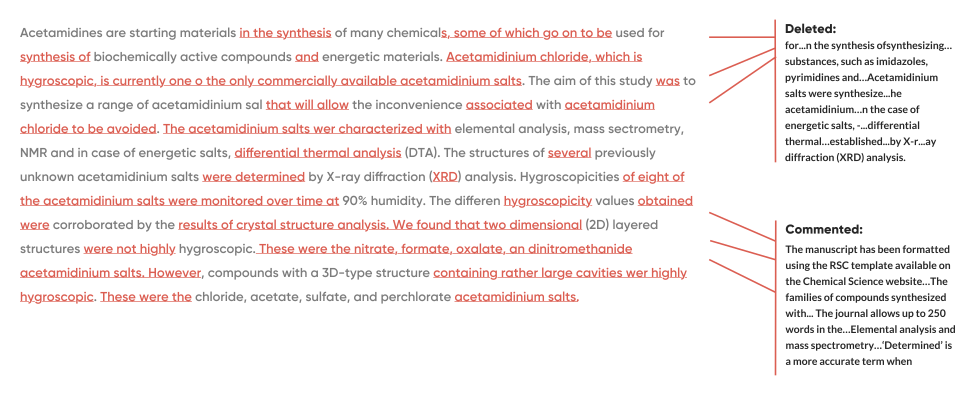
Medical & Scientific Communication
- Medico Legal Services
- Educational Content
- Academic Editorial Services
- Sample Work
Academic Editorial Services
- Educational Editorial Service
-
Education Editorial Services
- Sample Work
Education Editorial Services
-
- Industries
- Subjects
- About Us
- Academy
- Insights
- Contact Us
Targeted literature searches are a fundamental part of writing clinical manuscripts that will meet the standards of high-quality journals and contribute meaningfully to evidence-based practice. When physicians write clinical manuscripts, utilizing a targeted literature search can identify high-quality, relevant, and current evidence. While a general literature review is useful, a targeted literature search is specific to the clinical question and should be completed through frameworks established, such as PICO (Population, Intervention, Comparator, Outcome) and PRISMA [1].
Common Types of Plagiarism
- Home
- Academy
- Research Impact
- Common Types of Plagiarism
Common Types of Plagiarism
Interesting topics
Common Types of Plagiarism
Plagiarism is not giving credit to someone else’s work, thought, or idea. It can take on many forms such as quoting someone else’s work directly, reusing your own work (without credit), mosaic plagiarism (mixing sources without credit), paraphrasing plagiarism (rewriting the thought without credit), and accidental plagiarism (which would be failed to credit, and you don’t mean to). It is important to learn about these types of plagiarism so you can demonstrate academic and professional integrity. [1]

1. Direct Plagiarism
When direct plagiarism occurs, an individual takes another person’s work verbatim, without any modification and without any proper citation. Direct plagiarism is.[2]
- Copying text from a book, article, or website without quotation marks and without crediting the original author.
- Using another person’s ideas, research, or expressions as one’s own without acknowledging the source.
- Cut-and-pasting directly without any changes from a given source into the work that you are submitting, then presenting that work as if it were your own.
2. Self-plagiarism
Self-plagiarism occurs when published work, or parts of that published work, are reused by the author in a new circumstance or publication, without proper acknowledgement. Self-plagiarism includes. [3]
- Submitting the same research, data, or content to different journals or forums without notifying them of your prior publication.
- Reusing parts of an earlier paper, thesis or article in a new submission without obviating that you had used these parts previously.
- Presenting prior work as new, or original, work with no citation or reference to your earlier version.
3. Mosaic Plagiarism
Mosaic plagiarism (or patchwriting) occurs when a writer takes phrases, sentences, or ideas from a source and integrates them into their own work without proper attribution, creating a mosaic from borrowed materials. Mosaic plagiarism differs from direct plagiarism in that the writer is not repeating original items word-for-word; rather, when presented with the source material, the writer has made a paraphrase of the original material, or has merely changed the order of the original, or a small number of words, while completely retrieving the ideas of an original source and omitting to provide citation. [4]
- Changing a few words of a passage taken from a source but keeping the original intention, meaning, and structure without a citation.
- Including mixed quotations and paraphrased material without distinguishing between the two and failing to cite the original source material.
- Using several sources and integrating what one perceives are ideas from the original authors in a way that makes identifying the original authors impossible.
4. Paraphrasing Plagiarism
Paraphrasing plagiarism refers to the writer paraphrasing someone else’s ideas or content in his or her own words without citing the original source. The writer has the words or structure differ, but the idea or information is still taken from another author without specifying the original source. [5]
- Paraphrasing (rewriting) a passage (the writer even uses quotation marks or citations) from a source, even if words were changed.
- Summarizing the argument or research of another person without crediting the original author.
- Using another person’s unique idea or framework without citation or reference to their work.
5. Accidental Plagiarism
Accidental plagiarism happens when an author accidentally uses somebody else’s work, ideas, or expressions and fails to cite or acknowledge it properly. [6]
- Poor Notetaking: Not keeping track of whatever personal thoughts and ideas were borrowed from sources wrote down could lead to confusion when writing.
- Poor Paraphrasing: Trying to paraphrase someone else’s work, but you accidentally use their phrases or sentence structure in the different wording you used that requires citation.
- Accidental Registration Error: A misregistered source or simply forgetting to register a source.
- Using Direct Quotations: Using direct quotations without quotation marks and/or attribution to the source, even though it is cited elsewhere.
6. Sources Without Credit
This is a form of plagiarism, even when the materials are used with quotation, paraphrase, or summary. Failure to give credit for the source of information violates the ethical standards of writing or publishing.
- Using another person’s research findings or data in your work without citing the original publication.
- Paraphrasing or summarizing an author’s work without providing a citation and claiming the ideas are your own.
- Presenting an idea or theory originally published by another researcher without reference to the source.
- Reusing an image, graph, or table from another source without attribution or permission.
7. Improper Citation
This type of citation mishap can incite plagiarism accusations even when the author had the intent to cite. Citation issues can be caused by many different things, including incomplete information, citation formatting, or inconsistencies with citation style. [7]
| Incomplete citation | Not providing one or more of the relevant details, for example: the author’s complete name, date of publication, title, or publisher. |
|---|---|
| Incorrect formatting | Using the wrong style of citations (i.e. MLA, APA, Chicago) or formatting elements of the citation incorrectly (such as incorrectly italicizing the title or use of punctuation). |
| Incorrect author name(s) | Misspelling the author’s name, or using an incorrect author name, can lead readers to another incorrect source. |
| Missing page numbers | Missing page numbers when citing specific parts of text or not being sure of page numbers often occurs when using MLA or APA citation. |
| Citing secondary sources incorrectly | Misrepresenting a source always happens when you cite a citation from another source, if you do not cite correctly from a secondary citation. |
8. Cheating
Cheating means using unauthorized resources, or methods to gain an unfair advantage, typically in academic or test settings. Cheating involves copying during the exam from someone else, using unauthorized resources, submitting someone else’s work, or providing falsified data. Cheating violates the fairness, academic honesty and value of hard work in academic settings.[8]
Connect with us to explore how we can support you in maintaining academic integrity and enhancing the visibility of your research across the world!
Conclusion
Plagiarism can take many different forms, including the following: a) Direct copying b) Self-plagiarism c) Mosaic plagiarism d) Paraphrasing plagiarism e) Accidental plagiarism. All types of plagiarism involve using the words of others without credit or copyright appropriately, as well as using sources without citation or as directed, and cheating, using unauthorized means to gain an advantage. Academic integrity is best maintained by being honest when using sources that require credit and behaving ethically.
Common Types of Plagiarism? Our Pubrica consultants are here to guide you. [Get Expert Publishing Support] or [Schedule a Free Consultation]
References
- The common types of plagiarism. (n.d.). Dean of Students. Retrieved September 5, 2025, from https://www.bowdoin.edu/dean-of-students/conduct-review-board/academic-honesty-and-plagiarism/common-types-of-plagiarism.html
- (2019, February 1). Libguides.com. https://dacc.libguides.com/plagiarism/direct
- Plagiarism. (2016, January 5). Sjsu.edu. https://library.sjsu.edu/plagiarism/self-plagiarism
- De Amicis, A. (2023, December 12). Mosaic plagiarism: Examples, types, and avoidance tips. Turnitin.com. https://www.turnitin.com/blog/what-is-mosaic-plagiarism-examples-types-and-how-to-avoid-it
- Plagiarism. (2012, July 5). Randolph.edu. https://libguides.randolph.edu/plagiarism/paraphrasing
- Jindal, M. (2024, September 8). What is accidental plagiarism? – top 6 consequences //. Bytescare. https://bytescare.com/blog/what-is-accidental-plagiarism
- Academic Engagement. (2012, August 29). Citation. Brown.edu. https://libguides.brown.edu/citations/styles
- Sozon, M., Mohammad Alkharabsheh, O. H., Fong, P. W., & Chuan, S. B. (2024). Cheating and plagiarism in higher education institutions (HEIs): A literature review. F1000Research, 13, 788. https://doi.org/10.12688/f1000research.147140.2