
- Services
- Discovery & Intelligence Services
- Publication Support Services
- Sample Work
Publication Support Service
- Editing & Translation
-
Editing and Translation Services
- Sample Work
Editing and Translation Service
-
- Research Services
- Sample Work
Research Services
- Physician Writing
- Sample Work
Physician Writing Service
- Statistical Analyses
- Sample Work
Statistical Analyses
- Data Collection
- AI and ML Services
- Sample Work
AI and ML Services
- Medical Writing
- Sample Work
Medical Writing
- Research Impact
- Sample Work
Research Impact
- Medical & Scientific Communication
- Sample Work
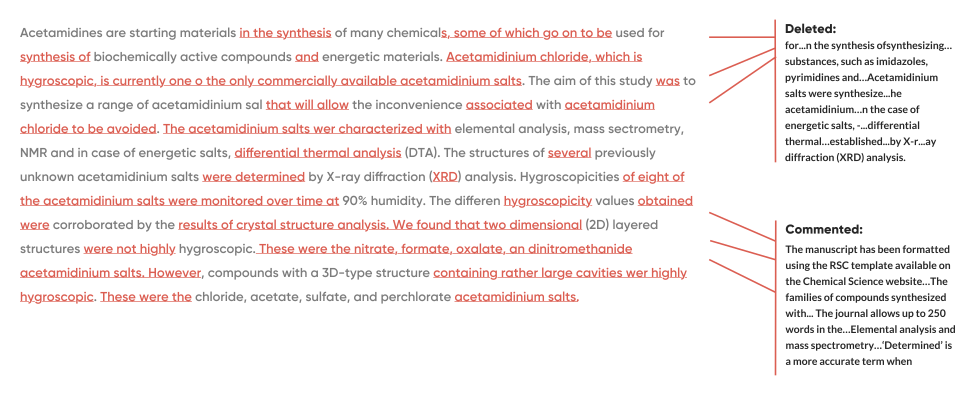
Medical & Scientific Communication
- Medico Legal Services
- Educational Content
- Academic Editorial Services
- Sample Work
Academic Editorial Services
- Educational Editorial Service
-
Education Editorial Services
- Sample Work
Education Editorial Services
-
- Industries
- Subjects
- About Us
- Academy
- Insights
- Contact Us
How to Write a Research Paper in APA Format (7th Edition): Why It’s Challenging and How to Succeed: A Complete Guide
- Home
- Academy
- Statistical analysis
- How to Write a Research Paper in APA Format (7th Edition): Why It’s Challenging and How to Succeed: A Complete Guide
High-Impact Journals
- Why Writing an APA Research Paper is Difficult
- Journals and Disciplines That Use APA Format
- What is APA Style? (APA 7th Edition Overview)
- How to Succeed in Writing an APA Manuscript: A Step-by-Step Strategy
- APA Research Paper Sections Explained (With Best Practices)
- Why APA Manuscripts Get Rejected and How to Avoid It
- Final Tips for Writing an Error-Free APA Paper
Interesting topics
How to Write a Research Paper in APA Format (7th Edition): Why It’s Challenging and How to Succeed: A Complete Guide
1. Why Writing an APA Research Paper is Difficult
2. Journals and Disciplines That Use APA Format
3. What is APA Style? (APA 7th Edition Overview)
4. How to Succeed in Writing an APA Manuscript: A Step-by-Step Strategy
5. APA Research Paper Sections Explained (With Best Practices)
6. Why APA Manuscripts Get Rejected and How to Avoid It
7. Final Tips for Writing an Error-Free APA Paper
In psychology, education, nursing, sociology, and other social and behavioural sciences, writing a research paper in APA format is one of the most common requirements for students and researchers. However, writing a polished APA-style research manuscript is one of the hardest things for early-career researchers, even though it is probably the most popular style in the world. [1]
APA formatting involves more than just citations and references; it is an entire writing system with established rules regarding structure, tone, clarity, tables, figures, headings, reporting on statistics, bias-free language, and academic ethics. Many researchers don’t struggle with the ideas; they struggle with how to bring the ideas into congruence with APA’s strict expectations.
This guide explains why writing an APA research paper is difficult, how to overcome the common challenges, the latest guidelines for APA 7th edition, and how to organize a high-quality APA-style research paper that meets journal-level standards.
1. Why Writing an APA Research Paper Is Difficult
- APA is highly structured: APA style requires strict structure: title page, abstract, introduction, literature review, methods, results, discussion, and references. Even slight deviations reduce professionalism.
- Heavy focus on clarity and bias-free language: Researchers must avoid vague wording, biased terms, and unscientific generalizations, something many first-time writers struggle to balance.
- Complex citation and referencing rules: APA in-text citations, narrative citations, parenthetical citations, and reference formatting are detailed. Misplaced periods, italics, or capitalization led to formatting errors.
- Detailed rules for tables, figures, and statistical reporting: From how p-values are formatted to how confidence intervals and effect sizes appear, statistical reporting in APA is precise.
- Requires logical flow + scientific argumentation: APA writing demands critical thinking, summarizing literature, synthesizing evidence, and presenting arguments systematically.
- Journals using APA expect high rigor: Leading APA-focused journals enforce strict formatting standards, higher than typical university submissions.
2. Journals and Disciplines That Use APA Format
The APA style is the mandated style for journals and disciplines in the social and behavioural sciences, including:
| Disciplines | Major journals using APA format |
|---|---|
|
|
|
|
3. What is APA Style? (APA 7th Edition Overview)
APA Style is a standardized writing and citation format developed by the American Psychological Association. It helps to improve clarity, consistency, readability, and credibility.
Main Features of APA 7th Edition
- 1-inch margins on all sides of the page
- Font is 12-pt Times New Roman, 11-pt Calibri, 11-pt Arial, or 11-pt Georgia
- Running head only required for professional papers (students will use only page numbers)
- Page numbers will be on every page
- Title page will be structured and will include the author’s affiliation
- Author-date citation style will be utilized
Reference list (not bibliography) and the first line of each entry will have a hanging indent
4. How to Succeed in Writing an APA Manuscript: A Step-by-Step Strategy
Many students fail because they write the paper before learning the APA format.
Success comes from reversing the process.[2]
Step 1: Start With the APA Structure (Before Writing)
APA Research Paper Structure
- Title Page
- Abstract (150-250 words)
- Introduction
- Literature Review
- Methods
- Results
- Discussion
- Conclusion
- References
Before writing any text, develop the skeleton outline of your research paper with the APA headings.
Step 2: Use APA Headings Correctly
APA 7th Edition provides 5 levels of headings.
Common mistakes happen when students skip or misapply levels.
Step 3: Master APA In-Text Citations
Examples:
- Narrative attribution: Smith (2022) found that…
- Paraphrased attribution: (Smith, 2022).
- Direct quote: “…” (Smith, 2022, p. 14).
Common errors: missing year, punctuation errors, or improper formatting of multiple authors.
Step 4: Build a Perfect APA Reference List
The reference list must be:
- Alphabetized
- Double-spaced
- Hanging indent (0.5 inches)
- Consistent in punctuation and formatting
Example (journal reference): Smith, J. A., & Brown, T. (2021). Title of the article. Journal Name, 45(2), 123–145. https://doi.org/xxxx
Step 5: Follow APA Statistical Reporting Rules
APA 7th edition requires:
- Italics for statistical symbols (M, SD, p, N)
- Exact p-values (e.g., p = .021)
- Confidence intervals (CI)
- Effect sizes
Step 6: Use APA Formatting for Tables & Figures
Tables and figures must:
- Follow APA title style
- Include notes below
- Use minimal formatting
Many students lose marks here due to spacing, bolding, or line usage .
5. APA Research Paper Sections Explained (With Best Practices)
Introduction
- State your research problem
- Provide background
- End with your research question or hypothesis
Literature Review
- Summarize and synthesize previous research
- Identify knowledge gaps
- Show how your study fills those gaps
Methods
- Participants
- Materials
- Procedure
- Data analysis
Results
- Report findings
- Use APA-formatted tables and figures
- No interpretation, only facts
Discussion
- Interpret results
- Compare with past research
- Explain implications and limitations
Conclusion
- Summarize overall findings
- Suggest future directions
6. Why APA Manuscripts Get Rejected and How to Avoid It
| Frequent Issues with an APA Research Manuscript | How to Promote Success |
|---|---|
[3] |
|
7. Final Tips for Writing an Error-Free APA Paper
- Follow APA 7th edition strictly
- Write concisely and objectively
- Avoid plagiarism by paraphrasing effectively
- Cite every source you use
- Proofread multiple times
- Use academic tone (formal, neutral, clear)
Connect with us to explore how we can support you in maintaining academic integrity and enhancing the visibility of your research across the world!
Conclusion
Navigating the APA research paper format, with which you may not be familiar, can be intimidating. However, once you understand how to establish the right composition, well-defined guidelines, and which parts to apply to the APA 7th edition (the latest edition of APA style), you can develop a professional research manuscript ready for publication. Whether for a class paper, your thesis, or for submission to a peer-reviewed journal, adhering to APA style ensures the credibility, uniformity, and academic quality of your writing.
If you are daunted by APA formatting, citation rules, or manuscript structure, expert help can help. Once you have mastered the guidelines needed to write an APA research paper, whether for class, your thesis, or a peer-reviewed journal, the task is much less intimidating and allows for a process for you to even communicate your writing with confidence.
Need help perfecting your APA research manuscript? Pubrica’s expert academic writers and editors ensure flawless APA formatting, accurate citations, strong structure, and publication-ready quality.
[Get Expert APA Support Today]
References
- Busse, C., & August, E. (2021). How to Write and Publish a Research Paper for a Peer-Reviewed Journal. Journal of cancer education: the official journal of the American Association for Cancer Education, 36(5), 909–913. https://doi.org/10.1007/s13187-020-01751-z
- Poldiak, N. P., & Crossley, N. (2025). How to Write a Successful Research Manuscript: Back to Basics. HCA healthcare journal of medicine, 6(2), 193–203. https://doi.org/10.36518/2689-0216.1715
- Ali J. (2010). Manuscript rejection: causes and remedies. Journal of young pharmacists: JYP, 2(1), 3–6. https://doi.org/10.4103/0975-1483.62205