Contents
AcademyOriginal Research Article
Guide
Research Abstract Example: An Annotated Structured Abstract for an Original Research Article
A good abstract states the purpose, methods, key findings and implications of a study clearly and briefly. This annotated structured abstract example walks through each section so you can model your own.
- Abstract writing
- Manuscript writing
- Original research
- Sections
- Background, objective, methods, results, conclusion
- Typical limit
- 150–300 words (check the journal)
- Keywords
- 3–6 searchable terms
- Use for
- Original research with methods and results
At a glanceOriginal Research Article
Talk to a Pubrica expertDiscuss your project
Quick answer
- Answer five questions in order: the problem, the aim, what you did, what you found, and what it means.
- Give real numbers in the results, with an effect size and a confidence interval or p value.
- Stay within the journal’s word count and add three to six searchable keywords.
What a structured abstract is
An abstract is the short research summary at the top of a paper, and for most readers it is the only part they will read. A structured abstract divides that summary into labelled sections, typically background, objective, methods, results and conclusion, instead of one block of prose1. The format grew from a 1987 proposal for clinical articles and was recommended by the International Committee of Medical Journal Editors in 19932. NLM now maps the labels in MEDLINE records to five standard categories, and since 2010 PubMed shows each section on its own line4. This structured abstract example shows why the format works: each label answers one predictable question, so a reader, reviewer or search engine finds what they need in seconds.
The labelled sections, one by one
The sections mirror the IMRAD structure of the full paper (introduction, methods, results and discussion), compressed into a few sentences each. Background states the problem and the gap in knowledge. The objective gives the single aim of the study, ideally phrased as the question you set out to answer. Methods names the study design, the participants and the main outcome. Results reports the key findings with actual numbers, not vague claims. The conclusion answers the objective and states what the finding means in practice1. Learning how to write an abstract is largely a matter of answering those five questions, in order, without padding.
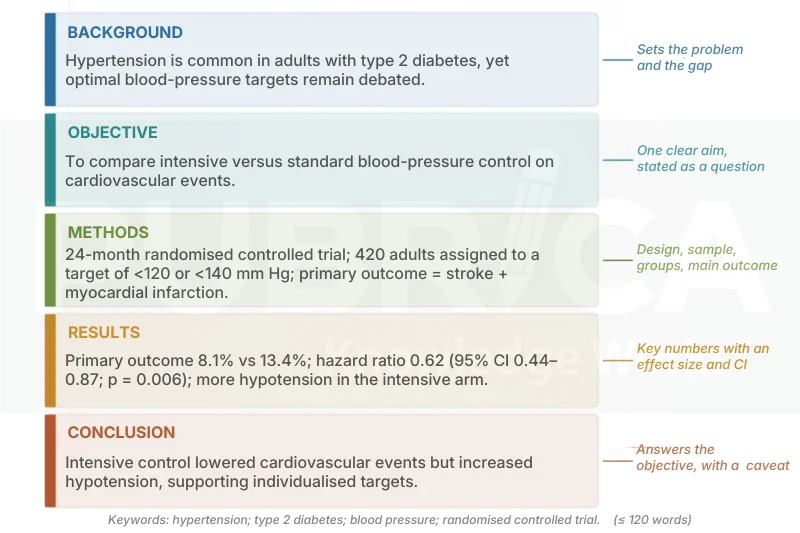
An annotated structured abstract example
Read Figure 1 from top to bottom and notice how tightly each section does its job. The background is two lines: a fact plus the unresolved question. The objective is a single sentence. The methods line packs design, sample size, the two groups and the primary outcome into one breath. The results line leads with the headline numbers and gives an effect size with a confidence interval, so readers can judge both size and precision. The conclusion returns to the objective and adds the honest caveat about hypotension. At under 120 words plus keywords, this structured abstract example fits almost any journal limit and still tells the whole story.
Check the numbers agree
In Figure 1 the hazard ratio of 0.62 with a 95% confidence interval of 0.44 to 0.87 corresponds to p ≈ 0.006, so the three figures are consistent. Reviewers notice when an interval and a p value disagree, so recompute them before submission.
Struggling to compress your study into a journal-ready abstract?
Pubrica’s medical-writing team drafts and polishes structured abstracts that match your target journal’s format and word count, and prepares the full manuscript around them.
Structured vs unstructured abstracts
An unstructured abstract contains the same information as one unlabelled paragraph. For simple or non-empirical articles that can read well, but research on the format finds that structured abstracts carry more complete information and are easier to search and read3. Uptake has grown steadily: structured abstracts rose from 2.5% of new MEDLINE records in 1992 to 20.3% in 20054. The practical rule: if you report original research with methods and results, use the structured format. Keep the unstructured abstract for editorials, commentaries and narrative reviews. Systematic reviews and trials have their own abstract checklists, such as the PRISMA 2020 for Abstracts checklist and the CONSORT extension for abstracts5.
Word count, keywords and common mistakes
Most journals cap the abstract at 150–300 words, so every sentence must earn its place; check the target journal’s instructions before you count. Use the past tense for what you did and found. After the abstract, list three to six keywords that a searcher would actually type, because they help discoverability. The commonest mistakes are easy to avoid: do not put data in the conclusion that never appeared in the results, do not cite references inside the abstract, and do not overstate findings beyond what the numbers support1. A tidy word count and precise keywords decide whether your paper is found and read.
A reusable abstract template
Table 1. A fill-in-the-blanks abstract template: swap in your own study and keep within the journal’s word count
| Section | What to write | Typical length |
|---|---|---|
| Background | 1–2 sentences: the problem and the knowledge gap | ~25 words |
| Objective | 1 sentence: the specific aim or question | ~15 words |
| Methods | Design, setting, participants, intervention or exposure, main outcome | ~40 words |
| Results | Key findings with numbers, effect size and confidence interval or p value | ~45 words |
| Conclusion | Direct answer to the objective, plus any caveat | ~25 words |
| Keywords | 3–6 searchable terms, separated by semicolons | — |
Put the figure and the template side by side and the method is clear: answer five questions, in order, with real numbers, inside the word limit. Do that and your abstract becomes a faithful research summary that readers trust and databases index cleanly, which is the purpose of the structured abstract format4. For other formats, see our guide to research abstract writing formats.
Pubrica team verdict
A strong structured abstract answers five questions in order, with real numbers, inside the journal’s word limit. Use the annotated example and the template to draft yours, then check every number against the results section.
Frequently asked questions
Most journals allow 150–300 words. Always check the journal’s instructions, because the word count limit and the exact section labels vary.
Most use background (or introduction), objective, methods, results and conclusion, mirroring the IMRAD structure of the full paper.
Use an unstructured abstract for editorials, commentaries and narrative reviews that have no formal methods and results; use the structured format for original research.
Sources
Sources were checked on 27 October 2026. Requirements and guidance may change after that date; confirm the current version with the issuing body.
- 1Andrade C. How to write a good abstract for a scientific paper or conference presentation. Indian J Psychiatry. 2011;53(2):172–175. https://pmc.ncbi.nlm.nih.gov/articles/PMC3136027/
- 2Nakayama T, Hirai N, Yamazaki S, Naito M. Adoption of structured abstracts by general medical journals and format for a structured abstract. J Med Libr Assoc. 2005;93(2):237–242. https://pmc.ncbi.nlm.nih.gov/articles/PMC1082941/
- 3Hartley J. Current findings from research on structured abstracts. J Med Libr Assoc. 2004;92(3):368–371. https://pmc.ncbi.nlm.nih.gov/articles/PMC442180/
- 4Ripple AM, Mork JG, Knecht LS, Humphreys BL. A retrospective cohort study of structured abstracts in MEDLINE, 1992–2006. J Med Libr Assoc. 2011;99(2):160–163. https://doi.org/10.3163/1536-5050.99.2.009
- 5Hopewell S, Clarke M, Moher D, et al. CONSORT for reporting randomized controlled trials in journal and conference abstracts: explanation and elaboration. PLoS Med. 2008;5(1):e20. https://doi.org/10.1371/journal.pmed.0050020
structured abstract exampleresearch abstract examplehow to write an abstractstructured abstract formatabstract templatebackground
How to cite this article
Pick your referencing style and copy it. Your university or target journal may vary the punctuation, so check its guide if it has one.
Dr. Charlie. (2026, October 27). Research Abstract Example: An Annotated Structured Abstract for an Original Research Article. Pubrica. https://pubrica.com/academy/original-research-article/structured-abstract-example/
This article is written to be learned from. Cite it if you are referring to what it says; if you are using the evidence behind it, cite the sources listed above instead.
Next steps
Struggling to compress your study into a journal-ready abstract?
Pubrica’s medical-writing team drafts and polishes structured abstracts that match your target journal’s format and word count, and prepares the full manuscript around them.
This article is general information for researchers, not legal, regulatory or funding advice. Check the current requirements of your journal, funder, ethics committee or regulator before you act on it.
More in Original Research Article