Where to Publish a Meta-Analysis: Journal Types, Indexing, APCs and Open-Access Options
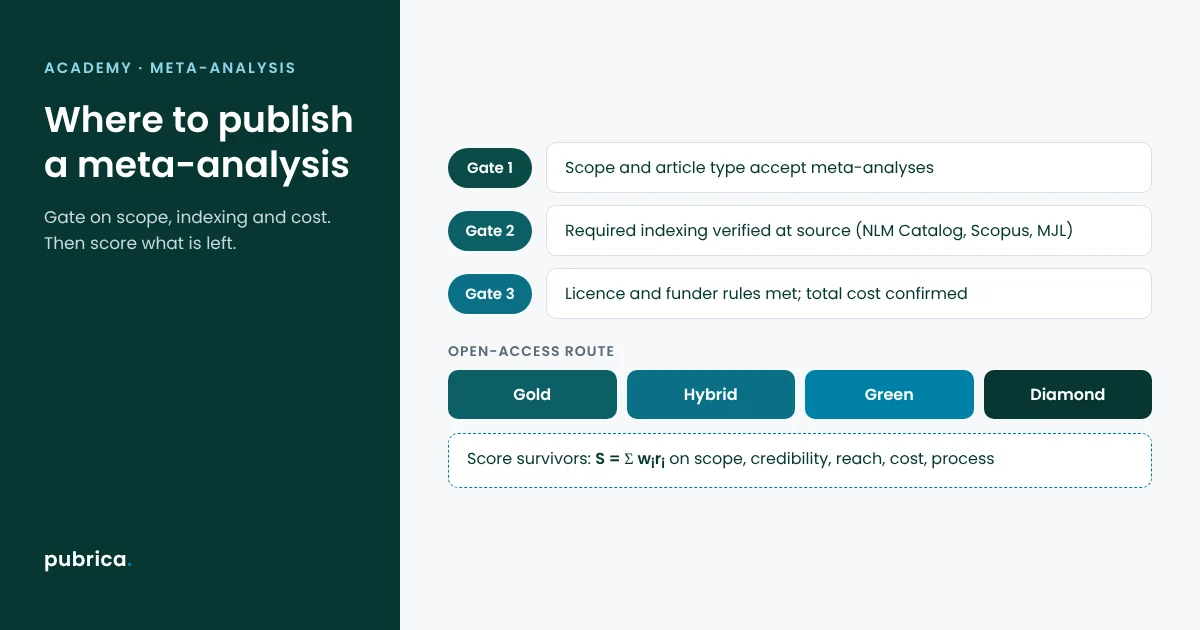
Meta-analysis journal selection is a sequence of gates, not an impact-factor contest: confirm scope, verify indexing at source, price the full publication costs, then score the journals that survive.
- Start with
- Journal scope and aims, recent reviews in the journal, and accepted article types
- Verify indexing
- NLM Catalog, Scopus Sources and the Master Journal List, not the publisher’s claims
- Price it
- APC plus tax, page or submission fees, minus waivers and institutional agreements
- UKRI-funded?
- Immediate open access under CC BY; standard hybrid APCs are not fundable from block grants
On this page
- Quick answer
- Which types of journals publish meta-analyses?
- Match the journal to the research design
- Verify journal indexing through official sources
- Compare APCs and other publication costs
- Choose an open-access option
- Identify predatory or unreliable journals
- Build and score a journal shortlist
- Questions
- References
Quick answer
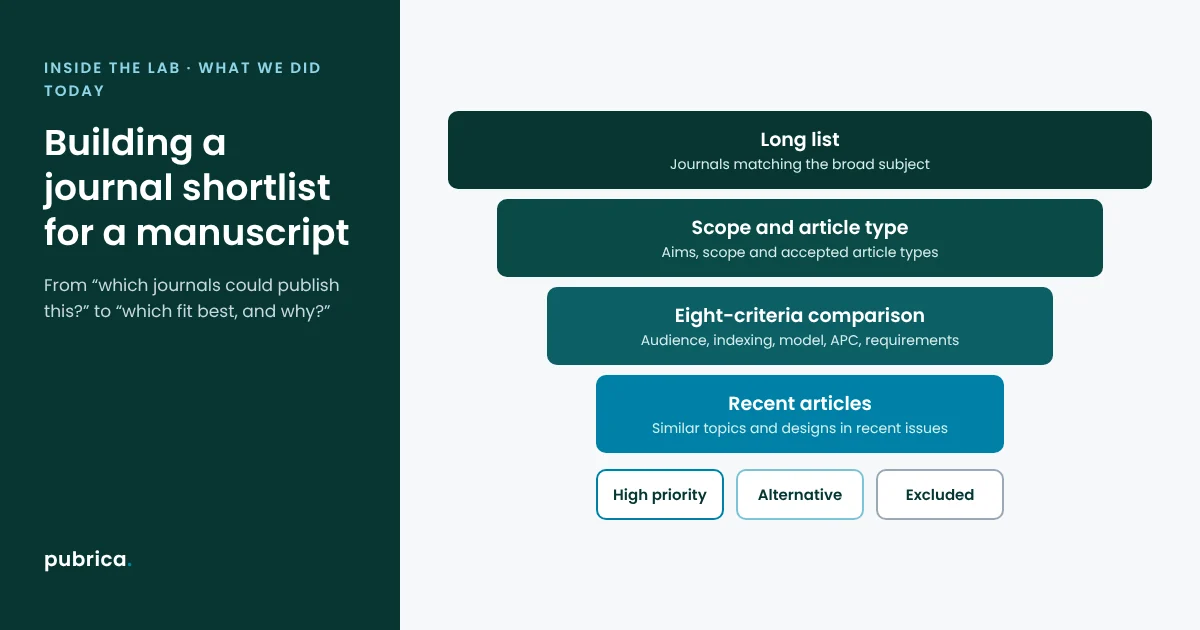
- Shortlist five to eight journals that have published meta-analyses on similar questions in the last few years.
- Treat required indexing, licence and funder rules as pass/fail gates before you compare anything else.
- A higher APC does not buy more citations: in 152 hybrid biology journals, APC cost did not predict citations.
- Score the survivors on weighted criteria, then submit to one journal at a time.
01Which types of journals publish meta-analyses?
Journals for meta-analysis fall into five broad groups, and the right one depends on your question, methods and readers. Read each candidate’s journal scope and aims, then check what it has actually published in the past two or three years: a journal that lists systematic reviews among its article types but has published none recently is a weak fit.
| Journal type | Best fit | Watch for |
|---|---|---|
| Specialty clinical | A focused disease, treatment or clinical decision | May prefer primary studies; check recent reviews in the journal |
| General medical or multidisciplinary | Findings that change practice or policy across fields | High rejection rates; needs broad relevance |
| Evidence synthesis and methodology | Network, diagnostic or methodological meta-analyses | Expects methods depth: heterogeneity, bias, models |
| Public health and health services | Population interventions, service delivery, policy | Wants implications for decision-makers |
| Pharmacology and HTA | Treatment effectiveness, safety and reimbursement evidence | Conflict-of-interest and funding scrutiny |
02Match the journal to the research design
A sound meta-analysis can still be desk-rejected when the design does not match the journal’s priorities. Diagnostic accuracy reviews need editors comfortable with bivariate or hierarchical models; network meta-analyses need reviewers who can judge transitivity and consistency; reviews that introduce a statistical method usually belong in a methodology journal, while clinical journals want implications for treatment decisions.
Reporting is part of fit. PRISMA 2020 provides a 27-item checklist, an abstract checklist and flow diagrams [1], and most journals ask for them at submission; compliance supports transparent systematic review publication but does not prove validity. Each journal’s exact upload rules are compared in our meta-analysis submission rules guide.
03Verify journal indexing through official sources
Journal indexing affects discoverability and often decides whether a paper counts for promotion, a degree or a funder report. MEDLINE is NLM’s curated, MeSH-indexed database and a primary component of PubMed; PubMed also holds citations from other sources, and PMC is a separate full-text archive [2]. So a PubMed record does not establish MEDLINE indexing.
Do indexing verification at the source, by exact title and ISSN, immediately before submission [3]: the NLM Catalog for MEDLINE, Scopus Sources for Scopus, and Clarivate’s Master Journal List for the specific Web of Science collection. Check DOAJ for open-access journals and use Crossref DOI verification to confirm that the journal’s DOIs resolve. Where indexing is a formal requirement, save a dated screenshot of each record.
| Database or directory | Verify at source | Common mistake |
|---|---|---|
| MEDLINE / PubMed | NLM Catalog record: current indexing status and coverage dates | Assuming a PubMed record means MEDLINE indexing |
| Scopus | Scopus Sources: exact title or ISSN, publisher, coverage years, discontinued flag | Trusting coverage that has since ended |
| Web of Science | Master Journal List: the exact collection (SCIE, SSCI or ESCI) | Treating any Web of Science listing as SCIE |
| DOAJ | Current listing, APC and licence details | Reading a listing as proof of scientific fit |
| Crossref | That the DOI resolves and its metadata match | Reading a DOI as a quality endorsement |
04Compare APCs and other publication costs
Article processing charges are fees for making an article open access, standard in fully open-access journals and optional in hybrid ones. They vary too widely by publisher and field for averages to help, so build an APC comparison from each journal’s official fee page: the amount, currency, tax, payment point and the article type it applies to. Add submission fees, page or colour charges, and subtract waivers and any institutional agreement that covers the journal.
Price does not track benefit. In 146,415 biology articles from 152 hybrid journals, open-access articles were cited more than closed ones, but the APC paid did not predict citations [4]. For an unfunded team, a credible no-fee journal often beats an expensive one that offers only a marginally better audience fit.
05Choose an open-access option
Open-access publishing lets clinicians and policymakers read your pooled estimate without a subscription, and open-access articles attract more citations on average [5]. The routes differ in who pays and when:
- Gold open access: the version of record is free on the journal site, usually with an APC.
- Hybrid open access: a subscription journal makes your article open for a fee.
- Green open access: you deposit the accepted manuscript in a repository under the journal’s self-archiving terms.
- Diamond open access: neither authors nor readers pay; a society, institution or consortium funds the journal.
Check the Creative Commons licence before you choose. UKRI-funded articles, for example, must be open immediately under CC BY, and UKRI block grants cannot pay standard hybrid APCs outside approved transitional agreements [6]. Confirm your own funder’s rules before you shortlist.
06Identify predatory or unreliable journals
Predatory journals mimic the signals authors look for: indexing badges, rapid decisions and polished websites. Warning signs include guaranteed acceptance, peer review measured in days, fees disclosed only after acceptance, editors you cannot verify and indexing claims that fail at source [8]. Judge editorial credibility against the Principles of Transparency and Best Practice from COPE, DOAJ, OASPA and WAME [7]: identifiable ownership and editors, a stated peer-review process, published fees, ethics and retraction policies, and archiving arrangements. Read two or three recent meta-analyses in the journal; their quality is the best evidence of what review your work will receive. Our predatory journal checklist covers this in more depth.
07Build and score a journal shortlist
Journal shortlist scoring works only after the gates. First remove any journal that fails a mandatory requirement: scope, required indexing, licence or funder compliance, or an unaffordable total cost. Then rate each survivor from 1 (poor) to 5 (excellent) on weighted criteria and compute S = Σ wiri, where the weights sum to 1, so S falls between 1 and 5. A scope rating of 4 at a weight of 0.35 contributes 1.40.
| Criterion (weight) | Journal A (specialty, hybrid) | Journal B (evidence synthesis, gold OA) | Journal C (society, diamond OA) |
|---|---|---|---|
| Scope and audience fit (0.35) | 5 | 4 | 3 |
| Editorial credibility (0.25) | 4 | 5 | 4 |
| Reach and visibility (0.15) | 4 | 3 | 2 |
| Affordability (0.15) | 2 | 3 | 5 |
| Process and timelines (0.10) | 3 | 5 | 3 |
| Weighted score S | 3.95 | 4.05 | 3.40 |
Journal B leads at 4.05, but Journal A (3.95) is close enough that the team’s judgement on audience should decide. The weights are illustrative, not a validated ranking method; set them before you score so the result does not simply confirm a favourite. The same approach is applied to a real manuscript in how we build a journal shortlist.
Manuscript submission readiness: final checks
- Indexing, APC, tax and licence re-checked on the day of submission.
- Word count, abstract format and reference style match the author guidelines.
- PRISMA 2020 checklist and flow diagram completed; protocol registration cited.
- Search strategy, risk-of-bias judgements and data availability statement ready.
- Submission to one journal only, unless its policy says otherwise.
Questions
Which journal is best for publishing a meta-analysis?
The one that accepts your review design, reaches the readers who will act on the result, holds the indexing you need and meets credible editorial standards. Verify indexing, costs and licence before submitting.
Can a meta-analysis be published without paying an APC?
Yes. Subscription journals usually charge no APC for standard publication, diamond open-access journals charge no author fees, and green open access lets you deposit the accepted manuscript at no cost.
Is PubMed indexing the same as MEDLINE indexing?
No. MEDLINE is a curated component of PubMed, which also holds citations from other sources. Check current MEDLINE status in the NLM Catalog.
Does a higher APC mean better peer review?
No. Fees reflect the business model, not review quality, and in one large study the APC paid did not predict citations.
References
- Page MJ, McKenzie JE, Bossuyt PM, et al. The PRISMA 2020 statement: an updated guideline for reporting systematic reviews. BMJ. 2021;372:n71. https://doi.org/10.1136/bmj.n71
- National Library of Medicine. MEDLINE overview. Updated 2025. https://www.nlm.nih.gov/medline/medline_overview.html
- Mondal H, Mondal S. Check indexing status of a journal. J Family Med Prim Care. 2020;9(6):3166–3167. https://doi.org/10.4103/jfmpc.jfmpc_423_20
- Clark AD, Myers TC, Steury TD, et al. Does it pay to pay? A comparison of the benefits of open-access publishing across various sub-fields in biology. PeerJ. 2024;12:e16824. https://doi.org/10.7717/peerj.16824
- Piwowar H, Priem J, Larivière V, et al. The state of OA: a large-scale analysis of the prevalence and impact of Open Access articles. PeerJ. 2018;6:e4375. https://doi.org/10.7717/peerj.4375
- Jisc. Complying with the UKRI open access policy: for publishers. https://www.jisc.ac.uk/complying-with-the-ukri-open-access-policy-for-publishers/
- Committee on Publication Ethics, Directory of Open Access Journals, Open Access Scholarly Publishing Association, World Association of Medical Editors. Principles of transparency and best practice in scholarly publishing. Version 4. 2022. https://publicationethics.org/guidance/guideline/principles-transparency-and-best-practice-scholarly-publishing
- Laine C, Winker MA. Identifying predatory or pseudo-journals. Biochem Med (Zagreb). 2017;27(2):285–291. https://doi.org/10.11613/BM.2017.031
Update log
- Published by Pubrica
How to cite this article
Pubrica Academy. (2026, October 21). Where to Publish a Meta-Analysis: Journal Types, Indexing, APCs and Open-Access Options. Pubrica. https://pubrica.com/academy/meta-analysis/where-to-publish-meta-analysis-journal-selection/
This article is general information for researchers, not legal, regulatory or funding advice. Check the current requirements of your journal, funder, ethics committee or regulator before you act on it.