What We Did Today: Building a Journal Shortlist for a Research Manuscript
A strong manuscript can still be desk-rejected by the wrong journal. Today our publication support team turned a long list of plausible journals into a short, ranked journal shortlist, with a reason for every choice.
On this page
- Quick answer
- The problem: many relevant journals, few good fits
- Step 1: review the manuscript before the journals
- Step 2: screen on journal scope
- Step 3: compare every journal on the same criteria
- Step 4: weigh impact factor, don’t lead with it
- Step 5: check what the journal publishes now
- The result: a ranked journal shortlist
- Questions
- References
Quick answer
- Start with the manuscript, not the journal list: fix the research question, design, article type and audience first.
- Compare every candidate on the same eight criteria, from journal scope to submission requirements.
- Check the last few issues: a journal that has recently published similar work is a stronger fit than one that only lists the topic.
- Weigh impact factor alongside fit, and sort the result into high-priority, alternative and excluded tiers.
01The problem: many relevant journals, few good fits
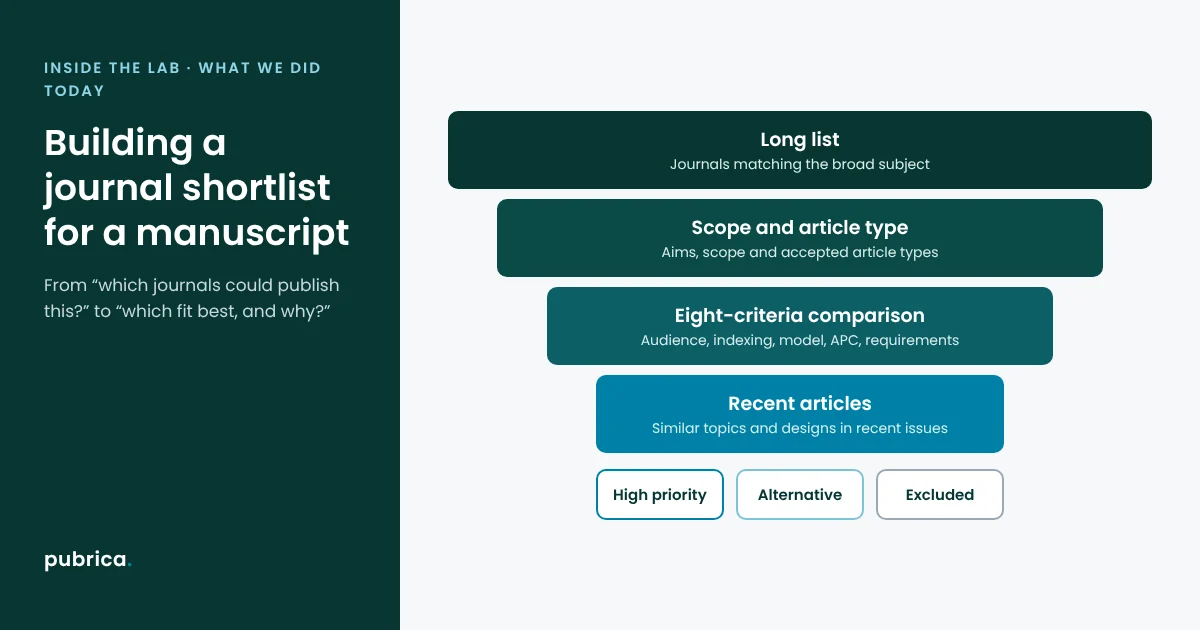
Searching for journals turns up dozens of titles that look relevant. A broad subject match does not make a good fit. The candidates differed in scope, accepted article types, readership, indexing, publication model, article processing charge and submission requirements, and a wrong choice risks desk rejection and a lost submission cycle [2, 3, 4].
So the question in choosing a journal for publication was not “which journals could publish this?” but “which journals fit this manuscript best, and why?”
02Step 1: review the manuscript before the journals
03Step 2: screen on journal scope
We read the aims and scope of each candidate against the research question and checked whether the journal publishes the article type. Belonging to the broad field was not enough: the manuscript had to matter to that journal’s readers [2]. Journals with weak scope alignment were dropped at this stage. Our guide to aligning a manuscript with journal guidelines covers this check in more detail.
04Step 3: compare every journal on the same criteria
| Selection factor | What we checked | Why it can rule a journal out |
|---|---|---|
| Journal scope | Aims and scope against the manuscript’s research question | Out-of-scope papers are a common desk-rejection reason |
| Article type | Whether the journal accepts this type (original research, review, protocol) | Some journals publish only selected types |
| Target audience | Whether its readers are the people the findings are for | Right field, wrong readership |
| Indexing | Coverage in the databases the authors need | Funder or institution may require it |
| Publication model | Subscription, hybrid or open access | Funder open-access mandates |
| Article processing charge | Whether an APC applies, from the journal’s own page | Budget |
| Recent articles | Similar topics, designs and article types in the last issues | Scope on paper is not scope in practice |
| Submission requirements | Word limits, formatting, reporting guidelines, author forms | Incompatible structure means a rewrite |
Using one set of criteria made the comparison structured and repeatable. For the publication model and APC we relied on each journal’s own stated information rather than assumptions, and we checked transparency against the COPE, DOAJ, OASPA and WAME principles to rule out predatory journals {c(5)}.
05Step 4: weigh impact factor, don’t lead with it
Impact factor and other metrics are useful, but a higher metric does not make a journal the right choice for a particular paper [2]. A well-known journal may have weak scope alignment or rarely publish the relevant article type. We read metrics alongside scope, readership, indexing, model, cost and recent output. See our explainer on journal quartiles for how to read them.
06Step 5: check what the journal publishes now
We reviewed recent articles in each remaining journal for similar topics, designs and article types. This separated journals that fit in theory from those that show a practical fit through what they actually publish [3].
07The result: a ranked journal shortlist
| Tier | Rule | What happens next |
|---|---|---|
| High priority | Strong fit on scope and article type; meets the major requirements | Format for the first choice |
| Alternative | Reasonable fit with one or more limitations | Fallback if the first choice declines |
| Excluded | Poor scope fit, unsuitable article type or incompatible requirements | Removed, with the reason recorded |
The output was not a list of names but a shortlist with a recorded reason for each journal, and a clear order of submission. That reduces guesswork and avoids sending the paper to journals unlikely to take it.
What we learned: journal selection is part of the publication strategy, not an administrative task left to the last day. The strongest choice is the journal where the manuscript has a clear and defensible fit {c(2, 6)}.
Questions
How many journals should be on a shortlist?
Three to five is practical: one or two high-priority journals and two or three alternatives. More than that usually means the scope screen was too loose.
Should I choose the journal with the highest impact factor?
Not by default. Scope, article type and readership decide whether the journal will consider the paper; metrics only matter among journals that fit.
How do I check a journal’s article processing charge?
Use the APC and publication model stated on the journal’s own website, and confirm whether waivers or institutional agreements apply before you submit.
References
- International Committee of Medical Journal Editors (ICMJE). Recommendations for the Conduct, Reporting, Editing, and Publication of Scholarly Work in Medical Journals. Updated 2025. https://www.icmje.org/about-icmje/faqs/icmje-recommendations/
- International Committee of Medical Journal Editors (ICMJE). Responsibilities in the submission and peer-review process. https://www.icmje.org/recommendations/browse/roles-and-responsibilities/responsibilities-in-the-submission-and-peer-peview-process.html
- Think. Check. Submit. Journals: choose the right journal or publisher for your research. https://thinkchecksubmit.org/journals/
- Think. Check. Submit. Journals checklist (PDF). https://thinkchecksubmit.org/wp-content/uploads/2023/06/ThinkCheckSubmit-Journals-English.pdf
- COPE, DOAJ, OASPA, WAME. Principles of Transparency and Best Practice in Scholarly Publishing. Version 4.0; 2022. https://publicationethics.org/guidance/guideline/principles-transparency-and-best-practice-scholarly-publishing
- International Committee of Medical Journal Editors (ICMJE). Preparing a manuscript for submission to a medical journal. https://www.icmje.org/recommendations/browse/manuscript-preparation/preparing-for-submission.html