Meta-Analysis Submission Rules Compared: Word Limits, Abstract Format, PRISMA Uploads and Registration at 20 Medical Journals
Many meta-analyses come back before peer review for reasons unrelated to the science. This comparison shows what 20 medical journals require on four checkpoints, and what the research says about getting each one wrong.

On this page
- Quick answer
- How the comparison was built
- Meta-analysis submission rules: the comparison table
- Systematic review word limits
- Abstract format and word limits
- PRISMA 2020 checklist and flow diagram uploads
- Protocol registration: PROSPERO, INPLASY or OSF
- Pre-submission checklist for your meta-analysis
- Questions
- References
Quick answer
- Meta-analysis submission rules are not standardised: main-text limits run from 3,500 words to none.
- Abstracts range from an unstructured 200 words to a structured 500, and some must carry the registry number.
- Annotate the PRISMA 2020 checklist with page numbers; declaring PRISMA is not the same as following it [4].
- Register the protocol before data extraction. PeerJ will not consider retrospectively registered health reviews.
01How the comparison was built
Each journal sets its own medical journal requirements, and they are not aligned. Across 559 biomedical journals from 11 publishers, endorsement of major reporting guidelines was inconsistent [1]. We read the instructions for authors at 20 journals on 14 October 2026 and recorded four items for systematic reviews and meta-analyses: the main-text word limit, the abstract format, how the PRISMA files must be uploaded, and the registration policy.
Fifteen journals’ pages could be read in full or in part. Five blocked automated access, so their rows say “check current instructions” rather than repeat unverified figures. “Not stated” means only that the item was not on the page reviewed.
02Meta-analysis submission rules: the comparison table
| Journal | Main-text limit | Abstract | PRISMA upload | Registration |
|---|---|---|---|---|
| The BMJ | No fixed limit; about 4,000 words suggested | 250–300 words (400 for PRISMA style); structured, with a Systematic review registration heading | Checklist and flowchart as supplemental files | Registry and number if registered |
| PLOS Medicine | No limit | 300 preferred, 500 maximum; PRISMA for Abstracts | Checklist with page references, plus flow diagram | State whether a protocol exists |
| PLOS ONE | No limit | Maximum 300 words | Flow diagram as Fig 1; checklist as supporting information | State whether a protocol exists; registry number in abstract |
| PeerJ | No review-specific limit | Registry name and number required | Flow diagram as Figure 1; checklist with page references and excerpts | Prospective registration required (PROSPERO, OSF, INPLASY) |
| Scientific Reports | 4,500 words (excludes abstract, Methods, references, legends) | Maximum 200 words; unstructured | Not stated | Not stated |
| CMAJ | 3,500 words for systematic reviews | About 250 words; Background, Methods, Results, Interpretation | Must adhere to PRISMA | Not stated for reviews |
| J Clin Med (MDPI) | No maximum | About 250 words; structured | Checklist and flow diagram, main text or supplement | Strongly encouraged (e.g., PROSPERO) |
| Nutrients (MDPI) | No maximum | About 250 words; structured | Checklist and flow diagram, main text or supplement | Strongly encouraged before data extraction |
| Healthcare (MDPI) | Not stated | About 250 words; structured | Checklist; flow diagram in text or supplement | Strongly recommended (e.g., PROSPERO) |
| Cancers (MDPI) | No maximum | About 250 words; structured | Conform to PRISMA; format not stated | Not stated |
| Medicina (MDPI) | Not stated | About 300 words maximum; structured | Conform to PRISMA | Not stated for reviews |
| J Pers Med (MDPI) | Not stated | About 250 words; structured | Conform to PRISMA | Not stated for reviews |
| Heliyon | No limit | 300 words | Not stated | Not stated |
| Frontiers in Medicine | Up to 12,000 words | Not stated | Conform to PRISMA; format not stated | Not stated |
| JMIR | Not stated | Not stated | Checklist as a multimedia appendix | Not stated |
| JAMA | Check current instructions | Check current instructions | Check current instructions | Check current instructions |
| The Lancet | Check current instructions | Check current instructions | Check current instructions | Check current instructions |
| Annals of Internal Medicine | Check current instructions | Check current instructions | Check current instructions | Check current instructions |
| BMJ Open | Check current instructions | Check current instructions | Check current instructions | Check current instructions |
| BMC Systematic Reviews | Check current instructions | Check current instructions | Check current instructions | Check current instructions |
Rules change, so open the live instructions for authors before you format. Where the BMJ suggests a length, CMAJ sets a hard cap.
03Systematic review word limits
- Fixed limits. CMAJ allows 3,500 words for systematic reviews; Scientific Reports caps the main text at 4,500.
- Guideline limits. The BMJ sets no fixed limit but suggests about 4,000 words.
- No limit. PLOS Medicine, PLOS ONE, Heliyon and several MDPI journals set no maximum; Frontiers in Medicine allows up to 12,000 words.
Count by each journal’s own definition. Scientific Reports leaves the Methods out of its count, while CMAJ excludes the title page, abstract, figures, tables, appendices and references.
04Abstract format and word limits
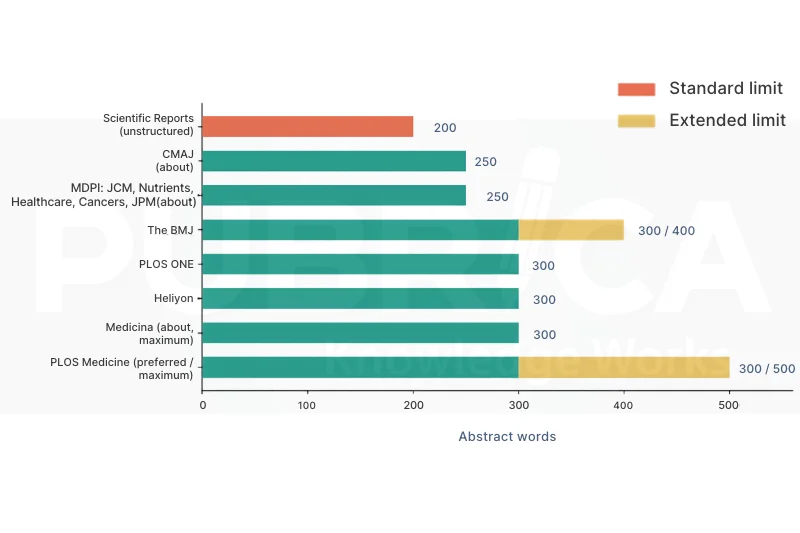
Abstract rules vary more than word limits. Scientific Reports wants no more than 200 unstructured words; MDPI journals and CMAJ ask for about 250 words under fixed headings; The BMJ allows up to 400 for a PRISMA-style abstract with a registration heading; PLOS Medicine follows PRISMA for Abstracts.
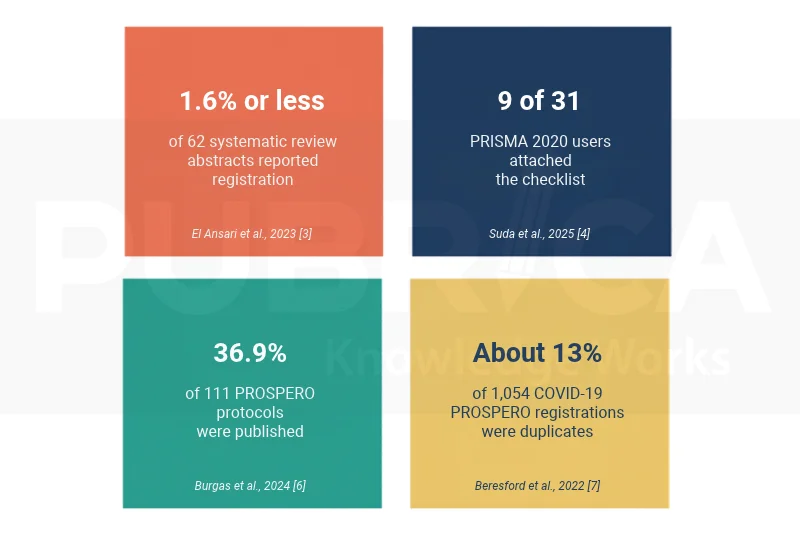
The registration line is the item most often lost when an abstract moves between formats. In 62 systematic review abstracts appraised over 12 years, risk of bias, funding and registration were each reported in 1.6% or fewer [3]. Write the structured abstract to the target journal’s own headings.
05PRISMA 2020 checklist and flow diagram uploads
PRISMA 2020 replaced the 2009 statement with a 27-item checklist in seven sections [2]. Journals differ in how they want compliance shown:
- Checklist with page references: PLOS Medicine and PeerJ.
- PRISMA flow diagram as Figure 1: PLOS ONE and PeerJ.
- File location: supplemental files at The BMJ, main text or supplement at MDPI, a multimedia appendix at JMIR.
- Statement only: CMAJ, Cancers and Frontiers in Medicine ask for PRISMA conformity without naming a format.
In 131 emergency medicine reviews, those declaring PRISMA 2020 met 72.8% of items against 68.4% for the rest; none met every item, and only 9 of 31 PRISMA 2020 users attached the checklist [4].
06Protocol registration: PROSPERO, INPLASY or OSF
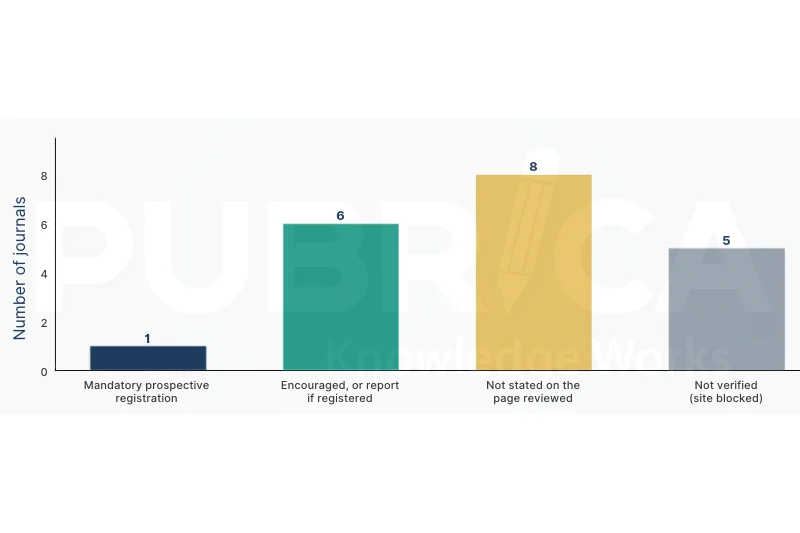
Registration is where policies diverge most, which makes it a deciding factor in journal selection. PeerJ requires prospective registration for health-related reviews and accepts PROSPERO, INPLASY or OSF registration. MDPI journals strongly encourage registration before data extraction; PLOS journals ask whether a protocol exists; several pages say nothing.
Among 4,750 evidence syntheses, PROSPERO was the most used registry, and adjusted time from registration to publication was 513 days for PROSPERO against 286 for INPLASY. One author founded INPLASY, which the study discloses [5]. Registration does not guarantee publication: 36.9% of 111 South American PROSPERO protocols were published [6]. Search the registry first, because about 13% of 1,054 COVID-19 registrations in PROSPERO were duplicates [7]. See our PROSPERO registration guide.
07Pre-submission checklist for your meta-analysis
| Checkpoint | What to confirm | Common failure |
|---|---|---|
| Word count | Count by the journal’s own definition of what is excluded | Methods or tables counted wrongly |
| Abstract | Limit, structure, required headings, registration line | Registry number omitted [3] |
| PRISMA checklist | Annotated with page numbers; correct file location | Declared but not attached [4] |
| Flow diagram | Position (Figure 1 where required) | Placed only in a supplement |
| Registration | Registered before data extraction, in a registry the journal accepts | Retrospective registration where it is barred |
| Duplication | Registry searched for the same question | Duplicate of an existing review [7] |
Treat these items as part of manuscript preparation, not formatting. For the five journals marked unverified, check the live guidelines before you submit.
Questions
What are the main submission requirements for a meta-analysis?
Most medical journals set a word limit, an abstract format, a PRISMA 2020 checklist and flow diagram, and a registration statement. Each journal defines these differently, so follow its instructions for authors.
Is PROSPERO registration mandatory for a meta-analysis?
Not at every journal. PeerJ requires prospective registration for health-related reviews and accepts PROSPERO, OSF or INPLASY; many others only encourage it. Register before data extraction whichever you choose.
What is the typical word limit for a medical meta-analysis?
It ranges from 3,500 words at CMAJ to no fixed maximum at PLOS ONE and several MDPI journals. Check what the count excludes, such as the abstract, Methods, tables and references.
References
- Wang P, Wolfram D, Gilbert E. Endorsements of five reporting guidelines for biomedical research by journals of prominent publishers. PLOS ONE. 2024;19(2):e0299806. https://doi.org/10.1371/journal.pone.0299806
- Page MJ, McKenzie JE, Bossuyt PM, et al. The PRISMA 2020 statement: an updated guideline for reporting systematic reviews. BMJ. 2021;372:n71. https://doi.org/10.1136/bmj.n71
- El Ansari W, AlRumaihi K, El-Ansari K, et al. Reporting quality of abstracts of systematic reviews/meta-analyses: an appraisal of Arab Journal of Urology across 12 years: the PRISMA-Abstracts checklist. Arab Journal of Urology. 2023;21(1):52–65. https://doi.org/10.1080/2090598X.2022.2113127
- Suda C, Yamamoto N, Tsuge T, et al. Enhancing reporting quality using the PRISMA 2020 in systematic reviews of emergency medicine journals: a cross-sectional study. Cureus. 2025;17(1):e78255. https://doi.org/10.7759/cureus.78255
- Ferreira RT, Reis MQ, Lange MHP, et al. What evidence syntheses reveal about PROSPERO, INPLASY, OSF, the Research Registry, and protocols.io: a meta-research study. Frontiers in Research Metrics and Analytics. 2026;11:1738112. https://doi.org/10.3389/frma.2026.1738112
- Burgos MA, Ivaldi D, Oltra G, Escobar Liquitay CM, Garegnani L. Meta-epidemiological study on the publication rate of South American countries’ systematic reviews of interventions registered in PROSPERO. Cochrane Evidence Synthesis and Methods. 2024;2(9):e70002. https://doi.org/10.1002/cesm.70002
- Beresford L, Walker R, Stewart L. Extent and nature of duplication in PROSPERO using COVID-19-related registrations: a retrospective investigation and survey. BMJ Open. 2022;12:e061862. https://doi.org/10.1136/bmjopen-2022-061862