How to Write a Grant Proposal: A Step-by-Step Guide for Health and Biomedical Researchers
Write the specific aims first, make significance explicit, show a rigorous approach and justify every budget line. Here are the seven steps in order, with the evidence on what reviewers respond to.

- Write first
- The specific aims page
- Scores decided in
- The approach section
- Feedback rated useful
- 38% of 634 applicants
- Plan for
- Resubmission from the start
Quick answer
- Read the call, map the review criteria and plan backwards from the deadline.
- Write the specific aims first; every other section must deliver them.
- Back every claim with data, link each budget line to an aim and plan for resubmission.
01Why the order of writing matters
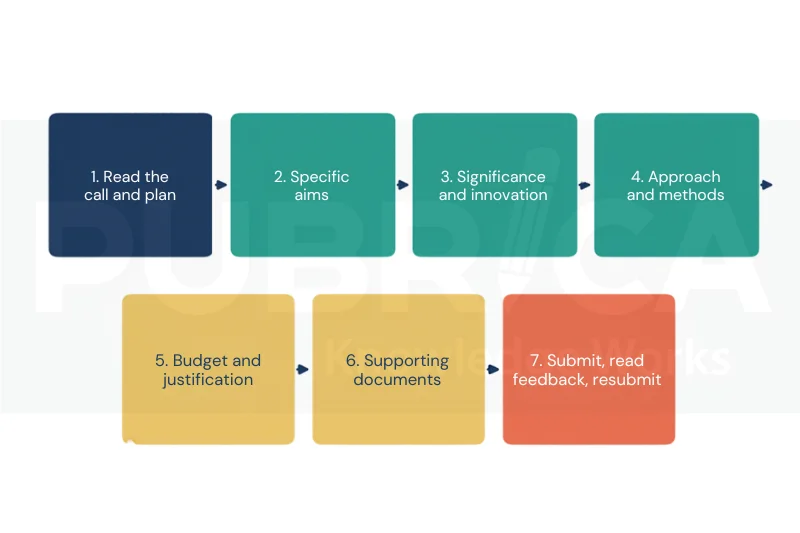
Funding for health and biomedical research is competitive and concentrated. At the US National Institutes of Health (NIH), 34,936 principal investigators held research project grants in fiscal year 2020, and the top 1% of investigators received 10.8% of research project grant funds in 2019, up from 8.3% in 1995 [1]. This guide explains how to write a grant proposal in the order the steps should be taken (Figure 1), with the evidence on what reviewers respond to.
02Step 1: Read the call and plan backwards
Start with the funding opportunity, not the science. Read the funding agency’s eligibility rules, review criteria, page limits, budget caps and required attachments, and note every institutional deadline that falls before the funder’s. The review criteria tell you how the proposal will be scored, so map each criterion to the section that answers it.
If the call allows contact, send the programme officer a one-paragraph summary. A brief reply can confirm fit before you invest weeks in writing. Then build a timeline backwards from the deadline (Table 1). Administrative steps take longer than most applicants expect; our grant application checklist lists them.
| Time before deadline | Key actions |
|---|---|
| 12 weeks | Read the call; confirm eligibility; contact the programme officer if allowed; agree the team |
| 10 weeks | Draft the specific aims; circulate them to mentors and co-investigators |
| 8 weeks | Draft significance, innovation and approach; request letters of support |
| 6 weeks | Draft the budget and justification with the research office |
| 4 weeks | Internal review by a colleague outside your immediate field |
| 2 weeks | Final edits; institutional finance and compliance sign-off |
| Deadline week | Submit early and check the system’s validation report |
03Step 2: Write the specific aims first
The specific aims page is the summary reviewers read first and return to when they score. Write it before the rest, because every later section must deliver what it promises. A strong aims page usually covers:
- The health problem and why it matters now
- The gap in knowledge that blocks progress
- Your long-term goal and the objective of this proposal
- The central hypothesis and the preliminary data that support it
- Two or three specific aims, each testing one part of the hypothesis
- The expected outcomes and their impact on health, practice or the field
Keep the aims related but not dependent on each other. If Aim 2 can only start once Aim 1 succeeds, a reviewer will see a single point of failure. Give each aim a measurable end point so feasibility can be judged against the time and budget requested.
04Step 3: Make significance and innovation explicit
Reviewers judge how a proposal is written as well as what it proposes. A linguistic analysis of grant applications found that features of the abstract, project description and applicant’s CV were associated with review scores and, through them, with funding decisions [2]. In a study of 11,535 applications to the NIH and the Novo Nordisk Foundation, applications using more promotional language, measured with 139 science-specific terms, had higher odds of funding: odds ratios of 1.51 (NIH) and 1.47 (foundation) for each one-percentage-point increase in the share of promotional words (Figure 2) [3].
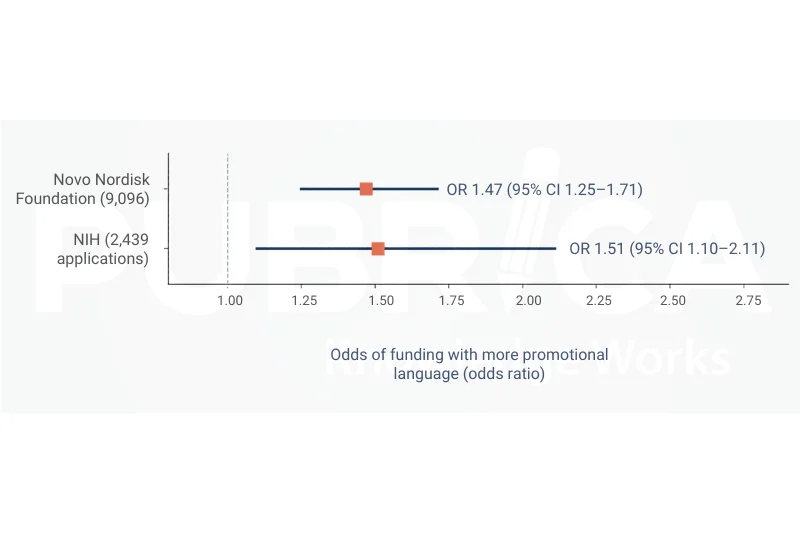
These are associations, not proof that particular words win grants. State the significance plainly and confidently, back every claim of novelty with data or a cited gap, and say what will change if the aims succeed. Panels include reviewers from neighbouring fields, so define specialist terms and use a simple figure for the conceptual model.
05Step 4: Write a rigorous approach
The approach section is where most scores are decided, so its methodology needs enough detail for a reviewer to judge feasibility. For each aim, set out:
- The study design and why it suits the question
- The population, sample size and power calculation
- Outcomes, data collection and measurement tools
- The statistical analysis plan, including missing data
- Rigour and reproducibility measures, such as randomisation and blinding
- Potential problems and alternative strategies
- Milestones for each aim
Where a method is new to the team, name the collaborator or core facility that brings the expertise, and say so in their letter of support.
06Step 5: Build the budget and budget justification
The budget should follow the work plan, not the other way round. Each line needs a budget justification that a reviewer can link to a specific aim (Table 2).
| Budget category | What the justification should show |
|---|---|
| Personnel | Named roles, percentage effort and the tasks each person will perform |
| Equipment | Items above the institution’s equipment threshold, and why existing equipment cannot be used |
| Supplies and consumables | Quantities linked to the number of samples, assays or participants |
| Participant costs | Payments, travel or incentives, with the planned number of participants |
| Travel | Conferences or study visits tied to data collection or dissemination |
| Indirect costs | The institution’s negotiated rate, applied as the funder’s rules allow |
07Step 6: Prepare the supporting documents
Most funders also ask for a cover letter, biosketches or CVs, letters of support, a data management plan and ethics statements. Where allowed, a short cover letter can request an appropriate panel or note conflicts. Letters of support should state what each collaborator will provide, such as samples, data access or training. Check that names, roles and effort match across the budget, the approach and the letters; inconsistencies suggest a rushed biomedical grant application.
08Step 7: Submit, read the feedback and resubmit
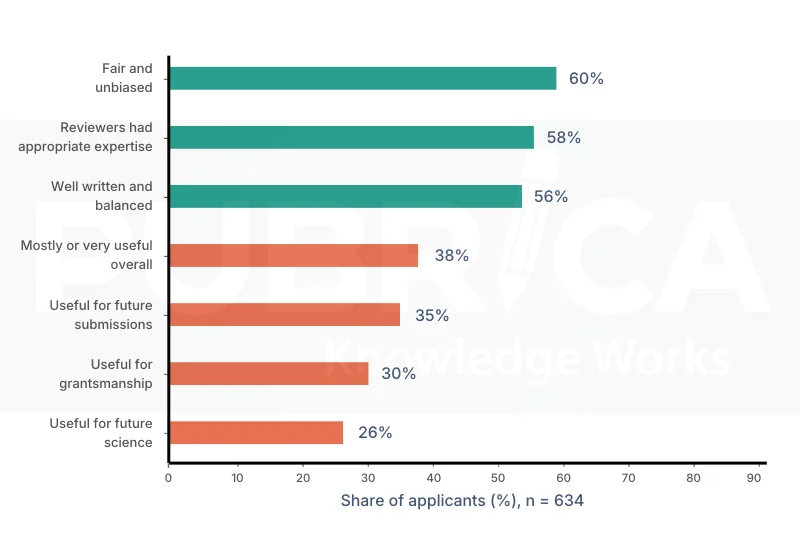
Many proposals are not funded at first submission, so peer review comments, such as an NIH summary statement, are part of the process. In a survey of 634 applicants, 60% found their feedback fair and unbiased, but only 38% found it mostly or very useful overall (Figure 3); funded applicants rated it fair more often than unfunded ones (71% vs 53%) [4].
A grant resubmission deserves the same care as the first draft. A meta-analysis found similar overall award rates for women and men, but award rates on reapplication 9 percentage points lower for women [5], so mentoring and institutional support at this stage are worth seeking for every applicant. Respond to every major criticism, group comments by theme, and say what changed and where. Where you disagree, explain why with data. If a reviewer misunderstood, treat it as a sign the text was unclear and rewrite it.
09Conclusion
A fundable proposal is built in a set order: read the call, write the aims, make the significance explicit, show a rigorous approach, justify the budget and prepare documents early. The evidence suggests that presentation influences scores, that feedback is often less useful than applicants hope, and that resubmission is a normal stage. This grant proposal guide works best alongside a compliance check before you submit, and good research grant writing treats each round of comments as information for the next version.
Questions
What is the first step in writing a grant proposal?
Read the funding call in full, map its review criteria and plan backwards from the internal deadline. Then write the specific aims page.
How long should I allow to write a grant proposal?
Many teams plan around 12 weeks, as in Table 1, but adjust this to the funder’s and your institution’s deadlines.
Should I resubmit a rejected grant proposal?
Often yes. Respond to every major criticism, show what changed and where, and check the funder’s resubmission rules.
References
- Lauer MS, Roychowdhury D. Inequalities in the distribution of National Institutes of Health research project grant funding. eLife. 2021;10:e71712. https://doi.org/10.7554/eLife.71712
- Van den Besselaar P, Mom C. The effect of writing style on success in grant applications. J Informetr. 2022;16(1):101257. https://doi.org/10.1016/j.joi.2022.101257
- Qiu HS, Peng H, Fosse HB, Woodruff TK, Uzzi B. Use of promotional language in grant applications and grant success. JAMA Netw Open. 2024;7(12):e2448696. https://doi.org/10.1001/jamanetworkopen.2024.48696
- Gallo SA, Schmaling KB, Thompson LA, Glisson SR. Grant review feedback: appropriateness and usefulness. Sci Eng Ethics. 2021;27:18. https://doi.org/10.1007/s11948-021-00295-9
- Schmaling KB, Gallo SA. Gender differences in peer reviewed grant applications, awards, and amounts: a systematic review and meta-analysis. Res Integr Peer Rev. 2023;8:2. https://doi.org/10.1186/s41073-023-00127-3
Update log
- Published by Pubrica
How to cite this article
Dr. Charlie. (2026, October 30). How to Write a Grant Proposal: A Step-by-Step Guide for Health and Biomedical Researchers. Pubrica. https://pubrica.com/academy/grant-writing/how-to-write-a-grant-proposal/
This article is general information for researchers, not legal, regulatory or funding advice. Check the current requirements of your journal, funder, ethics committee or regulator before you act on it.