Grant Application Checklist: A Downloadable Pre-Submission Compliance Check for Health Research Proposals
Compliance errors can stop a grant application before any reviewer reads it. Work through eligibility, formatting, budget, approvals, data plans and documents, then download the checklist for your team.

- Processes per application
- 7 to 13 for 58% of UK applicants
- Common gap
- Incomplete data management plans
- Your deadline
- The internal one, not the funder’s
- Download
- One-page PDF checklist
Quick answer
- Confirm eligibility and fit before you write.
- Check page limits, budget totals, approvals, the data plan and every attachment against the call.
- Give each check an owner and finish before the internal deadline.
01Why a pre-submission compliance check matters
A strong grant proposal can fail before any reviewer reads it. A missing letter, a budget that breaks the funder’s rules or a section over its page limit can get an application returned without review. Preparation is also heavy: in a UK survey, 58% of researchers reported completing 7 to 13 key processes to submit a single application [1]. This grant application checklist explains each area of a pre-submission checklist for health research proposals and ends with a version you can download.
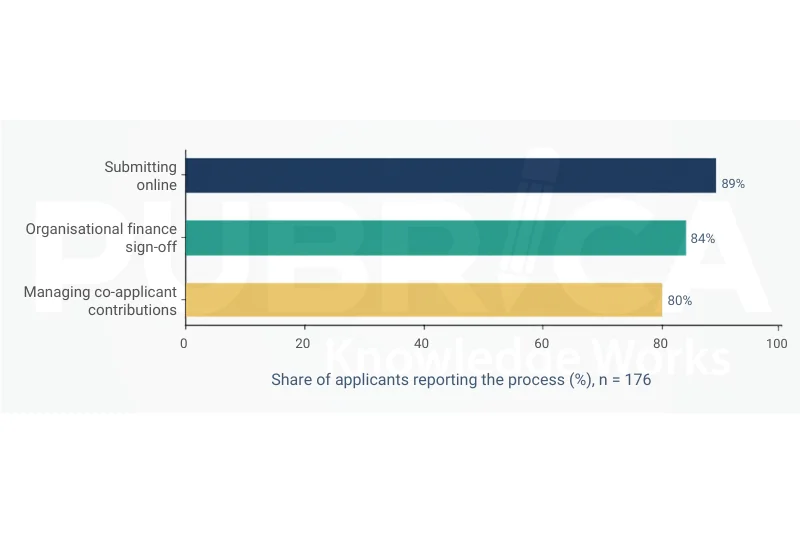
Compliance is the part of an application that is entirely within your control. Reviewers judge scientific merit; eligibility, formatting and completeness are checked against written rules. The work is also spread across people: the most reported processes were online submission (89%), organisational finance sign-off (84%) and managing co-applicant contributions (80%) (Figure 1) [1]. A checklist gives each task a named owner and a date.
Funders also change their processes. A realist synthesis of 96 publications identified 50 interventions funders have used, including shorter applications and limits on how many applications an institution may submit [2]. Research funding compliance therefore starts with reading every call document afresh rather than reusing your last template.
02Eligibility and fit with the call
Confirm first that you, your institution and your project are eligible (Table 1). These checks are quick and can save weeks of writing. If any item is unclear, ask the programme officer in writing before drafting, and keep the reply with the application file.
| Check | What to confirm |
|---|---|
| Applicant eligibility | Career stage, employment contract, residency rules and any limit on applications per person |
| Institutional eligibility | The host organisation is eligible and registered on the funder’s submission system |
| Scheme fit | The research question matches the call’s priorities, disease areas and permitted study types |
| Funding limits | Maximum amount and duration, and cost categories the funder will not pay |
| Collaborators | Rules for international partners, industry partners and subcontracts |
03Formatting, page limits and structure
Formatting rules are usually checked mechanically, so small deviations matter. Confirm:
- Page limits or word limits for every section, including the specific aims and research strategy
- Font type and size, margins and line spacing
- Required headings and section order
- File type, file names and file size limits
- Character limits in online form fields
- The reference style, and whether references count towards the page limit
Then read the narrative once for content: every claim of novelty or importance should be backed by preliminary data or a citation. Our step-by-step guide to writing a grant proposal covers what reviewers respond to.
04Budget and budget justification
Budget errors are among the easiest problems to catch and among the most damaging to miss. Check the budget form and the budget justification together (Table 2), use the funder’s own template or calculator where one exists, and ask the research office to review the budget before the internal deadline, not on submission day.
| Budget check | Problem to catch |
|---|---|
| Totals | Figures in the budget form differ from the justification or the summary page |
| Eligible costs | Items the funder does not pay for, such as some equipment or publication costs |
| Indirect costs | A rate that differs from the institution’s agreed rate or exceeds the funder’s cap |
| Personnel effort | Effort that does not match the approach section or the biosketches |
| Partner costs | Subcontract budgets missing, or not approved by the partner institution |
| Multi-year costs | Inflation or currency adjustments not applied as the funder requires |
05Ethics, data and regulatory approvals
Many funders do not require full ethics approval at submission, but most ask how and when it will be obtained. Check that these are in place or planned:
- The ethics approval route and a realistic timeline
- Trial registration plans for clinical trials
- Permissions for existing data, records or biosamples
- Consent and data protection arrangements
- Patient and public involvement, where the funder requires it
- A data management plan completed against the funder’s template
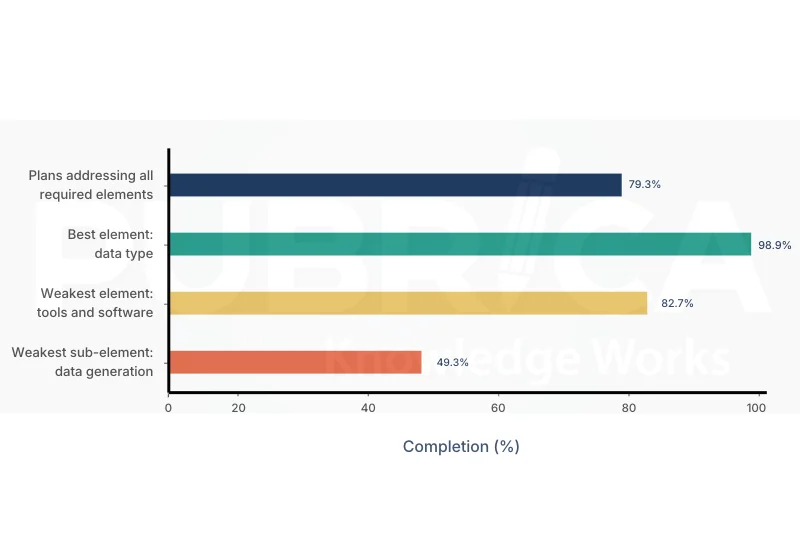
Data plans are a common gap. In one institution’s review of NIH Data Management and Sharing Plans over 18 months, 79.3% addressed all required elements, so about one in five omitted at least one. Element-level completion ranged from 98.9% for the data type to 82.7% for tools and software, the weakest sub-element (data generation) was completed in only 49.3%, and structured templates outperformed unstructured plans (Figure 2) [3]. See our guide to the data management plan in a research grant.
06Required documents, references and appendices
Check every attachment against the funder’s list of required documents, using the exact file names it specifies:
- Biosketches or CVs in the required format and length for every named investigator
- Letters of support that are signed, dated and specific about what each partner will provide
- Institutional authorisation or a head-of-department statement
- A complete, consistently formatted reference list
- Appendices only where the funder permits them
Request letters and signatures early. Letters requested in the final week tend to be generic, and a generic letter adds little to the case that a partnership is real.
07Deadlines and the submission timeline
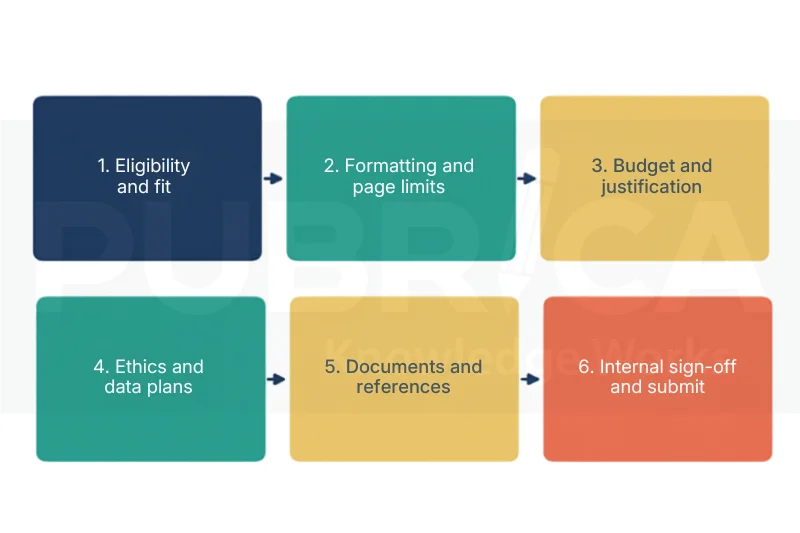
The funder’s deadline is not your deadline. Most institutions set an earlier internal deadline for finance and compliance internal sign-off, and partner budgets and letters often take longer than expected. Work backwards through the six gates in Figure 3 and record each layer of deadlines: the funder’s deadline and time zone, the research office deadline, partner deadlines and a final validation check. Plan to submit at least a day early in case the system is slow or returns validation errors.
08The downloadable grant submission checklist
Use Table 3 as the final grant submission checklist. Assign an owner to each row and tick it only when the item has been verified against the current call. Download the grant application checklist (PDF) to print it or share it with your team.
| Area | Check | Owner | Done |
|---|---|---|---|
| Eligibility | Applicant, institution and project are eligible for this call | ☐ | |
| Eligibility | Application limits per person or institution are respected | ☐ | |
| Formatting | All page, word and character limits are met | ☐ | |
| Formatting | Font, margins, headings and file formats follow the instructions | ☐ | |
| Content | Every claim of novelty is backed by data or a citation | ☐ | |
| Budget | Totals match across the form, justification and summary | ☐ | |
| Budget | Only eligible costs included; indirect rate correct | ☐ | |
| Ethics | Ethics and regulatory approval route and timeline stated | ☐ | |
| Data | Data management and sharing plan covers every required element | ☐ | |
| Documents | Biosketches, letters and authorisations attached and signed | ☐ | |
| References | Reference list complete and consistently formatted | ☐ | |
| Appendices | Only permitted appendices included | ☐ | |
| Sign-off | Research office and finance approval obtained | ☐ | |
| Submission | Validation report checked; submitted before the deadline | ☐ |
09After submission: feedback and resubmission
Keep the completed checklist with the application file, because the same checks apply to a resubmission. Read reviewer feedback for compliance points as well as science, such as unclear budgets or missing detail in data plans, then update the checklist for the new call and run every check again.
10Conclusion
A pre-submission compliance check protects the time you invest in the science. Confirm eligibility first, then formatting, budget, approvals, data plans and documents, and give each check a named owner and a date. Applicants face many administrative steps and data plans are often incomplete; a short, shared grant proposal checklist catches both before the deadline.
Questions
What should a grant application checklist include?
Eligibility, formatting and page limits, budget and justification, ethics and regulatory approvals, the data management plan, required documents, sign-off and the submission deadline.
When should I run the pre-submission check?
Before the institution’s internal deadline, which is usually several days before the funder’s, so the research office and finance can sign off.
Can I reuse the checklist for every funder?
Yes, as a starting point. Adapt each row to the current call, because funders change their rules.
References
- Fackrell K, Church H, Crane K, Recio-Saucedo A, Blatch-Jones A, Meadmore K. Online survey exploring researcher experiences of research funding processes in the UK: the effort and burden of applying for funding and fulfilling reporting requirements. BMJ Open. 2024;14(3):e079581. https://doi.org/10.1136/bmjopen-2023-079581
- Recio-Saucedo A, Crane K, Meadmore K, et al. What works for peer review and decision-making in research funding: a realist synthesis. Res Integr Peer Rev. 2022;7:2. https://doi.org/10.1186/s41073-022-00120-2
- Hamidi M, Bikkanuri M, Scott C, et al. Structured Data Management and Sharing Plan (DMSP) templates outperformed non-structured ones in an institutional implementation of the NIH Data Management and Sharing (DMS) policy. J Clin Transl Sci. 2025;9(1):e281. https://doi.org/10.1017/cts.2025.10212
Update log
- Published by Pubrica
How to cite this article
Dr. Charlie. (2026, October 30). Grant Application Checklist: A Downloadable Pre-Submission Compliance Check for Health Research Proposals. Pubrica. https://pubrica.com/academy/grant-writing/grant-application-checklist/
This article is general information for researchers, not legal, regulatory or funding advice. Check the current requirements of your journal, funder, ethics committee or regulator before you act on it.