How Grant Writing Turns a Research Idea into a Fundable Proposal: Inside Our Process
A good idea does not fund itself. Our grant writing team works on two tracks at once: the scientific argument reviewers score, and the application logistics that sink otherwise strong proposals. Here is how both run.
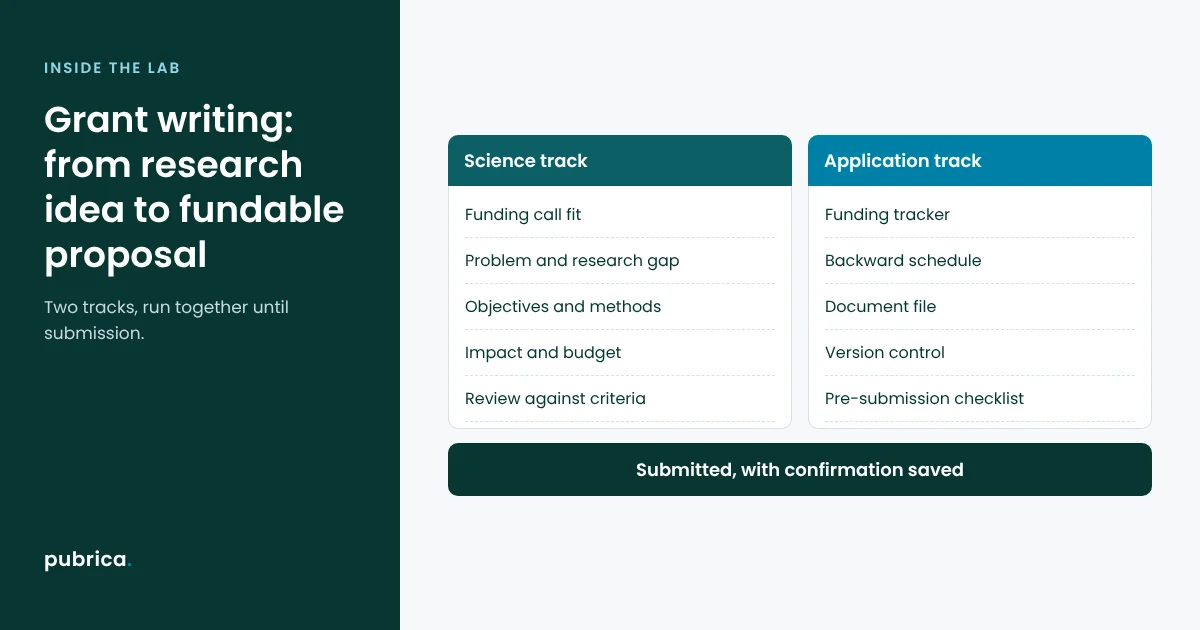
- Track 1
- The scientific argument: problem, gap, aims, methods, impact
- Track 2
- Grant application management: tracker, schedule, documents, checks
- Start point
- Ten weeks before the deadline, with the funder’s criteria open
- Common failure
- A strong idea sent to the wrong call
On this page
Quick answer
- Grant writing starts with the funding opportunity: check fit and eligibility before drafting.
- Build the grant proposal as one argument chain, from research gap to grant budget.
- Write to the funder’s review criteria; NIH now scores importance and rigor separately.
- Run grant application management in parallel, ending with a pre-submission checklist.
01Step 1: test the idea against the funding opportunity
Before anyone writes, we read the call with the investigator: eligible topics and applicants, funding level, duration, required sections and the review criteria. A sound study can still fail if it does not match what the funder wants to buy [1, 4]. We do not bend the science to fit a call; if the fit is weak, we look for a better funding opportunity.
We keep a tracker of relevant calls for each client, recording the funder, scheme, opening date, deadline, eligibility and required documents, so applications are planned months ahead rather than discovered weeks before a deadline.
02Step 2: build the argument chain
| Proposal component | The reviewer’s question | Where proposals usually break |
|---|---|---|
| Research problem | Why does this matter, and to whom? | Importance asserted, not shown with data |
| Research gap | What is unknown, and why now? | Gap is a topic, not a specific unknown |
| Objectives | What exactly will the project achieve? | Aims depend on each other, so one failure sinks all |
| Methodology | Will this design answer the aims? | No sample size, analysis or risk plan |
| Expected outcomes and impact | What changes if it works? | Impact larger than the study can deliver |
| Timeline and grant budget | Can this team do it with this money? | Costs not tied to named activities |
Reviewers read a research funding proposal as one argument. Each link must follow from the last: the research gap justifies the objectives, the objectives determine the methods, and the methods determine the budget [2, 4]. We draft a one-page aims summary first and test the chain on it, because a weak link is cheaper to fix on one page than on twenty.
03Step 3: write to the review criteria
Every funder publishes how applications are judged, and we structure the text so a reviewer can find each criterion. For NIH research project grants due from 25 January 2025, the Simplified Peer Review Framework scores two factors from 1 to 9, Importance of the Research (significance and innovation) and Rigor and Feasibility (approach), and rates Expertise and Resources as sufficient or not [3]. That shift rewards a tight methodology and a realistic timeline more than reputation.
Reviewers often sit outside the applicant’s specialty, so we use clear headings, short paragraphs and minimal jargon [1]. Impact claims stay within what the study can deliver.
04Step 4: cost the work, not the wish list
The grant budget lists personnel, equipment, software, data collection, participant costs, dissemination and other eligible items, and each line is traced to an activity in the methods [2]. A reviewer who sees a cost with no matching task, or a task with no cost, starts to doubt feasibility.
05Step 5: run grant application management in parallel
| Weeks before deadline | Milestone | Owner |
|---|---|---|
| 10–8 | Call checked, eligibility confirmed, aims page drafted | Lead investigator with our grant writer |
| 8–5 | Full draft of the science sections, budget outline | Writer, investigators |
| 5–3 | Collaborator documents, letters of support, biosketches | Co-investigators |
| 3–2 | Internal review against the funder’s criteria; revision | Independent reviewer |
| 2–1 | Institutional approvals and signatures | Research office |
| Final week | Upload, compliance check, confirmation saved | Applicant and research office |
NIH advises applicants to allow time for institutional processes and to plan backwards from the deadline [5]. We work the same way, with internal deadlines for collaborators set well before the funder’s date. A reusable document file holds current CVs, biosketches, publication lists, previous grants and template letters, each reviewed and adapted for every grant application rather than pasted in unchanged.
06Step 6: the pre-submission checklist
Version control matters once several people edit the files. Final documents are kept apart from drafts, every file carries a version number, and names and affiliations are checked across the whole package.
Our pre-submission checklist
- Correct scheme and application category selected on the portal.
- Every mandatory field and required attachment present.
- Current funder templates used; page, word and file-format limits met.
- Names, affiliations, dates and budget totals consistent across files.
- Institutional approvals and signatures in place.
- Submitted, not just saved, with the confirmation or reference number kept.
Questions
How early should I start a grant proposal?
We plan from about ten weeks before the deadline for a standard project grant, longer when several institutions or approvals are involved.
What is the most important part of a grant proposal?
The aims and the research gap behind them. If reviewers are not convinced the gap matters, a strong methodology rarely rescues the score.
Can one proposal be sent to several funders?
The core science can be reused, but each application must be rewritten to that funder’s priorities, sections and review criteria.
References
- National Institutes of Health. General grant writing tips. NIH Grants & Funding. https://grants.nih.gov/grants-process/write-application/general-grant-writing-tips
- National Institutes of Health. Advice on application sections. NIH Grants & Funding. https://grants.nih.gov/grants-process/write-application/advice-on-application-sections
- National Institutes of Health. Simplified Peer Review Framework. NIH Grants & Funding; 2025. https://www.grants.nih.gov/policy-and-compliance/policy-topics/peer-review/simplifying-review/framework
- Weidmann AE, Cadogan CA, Fialová D, et al. How to write a successful grant application: guidance provided by the European Society of Clinical Pharmacy. Int J Clin Pharm. 2023;45(3):781–786. https://doi.org/10.1007/s11096-023-01543-7
- National Institutes of Health. Organize your time to complete the application. NIH Grants & Funding. https://grants.nih.gov/grants-process/plan-to-apply/organize-your-time-to-complete-the-application
Update log
- Published by Pubrica
How to cite this article
Pubrica Grant Writing Team. (2026, October 20). How Grant Writing Turns a Research Idea into a Fundable Proposal: Inside Our Process. Pubrica. https://pubrica.com/insights/inside-the-lab/grant-writing-fundable-research-proposal/
This article is general information for researchers, not legal, regulatory or funding advice. Check the current requirements of your journal, funder, ethics committee or regulator before you act on it.