The Grant Writing Process, Step by Step: From Funding Call to Award (Flowchart with Owners and Timelines)
A 13-stage flowchart of the grant writing process with the owner of each stage, indicative timings, a responsibility matrix and how DFG, ERC, Horizon Europe and NIH clocks differ.

- Stages
- 13, in four phases
- Runs in parallel
- Budget with methods
- Gate before submit
- Compliance and sign-off
- Owner rule
- One accountable owner per stage
Quick answer
- The grant writing process runs in 13 stages, from call screening to the grant agreement.
- Give every stage one accountable owner and a due date planned back from the deadline.
- Cost the budget in parallel with the methods, and run compliance checks before the final week.
01The grant writing process is a workflow, not a writing task
The grant writing process runs from the moment a funding call is spotted to the signed grant agreement. It involves the principal investigator (PI), the research office, finance, collaborators and an authorised signatory, each with a deadline of their own. Most late submissions fail on hand-offs between them, not on the science.
The flowchart below is a planning model in 13 stages and four phases. Adapt it to the real deadline and to your institution’s approval lead times.
02Grant writing process flowchart
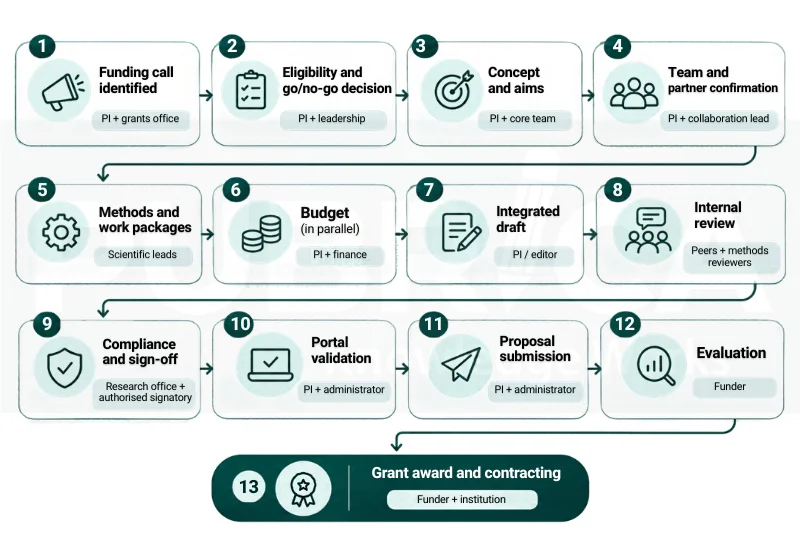
Phase 1 (plan) covers stages 1 to 4, phase 2 (develop) stages 5 to 8, phase 3 (finalise and submit) stages 9 to 11, and phase 4 (post-submission) stages 12 and 13. The budget runs in parallel with methods from stage 5, because the work packages and the costs must describe the same project.
03Stage owners and indicative timing
Table 1 gives our planning estimates for a medium-complexity grant application. They are not funder rules: large consortium bids need longer, and small calls may compress several stages into one week.
| Stage | Owner | Indicative time | Key outputs |
|---|---|---|---|
| 1 Funding call identified | PI + grants office | 1–3 working days | Fit, eligibility, deadline, funding ceiling |
| 2 Eligibility and go/no-go | PI + leadership | 2–5 days | Capacity and strategic-fit decision |
| 3 Concept and aims | PI + core team | 1–2 weeks | Gap, objectives, expected impact |
| 4 Team and partner confirmation | PI + collaboration lead | 1–3 weeks | Roles, contributions, letters of support |
| 5 Methods and work packages | Scientific leads | 2–4 weeks | Tasks, deliverables, milestones, risks |
| 6 Budget (in parallel) | PI + finance | 1–3 weeks | Eligible costs, effort, budget approval |
| 7 Integrated draft | PI or editor | 1–2 weeks | One narrative, annexes aligned |
| 8 Internal review | Peers + methods reviewers | 5–10 working days | Clarity, science and feasibility check |
| 9 Compliance and sign-off | Research office + signatory | 3–10 working days | Forms, approvals, institutional commitments |
| 10–11 Portal validation and submission | PI + administrator | 1–2 days | Validated proposal submission and receipt |
| 12–13 Evaluation and award | Funder + institution | Set by the scheme | Clarifications, grant award, contracting |
Every stage needs one accountable owner, even when several people contribute (Table 2).
| Role | Owns |
|---|---|
| Principal investigator | Scientific direction, aims, narrative integration, final scientific accountability |
| Co-investigators and work-package leads | Methods, deliverables, partner inputs, resource estimates |
| Grants or research office | Call interpretation, compliance checks, portal coordination, submission checklist |
| Finance | Costing, eligibility of costs, institutional rates, budget approval |
| Ethics and data specialists | Consent, approvals, data protection, data management plan |
| Authorised signatory | Institutional commitments and final approval to submit |
04How the funder changes the project timeline
The external clock differs by scheme, and so does the point at which your project timeline should start (Table 3).
| Scheme | What sets the clock |
|---|---|
| DFG Research Grants (Germany) | No fixed deadline: submit at any time through the elan portal [2]; a decision typically takes about six months [3]. Your internal plan, not the funder, sets the date. |
| ERC Starting Grant | One annual deadline (14 October 2026 for ERC-2027-StG). Indicative Step 1 results 11 May 2027, final results 24 August 2027, grant signature 22 December 2027 [4]. |
| Horizon Europe collaborative calls | Fixed call deadlines; applicants are informed around 5 months after the deadline and grants signed around 8 months after it, unless the call says otherwise [1]. Consortium building often has to start months before the call opens. |
| NIH research grants (US) | Standard due dates; one resubmission (A1) is allowed within 37 months of the original, with an introduction of one page or less [5]. |
05Timeline controls that prevent late submissions
- Plan backwards from the external deadline, then set an internal deadline several working days earlier for sign-off.
- Run work in parallel once the aims are stable: costing, partner letters and methods drafting can overlap.
- Freeze the aims before the budget is costed; every later change to the aims ripples into the budget and work packages.
- Reserve buffer time for signatures, translation, portal validation and late partner inputs.
- Run the compliance check at stage 9 with our grant application checklist, not on deadline day.
06After proposal submission
Archive the final PDF, the submission receipt and the proposal ID, and diary the expected decision window. If the grant award is confirmed, move to the grant agreement, budget finalisation, ethics conditions, recruitment and the reporting calendar; the data management plan often becomes a deliverable. If the proposal is declined, read the reviewer comments systematically, decide whether to revise and resubmit (funders limit this; NIH allows one resubmission [5]), and record what the next draft must change.
Questions
How early should a team start the grant writing process?
Who owns proposal submission?
Why use an internal deadline?
Does the process include award contracting?
References
- European Commission. Horizon Europe Work Programme 2026-2027, General Annexes, Annex F: Evaluation and award procedure. 2026. Copy accessed 5 November 2026. https://sciencebusiness.net/sites/default/files/inline-files/HORIZON-General-annexes-2026-2027_05_18_2026.pdf
- Deutsche Forschungsgemeinschaft. Research Grants. Accessed 5 November 2026. https://www.dfg.de/en/research-funding/funding-opportunities/programmes/individual/research-grants
- Deutsche Forschungsgemeinschaft. Arriving at a decision: individual grants programmes. Accessed 5 November 2026. https://www.dfg.de/en/research-funding/proposal-funding-process/individual-grants-programmes/arriving-decision
- European Research Council. ERC Work Programme 2027, Table 1: indicative call timetable. July 2026. https://erc.europa.eu/system/files/2026-07/ERC_Work_Programme_2027.pdf
- National Institutes of Health. Resubmission applications. Accessed 5 November 2026. https://grants.nih.gov/grants-process/submit/submission-policies/resubmission-applications
Update log
- Published by Pubrica
How to cite this article
Dr. Charlie. (2026, November 5). The Grant Writing Process, Step by Step: From Funding Call to Award (Flowchart with Owners and Timelines). Pubrica. https://pubrica.com/academy/grant-writing/grant-writing-process-flowchart/
This article is general information for researchers, not legal, regulatory or funding advice. Check the current requirements of your journal, funder, ethics committee or regulator before you act on it.