Contents
On this page
- Quick answer
- Start with the intended use, because it sets every later choice
- Build slide datasets that a reviewer will accept as independent
- Annotation and the reference standard
- Performance analysis: fix it before you look
- Which reporting guideline fits your study?
- Keep the FDA file and the publication consistent
- Checklist before you unblind the test set
- How Pubrica supports validation analytics
- Frequently asked questions
- Sources
AcademyResearch Data Analytics & AI
Reporting guideUSA
Validating an AI Model for Colorectal Cancer Histopathology Before FDA Submission: Slide Datasets, Annotation and Performance Analysis
The validation of a pathology AI model is judged on how the test slides were chosen, who labelled them and whether the analysis was fixed before anyone looked. This guide sets out the decisions a colorectal histopathology team should make before submission, and which reporting guideline fits.
- Research Data Analytics & AI
- Oncology & haematology
- Video & image analytics
- Topic
- Research Data Analytics & AI
- Written by
- Pubrica Academy
At a glanceResearch Data Analytics & AI
Request a QuoteDiscuss your project
Quick answer
- Define the intended use first. Detecting tumour on H&E slides, predicting microsatellite instability and estimating recurrence risk need different reference standards, endpoints and reporting guidelines.
- Keep the test set independent of development data at patient and site level, include the scanners and staining variation of intended use, and lock the model and analysis plan before testing.
- The reference standard decides credibility: name the pathologists or molecular assay, the adjudication rule and the inter-observer agreement.
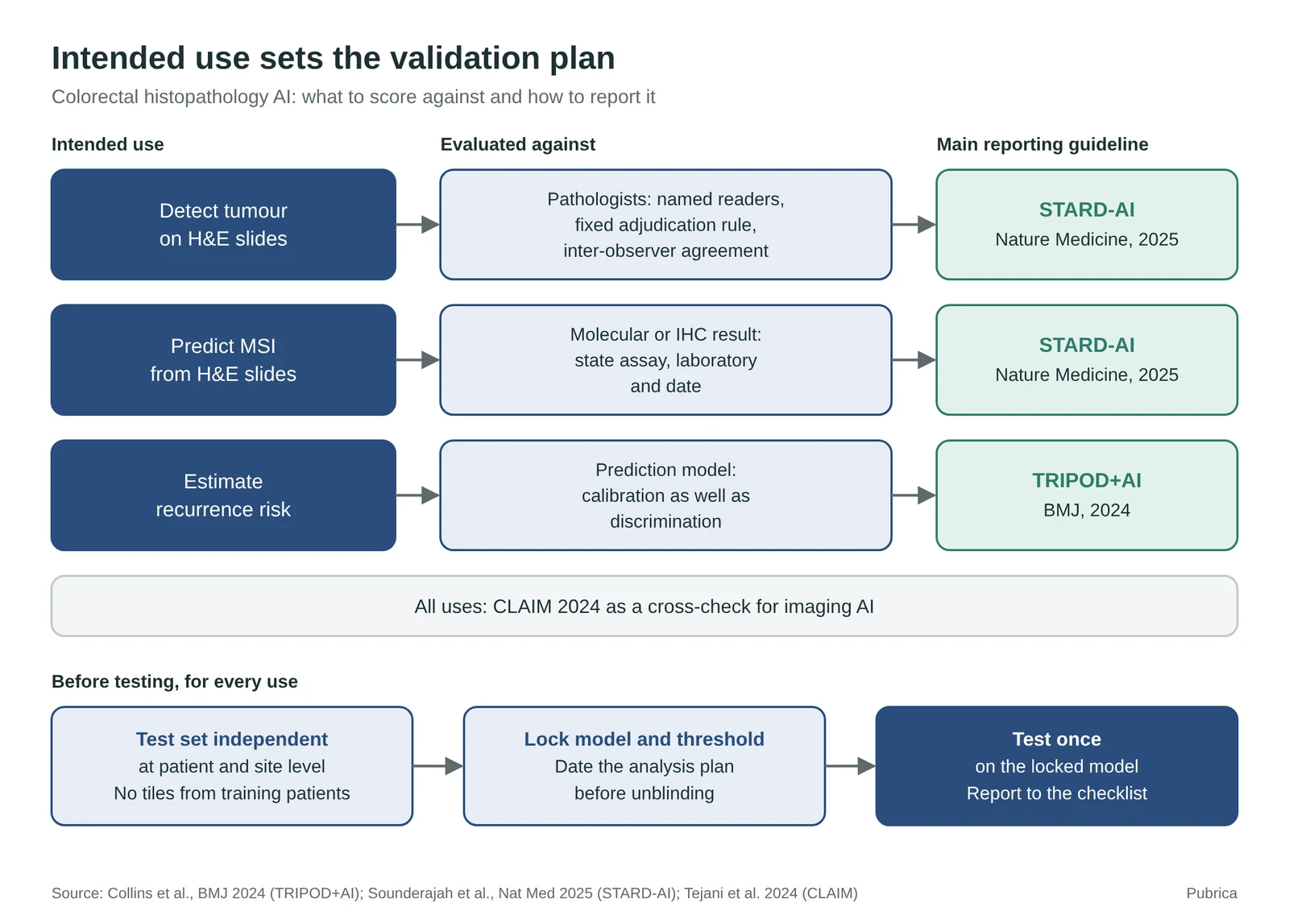
- Report diagnostic accuracy studies to STARD-AI, prediction models to TRIPOD+AI, and use CLAIM 2024 as a cross-check for imaging AI.
- FDA's January 2025 draft guidance on AI-enabled device software asks for evidence of test-data independence, representativeness and the reference standard; agreeing the validation plan through a Pre-Submission reduces the risk of repeating it.
Start with the intended use, because it sets every later choice
Colorectal cancer histopathology is one of the most active areas of pathology AI. Models have been developed to detect tumour on biopsies and resections, to grade or subtype it, and to predict molecular features from routine H&E slides: Kather and colleagues showed in 2019 that deep learning could predict microsatellite instability (MSI) directly from histology in gastrointestinal cancer.
For validation, the intended use is not a formality. A tool that flags suspicious regions for a pathologist is evaluated partly on how the pathologist performs with it. A tool that predicts MSI is evaluated against a molecular reference standard, not a pathologist's opinion. A tool that estimates recurrence risk is a prediction model that needs calibration as well as discrimination. Write the intended use, the target population, the specimen type and the user into the validation plan before choosing datasets, because each changes what an FDA reviewer or a journal reviewer will expect.
As a reference point, FDA's 2021 De Novo authorisation of Paige Prostate, a software device that flags suspicious areas on prostate biopsy images, was supported by a retrospective study in which 16 pathologists read 527 slide images. The study measured whether pathologists detected cancer better with the software, which is the question its intended use raised.
Build slide datasets that a reviewer will accept as independent
Most validation problems in pathology AI come from how slides were split, not from the model. The usual structure is a development set (training and tuning) and a test set that is used once, on the locked model.
| Dataset | Purpose | Decisions to document |
|---|---|---|
| Training | Fit model weights | Sites, scanners, years, inclusion criteria, label source |
| Tuning (internal validation) | Choose architecture, thresholds and stopping | How it was separated from training; whether it was re-used |
| Internal test | First estimate on unseen patients from the same sources | Patient-level split; no slides or tiles from training patients |
| External test | Performance on new sites, scanners and populations | Sites and scanners not used in development; collected after model lock if possible |
Three points deserve particular care in colorectal pathology:
- Patient-level separation. One patient can contribute several blocks, slides and thousands of tiles. Splitting at tile or slide level leaks information and inflates performance.
- Representativeness. Include the specimen types (biopsy and resection), tumour locations, stages, histological subtypes such as mucinous adenocarcinoma, and MSI prevalence that the intended population will contain.
- Scanner and stain variation. Whole slide images differ by scanner, compression and staining protocol. FDA's 2016 guidance on technical performance of whole slide imaging devices describes how imaging components affect image quality, and a model validated on one scanner may not transfer to another.
FDA's January 2025 draft guidance on AI-enabled device software functions asks sponsors to describe how test data are kept independent of development data, for example by collecting them from different clinical sites, and how representative they are of the intended use population. The 2021 Good Machine Learning Practice principles from FDA, Health Canada and the MHRA make the same point: test datasets should be independent of training data.
Practical tip
A test set can be used honestly only once. If you change the model or the threshold after seeing test results, that set has become a tuning set, and you need new test data to report performance.
Annotation and the reference standard
The reference standard is the benchmark against which the model is scored, and it is the part of a validation study that reviewers question most. CLAIM 2024 recommends the term "reference standard" rather than "ground truth" for this reason: it is a defined procedure with known limitations, not a fact.
Decide and document:
- Who labels. The number of pathologists, their subspecialty experience and whether they were blinded to the model output and to each other.
- At what level. Slide-level diagnosis, region annotations or pixel-level masks. Region annotations used for training do not need to be repeated at the same detail for testing, but the test labels must answer the intended-use question.
- How disagreements are resolved. Majority vote, consensus review or a senior adjudicator, with the rule fixed in advance.
- How much the experts agree. Report inter-observer agreement (for example Cohen's or Fleiss' kappa) on a sample of test cases, because model performance cannot sensibly be judged against a reference that pathologists themselves disagree on.
- When the reference is not a pathologist. For an MSI predictor, the reference is the molecular or immunohistochemical result, and the assay, laboratory and date should be stated.
Keep the annotation protocol, the annotator log and the adjudication record. They are needed for the submission and for the methods section of the paper.
Scope the validation analysis for your pathology model
Send the intended use, dataset description and draft analysis plan for one colorectal pathology model. Pubrica will review the scope of the validation analysis and provide a quote.
Performance analysis: fix it before you look
Write a statistical analysis plan for the test set and date it before the test data are unblinded. It should specify:
- the primary endpoint, such as sensitivity and specificity at a locked operating threshold, with area under the ROC curve as a secondary measure;
- confidence intervals that account for clustering when patients contribute several slides;
- pre-specified subgroups (site, scanner, specimen type, stage, MSI status) and how heterogeneity will be described;
- calibration for any model that outputs a probability or risk;
- how failed or unreadable slides are counted, because excluding them silently inflates performance;
- for an assistive tool, a reader study comparing pathologists with and without the model, since GMLP principle 7 focuses on the performance of the human–AI team.
Sizing the test set. A common starting point is the precision of the primary estimate. To estimate a sensitivity of 0.90 with a 95% confidence interval half-width of 0.05, you need about 1.96² × 0.90 × 0.10 / 0.05² ≈ 139 positive cases, and the same reasoning applies to negatives for specificity (Buderer, 1996). Clustering, subgroup estimates and a reader study all increase the number. A statistician should confirm the final size against the endpoint agreed with FDA.
Which reporting guideline fits your study?
Several reporting guidelines cover AI studies, and journals increasingly ask for a completed checklist. Choosing the right one depends on the study question, not the technology.
| Guideline | Applies to | Notes for pathology AI |
|---|---|---|
| TRIPOD+AI (BMJ, 2024) | Studies developing or evaluating prediction models, using regression or machine learning | 27-item checklist; supersedes TRIPOD 2015. Fits a recurrence-risk or prognostic model from H&E slides |
| STARD-AI (Nature Medicine, 2025) | Diagnostic accuracy studies of AI tests | Extends STARD 2015 with 18 new or modified items on datasets, the AI index test and bias. Fits tumour detection or MSI classification against a reference standard |
| CLAIM 2024 update (Radiology: Artificial Intelligence) | AI in medical imaging | Useful cross-check on data, reference standard and testing terminology; the panel did not extend it to imaging biomarker research such as pathomics |
Many colorectal pathology papers will cite more than one: for example, STARD-AI for the accuracy study with CLAIM items on image handling. The TRIPOD+AI reporting guideline becomes the main checklist when the output is a risk estimate for an individual patient. Planning against the checklist before testing is easier than retrofitting the paper afterwards.
Keep the FDA file and the publication consistent
Developers often publish validation results while preparing a marketing submission. The two should describe the same locked model, the same test set and the same numbers; differences invite questions from both FDA and journal reviewers.
- Agree the plan early. FDA's Q-Submission Program, updated in final guidance in May 2025, lets sponsors request written feedback or a meeting on specific questions, such as the test set design and the primary endpoint, before the study runs.
- Plan for change. If you intend to retrain or update the model after authorisation, FDA's final guidance on predetermined change control plans (PCCPs) for AI-enabled device software functions, first issued in December 2024 and reissued in August 2025, explains how planned modifications can be described and authorised in the original submission.
What FDA's draft AI guidance asks for. The guidance Artificial Intelligence-Enabled Device Software Functions: Lifecycle Management and Marketing Submission Recommendations was published as a draft on 7 January 2025 (comments closed 7 April 2025). At the time of writing (November 2026) FDA still lists it as a draft, not for implementation, so treat it as FDA's current thinking rather than a final requirement, and check its status before you file. It recommends that a marketing submission for an AI-enabled device describe:
- The device and its user interface: the AI-enabled functions, inputs and outputs, intended users and how outputs are shown to them, together with labelling that explains model performance and limitations. An example model card is given in an appendix.
- Risk assessment: risks specific to the AI function across the product lifecycle, documented in the risk management file.
- Data management: data sources, sites and collection periods, quality assurance, annotation and the reference standard, dataset size and diversity, use of any synthetic data, and how test data were kept independent of development data and represent the intended use population.
- Model description and development: the model architecture, its inputs and outputs, and how it was trained and tuned.
- Validation: performance validation on independent test data, with a reference standard that reflects the clinical task and with subgroup analyses, plus a usability evaluation. The draft notes that standalone and human–device team performance evaluations may both support the case, so a tool a pathologist interprets will usually need a reader study as well.
- Performance monitoring: a plan for detecting drift or degradation after deployment, recommended for certain submissions.
- Cybersecurity: AI-specific threats such as data poisoning and model evasion.
- A public submission summary: a plain description of the model, its data and its performance.
Appendices cover recommended documentation, transparency design, performance validation and usability evaluation. The June 2023 guidance on premarket content for device software functions still applies alongside it.
The same discipline applies to AI used in the documents themselves. Our Insights article on human QC for AI-drafted oncology clinical study reports sets out the checks a named reviewer should make before anything AI-assisted reaches FDA.
Checklist before you unblind the test set
- Intended use, user and specimen type written down
- Model weights, preprocessing and operating threshold locked and versioned
- Test set separated at patient level and, for external testing, at site level
- Scanner, staining and population mix documented against intended use
- Reference standard procedure, annotators, blinding and adjudication fixed
- Statistical analysis plan dated, with primary endpoint, subgroups and sample size
- Handling of failed slides and indeterminate cases defined
- Reporting guideline chosen and checklist drafted
- Any FDA Pre-Submission feedback reflected in the plan
If several of these are still open, the study is not ready to test, and running it now risks using up a test set that cannot be used again.
How Pubrica supports validation analytics
Pubrica's video and image analytics support covers algorithm development for computer vision, analyses including preprocessing and validation, performance evaluation and the presentation of analytics to the guidelines the target journal specifies. Our medical imaging techniques specialists work on diagnostic accuracy, reproducibility and agreement studies and on image analysis and AI studies, and assess reference standards and observer variability.
We work with medical device and IVD developers and with teams across the life sciences, as part of our oncology and haematology research and publication support in the USA. For related guides, browse the Research Data Analytics & AI section of the Academy.
If you have a pathology model approaching its test phase, send us the intended use, the dataset description and your draft analysis plan, and we will scope the validation analysis and provide a quote.
Frequently asked questions
A model that classifies slides or regions as tumour or not, scored against a pathologist reference standard, is a diagnostic accuracy study, so STARD-AI is usually the primary checklist. TRIPOD+AI fits models that estimate an individual's risk or prognosis.
For a credible claim of generalisability, yes. FDA's draft AI guidance gives data from different clinical sites as an example of independent test data, and journals expect external testing for models intended for wider use.
There is no single required number. Use enough independent readers to estimate agreement and to resolve disagreements by a pre-specified rule, and justify the choice in the protocol. Agreeing it with FDA through a Pre-Submission is sensible for a device.
Many developers do. Make sure the paper and the submission describe the same locked model and test set, and that the publication does not make claims beyond the intended use you plan to submit.
Sources
Sources were checked on 27 November 2026. Requirements and guidance may change after that date; confirm the current version with the issuing body.
- 1Collins GS, Moons KGM, Dhiman P, et al. TRIPOD+AI statement: updated guidance for reporting clinical prediction models that use regression or machine learning methods. BMJ. 2024;385:e078378. https://www.bmj.com/content/385/bmj-2023-078378
- 2Tejani AS, Klontzas ME, Gatti AA, et al. Checklist for Artificial Intelligence in Medical Imaging (CLAIM): 2024 Update. Radiology: Artificial Intelligence. 2024. doi:10.1148/ryai.240300. https://pubs.rsna.org/doi/10.1148/ryai.240300
- 3Sounderajah V, et al. The STARD-AI reporting guideline for diagnostic accuracy studies using artificial intelligence. Nature Medicine. 2025;31:3283-3289. https://www.equator-network.org/reporting-guidelines/the-stard-ai-reporting-guideline-for-diagnostic-accuracy-studies-using-artificial-intelligence/
- 4US FDA. Artificial Intelligence-Enabled Device Software Functions: Lifecycle Management and Marketing Submission Recommendations. Draft guidance. 7 January 2025 (still draft at November 2026). https://www.fda.gov/regulatory-information/search-fda-guidance-documents/artificial-intelligence-enabled-device-software-functions-lifecycle-management-and-marketing
- 5US FDA. Marketing Submission Recommendations for a Predetermined Change Control Plan for Artificial Intelligence-Enabled Device Software Functions. Final guidance. December 2024; reissued August 2025. https://www.fda.gov/regulatory-information/search-fda-guidance-documents/marketing-submission-recommendations-predetermined-change-control-plan-artificial
- 6US FDA, Health Canada, MHRA. Good Machine Learning Practice for Medical Device Development: Guiding Principles. October 2021. https://www.fda.gov/medical-devices/software-medical-device-samd/good-machine-learning-practice-medical-device-development-guiding-principles
- 7US FDA. Technical Performance Assessment of Digital Pathology Whole Slide Imaging Devices. Guidance for industry. April 2016. https://www.fda.gov/regulatory-information/search-fda-guidance-documents/technical-performance-assessment-digital-pathology-whole-slide-imaging-devices
- 8US FDA. Requests for Feedback and Meetings for Medical Device Submissions: The Q-Submission Program. Final guidance. May 2025. https://www.fda.gov/regulatory-information/search-fda-guidance-documents/requests-feedback-medical-device-submissions-pre-submission-program-and-meetings-food-and-drug
- 9US FDA. FDA authorizes software that can help identify prostate cancer. Press announcement. September 2021. https://www.fda.gov/news-events/press-announcements/fda-authorizes-software-can-help-identify-prostate-cancer
- 10Kather JN, Pearson AT, Halama N, et al. Deep learning can predict microsatellite instability directly from histology in gastrointestinal cancer. Nature Medicine. 2019;25(7):1054-1056. https://www.nature.com/articles/s41591-019-0462-y
- 11Buderer NM. Statistical methodology: I. Incorporating the prevalence of disease into the sample size calculation for sensitivity and specificity. Academic Emergency Medicine. 1996;3(9):895-900. https://onlinelibrary.wiley.com/doi/10.1111/j.1553-2712.1996.tb03538.x
TRIPOD+AI reporting guidelinedigital pathology AI validationwhole slide image test setreference standard annotationSTARD-AICLAIM 2024
How to cite this article
Pick your referencing style and copy it. Your university or target journal may vary the punctuation, so check its guide if it has one.
Pubrica Academy. (2026, November 27). Validating an AI Model for Colorectal Cancer Histopathology Before FDA Submission: Slide Datasets, Annotation and Performance Analysis. Pubrica. https://pubrica.com/academy/artificial-intelligence/validation-analytics-for-colorectal-ai-pathology/
This article is written to be learned from. Cite it if you are referring to what it says; if you are using the evidence behind it, cite the sources listed above instead.
Next steps
Scope the validation analysis for your pathology model
Send the intended use, dataset description and draft analysis plan for one colorectal pathology model. Pubrica will review the scope of the validation analysis and provide a quote.
This article is general information for researchers, not legal, regulatory or funding advice. Check the current requirements of your journal, funder, ethics committee or regulator before you act on it.
More in Research Data Analytics & AI