
How to Select the Right Journal for Your Research
High-Impact Journals
Interesting topics
How to Select the Right Journal for Your Research
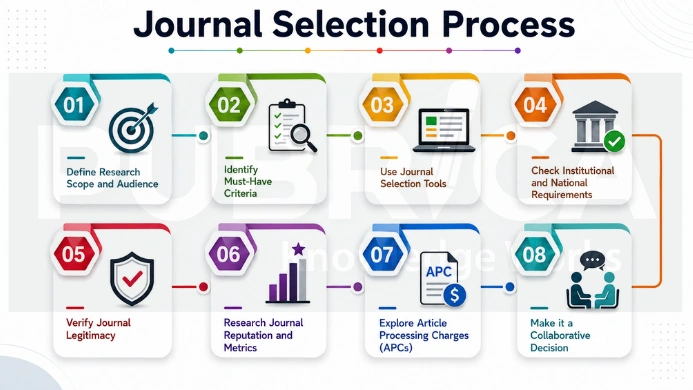
Just like conducting research, it is essential to publish research findings in an appropriate journal. An appropriate journal will increase the visibility of the work done; the right audience will see it, and there is a better chance that it will be accepted. On the other hand, publishing the research in an inappropriate journal may lead to the research being rejected, long reviews and waiting periods, or even being published in a less credible journal. This Research Journal Selection Guide explains how to identify the right journal scope and make informed decisions during journal selection for research. [1]
1. Understand Your Research Scope
The very first step towards selecting an appropriate journal is understanding the scope and contribution of one’s research work. All journals have a well-defined subject domain, targeted audience, and purpose for publication. Before submitting one’s manuscript, he/she should analyse his/her manuscript by comparing it with some recent articles that have been published in that journal. Understanding how to identify the right journal scope is one of the most important aspects of target journal selection.[2]
2. Evaluate Journal Quality
It is essential to measure the quality of a journal through various parameters and not by using just one measure, the impact factor. Some of the aspects that need to be considered include indexing of the journal, peer review system, editorial board, acceptance rate, time to publication, and publisher. Journals that are indexed in reputable databases offer more visibility and credibility. These factors are fundamental to scientific journal selection.
Selection Criterion | Why It Matters |
Journal Scope | Ensures the manuscript fits the journal’s focus |
Improves scientific quality and credibility | |
Indexing | Increases discoverability and citations |
Publication Timeline | Helps meet academic deadlines |
Publisher Reputation | Reflects journal quality and ethics |
3. Review Author Guidelines Carefully
Some manuscripts get rejected simply because of the author’s failure to adhere to journal guidelines. All journals have guidelines on how the manuscript should be formatted, structured, cited, worded, illustrated, and the ethical issues involved. It is important to check the guidelines before submitting any manuscript. This step plays a crucial role in successful target journal selection. [3]
4. Consider Publication Ethics
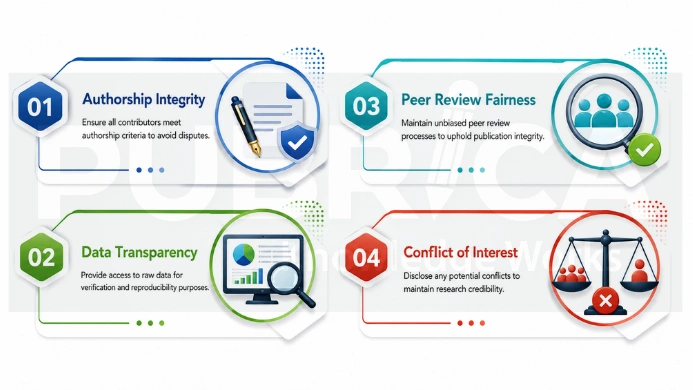
Ethical publishing must always be considered when choosing a journal. Scientists need to be sure that the journal operates according to established standards for publishing articles, conducts a proper peer-review process, and establishes editorial policies. Also, it is important not to select predatory journals that offer quick publishing without a proper scientific review of the material. [4]
5. Match the Journal with Your Research Goals
Diverse journals have diverse academic roles to play. The choosing high-impact journals for research strategy normally offers greater citation potential but comes with stringent acceptance policies. Specialised journals can offer higher visibility to the academic community of experts, while open-access journals make it more accessible to other people. Researchers must pick the journals that would best suit their needs.
Research Goal | Suitable Journal Type |
Broad visibility | High-impact journals |
Specialized audience | Subject-specific journals |
Faster publication | Rapid-review journals |
Greater accessibility | Open-access journals |
6. Avoid Common Journal Selection Mistakes
Many authors limit their chances of publication when they submit manuscripts that do not fall within the purview of the journal or limit themselves only to the impact factor. Some other errors commonly made by researchers are neglecting the issue of indexing, not following submission guidelines, and lack of verification of publication ethics. Careful journal selection for research helps avoid these common mistakes and improves publication success.[5]
Connect with us to explore how we can support you in maintaining academic integrity and enhancing the visibility of your research across the world!
Conclusion
Choosing the correct journal is an important stage that impacts on the publication of the research paper. It is possible to determine the most suitable journal for a research paper through its thorough evaluation. The following considerations will be useful for this purpose. They include the scope of the journal, its quality, indexing, editorial policies, and ethical aspects. Following this Research Journal Selection Guide supports effective scientific journal selection, helps researchers with target journal selection, and assists those seeking a reliable journal selection service in finding the best publication venue.
How to Select the Right Journal for Your Research. Our Pubrica consultants are here to guide you. [Get Expert Publishing Support] or [Schedule a Free Consultation]
Frequently Asked Questions (FAQs)
Choose a journal by evaluating its scope, target audience, indexing status, peer-review process, publisher reputation, and author guidelines to ensure it aligns with your research.
Selecting the right journal improves the likelihood of acceptance, increases research visibility, and ensures your work reaches the appropriate academic audience.
You should review the journal’s scope, formatting requirements, citation style, ethical policies, indexing, publication timeline, and submission guidelines.
High-impact journals reach a broader audience and typically have higher citation rates, while subject-specific journals focus on specialized research communities within a particular discipline.
Predatory journals often promise rapid publication, charge excessive publication fees, lack transparent peer review, and are not indexed in reputable academic databases.
Yes. Indexed journals generally provide greater credibility, visibility, discoverability, and citation potential for your published research.
Open-access journals can increase the accessibility and readership of your research. The choice depends on your funding, publication goals, and target audience.
References
- Ramia J. M. (2023). How to select a journal for your research. World journal of gastroenterology, 29(21), 3379–3384. https://doi.org/10.3748/wjg.v29.i21.3379
- Rogers, J. R., Mills, H., Grossman, L. V., Goldstein, A., & Weng, C. (2020). Understanding the nature and scope of clinical research commentaries in PubMed. Journal of the American Medical Informatics Association : JAMIA, 27(3), 449–456. https://doi.org/10.1093/jamia/ocz209
- Sedaghat, A. R., Bernal-Sprekelsen, M., Fokkens, W. J., Smith, T. L., Stewart, M. G., & Johnson, R. F. (2024). How to be a good reviewer: A step-by-step guide for approaching peer review of a scientific manuscript. Laryngoscope investigative otolaryngology, 9(3), e1266. https://doi.org/10.1002/lio2.1266
- Singhal, S., & Kalra, B. S. (2021). Publication ethics: Role and responsibility of authors. Indian journal of gastroenterology : official journal of the Indian Society of Gastroenterology, 40(1), 65–71. https://doi.org/10.1007/s12664-020-01129-5
- Porcino, A., & Moraska, A. (2015). Avoiding Common Writing Mistakes That Make Your Editors and Reviewers Cringe. International journal of therapeutic massage & bodywork, 8(4), 1–3. https://doi.org/10.3822/ijtmb.v8i4.310