
- Services
- Discovery & Intelligence Services
- Publication Support Services
- Sample Work
Publication Support Service
- Editing & Translation
-
Editing and Translation Services
- Sample Work
Editing and Translation Service
-
- Research Services
- Sample Work
Research Services
- Physician Writing
- Sample Work
Physician Writing Service
- Statistical Analyses
- Sample Work
Statistical Analyses
- Data Collection
- AI and ML Services
- Sample Work
AI and ML Services
- Medical Writing
- Sample Work
Medical Writing
- Research Impact
- Sample Work
Research Impact
- Medical & Scientific Communication
- Sample Work
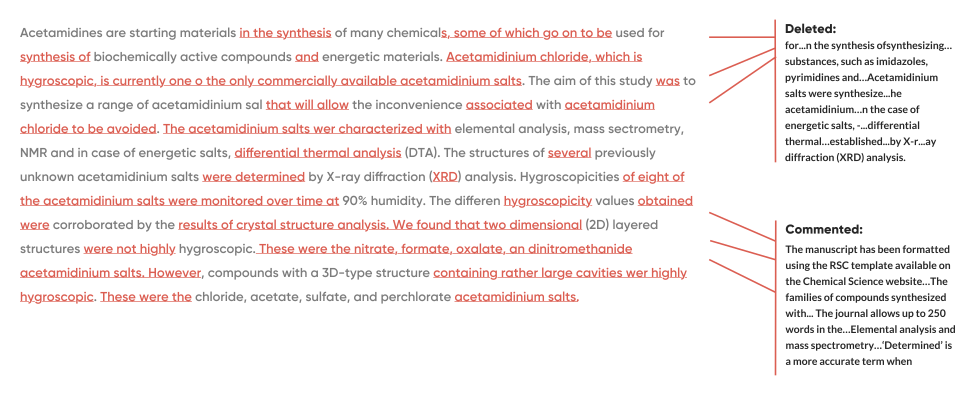
Medical & Scientific Communication
- Medico Legal Services
- Educational Content
- Academic Editorial Services
- Sample Work
Academic Editorial Services
- Educational Editorial Service
-
Education Editorial Services
- Sample Work
Education Editorial Services
-
- Industries
- Subjects
- About Us
- Academy
- Insights
- Contact Us
A step-by-step guide to the process of publishing a research paper
A Step-by-Step Guide to Publishing Your Research Paper: From Manuscript Preparation to Journal Acceptance
Publishing the scientific paper is an essential aspect of the scientific process. It allows researchers to share their findings with other people in their discipline and make contributions towards the development of knowledge. Nevertheless, publication of the paper entails not only conducting a study but also several important processes. They include creating the manuscript, choosing a suitable journal, dealing with reviewers’ suggestions, and meeting various standards. Familiarity with the different aspects of the Scientific Manuscript publication process will increase the chances of success. [1]
1. Understanding the Research Publication Process
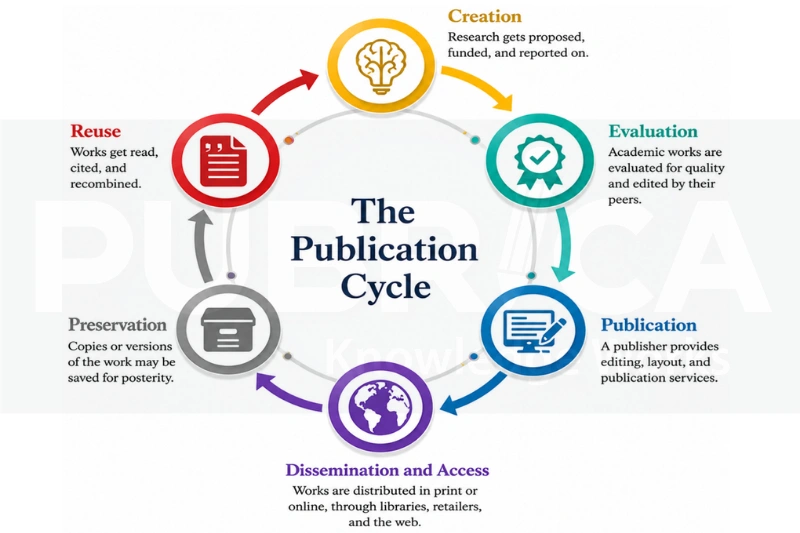
The journey from completed research to Scientific Publication Support and published article follows a structured pathway. Each stage serves a specific purpose in maintaining the quality, reliability, and integrity of scholarly literature. [2]
Stage | Purpose |
Manuscript Preparation | Organizing research findings into a publication-ready format |
Journal Selection | Identifying the most suitable publication venue |
Submission | Presenting the manuscript for editorial consideration |
Peer Review | Independent evaluation of scientific quality |
Revision | Improving the manuscript based on reviewer feedback |
Acceptance | Final approval for publication |
Publication | Dissemination of research findings |
2. Manuscript Preparation: Building a Strong Foundation
Preparing a well-organised manuscript is the initial step towards publishing the work successfully. All academic journals usually have set expectations for the scientific writing practices and reporting norms. [3]
The main components of a Research Paper include the title, abstract, keywords, introduction, methods, results, discussion, conclusion, and references. Each component plays an important role in the overall story of the research process.
In the introductory part, researchers need to define the problem addressed, discuss its importance and set out the research objectives. Methods should contain enough information about how to conduct research again, and the results section should contain objective data without its interpretation. The discussion interprets the findings against the literature.
Researchers also need to format their manuscripts before submitting them to the journals.
3. Selecting an Appropriate Journal
Selection of an appropriate journal may be considered one of the key steps in the publication process. One of the main reasons papers are rejected by journal editors is incompatibility with the journal’s scope. [4]
The following criteria should be considered while choosing a journal:
- Relevance of the journal scope to the topic of your paper
- Journal’s target audience
- Indexing of the journal in reputable databases
- Timeframes for publications
- Policy on open access
- Impact factor of the journal
Researchers seeking Medical Journal Publication Support or publication in other specialized journals need to study recent publications in a journal and decide if their findings match its objectives and target audience.
4. The Submission Process
After completing the manuscript and choosing an appropriate journal to publish in, the submission begins. Most present-day journals use online manuscript tracking systems.
In addition to the completed manuscript, other forms like a cover letter, ethics approval form, conflict of interest statement, and others may have to be filled out. A good cover letter needs to state the uniqueness of the original research papers as well as their importance to the chosen journal. [5]
5. Peer Review and Editorial Evaluation
Following submission, the manuscript undergoes an initial editorial assessment. If deemed appropriate for the journal, it is forwarded to expert reviewers for peer evaluation. [6]
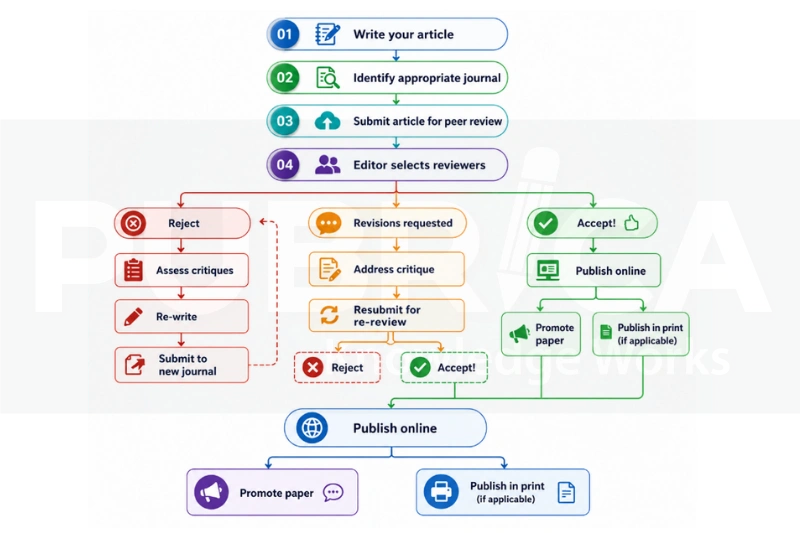
Peer review is a quality check system meant to evaluate:
- Scientific robustness
- Validity of methods used
- Originality of results
- Quality of presentation
- Contribution to current knowledge
Based on the reviewer’s recommendation, an article could be accepted, accepted with minor changes, require major changes, or rejected altogether. Revisions are part and parcel of the publishing a research paper process.
6. Revising the Manuscript
In fact, dealing well with comments from reviewers becomes the deciding factor on whether the work is accepted or rejected. This requires addressing all issues raised by reviewers and explaining clearly the changes that have been made.
It is necessary to draft a formal document stating how you have attended to the concerns raised by each reviewer. It is important to remain professional at this stage of Scientific Manuscript publication.
7. Acceptance and Publication
If there have been satisfactory changes, the editor will then proceed to accept the manuscript for publication. Before any publication, authors can get their page proofs for the last revision of the article, where they can spot any typos and confirm their identity and other relevant details.
Upon publishing, researchers are expected to share their work to ensure wider dissemination and research impact. Various Scientific Publication Support services can assist in maximizing the visibility of published work.
8. Ethical Considerations in Research Publishing
The importance of ethics cannot be undermined during the entire publishing process. The researchers are supposed to maintain integrity, honesty, and accountability in the research.[7]
Some of the important ethical issues that should not be overlooked by the researchers include:
- No plagiarism or duplicate submission
- Data should be presented truthfully
- Getting all the required ethical approvals
- Conducting a declaration of conflict of interest
- Maintaining authorship integrity.
Conclusion
Publication of Original research papers is not an easy task; rather, it involves a series of steps that are quite systematic and rigorous in nature and go beyond doing research alone. For one to be successful in the process, there is a need to consider such factors as manuscript preparation, selection of the right journal, maintenance of ethical conduct, and engaging in peer review. Whether seeking Medical Journal Publication Support or general Scientific Publication Support, understanding the complete process significantly improves the chances of successfully publishing a research paper.
A Step-by-Step Guide to Publishing Your Research Paper: From Manuscript Preparation to Journal Acceptance. Our Pubrica consultants are here to guide you. [Get Expert Publishing Support] or [Schedule a Free Consultation]
Reference
- Macdonald, N. E., Ford-Jones, L., Friedman, J. N., & Hall, J. (2006). Preparing a manuscript for publication: A user-friendly guide. Paediatrics & child health, 11(6), 339–342. https://doi.org/10.1093/pch/11.6.339
- Huecker MR, Shreffler J. How To Write And Publish A Scientific Manuscript. [Updated 2022 Oct 31]. In: StatPearls [Internet]. Treasure Island (FL): StatPearls Publishing; 2026 Jan-. Available from: https://www.ncbi.nlm.nih.gov/books/NBK564394/
- Colley, J., Parekh, S., Whitehead, E., & Cole, R. (2022). Building a Strong Foundation: Overcoming Obstacles in Applied Health Systems Research Through a Collaborative Approach From Funders. Health services insights, 15, 11786329221146386. https://doi.org/10.1177/11786329221146386
- Tullu, M. S., & Karande, S. (2018). Success in Publishing: Selecting an Appropriate Journal and Braving the Peer-review Process. Journal of postgraduate medicine, 64(1), 1–4. https://doi.org/10.4103/jpgm.JPGM_618_17
- Bhatia S. J. (2017). How to Choose the Right Journal. Reporting and Publishing Research in the Biomedical Sciences, 143–153. https://doi.org/10.1007/978-981-10-7062-4_16
- Walshe, C., & Ashby, D. (2026). Opening the black box: Understanding the editorial and peer review journey of a manuscript. Palliative medicine, 40(1), 4–6. https://doi.org/10.1177/02692163251406788
- Barrow JM, Brannan GD, Khandhar PB. Research Ethics. [Updated 2022 Sep 18]. In: StatPearls [Internet]. Treasure Island (FL): StatPearls Publishing; 2026 Jan-. Available from: https://www.ncbi.nlm.nih.gov/books/NBK459281/

Give yourself the academic edge today
Each order includes
- On-time delivery or your money back
- A fully qualified writer in your subject
- In-depth proofreading by our Quality Control Team
- 100% confidentiality, the work is never re-sold or published
- Standard 7-day amendment period
- A paper written to the standard ordered
- A detailed plagiarism report
- A comprehensive quality report