How a Systematic Review Actually Works: The Systematic Review Process Our Team Follows, Step by Step
Most guides list the steps of a systematic review. This one shows how our evidence synthesis team runs them in practice, and the one failure we check for at each stage before the review moves on.
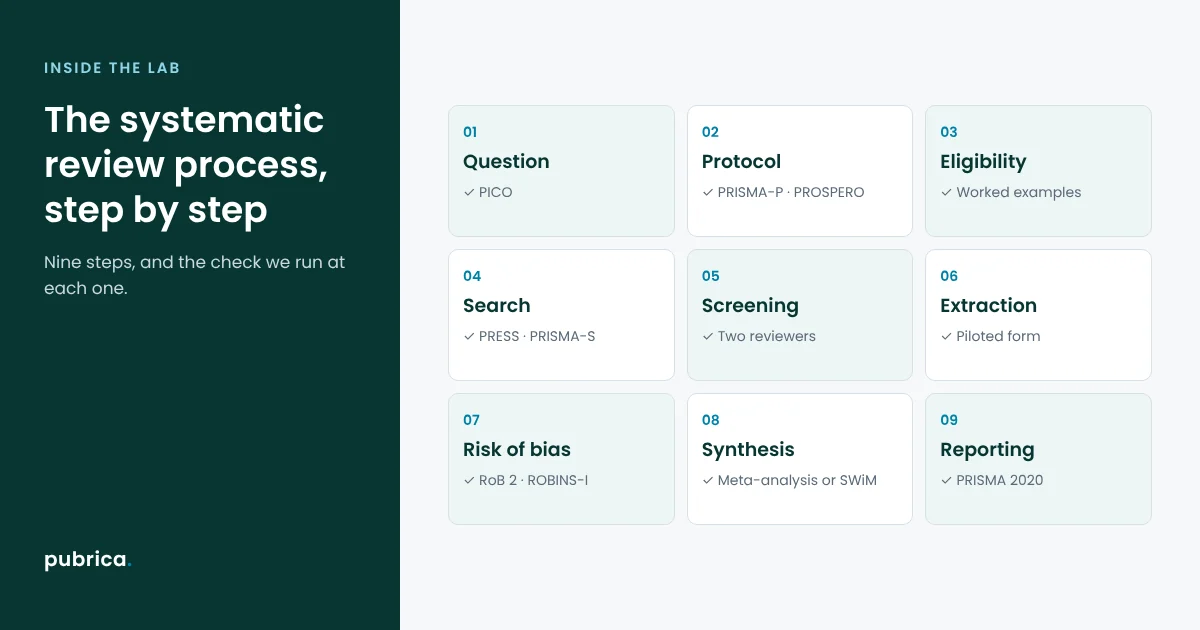
- Steps
- Nine, from a focused question to a PRISMA 2020 report
- Decided in advance
- Question, eligibility criteria, search, extraction and synthesis plan
- Done in pairs
- Screening, data extraction and risk of bias
- Most common failure
- Changing the rules after seeing the studies
On this page
- Quick answer
- What makes a review systematic
- Steps 1 to 3: question, review protocol and eligibility criteria
- Step 4: build and peer review the search strategy
- Steps 5 and 6: screening and data extraction
- Step 7: assess risk of bias with the right tool
- Step 8: synthesis, with or without meta-analysis
- Step 9: report with PRISMA 2020
- Questions
- References
Quick answer
- The systematic review process has nine systematic review steps, and most are fixed in a review protocol before searching.
- Register the protocol in PROSPERO where eligible, so changes are visible.
- Screen, extract data and assess risk of bias with two independent reviewers.
- Choose meta-analysis or narrative synthesis by the data, and report with PRISMA 2020.
01What makes a review systematic
A systematic review answers a defined question by finding, selecting, appraising and synthesising all eligible studies using methods set out in advance [1]. That pre-specification is what separates it from a narrative review: anyone could repeat the search and the selection and reach the same set of studies.
The steps themselves are well documented. Where reviews fail is in how each step is carried out, so the table below pairs each step with the failure our team checks for before moving on.
| Step | What we produce | The failure we look for |
|---|---|---|
| 1. Question | PICO (or another framework) with the comparison stated | A topic, such as “diabetes management”, not a question |
| 2. Review protocol | PRISMA-P protocol, registered in PROSPERO where eligible | Methods decided after seeing the results |
| 3. Eligibility criteria | Inclusion and exclusion rules with examples | Criteria loose enough to be applied two ways |
| 4. Search | Strategies for each database, peer reviewed with PRESS | One database, or no subject headings |
| 5. Screening | Two independent reviewers, reasons for exclusion | Single screening with no record of disagreements |
| 6. Data extraction | Piloted form, double-checked extraction | Form changed halfway without re-extraction |
| 7. Risk of bias | Tool matched to design, such as RoB 2 or ROBINS-I | One tool used for every design |
| 8. Synthesis | Meta-analysis or SWiM, as the data allow | Pooling studies that are not comparable |
| 9. Reporting | PRISMA 2020 checklist and flow diagram | PRISMA treated as the method, not the report |
02Steps 1 to 3: question, review protocol and eligibility criteria
We turn the topic into a question using PICO (population, intervention, comparison, outcome) for intervention reviews, or another framework when the question is about diagnosis, prognosis or experience [1]. The question then drives the review protocol, which we write to the PRISMA-P items: eligibility criteria, information sources, search strategy, screening, data extraction, risk-of-bias assessment and planned synthesis [2].
Where the review is eligible, we register the protocol in PROSPERO, ideally before screening starts. Eligibility criteria are written with worked examples, such as “trials in adults; trials that include children are excluded unless adult data are reported separately”, so two reviewers apply them the same way.
03Step 4: build and peer review the search strategy
Our information specialist combines subject headings and free-text synonyms with Boolean operators for each database, and adds trial registries and reference checking where the topic needs them [1]. A second specialist then reviews the strategy against the PRESS 2015 guideline, which covers how the question was translated, the Boolean and proximity operators, subject headings, text words, spelling and syntax, and limits [4]. The full strategies are reported to PRISMA-S so the search can be reproduced [3].
04Steps 5 and 6: screening and data extraction
After removing duplicates, two reviewers screen titles and abstracts independently, then full texts, with disagreements resolved by discussion or a third reviewer [1]. Each full text we exclude gets a recorded reason, which feeds the PRISMA flow diagram.
Data extraction uses a form piloted on two or three included studies before full use. It records study design, participants, interventions or exposures, comparators, outcomes and the data needed for synthesis, and a second reviewer checks the extraction [1].
05Step 7: assess risk of bias with the right tool
Risk of bias is assessed per study with a tool that fits the design, for example RoB 2 for randomised trials and ROBINS-I for non-randomised studies of interventions [1]. For overviews that include other reviews, ROBIS assesses bias at the review level [5]. Our risk of bias guide covers tool choice in more depth. The judgements shape how much weight findings carry; they do not automatically exclude a study.
06Step 8: synthesis, with or without meta-analysis
A meta-analysis is only run when studies are similar enough in population, intervention, outcome and design for a pooled estimate to mean something [1]. When they are not, we synthesise without pooling and report it with the SWiM guideline, which sets out how studies were grouped, which standardised metric was used and how certainty was judged [6]. Narrative synthesis is a method, not a fallback; done properly it is as transparent as a forest plot.
07Step 9: report with PRISMA 2020
The final manuscript follows the 27-item PRISMA 2020 checklist and includes a flow diagram showing records identified, screened, excluded with reasons and included [7]. PRISMA tells readers what was done; it does not tell you how to do it, which is why the methods above come first.
What we check before a review goes to a journal
- Methods match the registered protocol, or every change is in the decision log.
- Search strategies for every database are in the supplementary file.
- Flow diagram numbers add up at every stage.
- Risk-of-bias judgements are reflected in the conclusions.
- The synthesis method matches the data, and limitations are stated.
Questions
How long does a systematic review take?
It depends on the question and the number of records. Screening and data extraction usually take the most time, so a narrower question shortens the review.
Is a meta-analysis required in a systematic review?
No. A meta-analysis is only appropriate when studies are comparable. Otherwise, synthesis without meta-analysis, reported with SWiM, is the right choice.
Do I have to register my systematic review?
Not always, but many journals expect it. Registering in PROSPERO, where eligible, shows that the methods were set before the results were known.
References
- Higgins JPT, Thomas J, Chandler J, et al., editors. Cochrane Handbook for Systematic Reviews of Interventions. 2nd ed. Chichester: John Wiley & Sons; 2019. Online edition: https://training.cochrane.org/handbook
- Shamseer L, Moher D, Clarke M, et al. Preferred reporting items for systematic review and meta-analysis protocols (PRISMA-P) 2015: elaboration and explanation. BMJ. 2015;349:g7647. https://doi.org/10.1136/bmj.g7647
- Rethlefsen ML, Kirtley S, Waffenschmidt S, et al. PRISMA-S: an extension to the PRISMA Statement for Reporting Literature Searches in Systematic Reviews. Syst Rev. 2021;10:39. https://doi.org/10.1186/s13643-020-01542-z
- McGowan J, Sampson M, Salzwedel DM, Cogo E, Foerster V, Lefebvre C. PRESS Peer Review of Electronic Search Strategies: 2015 guideline statement. J Clin Epidemiol. 2016;75:40–46. https://doi.org/10.1016/j.jclinepi.2016.01.021
- Whiting P, Savović J, Higgins JPT, et al. ROBIS: a new tool to assess risk of bias in systematic reviews was developed. J Clin Epidemiol. 2016;69:225–234. https://doi.org/10.1016/j.jclinepi.2015.06.005
- Campbell M, McKenzie JE, Sowden A, et al. Synthesis without meta-analysis (SWiM) in systematic reviews: reporting guideline. BMJ. 2020;368:l6890. https://doi.org/10.1136/bmj.l6890
- Page MJ, McKenzie JE, Bossuyt PM, et al. The PRISMA 2020 statement: an updated guideline for reporting systematic reviews. BMJ. 2021;372:n71. https://doi.org/10.1136/bmj.n71
Update log
- Published by Pubrica
How to cite this article
Pubrica Evidence Synthesis Team. (2026, October 20). How a Systematic Review Actually Works: The Systematic Review Process Our Team Follows, Step by Step. Pubrica. https://pubrica.com/insights/inside-the-lab/systematic-review-process-step-by-step/
This article is general information for researchers, not legal, regulatory or funding advice. Check the current requirements of your journal, funder, ethics committee or regulator before you act on it.