



How to Conduct a Systematic Review and Write It Up
High-Impact Journals
- Developing a Well-Defined Research Question
- Preparing a Systematic Review Protocol
- Conducting a Comprehensive Literature Search
- Screening and Selecting Relevant Studies
- Extracting Data and Assessing Study Quality
- Synthesising the Evidence
- Writing the Systematic Review
- Challenges and Best Practices
- Conclusion
Interesting topics
How to Conduct a Systematic Review and Write It Up
A systematic review is a carefully defined and thorough approach to searching for, analysing, and summarising all relevant evidence in relation to a particular research question. A systematic review methodology differs from conventional literature reviews in that it utilises an explicit methodology designed to reduce bias in the literature review process. It is crucial in the practice of evidence-based medicine, health care, education, psychology, and social sciences since it summarises and provides evidence of existing knowledge on a topic through evidence synthesis. The execution of a systematic review is a well-planned and scientific approach. [1]
1. Developing a Well-Defined Research Question
How to conduct a systematic review always begins with a research question that is clearly formulated. This research question dictates the focus of the review and how it should be conducted. It forms the basis of how the literature review process is carried out and the criteria that will be used in the selection of the literature. In healthcare research, various structures, including PICO, are used to formulate research questions. [2]

2. Preparing a Systematic Review Protocol
Prior to undertaking the literature review, researchers must formulate an in-depth review protocol as part of the systematic review methodology. In the protocol, objectives, inclusion criteria, search databases, search strategies, data abstraction techniques, data quality appraisal process, and data synthesis approach are outlined. Having a review protocol prior to conducting the review is beneficial to the research process as it increases methodological transparency and eliminates any risk of bias. In health care research, many researchers register their protocols in PROSPERO.
3. Conducting a Comprehensive Literature Search
Literature search forms one of the most vital parts of a systematic review. The use of several scientific databases helps cover all sources of evidence. Some examples of scientific databases include PubMed, Scopus, Web of Science, Embase, and the Cochrane Library. The searches must include appropriate keywords and their synonyms together with Boolean operators and MeSH (Medical Subject Headings). This helps to retrieve all studies related to the topic under investigation. It is also possible for other researchers to conduct the same systematic review. A comprehensive search strategy is an essential part of how to conduct a systematic review. [3]
4. Screening and Selecting Relevant Studies
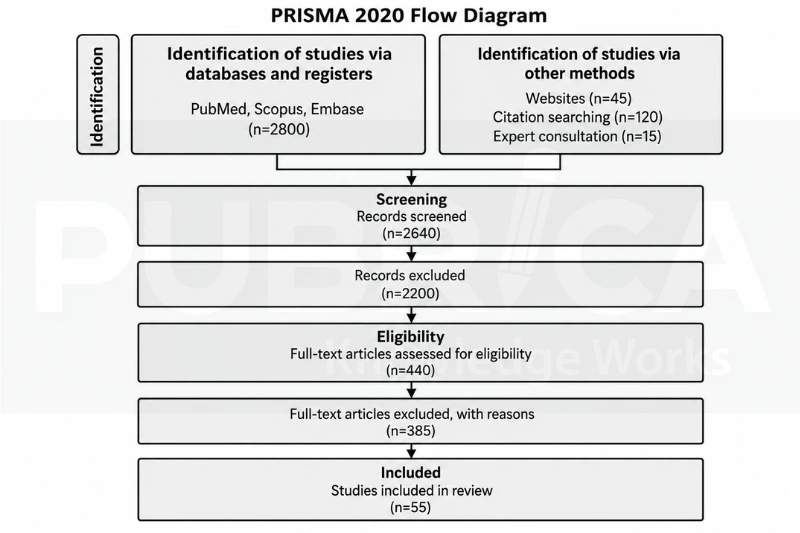
After the completion of the search procedure, the retrieved records will go through a systematic screening process. First, the duplicate records will be identified, and after that, the titles and abstracts of the records will be assessed using a set of predetermined inclusion and exclusion criteria. Further, the relevant studies will be scrutinised in detail based on their eligibility for inclusion. It is very important to maintain consistency throughout the screening process. [4]
5. Extracting Data and Assessing Study Quality
After the process of selecting articles for review, systematic data collection takes place from the included articles. Some of the data collected include variables such as article attributes, demographic features of participants, interventions, results, among others. Together with the process of collecting data, the methodological quality of each of the studies needs to be critically evaluated using evaluation tools such as the Cochrane Risk of Bias Tool, Newcastle-Ottawa Scale, and Joanna Briggs Institute Critical Appraisal Checklists. This stage strengthens the overall evidence synthesis.
Common Data Extracted During a Systematic Review
Data Element | Description |
Author and Year | Publication details |
Study Design | RCT, Cohort, Case-control, Cross-sectional |
Sample Size | Number of participants |
Intervention or Exposure | Treatment or variable investigated |
Outcome Measures | Primary and secondary outcomes |
Key Findings | Summary of study results |
6. Synthesising the Evidence
After extraction of the information, a synthesis of all the data derived from the studies included in the research takes place. If there is sufficient similarity between the various studies in terms of their designs and outcome measurements, a meta-analysis guide can be followed whereby statistical analysis of the data is done. In case statistical synthesis is not suitable due to heterogeneity, then a narrative synthesis is conducted where comparisons of the data are made. This process represents the core of evidence synthesis.
7. Writing the Systematic Review
Systematic review writing needs a logical organisation based on accepted international standards of reporting such as PRISMA 2020 guidelines. The manuscript is usually made up of five major sections including the introduction, methodology, results, discussion, and conclusions. Each part explains the review process, the justification of the methodologies used, results presented in an objective way, and their strengths, weaknesses, and implications. Transparency in reporting makes it possible for all readers
and reviewers to assess the validity of the review. Following the PRISMA 2020 guidelines improves the quality and reproducibility of the review. [5]
8. Challenges and Best Practices
In conducting systematic reviews, there exist several issues, including the inability to find all the literature, inconsistency when selecting studies, missing information, publication biases, and issues related to heterogeneity in methodology. All these problems can be reduced through developing an effective protocol for the review, applying standardised quality assessment methods, engaging independent reviewers, keeping track of all the steps involved in the literature review process, and following the PRISMA 2020 guidelines.
Common Challenges and Recommended Solutions
Challenge | Recommended Solution |
Incomplete literature search | Search multiple databases using comprehensive strategies |
Selection bias | Use predefined eligibility criteria and independent reviewers |
Poor reporting | Follow PRISMA 2020 guidelines |
High heterogeneity | Conduct subgroup or sensitivity analyses |
Publication bias | Search grey literature and trial registries |
Connect with us to explore how we can support you in maintaining academic integrity and enhancing the visibility of your research across the world!
Conclusion
Systematic reviews are some of the best methodologies used to synthesise evidence scientifically and base decision-making on scientific evidence. Performing a systematic review involves asking clear research questions, performing extensive searches, selecting appropriate studies, data extraction, and evaluating the quality of the selected studies, among others. Using methodological frameworks such as the PRISMA 2020 guidelines, researchers can generate valid, reproducible, and publishable systematic reviews. Understanding how to conduct a systematic review, applying a rigorous systematic review methodology, following a structured literature review process, conducting effective evidence synthesis, and using a meta-analysis guide where appropriate all contribute to producing high-quality research.
How to Conduct a Systematic Review and Write It Up. Our Pubrica consultants are here to guide you. [Get Expert Publishing Support] or [Schedule a Free Consultation]
Frequently Asked Questions (FAQs)
A systematic review is a structured and comprehensive method of identifying, evaluating, and synthesising all relevant studies to answer a specific research question. It follows predefined methods to minimise bias and ensure reliable results.
A literature review provides a general overview of existing research, whereas a systematic review follows a rigorous, transparent methodology with predefined inclusion criteria, comprehensive database searches, and quality assessment of studies.
The first step is to formulate a clear and focused research question, often using frameworks such as PICO (Population, Intervention, Comparison, Outcome) for healthcare research.
A protocol outlines the review objectives, eligibility criteria, search strategy, data extraction methods, and analysis plan. It improves transparency, reduces bias, and ensures consistency throughout the review.
Common databases include PubMed, Scopus, Web of Science, Embase, and the Cochrane Library. Searching multiple databases helps identify all relevant studies.
PRISMA 2020 (Preferred Reporting Items for Systematic Reviews and Meta-Analyses) is an internationally recognized reporting guideline that improves the transparency and quality of systematic review reporting.
References
- Calderon Martinez, E., Ghattas Hasbun, P. E., Salolin Vargas, V. P., García-González, O. Y., Fermin Madera, M. D., Rueda Capistrán, D. E., Campos Carmona, T., Sanchez Cruz, C., & Teran Hooper, C. (2025). A comprehensive guide to conduct a systematic review and meta-analysis in medical research. Medicine, 104(33), e41868. https://doi.org/10.1097/MD.0000000000041868
- Fandino W. (2019). Formulating a good research question: Pearls and pitfalls. Indian journal of anaesthesia, 63(8), 611–616. https://doi.org/10.4103/ija.IJA_198_19
- Ecker, E. D., & Skelly, A. C. (2010). Conducting a winning literature search. Evidence-based spine-care journal, 1(1), 9–14. https://doi.org/10.1055/s-0028-1100887
- Institute of Medicine (US) Committee on Standards for Systematic Reviews of Comparative Effectiveness Research; Eden J, Levit L, Berg A, et al., editors. Finding What Works in Health Care: Standards for Systematic Reviews. Washington (DC): National Academies Press (US); 2011. 3, Standards for Finding and Assessing Individual Studies. Available from: https://www.ncbi.nlm.nih.gov/books/NBK209517/
- Chien, P. F., & Khan, K. S. (2023). Systematic Review Reporting – Writing concisely and precisely. Pakistan journal of medical sciences, 39(2), 317–322. https://doi.org/10.12669/pjms.39.2.7428