AI Journal Selection: How Our Team Uses AI Journal Finders, and Where We Stop Trusting Them
AI tools now suggest journals from an abstract in seconds. We use them every week when choosing a research journal for clients, and we have learned exactly where they help and where a human has to take over.
- What AI does well
- Fast manuscript-to-journal matching from an abstract
- Biggest blind spot
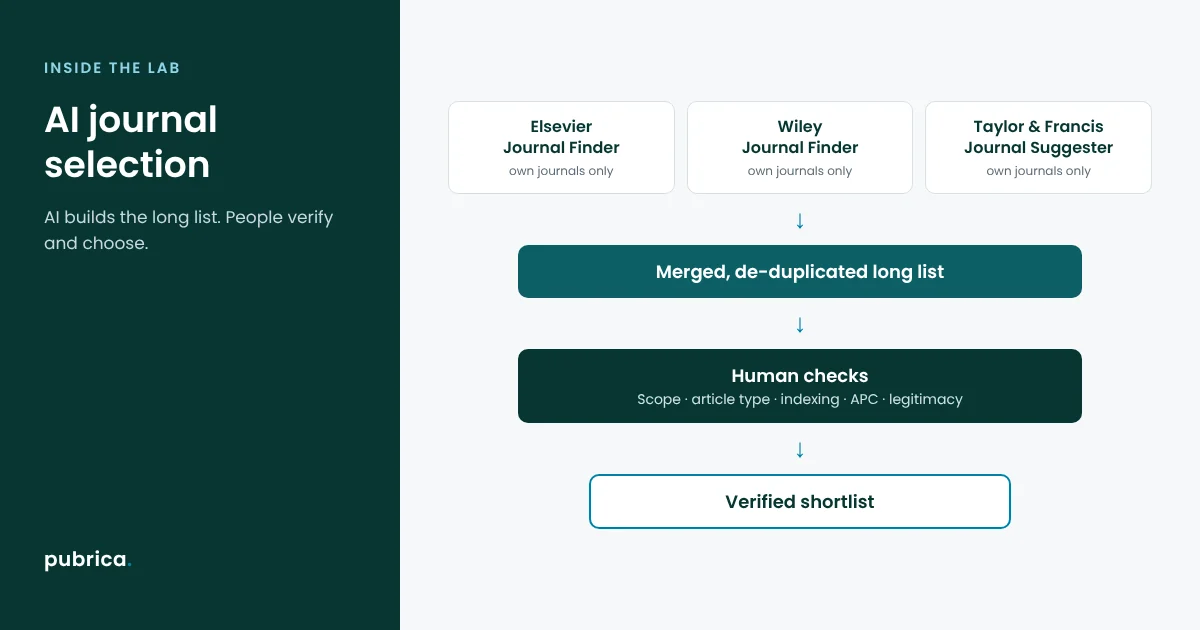
- Each publisher’s finder only recommends its own journals
- Evidence so far
- A 2025 pilot of 40 papers: strong in settled fields, weak for interdisciplinary and niche work
- Our rule
- AI builds the long list; people verify and choose
On this page
Quick answer
- AI journal selection tools match your abstract to journals that have published similar work.
- Publisher tools from Elsevier, Wiley and Taylor & Francis only search their own journals, so run several.
- Research shows AI recommendations are weaker for interdisciplinary, niche and emerging topics.
- Verify journal scope, indexing, open access terms and the article processing charge on the journal’s own site.
01What changed in choosing a research journal
Choosing a research journal used to start with a list of familiar titles, compared one by one on scope, article type, indexing, metrics and author guidelines. Journal recommendation tools reverse the order: you paste a title and abstract, and the tool proposes journals whose published articles look similar. Elsevier described its recommender for this kind of manuscript-to-journal matching as early as 2015 [2].
Today the major publishers all offer an AI journal finder of some kind [3, 4, 5], and general chatbots will suggest journals for any text you give them.
02What each AI journal finder actually searches
| Tool | What you enter | What it searches | Blind spot |
|---|---|---|---|
| Elsevier Journal Finder | Title, abstract or keywords | Elsevier journals that have published similar articles | Journals from other publishers |
| Wiley Journal Finder | Title and abstract (AI-powered matching) | Wiley’s portfolio of 1,800+ journals | Journals from other publishers |
| Taylor & Francis Journal Suggester | Abstract or keywords | Taylor & Francis journals, matched by AI to related published content | Journals from other publishers |
| General chatbots (large language models) | Any text | Whatever the model learned in training | Current APCs, indexing, and journals that no longer exist |
The pattern matters more than any single tool. Wiley’s finder searches its own portfolio, and the Taylor & Francis Journal Suggester matches your abstract against content published in Taylor & Francis journals [4, 5]. Each list is a good list of that publisher’s journals, not of the field. A researcher who uses one finder has quietly let one publisher pick the candidates.
03What the research says about AI tools for journal selection
A 2025 pilot study tested large language models on 40 papers from law, psychology, the exact sciences and engineering, and compared their journal suggestions with expert judgements [1]. The models did well in psychology and the exact sciences, where publishing norms are settled. They struggled with interdisciplinary research, niche topics, emerging fields and innovative methods, and showed regional biases in the journals they suggested [1].
That matches what we see. Text similarity finds journals that use the same words, which is not the same as journals whose editors and peer reviewers want this paper.
04The checks AI cannot do for you
Every publisher is explicit that its tool does not predict acceptance: editors decide after peer review [3, 5]. So after the AI step, each candidate goes through the same manual checks we use for any journal shortlist.
What we verify on the journal’s own website
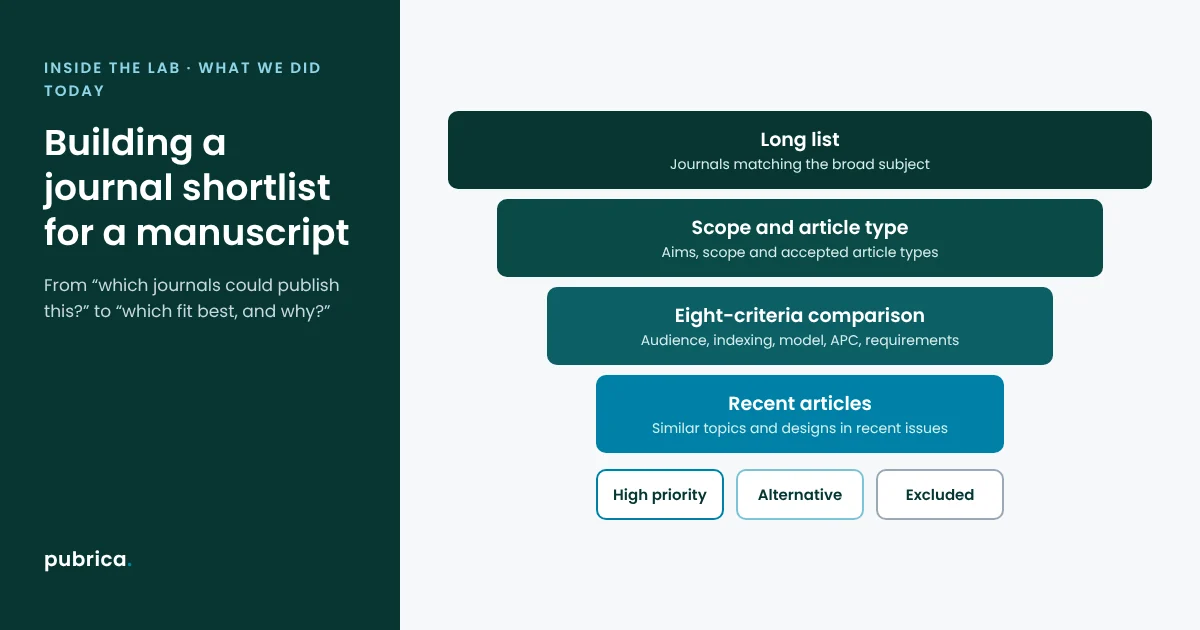
- Journal scope: the aims and scope cover this question, and recent issues contain similar studies.
- Article type: the journal accepts this type, such as original research, systematic review or protocol.
- Indexing: confirmed in the database itself (MEDLINE, Scopus, Web of Science), not on a third-party site.
- Citation metrics: read in context; a higher number does not make a poor fit a good choice.
- Open access and article processing charge: the current model and APC, and any waiver or institutional deal.
- Peer review and timelines: the stated model and typical time to first decision.
- Legitimacy: publisher, editorial board and fees are transparent under the COPE, DOAJ, OASPA and WAME principles [6, 7].
05Our AI journal selection workflow
| Stage | AI tools help with | Our team decides |
|---|---|---|
| Manuscript profile | Extracting topics and keywords | The paper’s real contribution and audience |
| Discovery | Suggesting journals in several portfolios | Which suggestions are worth checking |
| Shortlisting | Grouping similar journals | Fit against scope and recent issues |
| Verification | Surfacing metrics and policies | Checking them on the journal’s own site |
| Final choice | Nothing | Submission order, with reasons |
The split is deliberate. AI saves time at the discovery and grouping stages, where speed matters and errors are cheap. Every decision that affects desk rejection, cost or the authors’ career goals stays with a person who has read the journal.
06What this means for researchers
AI journal selection is worth using, but as a starting point. Run more than one tool, treat chatbot suggestions as leads to check rather than facts, and verify everything that matters on the journal’s own pages before formatting the manuscript. Our guide to choosing the right journal and avoiding predatory titles covers the legitimacy checks in more detail [7].
Questions
Can AI choose the best journal for my paper?
No. AI can suggest journals with similar published content, but fit, legitimacy, cost and acceptance depend on checks and decisions that tools cannot make.
Which AI journal finder is best?
There is no single best tool, because each publisher’s finder covers only its own journals. Use several and compare.
Can I trust journal details from ChatGPT or other chatbots?
Treat them as leads. Chatbots can give outdated APCs, wrong indexing or journals that have changed scope, so confirm every detail on the journal’s website.
References
- Farber S. Enhancing academic decision-making: a pilot study of AI-supported journal selection in higher education. Innov High Educ. 2025;50(5):1813–1831. https://doi.org/10.1007/s10755-025-09791-3
- Kang N, Doornenbal MA, Schijvenaars RJA. Elsevier Journal Finder: recommending journals for your paper. In: Proceedings of the 9th ACM Conference on Recommender Systems. 2015:261–264. https://doi.org/10.1145/2792838.2799663
- Elsevier. How can I find the right journal for my paper in Journal Finder? Elsevier Support Center. https://www.elsevier.support/publishing/answer/how-can-i-find-the-right-journal-for-my-paper-in-journal-finder
- Wiley. Find the right journal for your research. Wiley Author Services. https://authors.wiley.com/author-resources/Journal-Authors/find-a-journal/index.html
- Taylor & Francis. Journal Suggester: frequently asked questions. Taylor & Francis Author Services. https://authorservices.taylorandfrancis.com/publishing-your-research/choosing-a-journal/journal-suggester-faqs/
- COPE, DOAJ, OASPA, WAME. Principles of Transparency and Best Practice in Scholarly Publishing. Version 4.0; 2022. https://publicationethics.org/guidance/guideline/principles-transparency-and-best-practice-scholarly-publishing
- Think. Check. Submit. Journals: choose the right journal or publisher for your research. https://thinkchecksubmit.org/journals/
Update log
- Published by Pubrica
How to cite this article
Pubrica Publication Support Team. (2026, October 20). AI Journal Selection: How Our Team Uses AI Journal Finders, and Where We Stop Trusting Them. Pubrica. https://pubrica.com/insights/inside-the-lab/ai-journal-selection/
This article is general information for researchers, not legal, regulatory or funding advice. Check the current requirements of your journal, funder, ethics committee or regulator before you act on it.