How to Choose the Right Journal: Scope, Quartile, Indexing & Predatory-Journal Checks
High-Impact Journals
Interesting topics
How to Choose the Right Journal: Scope, Quartile, Indexing & Predatory-Journal Checks
The selection of the appropriate journal is a significant aspect of the scientific publication process. The selection of an appropriate journal must be not only one that has a high reputation but also one that fits well with the manuscript in terms of its subject matter, approach, target audience, and contribution to science. Researchers should understand how to choose the right journal based on these factors.
This will ensure the submission of manuscripts only to relevant journals that can reach their appropriate audience. [1]
1. Start by Checking the Journal Scope
The first stage is checking whether the journal is publishing research like your manuscript. The journal scope and aims usually state the topics, types of articles, methods, and subjects of research considered by the journal. [2]
Prior to submitting the manuscript, authors should:
- Read the aims and scope of the journal.
- Look at several recent articles published in the journal.
- See whether similar research has been published before.
- Check whether the manuscript belongs to the journal’s subject area.
A prestigious journal may turn out to be inappropriate if its scope does not correspond to the research.
2. Understand Journal Quartiles
Journal quartiles help researchers on how a journal is positioned within a certain field category. Q1, for instance, means a journal that is ranked among the best 25 percent within a certain ranking system. Nevertheless, journal quartile systems may vary depending on the database and measure used. Researchers should consider journal quartile and indexing check when evaluating potential journals.
An example of this is Scopus Sources which provide Cite Score-based quartiles that are sorted by subject and quartile. Researchers can also review SJR quartile ranking when comparing journals.
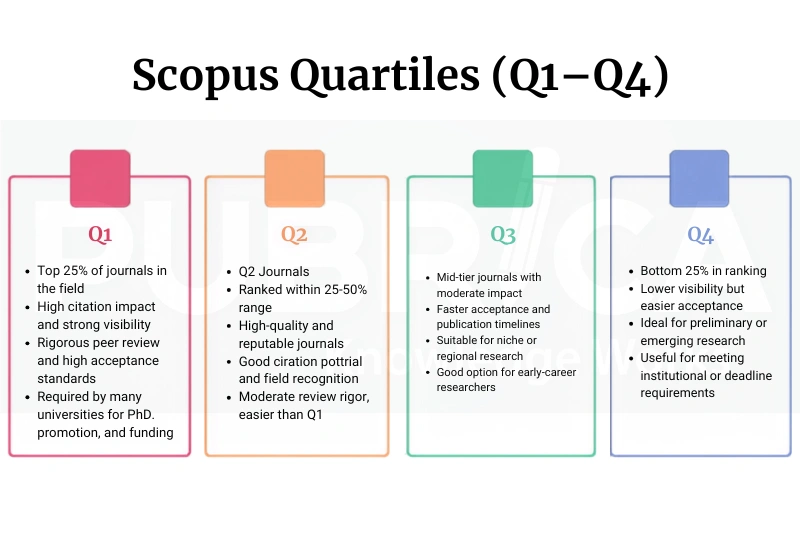
Quartile should therefore be considered alongside scope, peer review, readership, indexing, and research relevance rather than treated as the only measure of journal quality.
3. Verify Journal Indexing
Indexing can enhance discoverability and can also be an essential requirement for researchers, organizations, and funding agencies. Researchers need to confirm the indexing claim from the respective database rather than taking the claim from the statement on the journal website alone. Scopus indexed journals and Web of Science indexing should be verified directly through the respective databases.
Some of the databases are. [3]
Some of the databases are:
- Scopus
- Web of Science
- PubMed/MEDLINE for appropriate biomedical journals
- DOAJ for qualifying open access journals
Scopus provides information about the source, such as title, publisher, field, Cite Score, percentile, etc.
4. Evaluate Peer Review and Editorial Practices
A credible journal should clearly explain its peer-review process. Researchers should check whether the journal identifies the type of peer review used and provides appropriate information about its editorial board and publication policies. Peer-reviewed journal selection should include an assessment of the journal’s review process and editorial practices. [4]
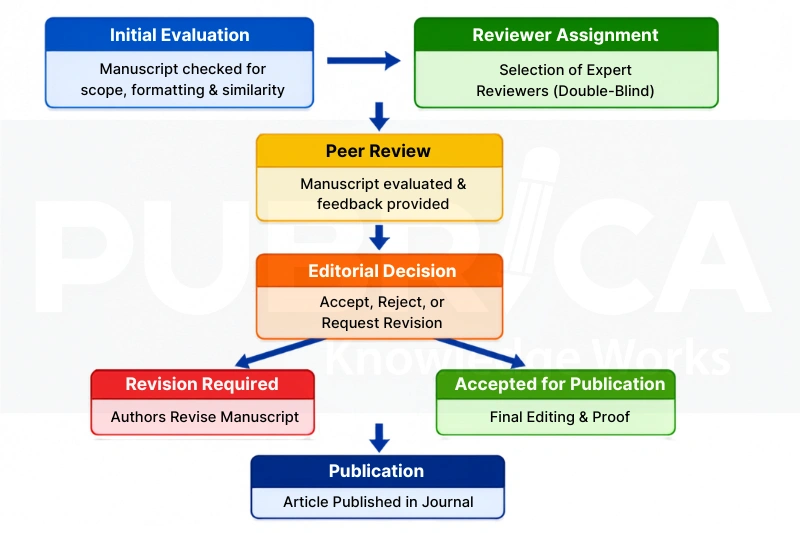
Think. Check. Submit. recommends checking whether the journal clearly describes its peer-review process and whether the publisher can be identified and contacted.
5. Check for Predatory-Journal Warning Signs
These can pose great risks to researchers because they can indulge in deceptive publishing practices, poor peer reviews, unclear costs, and false claims about indexing and the credentials of their editorial board. Researchers should use a predatory journal checklist when assessing potential journals. [5]
Scientists must investigate:
- The legitimacy of the ISSN and title of the journal.
- The legitimacy of the claimed indexing in the related databases.
- The clarity of publication costs.
- The legitimacy of the editorial board and affiliations.
- The transparency of the peer-review and publication policy.
Think. Check. Submit recommends that researchers investigate the journal’s website, its editorial board, articles published, peer-review process, indexing, and cost and not just the predatory-journal lists.
6. Compare Journals Before Submission
A simple comparison framework can help researchers make a more evidence-based decision. [6]
Selection Factor | What to Check | Why It Matters |
Scope | Subject and article types | Ensures manuscript relevance |
Quartile | Q1–Q4 and database | Indicates relative journal position |
Indexing | Scopus, Web of Science, PubMed, etc. | Improves discoverability |
Review model and policies | Supports research quality | |
Fees | APCs and other charges | Prevents unexpected costs |
Editorial Board | Expertise and authenticity | Supports journal credibility |
Publication Ethics | COPE/publishing policies | Indicates responsible practices |
7. Use a Structured Journal-Selection Process
Choosing a journal should not be limited to one aspect but should take several aspects into account, including the impact factor or indexing of the journal. The researcher must narrow down a list of potential journals and then make comparisons in terms of their scope, aim, guidelines for authors, publication criteria, indexing, peer review policy, publication ethics, and time frame.
Connect with us to explore how we can support you in maintaining academic integrity and enhancing the visibility of your research across the world!
Conclusion
Journal selection involves more than just finding a journal in the high quartile. The researcher must consider the scope of the journal, its indexing status, quartile, the presence or absence of peer review and peer review policy, the integrity of the editorial board, and the fee and ethics policies before selecting the journal. A structured approach to the selection process will assist researchers in how to choose the right journal.
How to Choose the Right Journal: Scope, Quartile, Indexing & Predatory-Journal Checks. OurPubrica consultants are here to guide you. [Get Expert Publishing Support] or [Schedule a Free Consultation]
Frequently Asked Questions (FAQs)
Choose a journal whose scope, target audience, article type, indexing, peer-review process, and publication requirements closely match your manuscript.
Q1 generally means that a journal is ranked in the top 25% of journals within a particular subject category and ranking system.
Verify the journal directly through the official Scopus Sources or Web of Science database rather than relying only on claims made on the journal’s website.
Check the journal’s ISSN, publisher, editorial board, peer-review process, indexing claims, publication fees, and publication ethics policies. Avoid relying solely on predatory-journal lists.
No. A Q1 ranking does not automatically mean the journal is the best fit. Scope, readership, indexing, peer review, publication ethics, fees, and relevance to your research should also be considered.
Compare journal scope, quartile, indexing, peer review, publication fees, editorial board, publication ethics, article types, and expected publication timelines.
References
- Ramia J. M. (2023). How to select a journal for your research. World journal of gastroenterology, 29(21), 3379–3384. https://doi.org/10.3748/wjg.v29.i21
- Mak, S., & Thomas, A. (2022). Steps for Conducting a Scoping Review. Journal of graduate medical education, 14(5), 565–567. https://doi.org/10.4300/JGME-D-22-00621.1
- Mondal, H., & Mondal, S. (2020). Check indexing status of a journal. Journal of family medicine and primary care, 9(6), 3166–3167. https://doi.org/10.4103/jfmpc.jfmpc
- Wong, T., Soni, R. N., & Glass, C. (2025). A Guide to an Effective Peer Review. POCUS journal, 10(2), 7–10. https://doi.org/10.24908/pocusj
- Cukier, S., Helal, L., Rice, D. B., Pupkaite, J., Ahmadzai, N., Wilson, M., Skidmore, B., Lalu, M. M., & Moher, D. (2020). Checklists to detect potential predatory biomedical journals: a systematic review. BMC medicine, 18(1), 104. https://doi.org/10.1186/s12916-020-01566-1
- Ramia J. M. (2023). How to select a journal for your research. World journal of gastroenterology, 29(21), 3379–3384. https://doi.org/10.3748/wjg.v29.i21