From Patient to Publication: How to Write a Case Report for Publication, Stage by Stage (Flowchart with Owners and Timelines)
A ten-stage case report workflow, from the reportability check and patient consent to peer review and publication, with an owner and an indicative time for every stage.

- Stages
- 10, in three phases
- First gate
- Written patient consent
- Reporting standard
- CARE guidelines
- To submission
- About 7–12 weeks
Quick answer
- Confirm the case is reportable, then obtain written patient consent before collecting data.
- De-identify the data, search the literature and pick the target journal before drafting.
- Draft to the CARE guidelines, complete co-author review, then submit and respond to peer review.
01A case report is a managed workflow
A publishable case report starts long before the first draft. Knowing how to write a case report for publication means managing a sequence of clinical, ethical and editorial steps: confirming that the case is worth reporting, obtaining patient consent, protecting patient data, writing to the CARE guidelines and choosing the right target journal [1, 3].
The case report workflow below sets out each stage with an accountable owner and an indicative duration. Adapt it to your institution’s rules and to the requirements of the target journal [2]. For the writing itself, see our step-by-step guide on how to write a case report.
02Case report workflow flowchart
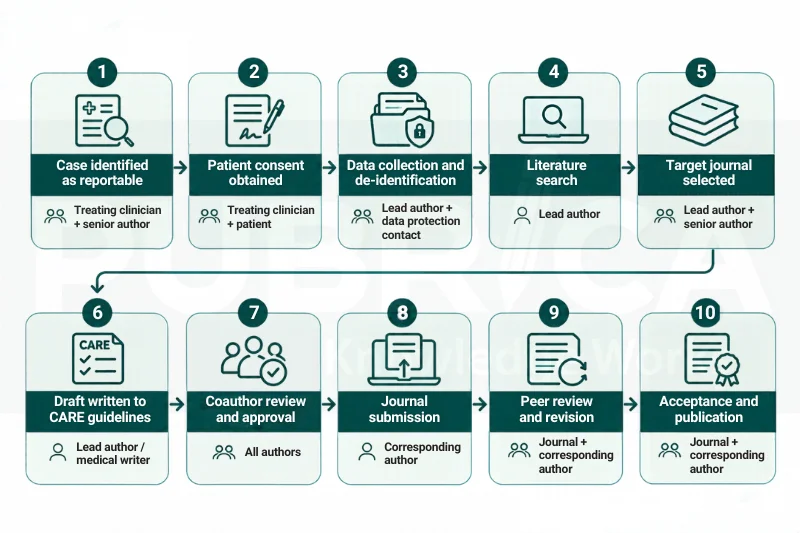
The flowchart groups ten stages into three phases: preparation (stages 1 to 3), writing (stages 4 to 7) and publication (stages 8 to 10). Each box names the accountable owner [1, 3]. Consent comes before data collection, because the patient’s agreement decides what you may collect and publish.
03Stage owners and indicative timelines
The durations in Table 1 are our working estimates for a single case report. Peer review times vary widely by journal, so build the publication timeline around the target journal’s published turnaround where it is available [2, 3].
| Stage | Owner | Indicative time | Key output |
|---|---|---|---|
| 1. Reportability check | Clinician + senior author | 1–3 days | Decision on novelty and value |
| 2. Patient consent | Clinician + patient | 1–2 weeks | Signed consent for publication |
| 3. Data and de-identification | Lead author + data protection contact | 1–2 weeks | De-identified case dataset and images |
| 4. Literature search | Lead author | 1 week | Evidence summary showing what is new |
| 5. Target journal | Lead + senior author | 2–3 days | Journal shortlist and author instructions |
| 6. Drafting | Lead author / medical writer | 2–3 weeks | Draft with completed CARE checklist |
| 7. Co-author review | All authors | 1–2 weeks | Approved final manuscript |
| 8. Submission | Corresponding author | 1–2 days | Submission confirmation |
| 9. Peer review | Journal + authors | Weeks to months | Revised manuscript and response letter |
| 10. Publication | Journal + authors | Varies by journal | Proofs approved; article published |
Run back to back, stages 1 to 8 take roughly seven to twelve weeks. Running the literature search and journal shortlist while consent is being obtained shortens this. A pre-submission peer review before stage 8 catches gaps that would otherwise surface in stage 9.
04Patient consent and data protection
The ICMJE recommendations state that identifying information should not be published unless it is essential for scientific purposes and the patient, or a parent or guardian, has given written informed consent for publication [3]. Many journals go further and require written consent for every case report, whether or not the patient is identifiable.
Health data are a special category of personal data under the GDPR, so collect only what the report needs and remove dates, locations and other details that could identify the patient [4]. Our guide to anonymisation vs pseudonymisation in case reports explains where the legal line sits. Check with your institution whether ethics committee notification is expected; UK authors can use our guide on case report ethics approval in the UK.
05Responsibility matrix
Clear roles prevent delays and authorship disputes. The ICMJE authorship criteria apply to every named author, and a medical writer who does not meet them is acknowledged rather than listed [3].
| Role | Core responsibilities |
|---|---|
| Treating clinician | Identifies the case, explains publication to the patient and obtains patient consent |
| Lead author | Literature search, data collection, drafting and the CARE checklist |
| Senior author | Clinical accuracy, interpretation and final scientific approval |
| Data protection contact | Advice on de-identification and secure data handling |
| Medical writer (optional) | Structuring, editing and journal formatting under the authors’ direction |
| Corresponding author | Journal submission, correspondence and peer review responses |
06Writing to the CARE guidelines
Draft the manuscript in CARE order: title, keywords, abstract, introduction, patient information, clinical findings, timeline, diagnostic assessment, therapeutic intervention, follow-up and outcomes, discussion, patient perspective and informed consent [1, 2]. Complete the CARE checklist as you write, and check the target journal’s word limits and figure rules before co-author review. Write the abstract last, using our guide to the case report abstract.
07Conclusion
The answer to how to write a case report for publication is a managed workflow: clear owners, early patient consent, careful de-identification, CARE-based drafting and a realistic publication timeline. Treating each stage as a checkpoint reduces revisions and protects both the patient and the authors.
Questions
How long does it take to publish a case report?
Is patient consent always required?
Do case reports need ethics approval?
References
- Gagnier JJ, Kienle G, Altman DG, Moher D, Sox H, Riley D; CARE Group. The CARE guidelines: consensus-based clinical case reporting guideline development. Glob Adv Health Med. 2013;2(5):38-43. https://doi.org/10.7453/gahmj.2013.008
- Riley DS, Barber MS, Kienle GS, et al. CARE guidelines for case reports: explanation and elaboration document. J Clin Epidemiol. 2017;89:218-235. https://doi.org/10.1016/j.jclinepi.2017.04.026
- International Committee of Medical Journal Editors. Protection of research participants. In: Recommendations for the conduct, reporting, editing, and publication of scholarly work in medical journals. Accessed 7 November 2026. https://www.icmje.org/recommendations/browse/roles-and-responsibilities/protection-of-research-participants.html
- Regulation (EU) 2016/679 (General Data Protection Regulation), Article 4(5), Article 9 and Recital 26. Official Journal of the European Union. 2016;L119:1-88. https://eur-lex.europa.eu/eli/reg/2016/679/oj
Update log
- Published by Pubrica
How to cite this article
Dr. Charlie. (2026, November 6). From Patient to Publication: How to Write a Case Report for Publication, Stage by Stage (Flowchart with Owners and Timelines). Pubrica. https://pubrica.com/insights/case-report/case-report-workflow-patient-to-publication/
This article is general information for researchers, not legal, regulatory or funding advice. Check the current requirements of your journal, funder, ethics committee or regulator before you act on it.