Contents
On this page
- Quick answer
- Why case reports raise a data protection question
- Anonymisation and pseudonymisation: the legal difference
- What changed in 2025 and 2026
- Why a case report is rarely fully anonymous
- Patient images: the highest re-identification risk
- Informed consent: the practical safeguard
- A step-by-step compliance checklist for authors
- Conclusion
- Frequently asked questions
- Sources
AcademyCase Report
Guide
Anonymisation vs Pseudonymisation of Patient Data in Case Reports: What GDPR and the EDPB’s 2025 Guidelines Mean for Authors
Pseudonymised patient data are still personal data under GDPR, and a published case report is rarely fully anonymous. Here is what the law, the EDPB and the evidence on re-identification mean for authors.
- Case reports
- GDPR
- Patient consent
- Pseudonymised data
- Still personal data under GDPR
- Anonymous data
- Outside GDPR, but hard to achieve
- Highest risk
- Photographs and scans
- Main safeguard
- Written consent for publication
At a glanceCase Report
Talk to Pubrica’s medical writing teamDiscuss your project
Quick answer
- Pseudonymised data can be re-linked by whoever holds the key, so GDPR still applies.
- A published case report is anonymous only if no reasonably likely reader could identify the patient.
- Minimise details, clean images and obtain written consent for publication.
Why case reports raise a data protection question
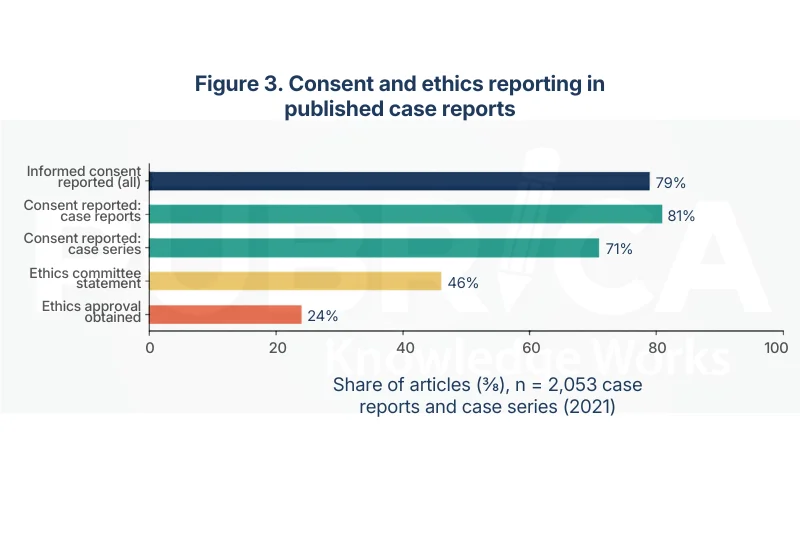
The detail that makes a case report useful, such as a rare diagnosis, a precise timeline or a photograph, can also make the patient recognisable. Practice is uneven: in a meta-research study of 2,053 case reports and case series published in 2021, informed consent was reported in 79% and an ethics committee statement in only 46%1. For authors in Europe the question is also legal. This article explains anonymisation vs pseudonymisation under the General Data Protection Regulation (GDPR), what the EDPB 2025 guidelines and later guidance changed, and what to do before submission. It is general guidance, not legal advice.
Anonymisation and pseudonymisation: the legal difference
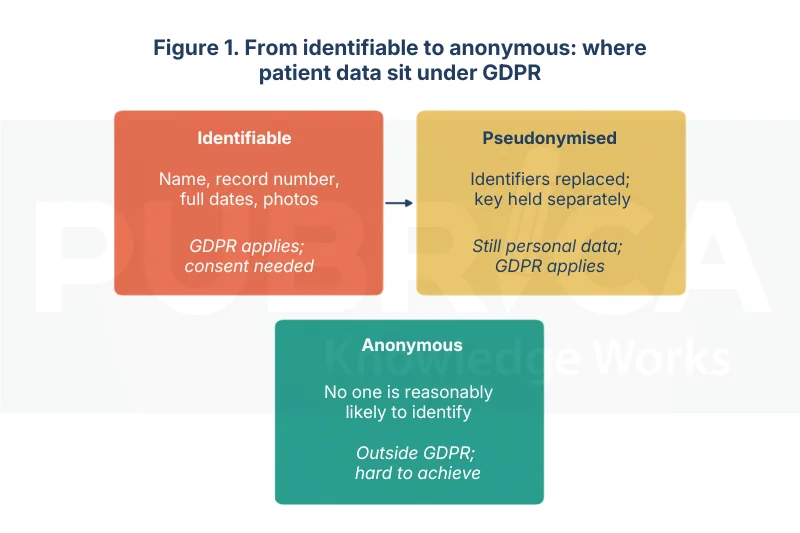
GDPR applies to personal data: information about an identified or identifiable person. Health data are special category data under Article 9. Article 4(5) defines pseudonymisation as processing data so that they can no longer be attributed to a person without additional information, which is kept separately and protected; Recital 26 places anonymous information, where the person is not or no longer identifiable, outside the Regulation6.
The practical difference is reversibility. Pseudonymised data can be linked back to the patient by whoever holds the key, so they remain personal data for that party. The European Data Protection Board (EDPB) confirms this and requires the additional information to be kept apart under technical and organisational safeguards2. Table 1 compares the two.
Table 1. Pseudonymisation and anonymisation compared (GDPR Article 4(5), Recital 26 and EDPB guidance)
| Feature | Pseudonymisation | Anonymisation |
|---|---|---|
| GDPR status | Personal data; GDPR applies | Not personal data; outside GDPR |
| Reversible? | Yes, for whoever holds the additional information | No one is reasonably likely to re-identify the person |
| Example in a case report | A study code replaces the name; the clinical team holds the key | Details generalised so that no reader, including people who know the patient, could identify them |
| What authors need | A lawful basis, safeguards and usually consent for publication | A documented assessment of re-identification risk |
What changed in 2025 and 2026
On 16 January 2025 the EDPB adopted Guidelines 01/2025 on pseudonymisation for public consultation; no final version had been published by October 2026. They explain how to transform identifiers, keep additional information separate and define a “pseudonymisation domain”: the people who should only ever see the pseudonymised data2.
On 4 September 2025 the Court of Justice ruled in EDPS v SRB (C-413/23 P) that pseudonymised data are not necessarily personal data for every recipient. The case concerned the regulation for EU institutions, whose definitions mirror the GDPR’s. Where a recipient cannot re-identify the person by means reasonably likely to be used, the data may not be personal data for that recipient, although the controller’s obligations still apply7.
In July 2026 the EDPB published draft EDPB anonymisation guidelines 2026 (Guidelines 02/2026), with consultation open until 30 October 2026. They update the 2014 Article 29 Working Party opinion on anonymisation techniques and take a contextual approach, assessing anonymity from the perspective of each party with realistic access to the data8. Check the adopted version before relying on its detail.
For a GDPR case report, this cuts both ways. A published report reaches the patient’s family, colleagues and community, who may hold “additional information” of their own. In our view, a report is anonymous only when no reasonably likely reader could identify the patient, a high bar for rare conditions.
Prepare a compliant case report with Pubrica
Pubrica’s medical writing team reviews your case report for direct and indirect identifiers, checks images for visible and embedded identifiers, and aligns consent and ethics statements with the target journal. You receive an edited manuscript, a de-identification log and a pre-submission checklist.
Why a case report is rarely fully anonymous
Removing the name is not enough. Patients can be identified through direct identifiers and through combinations of indirect identifiers that are harmless alone (Table 2). The rarer the condition, the more each remaining detail narrows the pool of possible patients, so treat every report as identifiable unless you can document why it is not.
Table 2. Direct and indirect identifiers in case reports
| Identifier type | Examples in a case report | Author action |
|---|---|---|
| Direct | Name, initials, hospital or record number, address, full dates of birth or admission, contact details | Remove entirely |
| Indirect: time | Exact dates of admission, surgery or death | Use relative time, such as “day 3” or “after 6 months” |
| Indirect: place | Hospital name, town, rare local exposure | Generalise to region or type of setting |
| Indirect: person | Exact age, occupation, ethnicity, family details | Use age ranges; omit details the clinical lesson does not need |
| Indirect: clinical | Very rare diagnosis, unique event, distinctive tattoo or scar | Keep only what the clinical lesson requires |
| Images and scans | Faces, eyes, labels burned into radiology files, background objects | Crop, remove metadata and labels, and obtain consent |
Good de-identification of patient data also covers supplementary files, legends, footnotes and file names, where identifiers often survive.
Patient images: the highest re-identification risk
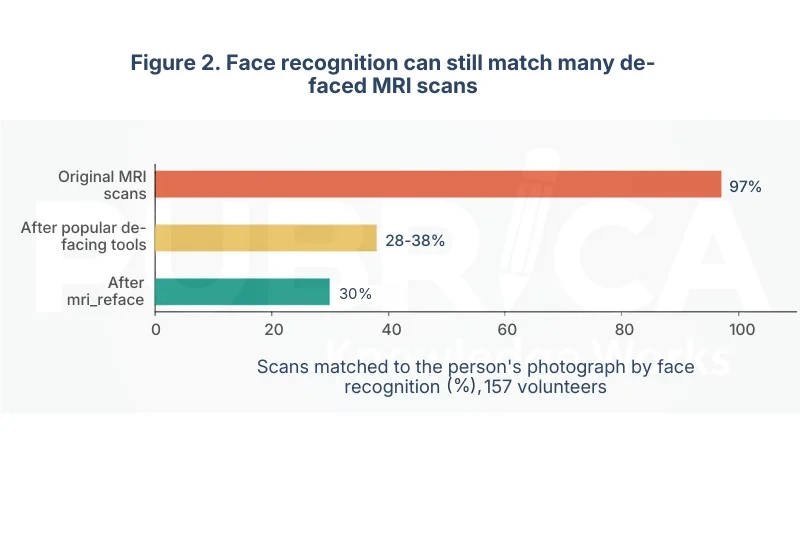
Patient images are the hardest element to de-identify. A scoping review of 30 studies on publishing patient photographs found that masking the eyes with a black bar was the most common technique, and in one included study 87% of images were inadequately concealed3. Scans carry re-identification risk. In a study of 157 volunteers, face recognition matched about 97% of original MRI scans to the person’s photograph, and 28% to 38% after popular de-facing software (Figure 2)4.
Journal policies vary. Among the top 50 dermatology journals, 88% required consent to publish patient images, but only 36% limited that requirement to recognisable images, while 48% applied it to all images5. Assume any image needs consent, and strip embedded metadata and labels from radiology and pathology files.
Informed consent: the practical safeguard
Because full anonymisation is rarely achievable, written informed consent for publication is the safeguard most journals rely on. In the 2021 sample, consent came from the patient in 74% of articles, from parents in 6% and from a guardian or next of kin in 5.9%; the most common wording was written consent to publish the article and accompanying images (Figure 3)1.
Consent forms should be honest about limits. Among dermatology journals that published their forms, 59% stated that anonymity cannot be guaranteed and 77% mentioned dissemination beyond print, such as online and social media5. Explain what will be published, where, and that people who know the patient may still recognise them; honesty here protects patient privacy.
GDPR does not apply to the data of deceased persons (Recital 27), but member states may set their own rules6, and journals usually still expect next-of-kin consent. Where a patient cannot be traced or lacks capacity, follow journal and institutional policy and record the decision. Our guide to GDPR Article 9 and manuscript editing covers sharing identifiable data with editors and AI tools.
A step-by-step compliance checklist for authors
Use Table 3 before submitting any case report that includes patient data. If the data are pseudonymised rather than anonymous, GDPR still applies to the authors and their institution: keep the additional information within a defined group, protect it with access controls and never send it to the journal2. For UK approvals, see whether case reports need ethics approval in the UK.
Table 3. Pre-submission data protection checklist for case reports (confirm local law, institutional policy and the journal’s rules)
| Step | Action |
|---|---|
| 1. Classify the data | Decide whether the manuscript holds identifiable, pseudonymised or anonymous data, and record why |
| 2. Minimise | Remove direct identifiers and every indirect detail the clinical lesson does not need |
| 3. Generalise | Replace dates with relative time, places with regions and exact ages with ranges |
| 4. Separate the key | Keep any linking code or source records outside the manuscript and the submission system |
| 5. Clean images | Crop, remove metadata and burned-in labels, and do not rely on eye bars |
| 6. Obtain consent | Use the journal’s or institution’s written form, signed by the patient or a legal representative |
| 7. State it | Report consent and ethics committee status in the manuscript |
| 8. Retain records | Store the signed consent securely, following institutional policy |
Conclusion
For most case reports, true anonymisation under GDPR is hard to achieve, because a published report reaches readers who may already know the patient. Pseudonymisation reduces risk but keeps the data within the Regulation. The 2025 guidelines, the EDPS v SRB judgment and the 2026 draft all point to a context-dependent test of identifiability. Good data protection in practice means minimising and generalising details, treating images as high risk, obtaining written consent and documenting each decision.
Pubrica team verdict
Treat every case report as identifiable unless you can document otherwise. Minimise and generalise details, treat images as high risk and rely on written consent, not on anonymisation alone.
Frequently asked questions
Usually not. Dates, place, age and a rare diagnosis can still identify the patient to people who know them.
Yes. Most journals require written consent for case reports, and pseudonymised data remain personal data under GDPR.
No. They were released as a draft for public consultation; check the EDPB website for the adopted version.
Sources
Sources were checked on 30 October 2026. Requirements and guidance may change after that date; confirm the current version with the issuing body.
- 1Valešić M, Čivljak M, Puljak L. Informed consent and ethics committee involvement in case reports and case series: cross-sectional meta-research study. BMC Med Ethics. 2025;26:64. https://doi.org/10.1186/s12910-025-01226-0
- 2European Data Protection Board. Guidelines 01/2025 on pseudonymisation (version for public consultation). Adopted 16 January 2025. https://www.edpb.europa.eu/our-work-tools/documents/public-consultations/2025/guidelines-012025-pseudonymisation_en
- 3Roguljić M, Šimunović D, Poklepović Peričić T, et al. Publishing identifiable patient photographs in scientific journals: scoping review of policies and practices. J Med Internet Res. 2022;24(8):e37594. https://doi.org/10.2196/37594
- 4Schwarz CG, Kremers WK, Wiste HJ, et al. Changing the face of neuroimaging research: comparing a new MRI de-facing technique with popular alternatives. NeuroImage. 2021;231:117845. https://doi.org/10.1016/j.neuroimage.2021.117845
- 5Taiwo T, Obiakor B, McClung S, Shinkai K. Informed consent practices for publication of patient images in dermatology journals. JMIR Dermatol. 2025;8:e60795. https://doi.org/10.2196/60795
- 6Regulation (EU) 2016/679 (General Data Protection Regulation), Article 4(5) and Recitals 26–27. https://eur-lex.europa.eu/eli/reg/2016/679/oj
- 7Court of Justice of the European Union. Judgment of 4 September 2025, EDPS v SRB, C-413/23 P. https://eur-lex.europa.eu/eli/C/2025/5551/oj/eng
- 8European Data Protection Board. Guidelines 02/2026 on anonymisation (version for public consultation). Adopted 7 July 2026. https://www.edpb.europa.eu/documents/guideline/guidelines-022026-on-anonymisation_en
anonymisation vs pseudonymisationpatient data case reportsGDPR case reportEDPB 2025 guidelinesde-identification patient dataEDPB anonymisation guidelines 2026
How to cite this article
Pick your referencing style and copy it. Your university or target journal may vary the punctuation, so check its guide if it has one.
Dr. Charlie. (2026, October 30). Anonymisation vs Pseudonymisation of Patient Data in Case Reports: What GDPR and the EDPB’s 2025 Guidelines Mean for Authors. Pubrica. https://pubrica.com/academy/case-report/anonymisation-vs-pseudonymisation-case-reports/
This article is written to be learned from. Cite it if you are referring to what it says; if you are using the evidence behind it, cite the sources listed above instead.
Next steps
Prepare a compliant case report with Pubrica
Pubrica’s medical writing team reviews your case report for direct and indirect identifiers, checks images for visible and embedded identifiers, and aligns consent and ethics statements with the target journal. You receive an edited manuscript, a de-identification log and a pre-submission checklist.
This article is general information for researchers, not legal, regulatory or funding advice. Check the current requirements of your journal, funder, ethics committee or regulator before you act on it.
More in Case Report