
- Services
- Discovery & Intelligence Services
- Publication Support Services
- Sample Work
Publication Support Service
- Editing & Translation
-
Editing and Translation Services
- Sample Work
Editing and Translation Service
-
- Research Services
- Sample Work
Research Services
- Physician Writing
- Sample Work

Physician Writing Service
- Statistical Analyses
- Sample Work

Statistical Analyses
- Data Collection
- AI and ML Services
- Sample Work

AI and ML Services
- Medical Writing
- Sample Work
Medical Writing
- Research Impact
- Sample Work
Research Impact
- Medical & Scientific Communication
- Sample Work
Medical & Scientific Communication
- Medico Legal Services
- Educational Content
- Academic Editorial Services
- Sample Work
Academic Editorial Services
- Educational Editorial Service
-
Education Editorial Services
- Sample Work
Education Editorial Services
-
- Industries
- Subjects
- About Us
- Academy
- Insights
- Contact Us
The Complete Case Report Submission Package: CARE Checklist, Consent & Cover Letter
High-Impact Journals
- Understanding the CARE Guidelines
- Building a CARE-Compliant Case Report
- Preparing the Informed Consent
- Protecting Patient Privacy and De-identifying Information
- Preparing the CARE Checklist
- Creating a Clinical Case Timeline
- Preparing the Journal Submission Package
- Writing an Effective Case Report Cover Letter
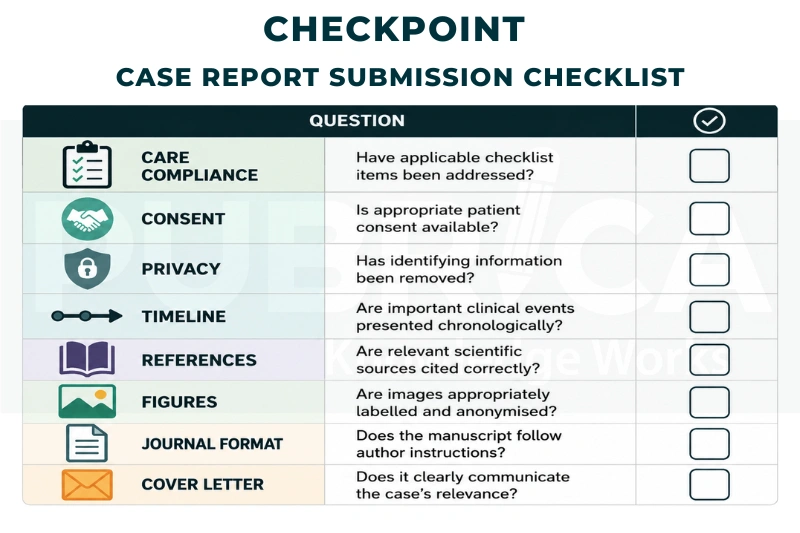
- Conducting a Final Pre-Submission Quality Check
- Conclusion
Interesting topics
The Complete Case Report Submission Package: CARE Checklist, Consent & Cover Letter
Not only should authors have a clinically interesting case at hand, but a good case report also needs to include all other elements that contribute to a successful case study. These include a clear description of the case, maintaining patient confidentiality, proper consent, and adherence to submission guidelines from the targeted journal. A complete case report submission package should therefore be prepared carefully.
The submission package should thus contain all the elements mentioned above, such as the manuscript, CARE checklist, consent forms, declarations, figures/tables, references, and the journal-specific cover letter. Systematic preparation of the above-mentioned elements can help avoid unnecessary difficulties with submission. [1]
1. Understanding the CARE Guidelines
CARE guidelines are a set of guidelines that have been developed for reporting a case report. These include the key aspects such as the title, keywords, abstract, introduction, patient information, clinical findings, timeline, diagnosis, treatment, follow-up and outcome, discussion, patient’s point of view, and informed consent. The CARE checklist for case reports helps authors ensure that important reporting elements are addressed. [2]
Components of CARE Guidelines
- Description of the clinical case
- Timeline of events
- Diagnosis and treatment details
- Follow-up and outcomes
- Patient’s point of view and informed consent
2. Building a CARE-Compliant Case Report
The manuscript should be organised according to the requirements of the target journal while ensuring that the relevant CARE items are addressed. The medical case report structure and case report writing format should be aligned with the target journal’s requirements. [3]
| Case Report Component | Key Content to Include |
| Title | Diagnosis/intervention and “case report” where appropriate |
| Abstract | Case background, clinical findings, intervention, outcome and key lesson |
| Introduction | Clinical relevance and uniqueness of the case |
| Patient Information | De-identified demographic and clinical information |
| Clinical Findings | Relevant examination and findings |
| Timeline | Chronological sequence of important events |
| Diagnostic Assessment | Tests, imaging, differential diagnosis and diagnosis |
| Intervention | Treatment, dosage, duration and modifications |
| Follow-up | Outcomes, adherence and adverse events |
| Discussion | Interpretation, literature comparison, limitations and lessons |
| Consent | Appropriate informed consent documentation |
The CARE checklist should be used as a reporting tool, rather than as a substitute for the journal’s author instructions.
3. Preparing the Informed Consent
Informed consent is an important part of case report publication. A patient consent form for publication may be required depending on the journal. Patient information needs to be de-identified properly, and according to CARE guidelines, authors need to get informed consent for case report publication prior to publishing the case report. There could be specific consent forms required by individual journals even when the consent is already given.
It is important for the authors to make sure that the target journal requires the following from them: [4]
- Patient consent form
- Release of clinical images
- Identifiable patient information
- Patient’s point of view
- Additional ethics or institutional requirements
It is also essential for the authors not to expose any confidential personal information through the consent documentation.
4. Patient Privacy and De-identification
Patient anonymity is especially crucial in the instance where case reports include photos, images, uncommon findings, dates, or unique histories.
The authors should check their manuscript for potentially identifying information before submission. Patient photos and diagnostic images must be checked carefully since the combination of seemingly unidentifiable pieces of information can identify the patient.
De-identification should thus be considered during the manuscript, figure, supplementary file preparation, and submission.
5. Preparing the CARE Checklist
The CARE checklist for case reports allows the author to do an assessment of the manuscript for reporting quality prior to submission. The author will then match each item of the checklist to the relevant part of the manuscript and note information that is missing or inadequately reported.
Workflow of checklist completion
- Write the case report manuscript.
- Consider all applicable items of CARE checklist.
- Identify missing information.
- Make changes to the manuscript if necessary.
- Care checklist completed with manuscript references.
- Checklist submitted as per journal guidelines.
Official CARE resources consist of the checklist and other writing resources for the author.
6. Creating a Case Timeline
| Stage | Clinical Event | Relevant Information |
| Initial presentation | Symptoms identified | Chief complaints and history |
| Diagnostic assessment | Investigations performed | Laboratory tests/imaging |
| Diagnosis | Condition identified | Diagnostic conclusion |
| Intervention | Treatment initiated | Type, dose and duration |
| Follow-up | Patient reassessed | Clinical response/outcomes |
A concise timeline can make a complex clinical narrative easier for reviewers and readers to follow.
7. Preparing the Journal Submission Package
Apart from these, it is important for the authors to consider all the journal submission requirements of the journal that they have chosen. These submission requirements can include things like figures, supplementary files, declaration, funding information, conflicts of interest, authorship information, etc. [5]
The CARE Checklist itself suggests following the author guidelines of the target journal.
8. Writing an Effective Cover Letter
The cover letter needs to briefly address the relevance of the case to the journal and how the case might be of interest to their readership.
An effective cover letter for the case report will briefly touch upon:
- Relevance and significance of the case
- Novelty and educational worth of the case
- The relationship between the journal and the case
- The ethical requirements have been fulfilled
Any other necessary information needed from the author by the journal. The exact wording of the cover letter must be tailored according to the journal.
9. Final Pre-Submission Quality Check
Before submission, authors should conduct a final review covering scientific, ethical, reporting, and technical requirements. [6]
Connect with us to explore how we can support you in maintaining academic integrity and enhancing the visibility of your research across the world!
Conclusion
More is needed than an interesting observation to have an accepted case report. It needs to be a paper that is openly reported, respects patient confidentiality, demonstrates consent, and fulfils all the necessary requirements of the intended journal. The CARE Guidelines offer a set of steps for writing the key parts of a case report and will guide you to fill all the necessary details before submission.
Using the CARE checklist along with proper consent management, de-identification, a clinical timeline, references, and a cover letter makes for a complete submission.
The Complete Case Report Submission Package: CARE Checklist, Consent & Cover Letter. Our Pubrica consultants are here to guide you. [Get Expert Publishing Support] or [Schedule a Free Consultation]
Frequently Asked Questions (FAQs)
The CARE checklist is a reporting guideline that helps authors provide complete and transparent information when preparing and reporting a clinical case report.
Informed consent is commonly required for case report publication, particularly when patient information or images could identify the patient. Authors should follow the specific requirements of the target journal.
Authors should remove or appropriately modify identifying information and carefully review clinical details, dates, photographs, diagnostic images, and supplementary files that could potentially identify the patient.
A clinical timeline can include the patient’s initial presentation, diagnostic investigations, diagnosis, treatment or intervention, follow-up, and clinical outcomes in chronological order.
A cover letter should briefly explain the case’s clinical significance, novelty, educational value, relevance to the journal’s readership, and confirmation that applicable ethical requirements have been addressed.
Before submission, check the manuscript against the CARE checklist and journal author guidelines, including consent, patient privacy, figures and tables, references, declarations, conflicts of interest, funding, authorship information, and required submission files.
References
- Gagnier, J. J., Kienle, G., Altman, D. G., Moher, D., Sox, H., Riley, D., & CARE Group (2013). The CARE guidelines: consensus-based clinical case reporting guideline development. BMJ case reports, 2013, bcr2013201554. https://doi.org/10.1136/bcr-2013-201554
- Gagnier, J. J., Kienle, G., Altman, D. G., Moher, D., Sox, H., Riley, D., & CARE Group* (2013). The CARE Guidelines: Consensus-based Clinical Case Reporting Guideline Development. Global advances in health and medicine, 2(5), 38–43. https://doi.org/10.7453/gahmj.2013.008
- Rison, R. A., Kidd, M. R., & Koch, C. A. (2013). The CARE (CAse REport) guidelines and the standardization of case reports. Journal of medical case reports, 7, 261. https://doi.org/10.1186/1752-1947-7-261
- Manti, S., & Licari, A. (2018). How to obtain informed consent for research. Breathe (Sheffield, England), 14(2), 145–152. https://doi.org/10.1183/20734735.001918
- Ochner, C. N., & Mineo, J. (2020). A Brief Tutorial on Manuscript Preparation: From Journal Selection to Manuscript Review. HCA healthcare journal of medicine, 1(1), 3–10. https://doi.org/10.36518/2689-0216.1023
- Santini A. (2018). The Peer Review Process: Underwriting Manuscript Quality & Validity. Journal of critical care medicine (Universitatea de Medicina si Farmacie din Targu-Mures), 4(4), 111–113. https://doi.org/10.2478/jccm-2018-0020