Emerging Trends in Precision Medicine: A Systematic Review of Clinical Applications
High-Impact Journals
Interesting topics
Emerging Trends in Precision Medicine: A Systematic Review of Clinical Applications
Precision Medicine Clinical Applications have revolutionised the field of medicine by moving away from traditional medicine, which focuses on offering generic forms of care to patients who are genetically different. While traditional medicine does not focus on treating specific individuals based on their genetics, lifestyle and clinical background, precision medicine in healthcare tries to give the correct type of treatment at the right time. Recent breakthroughs in the fields of genomics, artificial intelligence, molecular diagnostics and digital health have facilitated the clinical applications of precision medicine in various medical disciplines. The review of the existing literature reveals the increasing use of this form of medicine in diagnosing, predicting risks, improving the outcomes of therapy, and reducing the side effects of drugs. [1]
1. Understanding Precision Medicine
Precision medicine is a medical strategy that combines genomic, clinical, environmental, and lifestyle data to personalise prevention and treatment plans. Precision medicine in healthcare does not treat everyone alike but adjusts therapies in accordance with biological differences, making treatments more efficient and less invasive at the same time. [2]
The main technologies used in precision medicine are:
- Genomic sequencing
- Biomarker testing
- Artificial intelligence and machine learning
- Electronic health records (EHRs)
- Multi-omics (genomics, proteomics, metabolomics)
2. Evolution of Precision Medicine in Clinical Research
The fast pace at which new-generation sequencing (NGS), bioinformatics, and computational biology have advanced has enabled the growth of precision medicine cancer treatment, cardiology, neurology, infectious diseases, and genetic diseases. Efforts like population genomics and biobanks have helped boost the scientific support for personalized medicine. [3]
3. Emerging Clinical Applications
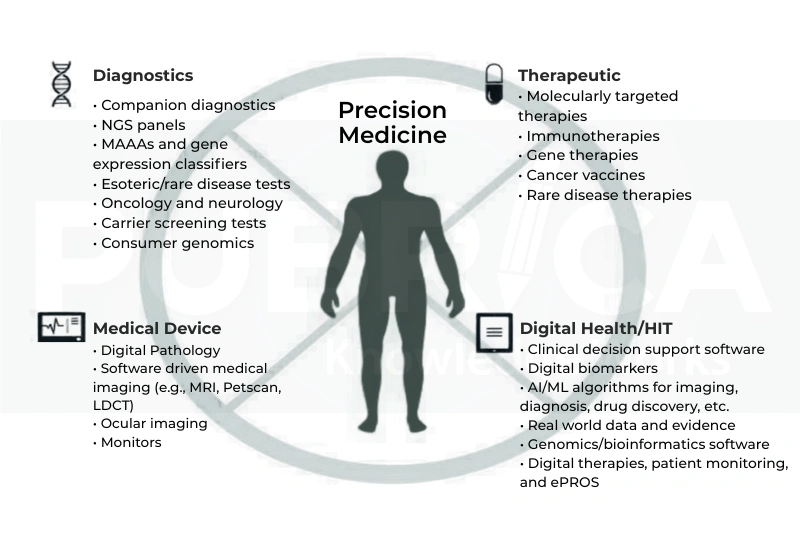
Precision medicine is increasingly applied across multiple medical specialities.
Clinical Area | Precision Medicine Application | Clinical Benefit |
Oncology | Targeted therapies and tumour genomic profiling | Improved survival and treatment response |
Cardiology | Pharmacogenomics and genetic risk assessment | Personalized cardiovascular treatment |
Neurology | Biomarker-guided therapy | Earlier diagnosis of neurodegenerative diseases |
Infectious Diseases | Pathogen genome sequencing | Rapid diagnosis and antimicrobial selection |
Rare Diseases | Whole genome sequencing | Identification of rare genetic disorders |
Precision risk stratification | Personalized disease management |
4. Role of Artificial Intelligence in Precision Medicine
Artificial Intelligence contributes to precision medicine in healthcare through analysing complex data sets which involve genetic, imaging, laboratory, and health records data. Algorithms using machine learning discover disease patterns, make predictions about treatment response, and aid clinical decision-making. The implementation of AI greatly increases diagnostic accuracy, supports precision oncology trends, and speeds up clinical research. [4]
AI use cases may involve:
- Disease risk prediction
- Image analysis
- Prediction of drug response
- Clinical decision making
- Treatment personalisation
The implementation of AI greatly increases diagnostic accuracy and speeds up clinical research.
5. Precision Medicine Workflow
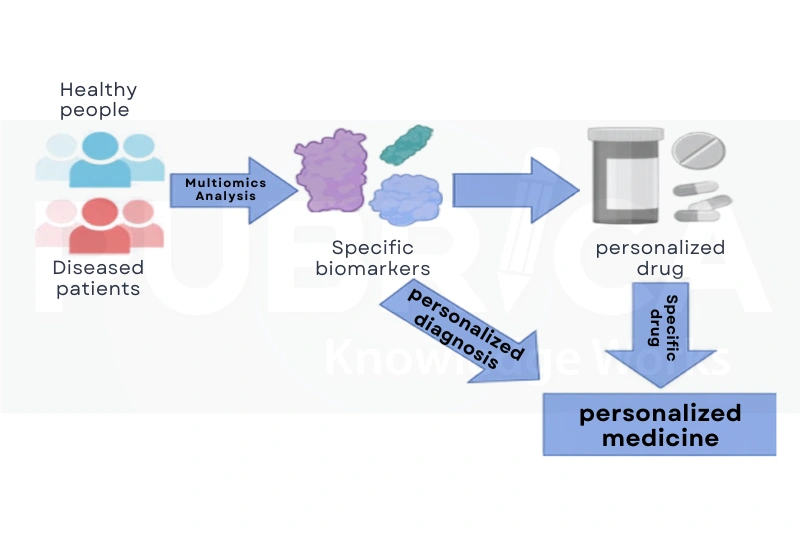
Precision medicine involves several procedures such as:
- Assessment of the patient
- Collection of clinical data
- Genomic and biomarker testing
- Integration of data and bioinformatics analysis
- Personalised treatment selection
- Clinical monitoring
- Evaluation of outcomes
This process allows physicians to provide evidence-based personalised medicine.
6. Benefits of Precision Medicine
Precision medicine provides several advantages for patients, clinicians, and healthcare systems.
Benefit | Clinical Impact |
Improved Diagnostic Accuracy | Earlier and more accurate disease detection |
Personalized Therapy | Increased treatment effectiveness |
Reduced Adverse Drug Reactions | Safer medication selection |
Better Disease Prevention | Identification of high-risk individuals |
Enhanced Patient Outcomes | Improved quality of life and survival |
Efficient Healthcare Resource Utilization | Reduced unnecessary interventions |
7. Challenges in Clinical Implementation
Though there have been many breakthroughs, certain barriers are still posing challenges for the use of precision medicine in the healthcare sector.[5]
- Data Integration: There is a lack of integration of healthcare data in most cases.
- Ethical and Privacy Issues: Genomic data must be kept confidential and stored properly while maintaining data protection laws.
- High Cost of Implementation: High costs involved in genomics, molecular testing, and computation infrastructure pose barriers.
- Lack of Clinical Standardisation: Clinical standards for genomic interpretation and therapy are still developing in many health care institutions.
8. Future Directions
The future of personalized medicine in healthcare is expected to include the integration of genomics with advanced technologies such as artificial intelligence, wearable devices, digital biomarkers, and real-time health monitoring systems. The use of multi-omics, cloud computing, and federated learning is predicted to improve predictive models while maintaining patient privacy.
Connect with us to explore how we can support you in maintaining academic integrity and enhancing the visibility of your research across the world!
Conclusion
Precision Medicine Clinical Applications are transforming clinical practice through personalised diagnosis, treatment, and disease prevention. Genomics, artificial intelligence, biomarker discovery, and digital health technologies have expanded the clinical applications of precision medicine across multiple medical disciplines. However, several precision medicine challenges, including costs, data integration, ethics, and clinical standardisation, remain. Despite these barriers, ongoing innovations and precision oncology trends continue to support the future of personalized medicine in healthcare, making precision medicine an integral part of modern healthcare.
Emerging Trends in Precision Medicine: A Systematic Review of Clinical Applications. OurPubrica consultants are here to guide you. [Get Expert Publishing Support] or [Schedule a Free Consultation]
Frequently Asked Questions (FAQs)
Precision medicine is a personalised healthcare approach that uses a patient’s genetic, clinical, environmental, and lifestyle information to tailor disease prevention, diagnosis, and treatment.
Key technologies include genomic sequencing, biomarker testing, artificial intelligence (AI), machine learning, electronic health records (EHRs), and multi-omics approaches such as genomics, proteomics, and metabolomics.
Precision medicine is widely used in oncology, cardiology, neurology, infectious diseases, rare genetic disorders, and diabetes to improve diagnosis, treatment selection, and patient outcomes.
AI analyzes large healthcare datasets to predict disease risk, identify treatment responses, assist with medical imaging, support clinical decision-making, and personalize treatment plans.
Major challenges include high implementation costs, healthcare data integration, ethical and privacy concerns related to genomic data, and the lack of standardized clinical guidelines.
The future of precision medicine includes greater integration of genomics, AI, wearable health devices, digital biomarkers, cloud computing, and multi-omics technologies to deliver more accurate, personalised, and preventive healthcare.
References
- Ahmed, A., & Mustafa, M. (2024). Precision Emergency Medicine: A Systematic Review. Cureus, 16(12), e75068. https://doi.org/10.7759/cureus.75068
- Naithani, N., Sinha, S., Misra, P., Vasudevan, B., & Sahu, R. (2021). Precision medicine: Concept and tools. Medical journal, Armed Forces India, 77(3), 249–257. https://doi.org/10.1016/j.mjafi.2021.06.021
- He, M., Xia, J., Shehab, M., & Wang, X. (2015). The development of precision medicine in clinical practice. Clinical and translational medicine, 4(1), 69. https://doi.org/10.1186/s40169-015-0069-y
- Ali, A., Kausar, M. A., Anwar, S., Khan, F. H., Elagib, H. M., Shahien, M. M., & Alshabrmi, F. M. (2026). The expanding role of artificial intelligence in personalised medicine: from innovation to individualized care. Frontiers in medicine, 13, 1795879. https://doi.org/10.3389/fmed.2026.1795879
- Salari, H., Najm, F., Yazdankhahfard, M., & Esfandiari, A. (2024). Challenges, barriers and solutions for implementing clinical practice guidelines: a qualitative study in southern Iran. BMJ open quality, 13(3), e002595. https://doi.org/10.1136/bmjoq-2023-002595