How to Turn Your Clinical Data into a High-Impact Research Article
High-Impact Journals
- Start With a Research Question, Not the Dataset
- Name Your Study Design Correctly and Pick the Right Reporting Guideline
- Audit Your Data Before Analysis
- Analyse for Estimation, Not Significance Hunting
- Interpret Findings Without Overstating Them
- Structure the Manuscript for Reviewers
- Complete Pre-Submission Integrity Checks
- When Expert Support Makes the Difference
- Conclusion
Interesting topics
How to Turn Your Clinical Data into a High-Impact Research Article
Many clinicians have valuable data sitting in spreadsheets: audit results, retrospective cohorts, trial datasets or registry extracts. Very little of it becomes a published paper. The data are rarely the problem. The usual problem is the path from data to article.
Journals reject clinical manuscripts for predictable reasons. The research question is unclear, the study design is mislabelled, the analysis does not match the question, associations are presented as causes, or reporting guidelines are ignored. Turning clinical data into a research article means fixing these issues before writing, not after peer review.
This guide explains that process step by step, with the decisions reviewers and editors check.
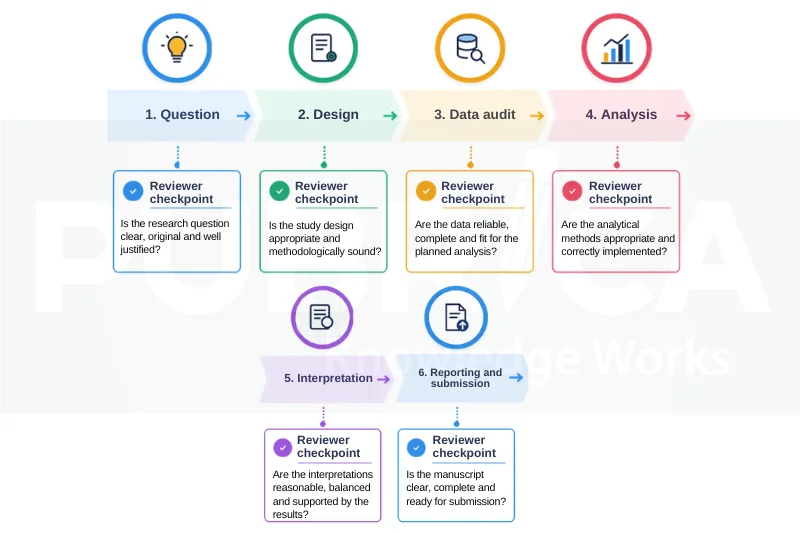
1. Start With a Research Question, Not the Dataset
A dataset can answer many questions, but a publishable article answers one primary question clearly. Frame it with PICO (interventional studies) or PECO (exposure studies):
| Element | Example (illustrative) |
|---|---|
| Population | Adults with type 2 diabetes admitted with heart failure |
| Intervention or exposure | SGLT2 inhibitor use at admission |
| Comparator | No SGLT2 inhibitor use |
| Outcome | 30-day all-cause readmission |
Why it matters: If you define the question after exploring the data, you risk selective reporting. Reviewers increasingly ask whether outcomes were pre-specified. Write down your primary outcome and your analysis plan before you run the models.
2. Name Your Study Design Correctly and Pick the Right Reporting Guideline
Misidentifying the study design can create methodological and reporting inconsistencies that editors and reviewers may identify during assessment. For example, a retrospective chart review is not a “prospective study” just because the data were collected prospectively in routine care. Each design has a reporting guideline that sets out what you must report.
| Study design | Reporting guideline | What it changes for the author |
|---|---|---|
Randomised controlled trial | CONSORT [2] | Report randomisation, allocation concealment, blinding, a participant flow diagram and trial registration |
Cohort, case-control, cross-sectional | STROBE [3] | Explain how confounders were handled, report missing data and justify the study size |
| Diagnostic accuracy | STARD [4] | Report the reference standard, a 2×2 table and how indeterminate results were handled |
| Prediction model (including AI/ML) | TRIPOD+AI [5] | Report model development and validation, calibration and discrimination |
| Case report | CARE [7] | Present a timeline, patient consent and the patient’s perspective where possible |
Systematic review | PRISMA [6] | Provide a search strategy, a flow diagram and a risk-of-bias assessment |
Download the relevant checklist from the EQUATOR Network and complete it alongside your draft. Many journals require it at submission.
3. Audit Your Data Before Analysis
Most analytical errors trace back to data preparation. Before any statistical test, confirm the following:
- Ethics and consent: Retrospective data still usually needs ethics committee approval or a documented waiver. Journals will ask.
- Trial registration: For clinical trials, ICMJE recommends that medical journals require clinical trial registration in a public trials registry at or before first patient consent for enrolment as a condition of consideration for publication. [1]
- Data dictionary: Every variable should be defined, with its units, coding and source (for example, EHR field or case report form).
- Missing data: Quantify missingness for each variable and describe the likely missing-data mechanism. Complete-case analysis can introduce bias when the probability of missingness is related to observed or unobserved factors. For observational data that address a causal question, a target trial emulation [9] framework can improve credibility. You specify the hypothetical randomised trial your data are trying to mimic, and this forces clear eligibility, time-zero and follow-up definitions. It also helps avoid immortal time bias.
- Outliers and implausible values: Check them against source records rather than deleting them automatically.
- Statistical analysis plan (SAP): Document the primary analysis, covariates, subgroups and sensitivity analyses in advance.
4. Analyse for Estimation, Not Significance Hunting
Editors and statistical reviewers expect effect estimates with confidence intervals, alongside appropriate statistical tests and p-values where relevant. The SAMPL guidelines provide practical recommendations for reporting statistical analyses. [8,1]
- Report the magnitude and precision of effects. “Adjusted OR 1.42 (95% CI 1.10–1.83)” tells readers far more than “p = 0.007”.
- Adjust for confounding transparently. Justify your covariate choice, ideally with a causal diagram (DAG) rather than stepwise selection.
- Control multiplicity. When multiple hypotheses are tested, the probability of at least one statistically significant result can increase unless multiplicity is addressed.
- Label subgroup and post hoc analyses clearly as exploratory.
- Run sensitivity analyses. Show that your conclusion survives alternative assumptions.
5. Interpret Findings Without Overstating Them
This is where many clinical manuscripts lose credibility. An observational association does not prove that a treatment works.
| Finding (illustrative) | Overstated wording | Defensible wording |
|---|---|---|
| Adjusted HR 0.78 (95% CI 0.62–0.98) in a retrospective cohort | “Drug X reduces readmission by 22%” | “Drug X use was associated with a lower hazard of readmission; residual confounding cannot be excluded” |
| p = 0.08 for primary outcome | “There was a trend towards benefit” | “The estimate was imprecise and compatible with both benefit and no effect” |
| Significant result in one subgroup | “Drug X works in women” | “An exploratory subgroup analysis suggested a possible difference that requires confirmation” |
A strong discussion follows this order: evidence → interpretation → comparison with existing literature → limitations → clinical implication. State the limitations honestly. Reviewers trust authors who identify weaknesses before they do. [2]
6. Structure the Manuscript for Reviewers
| Section | What reviewers look for | Common failure |
|---|---|---|
| Title and abstract | Design stated, key numerical result included | Vague title, no effect estimate |
| Introduction | A clear knowledge gap and objective | A literature review with no stated gap |
| Methods | Reproducibility and a pre-specified analysis | Missing inclusion criteria or confounder handling |
| Results | A flow diagram, Table 1 and effect estimates with CIs | Interpretation mixed into the results |
| Discussion | Balanced interpretation and limitations | Causal claims from associations |
| Declarations | Ethics, funding, conflicts, data sharing and AI use | Missing statements that cause technical rejection |
An annotated IMRaD “anatomy of a clinical manuscript” graphic with a reviewer’s red-pen callouts on the common failures above.
7. Complete Pre-Submission Integrity Checks
A “high-impact” article is not defined only by the journal’s impact factor. It is defined by rigour, relevance and transparency. Before submission, confirm these points:
- Authorship meets all four ICMJE criteria: a substantial contribution, drafting or critical revision, final approval and accountability. [1]
- AI use is disclosed: State at submission whether AI-assisted technologies were used and, if so, how. AI tools cannot be credited with authorship; the human contributors remain responsible for the accuracy, integrity, originality and attribution of the submitted work. [1]
- A data sharing statement: For manuscripts reporting clinical trials submitted to ICMJE journals, a data-sharing statement is required. The statement should specify whether de-identified individual participant data will be shared, what data and related documents will be available, when and for how long, and the criteria and mechanism for access.
- References are verified against the original sources, not secondary citations.
- The target journal fits your scope, design and audience. Check its instructions for authors and whether it is a legitimate, indexed journal.
8. When Expert Support Makes the Difference
Grammar editing cannot fix a mislabelled study design, an inappropriate statistical model or a causal overclaim. These problems require expertise in clinical methodology, biostatistics and journal reporting requirements.
Pubrica’s clinical publication support works on the full path from data to article:
- Study design and guideline mapping: We review the study design, identify the applicable reporting guideline and support completion of the relevant CONSORT, STROBE, STARD or TRIPOD+AI checklist.
- Biostatistical review: We check model choice, confounder adjustment, missing-data handling and sensitivity analyses.
- Clinical interpretation review: We align your claims with the strength of your evidence.
- Manuscript development and journal selection: We prepare a submission-ready manuscript, a cover letter and the required declarations.
Deliverable: a reviewer-ready manuscript with a completed reporting checklist and a methodology report. [Book a free manuscript consultation with Pubrica]
Get expert support from Pubrica for addressing reviewer comments, preparing point-by-point rebuttals, and strengthening manuscripts for journal resubmission. Prepare your revised manuscript with confidence.
Conclusion
Turning clinical data into a research article is a methodological process, not a writing exercise. Articles that succeed in peer review share the same foundations: a pre-specified research question, a correctly named study design, a completed reporting guideline checklist, transparent data preparation, estimation-focused analysis and interpretation that matches the strength of the evidence. Most rejections of clinical manuscripts are preventable. They come from decisions made before the first sentence is written, such as an unclear question, an undocumented analysis plan or an association described as a cause. Addressing these issues early saves months of revision and protects your credibility with editors and reviewers. Impact does not come from overstating results. It comes from rigorous, transparent and clinically relevant reporting that other researchers can trust, reproduce and build on. If your dataset is ready but the path to publication is not, a methodology-led review can close that gap before submission.
Frequently Asked Questions (FAQs)
Yes. Retrospective cohort and case-control studies are widely published if they have ethics approval or a waiver, follow STROBE, handle confounding and missing data transparently, and avoid causal overclaims.
Often yes, or a formal waiver. Requirements vary by country and institution, and most journals require a statement either way.
It depends on your design: CONSORT for randomised trials, STROBE for observational studies, STARD for diagnostic accuracy, TRIPOD+AI for prediction models and CARE for case reports.
Confidence intervals show both the size and the precision of an effect. P-values alone do not tell readers whether a result is clinically meaningful.
References
- International Committee of Medical Journal Editors. (2026). Recommendations for the conduct, reporting, editing, and publication of scholarly work in medical journals. https://www.icmje.org/recommend
- Hopewell, S., Chan, A.-W., Collins, G. S., Hróbjartsson, A., Moher, D., Schulz, K. F., & others. (2025). CONSORT 2025 statement: Updated guideline for reporting randomised trials. BMJ, 389, e081123. https://doi.org/10.1136/bmj-2024-081123
- von Elm, E., Altman, D. G., Egger, M., Pocock, S. J., Gøtzsche, P. C., & Vandenbroucke, J. P. (2007). The STROBE statement: Guidelines for reporting observational studies. The Lancet, 370(9596), 1453–1457. https://doi.org/10.1016/S0140-6736(07)61602-X
- Bossuyt, P. M., Reitsma, J. B., Bruns, D. E., Gatsonis, C. A., Glasziou, P. P., Irwig, L., Lijmer, J. G., Moher, D., Rennie, D., de Vet, H. C. W., & Kressel, H. Y. (2015). STARD 2015: An updated list of essential items for reporting diagnostic accuracy studies. BMJ, 351, h5527. https://doi.org/10.1136/bmj.h5527
- Collins, G. S., Dhiman, P., Ma, J., Schlussel, M. M., Archer, L., Van Calster, B., Chatfield, M. D., et al. (2024). TRIPOD+AI statement: Updated guidance for reporting clinical prediction models that use regression or machine learning methods. BMJ, 385, e078378. https://doi.org/10.1136/bmj-2023-078378
- Page, M. J., McKenzie, J. E., Bossuyt, P. M., Boutron, I., Hoffmann, T. C., Mulrow, C. D., Shamseer, L., Tetzlaff, J. M., Akl, E. A., Brennan, S. E., Chou, R., Glanville, J., Grimshaw, J. M., Hróbjartsson, A., Lalu, M. M., Li, T., Loder, E. W., Mayo-Wilson, E., McDonald, S., McGuinness, L. A., Stewart, L. A., Thomas, J., Tricco, A. C., Welch, V. A., Whiting, P., & Moher, D. (2021). The PRISMA 2020 statement: An updated guideline for reporting systematic reviews. BMJ, 372, n71. https://doi.org/10.1136/bmj.n71
- Gagnier, J. J., Kienle, G., Altman, D. G., Moher, D., Sox, H., & Riley, D. (2013). The CARE guidelines: Consensus-based clinical case reporting guideline development. Global Advances in Health and Medicine, 2(5), 38–43. https://doi.org/10.7453/gahmj.
- Lang, T. A., & Altman, D. G. (2015). Basic statistical reporting for articles published in biomedical journals: The “Statistical Analyses and Methods in the Published Literature” or SAMPL guidelines. International Journal of Nursing Studies, 52(1), 5–9. https://doi.org/10.1016/j.ijnurstu.2014
- Hernán, M. A., & Robins, J. M. (2016). Using big data to emulate a target trial when a randomized trial is not available. American Journal of Epidemiology, 183(8), 758–764. https://doi.org/10.1093/aje/kwv254