




Systematic Reviews: A Guide for Researchers and Academics
High-Impact Journals
Interesting topics
Systematic Reviews: A Guide for Researchers and Academics
The systematic review is one of the most credible types of methodologies employed in evidence-based research. It contrasts with the conventional literature review in that it follows a systematic procedure to find out and assess all pertinent studies related to the research topic. It is commonly utilised in medicine, social sciences, education, psychology, and management disciplines. This research methodology helps researchers produce reliable and transparent findings for academic and scientific purposes. [1]
1. What is a Systematic Review?
The systematic review methodology is an extensive approach to gathering, analysing, and synthesising current literature on a particular topic or issue. The researcher uses established criteria to ensure that bias is avoided, thereby making the results more reliable. A systematic review is widely used in evidence-based research because it follows a transparent and reproducible process. [2]
Key Features of Systematic Reviews
- Clearly defined research question
- Structured search strategy
- Transparent inclusion and exclusion criteria
- Critical appraisal of studies
- Evidence synthesis and interpretation
- Reproducible methodology
2. Why Are Systematic Reviews Important?
A systematic review assists scholars in determining any patterns or areas where there is a lack of reliable information by analysing large bodies of literature that have been published. This form of research methodology strengthens the quality of evidence-based research and supports informed academic decision-making. [3]
Advantages of a Systematic Review
- Helps in making evidence-based decisions
- Avoids any bias in research
- Determines gaps in existing literature
- Supports recommendations for policies and practice
- Saves time through summarising large bodies of evidence
- Increases research reliability
3. Types of Systematic Reviews
Different types of systematic reviews are conducted depending on the research objectives and data sources.
Type of Review | Purpose | Example |
Quantitative Review | Statistical analysis of studies | Clinical treatment effectiveness |
Qualitative Review | Explore experiences and perceptions | Patient satisfaction studies |
Mixed-Methods Review | Combines quantitative and qualitative evidence | Healthcare service evaluation |
Scoping Review | Maps existing literature | Emerging AI applications |
Meta-analysis | Combines numerical data statistically | Drug efficacy comparison |
Both scoping review and meta-analysis approaches are essential components of advanced research methodology in academic studies.
4. Steps Involved in Conducting a Systematic Review
Researchers must follow a procedure to make sure that their systematic review is scientifically methodical and reproducible. [4]
- Defining the Research Question: The systematic review starts with a clearly defined research question using the PICO format (Population, Intervention, Comparison, and Outcome)
- Writing the Systematic Review Protocol: The protocol is written by the researchers before the review. It includes objectives, methods, and other things.
- Performing Literature Search: Literature searches may be conducted in the following databases
- PubMed
- Scopus
- Web of Science
- Google Scholar
- Screening and Selecting Studies: Studies relevant to the topic are selected based on certain criteria.
- Assessing Study Quality: Researchers appraise the quality of studies and identify the presence of any biases.
- Data Extraction and Analysis: The researchers extract data from studies, including the outcomes. In some studies, a meta-analysis may also be performed for statistical synthesis.
- Reporting of Results: The results of the study are reported according to guidelines like PRISMA.
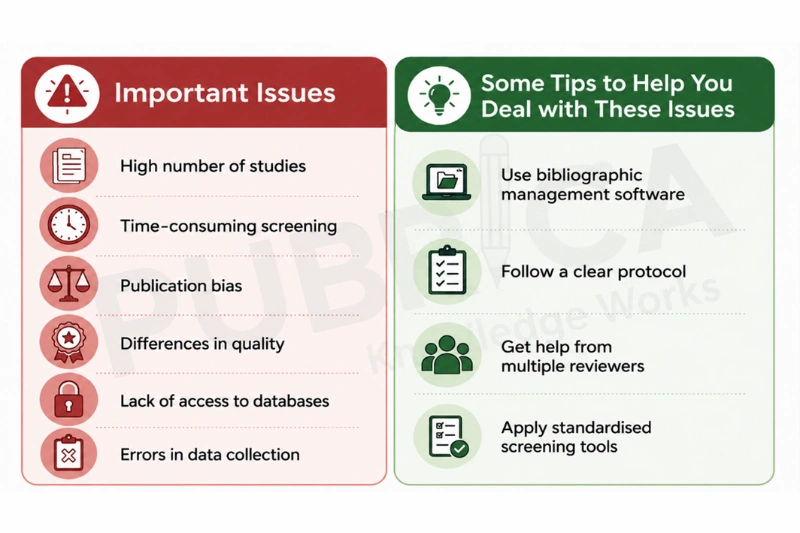
5. Common Challenges in Systematic Reviews
Despite the great importance of systematic reviews, researchers can face various issues during the review process. Challenges may include limited access to studies, publication bias, time-consuming screening procedures, and difficulties in maintaining transparency throughout the literature review process.[5]
6. Tools Used for Systematic Reviews
Several digital tools help researchers organise and manage systematic reviews efficiently.
Tool | Purpose |
EndNote | Reference management |
Zotero | Citation organization |
Rayyan | Study screening |
Covidence | Systematic review management |
RevMan | Meta-analysis and data synthesis |
These tools improve the efficiency of the research methodology and simplify the management of large-scale evidence-based research projects.
7. Best Practices for High-Quality Systematic Reviews
For obtaining dependable results, the following measures are to be taken in conducting a literature review:
- A clear research question
- PRISMA guidelines
- Transparency in each step taken
- Multiple databases
- Detailed assessment of studies
- Update the literature review regularly
Connect with us to explore how we can support you in maintaining academic integrity and enhancing the visibility of your research across the world!
Conclusion
A systematic review is an important part of research in contemporary academia and science because it provides scientifically based results for decision-making. The use of the systematic approach helps minimise any biases in research while improving its quality and increasing the level of transparency. No matter whether one studies medicine, business, psychology, or any other field, such reviews will help him or her analyse great amounts of data. Methods such as meta-analysis and scoping review further strengthen the reliability of findings in modern research methodology and evidence-based research.
Systematic Reviews: A Guide for Researchers and Academics. Our Pubrica consultants are here to guide you. [Get Expert Publishing Support] or [Schedule a Free Consultation]
References
- Calderon Martinez, E., Ghattas Hasbun, P. E., Salolin Vargas, V. P., García-González, O. Y., Fermin Madera, M. D., Rueda Capistrán, D. E., Campos Carmona, T., Sanchez Cruz, C., & Teran Hooper, C. (2025). A comprehensive guide to conduct a systematic review and meta-analysis in medical research. Medicine, 104(33), e41868. https://doi.org/10.1097/MD.000000
- Al-Khabori, M., & Rasool, W. (2022). Introduction to Systematic Reviews and Meta-analyses of Therapeutic Studies. Oman medical journal, 37(5), e428. https://doi.org/10.5001/omj.2022.42
- Brice, R. (2023, September 22). What is A systematic review & why are they important?CASP – Critical Appraisal Skills Programme. https://casp-uk.net/news/what-is-a-systematic-review/
- Khan, K. S., Kunz, R., Kleijnen, J., & Antes, G. (2003). Five steps to conducting a systematic review. Journal of the Royal Society of Medicine, 96(3), 118–121. https://doi.org/10.1177/0141076803
- Chapman, A., Rankin, N. M., Jongebloed, H., Yoong, S. L., White, V., Livingston, P. M., Hutchinson, A. M., & Ugalde, A. (2023). Overcoming challenges in conducting systematic reviews in implementation science: a methods commentary. Systematic reviews, 12(1), 116. https://doi.org/10.1186/s13643-023-02285-3